


Introduction
Andaman & Nicobar Islands in the Bay of Bengal are one of India’s top tourist destinations. In 2023–24, 3,57,000 tourists visited these islands, which amounted to ca. 47% of the total population based on the 2011 census.1Tourism will continue to be a major driver of the Island economy due to these islands’ exceptional scenic beauty, improved infrastructure and connectivity. This has resulted into increased competition for land among agricultural, infrastructure, and service-sector endeavours. Therefore, providing farmers with remunerative agricultural ventures is of great importance for keeping the island agriculture profitable. In fact, the authors propose that with rich biodiversity of various native flora, it would be more pragmatic if agriculture is considered as a complimentary sector to the tourism rather than its competitor sector. For this, identification and systematic promotion of unique crops from the native biodiversity is of utmost importance. The incoming tourists in the islands could offer good opportunity to the island farmers to market their unique produce as lack of marketing opportunity has often been cited as a major impediment in farmer’s welfare elsewhere.2
Woody pepper (Piper pendulispicum C.DC), locally referred to as Choi Jhaal, is a unique species reported from the Andaman Islands.3 The stem pieces of this species have been identified as a source of antioxidants including phenolic compounds and piperine,4 and is being promoted as a novel spice crop in these islands. Traditionally, woody pepper is being grown using various live standards viz. mango, jackfruit, forest trees, coconut, drumstick etc., while it has been identified as a potential crop for cultivation as intercrop in the arecanut plantations.5 Of the 32,446 ha of arable land available in the Union Territory, 4,757 ha is under arecanut, and the area has shown an increasing trend in the recent past.6 Extensive research in arecanut growing regions has shown that systematic intercropping within arecanut plantations has improved land-use efficiency and farm profitability, rendering these systems more resilient and economically appealing to the smallholders.5, 7-11 Cultivation of this unique species would not only help in getting better profits to the island farmers but would also offer new flavours for tourists thereby complimenting the tourism industry.
From an economic perspective, the limited availability of quality planting material represents a critical constraint in scaling up woody pepper cultivation, reflecting a form of input market inefficiency. To overcome this bottleneck, productivity enhancement strategies should focus on ensuring timely access to quality planting materials, implementing disease control measures, and assured irrigation.12 Moreover, the conventional vine cutting propagation techniques have attained merely 20% success.13 This reflects an input supply inefficiency that restricts crop expansion. Authors’ Institute standardised and promoted serpentine layering (Fig. 1) as an efficient propagation method, facilitating more dependable multiplication of woody pepper for both monoculture and intercropping systems.14 Although planting material is being produced and supplied to farmers in South Andaman Island, growers in remote islands face considerable difficulty in accessing these inputs due to geographical isolation. High inter-island transportation and associated transaction costs further inflate the price of propagules, reducing affordability and adoption. This underscores the importance of developing low-cost and location-specific models, as highlighted by Prabhakar et al.15 In this context, decentralized nursery production through island-based entrepreneurs can play a crucial role in strengthening backward linkages in the value chain by improving local availability of quality planting material, reducing transaction costs, and ensuring timely access to inputs. Such localized production systems can enhance economic efficiency while supporting wider adoption of woody pepper cultivation among smallholders.Since there is virtually no study on economic viability of low-cost nursery production of woody pepper, this study was taken up with objectiveof assessing the economic feasibility of a suggested nursery production technique for woody pepper utilising serpentine layering within a low-cost polyhouse system.
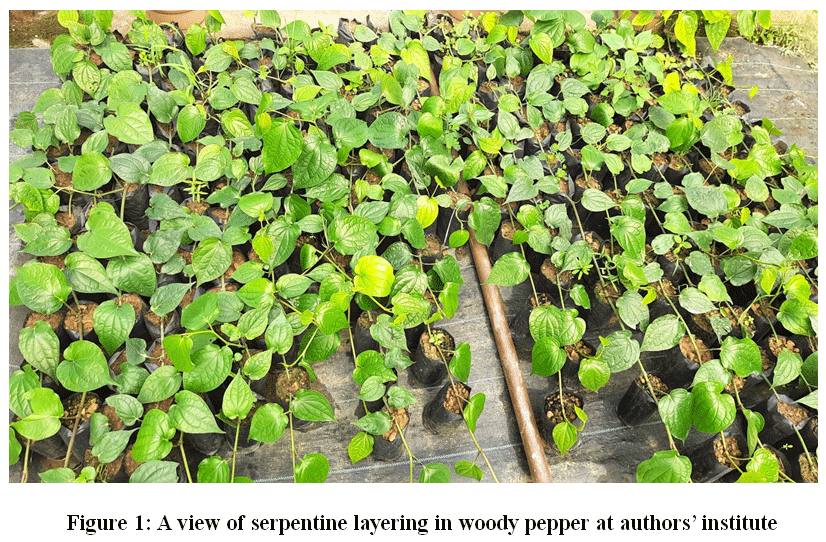 |
Figure 1: A view of serpentine layering in woody pepper at authors’ instituteClick here to view Figure |
Materials and Methods
A low-cost bamboo polyhouse structure measuring 50 m² wasused for calculationin this study (Fig. 2). The total construction cost of polyhouse was estimated to be ₹20,000/-with an estimated lifespan of four years. The planting layout, number of mother plants, and expected output of cuttings were estimated based on published literature13 and authors’ experience in the institute’s nursery. Each mother plant was assumed to produce an average number of cuttings annually under optimal management conditions.
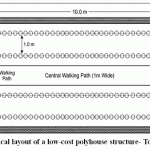 |
Figure 2: Technical layout of a low-cost polyhouse structure- Top-Down ViewClick here to view Figure |
(The image is generated with help of AI tool-Perplexity and technically validated by authors)
The planting arrangement was planned such that the polyhouse had four rows, each containing 65 plants, culminating in a total of 260 mother plants inside the structure. Standardized procedure for serpentine layering described by Waman et al.14 was followed. Equal ratios of farmyard manure (FYM) and soil were utilised for the formulation of the substrate. Observations have suggested that each mother plant could produce an average of 26.6 cuttings each year, totalling 6,916 cuttings from the planned structure. A demand of 2,766 kg of FYM and soil was calculated based on the intended operational scale. The unit cost of FYM was deemed ₹ 1.00 per kg, whereas the cost of soil was set at ₹ 0.50 per kg, according to prevailing market prices.The labour needed for maintenance and operating tasks was estimated at two hours daily. For economic assessment, the Andaman and Nicobar Administration set wages for unskilled workers at ₹ 641 per day for an 8-hour workday were used, with a standard workforce utilisation of 91.25 working days yearly. Cost A1 included miscellaneous expenses such as minor repairs, consumables, and incidental charges at 5% of the total paid-out cost, a common approximation in farm management studies. The fixed capital investment in the polyhouse structure was subject to an annual interest rate of 10%, determined by the average value of the asset throughout its anticipated useful life.
Table 1: Components of Cost analysis
| Cost | Items included |
| A1 | Planting material of mother plantsPlanting bagsFarmyard manure
Soil Plant Protection Chemicals Depreciation of polyhouse Miscellaneous |
| B1 | A1+ Interest of fixed capital assets (Polyhouse) at 10% |
| B2 | B1+ Rental value of owned land |
| C1 | B1 + Imputed value of family labour |
| C2 | B2 + Imputed value of family labour |
| C3 | C2 + 10 % C2 |
Source: Adapted from Directorate of Economics and Statistics (2021), Cost Concept.16
Economic analysis was carried out using standard cost ideas offered by Commission on Agricultural Costs and Prices (CACP) as per requirement of the study (Cost A1, B1, B2, C1, C2, and C3) to estimate total cost of production (Table 1).Rent for land in the Islands is paid either half-yearly or annually depending on the terms of the landowner’s agreement, which ranged from ₹ 17,500/- to ₹ 26,500/- in 2019.17 The annual rent for agricultural land was calculated to be Rs 30,000/- based on secondary data from public reports and conversations with farmers. This amount was then added at a 10% interest rate to determine Cost B2. Returns were calculated based on assumed survival rate and prevailing market price of planting material. Indicators such as Net Present Worth (NPW), Benefit–Cost Ratio (BCR), and Operational Efficiency were used to assess the economic viability of the proposed model. Since the study is based on a proposed model, the results represent indicative estimates under assumed optimal conditions and may vary under actual field situations.
Results
Economics of Woody Pepper Nursery Production under Low-Cost Bamboo Polyhouse
The economic analysis of the low-cost bamboo polyhouse structure revealed promising financial returns from woody pepper nursery production (Table 2). In the experiment, a total of 260 mother plants produced 6,916 rooted cuttings annually, corresponding to an average output of 26.6 cuttings per mother plant. The operational cost (Cost A1) was estimated at ₹25,794, while Cost B1 and Cost B2 were ₹26,793.60 and ₹26,943.60, respectively. The comprehensive costs C1, C2, and C3 were estimated at ₹85,284, ₹85,435, and ₹93,978, respectively. Among the cost components, planting material (₹6,500), polythene bags for cuttings (₹6,916), and depreciation of the polyhouse (₹5,000) constituted the major expenditure items.
Table 2: Economics for woody pepper nursery production for a year
| Costs | Values (₹) |
| Planting material cost | 6,500 |
| Cost of polythene for cuttings @ ₹1 per cutting | 6,916 |
| FYM cost @ ₹ 1 per kg | 2,766 |
| Soil cost @ ₹ 0.5 per kg | 1,383 |
| Plant protection cost | 2,000 |
| Depreciation of polyhouse | 5,000 |
| Miscellaneous cost | 1,228 |
| Cost A1 | 25,793.6 |
| Interest of fixed capital assets at 10% | 1,000 |
| Cost B1 | 26,793.6 |
| Rental Value of 50 m2 land | 150 |
| Cost B2 | 26,943.6 |
| Cost C1 | 85,284 |
| Cost C2 | 85,434.85 |
| Cost C3 | 93,978.33 |
| Gross receipts @ ₹ 40/- per rooted cutting | 2,76,640 |
| Ratios | |
| Net Present Worth (GR-Cost C3) | 1,82,661.67 |
| Benefit cost ratio (GR/C3) | 2.944 |
| Operational Efficiency (GR/B2) | 10.267 |
Source: Authors’ calculation based on the study data
The gross receipts from nursery production were estimated at ₹2.76 lakh based on a sale price of ₹40 per rooted cutting (Farm Gate Price). The Net Present Worth (NPW) was calculated as ₹1.82 lakh. The Benefit-Cost Ratio (BCR), estimated using Cost C3, was 2.944, while the operational efficiency (Gross Returns/Cost B2) was 10.267, indicating favourable economic returns from the enterprise.
Table 3: Sensitivity analysis of the economics of woody pepper nursery production under selected production and market scenarios
| Scenario | Gross Returns (₹) | Cost C3 (₹) | Net Returns (₹) | B:C Ratio |
| Base scenario | 276,640 | 93,978.33 | 182,661.67 | 2.94 |
| Market price ₹36 per cutting (-10%) | 248,976 | 93,978.33 | 154,997.67 | 2.65 |
| Market price ₹44 per cutting (+10%) | 304,304 | 93,978.33 | 210,325.67 | 3.24 |
| Productivity −10% (23.94 cuttings/mother plant) | 248,960 | 93,978.33 | 154,981.67 | 2.65 |
| Productivity +10% (29.26 cuttings/mother plant) | 304,320 | 93,978.33 | 210,341.67 | 3.24 |
| Labour cost −10% | 276,640 | 88,129.20 | 188,510.80 | 3.14 |
| Labour cost +10% | 276,640 | 99,827.46 | 176,812.54 | 2.77 |
Source: Authors’ calculation based on the study data
Sensitivity analysis indicated that the profitability of woody pepper nursery production was robust under plausible variations in key economic parameters. A ±10% change in the market price of rooted cuttings or in the average number of rooted cuttings produced per mother plant (26.6 ± 10%) resulted in B:C ratios ranging from 2.65 to 3.24. Similarly, a ±10% variation in labour cost changed the B:C ratio from 2.77 to 3.14. In all scenarios, the B:C ratio remained well above unity, indicating that woody pepper nursery production is economically viable under moderate fluctuations in production and market conditions.
Discussion
The positive NPW obtained in the present study indicates that the low-cost bamboo polyhouse nursery model is economically viable, with returns substantially exceeding the total investment cost. The estimated BCR of 2.944 suggests that every rupee invested in the nursery enterprise could generate nearly three rupees in return, demonstrating the profitability of woody pepper propagation under protected conditions. Similar observations were reported by Kumar et al.,18 who attributed higher profitability in protected cultivation systems to improved productivity and efficient resource utilization.The BCR estimated in the present study is comparable to values reported for black pepper nursery production of Panniyur-1 in Karnataka (2.95), supporting the economic feasibility of nursery-based enterprises.19 Plantation-level studies in Karnataka have also reported BCR values ranging from 2.35 to 4.52, indicating that spice crop nurseries can provide attractive economic returns.20 In contrast, lower input-output ratios (1.76–1.94) reported for field-level black pepper cultivation in Kerala suggest that nursery enterprises may offer greater profitability than conventional cultivation systems.21The operational efficiency value of 10.267 further indicates efficient utilization of resources within the production system. Despite the relatively high cost of agricultural inputs in island ecosystems due to transportation and logistical constraints, the nursery model maintained strong economic performance. These findings are in agreement with observations reported under polyhouse-based cultivation systems, where protected structures enhanced resource-use efficiency and economic returns.22Although the estimates are based on assumed production and price parameters, the results highlight the substantial economic potential of low-cost bamboo polyhouse nurseries for woody pepper multiplication. The sensitivity analysis demonstrated that woody pepper nursery production remained economically viable under ±10% variations in market price, productivity, and labour cost, indicating the robustness of the enterprise against moderate production and market uncertainties. The authors recommend pilot-scale adoption of the nursery to validate the underlying assumptions and findings under local conditions before scaling up to commercial production. The technology appears particularly suitable for small and resource-constrained farmers in the Middle Andaman, North Andaman, and Little Andaman regions. Furthermore, the model may also provide opportunities for entrepreneurs in other warm and humid regions of mainland India interested in commercial woody pepper propagation.
Conclusion
Recent research indicates that the proposed nursery production method for woody pepper, employing serpentine layering within a cost-effective bamboo polyhouse, holds considerable potential for economic feasibility in the Andaman and Nicobar Islands. The economic forecasts, based on assumed optimal conditions, provide a favourable Net Present Worth of ₹1.82 lakh and a Benefit–Cost Ratio of 2.94, indicating efficient resource allocation and potential financial benefits, even for small landholdings. The adoption of advanced propagation techniques, such as serpentine layering, may alleviate the scarcity of high-quality planting material and promote cultivation. However, since the research is based on a proposed framework, the results are only suggestive and may vary in practical applications. Therefore, it is recommended to do field-level validation before extensive implementation. The methodology demonstrates considerable promise for enhancing sustainable horticultural entrepreneurship in the region.
Acknowledgement
The authors are thankful to the Director, ICAR-Central Island Agricultural Research Institute, Sri Vijaya Puram, Andaman and Nicobar Islands for providing necessary facilities for the study.
Funding Sources
Indian Council of Agricultural Research provided financial assistance in the form of inhouse project (Project Code: HORTCIARISIL202400700251) to the first author.
Conflict of Interest
AAW is a member of the Editorial cum Advisory Board of Current Agriculture Research Journal. To ensure impartiality, the author had no role in the editorial review or decision-making process for this manuscript. The submission was handled independently by other editors.
Data Availability Statement
The supporting data are available in the public domain and the data are obtained from the web sites of Government of India.
Ethics Statement
This research did not involve human participants, animal subjects, or any material that requires ethical approval and therefore, informed consent was not required.
Clinical Trial Registration
This research does not involve any clinical trials.
Permission to reproduce material from other sources:
No content in this article has been reproduced from any sources.
Author Contributions:
- SharathYeligar: Calculation and data analysis, writing of first draft.
- Ajit Arun Waman: Conceptualization, development of method and editing of the draft. Both the authors read and agreed to the final version of the draft.
References
- Directorate of Economics and Statistics. Basic statistics 2023–24: Tourism. Andaman and Nicobar Administration. Published 2024. http://andssw1.and.nic.in/ecostat/ basicstatPDF2023_24/ 21.Tourism.pdf
- Singh S, Singh DR, Jaisankar I. Sustainable technological support options for promotion of horticulture sector to attain nutritional security in tropical islands: a case study of Andaman and Nicobar Islands, India. J Andaman Sci Assoc. 2025;30(1):1-12.
- Waman AA, De AK, Bohra P, Sawhney S, Mishra S. DNA barcoding-assisted confirmation of the botanical identity of Woody Pepper (Piper pendulispicum DC., Piperaceae): an addition to the Indian flora. Genet Resour Crop Evol. 2024;71:4631-4645.
CrossRef - Waman AA, Bohra P, Devi RK, Lokesha AN, Shivashankara KS. Stem of Woody Pepper (Piper pendulispicum DC) as a source of phenolic acids and piperine. Indian J Plant Genet Resour. 2024;37(2):294-300.
- Waman AA, Jha SK, Bohra P, Jerard BA. Woody pepper: a potential spice crop for intercropping in arecanut gardens. J Andaman Sci Assoc. 2019;24(2):131-135.
- Directorate of Economics and Statistics. Basic statistics 2024–25: Andaman and Nicobar Administration. Published 2025.http://andssw1.and.nic.in/ecostat/ basicstatPDF2024_25/ 3.Agriculture.pdf
- Bhat R, Sujatha S. Soil fertility status as influenced by arecanut based cropping system and nutrient management. J Plantation Crops. 2007;35:158-165.
- Hussain M, Ray AK, Maheswarappa HP, Krishnakumar V, Bhat R, Subramanian P, Thomas GV. Recycling of organic biomass from arecanut based high density multi-species cropping system models under Assam condition. J Plantation Crops. 2008;36:53-57.
- Sujatha S, Bhat R, Kannan C, Balasimha D. Impact of intercropping of medicinal and aromatic plants with organic farming approach on resource use efficiency in arecanut (Areca catechu) plantation in India. Ind Crops Prod. 2011;33(1):78-83.
CrossRef - Selva Rani A, Subbulakshmi S, Sudha R, et al. Synergizing sustainability: integrated nutrient management and intercropping for optimal coconut cultivation in South India. Horticulturae. 2024;10(6):653.
CrossRef - Waman AA, Bohra P, Maheswarappa HP, Jerard BA, Sumitha S. Culantro (Eryngiumfoetidum): a profitable intercrop in arecanut plantations for diversification of island agriculture. Natl AcadSci Lett. 2025;48:417-420.
CrossRef - Sengupta J. Growth performance in area, production, and productivity of major spice crops in India. Curr Agric Res J. 2025;13(2):495-501. doi:10.12944/CARJ.13.2.8
CrossRef - Waman AA, Bohra P, Devi RK. Propagation studies in woody pepper (Piperpendulispicum DC). In: Proceedings of International Symposium on Spices as Flavours, Fragrances & Functional Foods (SYMSAC X 2021). 2021:81.
- Waman AA, Bohra P, Ravi KD. Serpentine layering as an efficient means of propagation in woody pepper (Piper pendulispicum DC.): a novel spice from Andaman Islands. Natl AcadSci Lett. 2023;46(4):277-279.
CrossRef - Prabhakar I, Singh RK, Kumar A, Singh SP. Constraints in adoption and strategies to promote polyhouse technology among farmers. Indian J Agric Sci. 2017;87(4):485-490.
CrossRef - Directorate of Economics and Statistics. (2021). Cost Concept. Department of Agriculture and Farmers Welfare, Ministry of Agriculture and Farmers Welfare, Government of India. https://desagri.gov.in/wpcontent/uploads/2021/04/Cost_Con.pdf
- Chand S, Meena B, Chaudhary G, Chaudhary KR. Leased farming degrading the farmlands? Analysis of farmers’ perceptions in Andaman and Nicobar Islands, India. Indian J Soil Conserv. 2019;47(3):273-279.
- Kumar P, Kumar S, Kumar A, Kumar R. Comparative profitability of capsicum cultivation under different protected structures in Haryana. Indian J Agric Sci. 2021;91(1):58-63.
CrossRef - Ashoka N, Hongal S, Raju R, et al. Comparative study of black pepper (Pipernigrum) nursery raising in Karnataka. Curr Sci. 2021;121(9):1201-1207.
CrossRef - Ashoka N, Shashidhara N, Pallavi G, Raju R, Patil GI. A comparative study on economics of traditional versus popular variety of black pepper (Pipernigrum) plantations in Karnataka. Indian J Econ Dev. 2023;19(2):312-319.
CrossRef - Babu V, Ramchandra. An economic analysis of cost of production of black pepper in Wayanad district of Kerala in India. J Exp Agric Int. 2023;45(8):66-71.
CrossRef - Singh AK, Singh B, Gupta R. Analysis of bell pepper cultivation under fertigation and training systems in protected environment. Indian J Agric Sci. 2018;88(7):1077-1082.
CrossRef