


 PDF Downloads:
502
PDF Downloads:
502


Introduction
One of the most important sectors that can support a nation’s economic growth is horticulture, which can produce a variety of revenue streams. In addition to being a primary source of income supplement, horticulture can be practiced as market-driven vegetable, fruit, floriculture, ecotourism, medicinal plant harvesting and therapeutic plant harvesting.1 It also ensures livelihood stability by creating employment opportunities and providing for increased agricultural revenue. Over the last 20 years, there has been an increase in horticultural production globally, and at the time, the value of the vegetable trade exceeded that of grains.2 With improved purchasing power, people in developed and developing nations especially, China, Brazil, India and UK have started to consume more fruits and vegetables, making the horticultural sector one of the fastest-expanding industries to meet growing demand.3 Due to high demand, it is frequently necessary to use an excessive amount of chemical fertilisers and pesticides to increase yield. However, these practices have affected the quality and safety of food, polluted the soil and reduce the fertility of the soil.4
However, the cultivation of horticulture crops comes with many obstacles. These issues stem from several fundamental causes, including a growing global population expected to reach 10 billion by 2050, which is biased towards urban groups that consume rather than produce food.5 The detrimental effect of climate change is related to environmental challenges like drought, flood and salinity, which reduce the availability of arable land and lower the crop yield.6 A surge in the application of pesticides and bactericides, as well as environmental and health issues associated with excessive usage of these chemicals.7 This has a theoretical basis for Holling8. Holling8 developed the notion of ecosystem resilience, while Gunderson et al.9 extended it to social-ecological systems. According to Walker et al.,10 agricultural systems are made up of biophysical, technical and social components that can be disrupted by internal and external stressors, including pests, illness, and market changes, before going through a regime shift, which entails rearrangement of the system around new procedures, structures, and functions. Although human activity and/or climatic factors can trigger regime shifts, these changes are typically sudden, undesirable and significant. Temperature, precipitation, and humidity are three climate characteristics that affect a region’s agricultural development and encourage rural and urban resilience to climate change.11 Three resilience capacities existed, according to the study conducted by Meuwissen et al.12 First, robustness refers to the farming system’s ability to endure stress and unexpected shocks. The second is adaptability, which is the capacity to shift production, marketing and input composition, including the application of fertilizer and risk management in response to shocks and stress without altering the structural elements or feedback systems of farming. Finally, transformability refers to the farming system’s ability to drastically alter its internal structure and feedback mechanism to the extent of extreme shock or prolonged stress that prevents the operation from continuing as usual. These changes could also mean adjustments to how the farming system operates.
A review of the existing literature on horticultural production highlights notable research gaps concerning the combined impact of climatic and technological factors.13-19 While a number of studies have investigated the individual effects of climate variables—such as temperature, rainfall, or carbon dioxide emissions—or technological inputs like fertilizer usage and land management practices, few have offered a comprehensive assessment that integrates both dimensions. This segmented approach limits the ability to fully understand how climate and technology interact to influence horticultural productivity, particularly over the long term.
Furthermore, much of the available research tends to be crop-specific or confined to particular geographic regions. Such narrow scopes reduce the generalisability of findings and hinder the formulation of broader, scalable strategies that can be applied across diverse horticultural systems, especially in countries like India that feature a wide range of agroecological zones. As climate change impacts continue to intensify, the need for regionally adaptable and climate-resilient horticultural strategies becomes increasingly urgent. Another significant limitation in the literature is the underutilisation of advanced econometric techniques capable of capturing both short-term dynamics and long-term relationships. Models such as the Auto Regressive Distributed Lag (ARDL) are particularly well-suited for this purpose, yet remain infrequently applied in the context of horticultural research. Employing such models could provide deeper insights into how climatic and technological factors jointly influence production trends over time. Addressing these gaps is essential for designing effective, evidence-based policies and practices that can enhance resilience, productivity, and sustainability in horticultural systems amid evolving environmental conditions. Hence, the research aims to:
Investigate the actual and potential impact of climate change on horticultural production in India,
Assess the effect of fertilizer on horticultural production, and
Evaluate the influence of the area under cultivation on the total output of horticulture.
India has a varied climate and many agroecological zones with unique characteristics.
This diverse climate offers several opportunities to develop various varieties of horticultural crops. Research on horticultural production and the impact of climate and technological factors can benefit Indian agricultural resilience initiatives. Comprehending the correlation between horticultural production and the above-mentioned factors may also stimulate the development of new policies.
Materials and Method
Conceptual framework
The following research framework has been developed for the current study. The model investigates the relationship between the dependent factor (horticultural production) and the extraneous factor (average temperature, average rainfall, fertilizer utilization, area under horticultural production and carbon dioxide emission). In Fig. 1, the conceptual framework is illustrated.
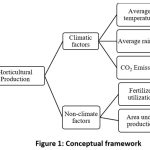 |
Figure 1: Conceptual frameworkClick here to view Table |
Data Source and Collection
The investigation used secondary data gathered between 1991 and 2020. Annual average rainfall and mean temperature data were sourced from the India Meteorological Department,20 where the areas under horticultural production were obtained from the Ministry of Agriculture and Farmers Welfare.21 The World Bank’s open data.22 became the production, fertilizer utilization and carbon dioxide emission database, as shown in Table 1. A significant turning point in India’s economic history was reached in 1991 when the Liberalisation, Privatisation, and Globalisation (LPG) reforms were implemented. Through the promotion of market-driven strategies, the use of new technologies, and greater investment, these reforms profoundly changed a number of industries, including agriculture. The post-LPG era in horticulture witnessed changes in crop diversity, input use, and exposure to demands from international markets. Understanding how liberalisation has affected horticulture production patterns, especially in light of shifting environmental circumstances and technical improvements, requires evaluating both climatic and non-climatic elements from this time on. This period offers a thorough foundation for evaluating the efficacy of policies and their long-term effects.
Table 1: Factor specification and Database
| Factors | Specification | Unit of Measurement | Database |
| Horticultural Production (Hp) | Horticultural Production in India | Thousands of tons | Ministry of Agriculture and farmers welfare21 |
| Temperature (Tp) | Average temperature | Degree Celsius | Indian Meteorological Department20 |
| Rainfall (Rn) | Average rainfall | Millimetres | Indian Meteorological Department20 |
| Area (Ar) | Area under Horticulture | Thousands of hectares | Ministry of Agriculture and farmers welfare21 |
| Fertilizer (Fz) | Fertilizer utilization | Thousands of tons | World Bank database22 |
| Carbon dioxide emission (Ce) | Carbon dioxide emission | Thousands of tons | World Bank database22 |
Unit Root Test
Before using the statistical model, each piece of data should undergo a stationary test to see whether the variance and mean remain constant over time. The data in the form of a time series is considered stationary if the mean and variance remain stable throughout the period; on the other hand, the covariance value within the two phases is contingent upon the time interval between them rather than the precise moment at which covariance is evaluated.23 Hence, we use the unit root test to check whether the factors employed in the research are stationary before applying the ARDL approach. The research used the Augmented Dickey-Fuller (ADF)24 unit root test. The following assumptions form the basis of the ADF test.
(H0) Yt is not I(0), or Yt is non-stationary.
(H1) Yt is I(0) or Yt is stationary.
The test compares the critical values from Fuller’s table with the computed ADF statistics. Suppose the test statistic is less than the critical value and does not result in the rejection of the null hypothesis (H0). In that case, the sequence is regarded as non-stationary or non-integrated of order zero.
Cointegration
Variables are said to be cointegrated if a linear relationship between the factors exists at a stationary point. It is studied using the Engle-Grange25 approach, the Johansen-Juselius26 method, or the ARDL approach. However, the first two methods can be employed only when the factors are integrated in the same order.27 If the integration of the factors is in an unequal order, the ARDL approach may be utilised.
ARDL approach
The auto-regressive distributed lag model was introduced by Pesaran et al.28 It is most suitable to determine the short and long-run relationship between the factors for a small sample size if the factors are integrated in different order. The dependent-independent relationship was determined by using the following model.
HPt = α0 + α1Art + α2Rnt + α3Tpt + α4Fzt + α5Cet + vt ………(1)
Where,
HPt = Horticulture production at time t
Art = Area under horticulture production at time t
Rnt = Rainfall at time t
Tpt = Temperature at time t
Fzt = Fertilizer at time t
Cet = Carbon dioxide emission at time t
α0 is the constant; α1 to α5 are the coefficients and vt is the error term. By transforming all the factors into the natural log, the following model is developed.
InHPt = α0+ α1InArt + α2InRnt + α3InTpt + α4InFzt + α4InCet + vt ……….(2)
Equation (2) may be expressed as follows in ARDL form:
ΔInHPt = α0 +1i InHPt-I + 2i ΔInArt- i + 3i ΔInRnt- i + 4i ΔInTpt-i + 5i InFzt -i + 6i InCet -i + β1InHPt-1 + β2InArt-1 + β3InRnt-1 + β4InTPt-1+ β5InFzt-1 + β6InCet-1 + et ………..(3)
Where α0 represents a drift component, Δ indicates the first difference between the variables, and et is the white noise error term. In equation (3), coefficients from 2nd to 6th (α1i to α6i) suggest the association in the short run and the long-run association is depicted by coefficients from 7th to 11th (β1 to β6). Utilizing the ARDL bounds testing technique, the long-term association between the variables is investigated. The F-statistic is used in the bounds-testing approach to evaluate the hypothesis. This may be stated as follows.
H0: There is no cointegration.
H1: There is cointegration.
The H0 is rejected if the estimated f-statistic exceeds the upper bound value. If the computed f-statistic is less than the crucial value’s lower bound, H0 cannot be rejected. We cannot make any inferences if the f-statistic lies within the lower and upper bounds’ critical values. However, an unrestricted error correction model can be included under the assumption of Pesaran et al.,27 where the long-run elasticities are the negative coefficients of a one-lag dependent variable. The Error correction model (ECM) version of the ARDL model is demonstrated as follows.
ΔInHPt = α0 +1i InHPt-i + 2i ΔInArt- i+ 3i ΔInRnt- i + 4i ΔInTpt-i + 5i InFzt -i +5i InCet -i + ℽ ECt-1 + et ……(4)
Where ℽ represents the rate of adjustment and Error correction are the residual derived from equation (3).
CUSUM (Cumulative Sum) and CUSUMQ (Cumulative Sum of Squares) tests
According to Brooks,29 “the CUSUM (Cumulative Sum) test is based on a normalised version of the cumulative sums of residuals, whereas the CUSUMQ (Cumulative Sum of Squares) test is based on a normalised form of the cumulative sums of squared residuals”. Long-run coefficient stability was checked by applying the CUSUM and CUSUMQ tests. The results imply that if the values shown in the plot are within the critical bounds at a significant value of five percent, the ARDL approach’s coefficients are stable.
Results
Descriptive summary
The current study determines how variations in climate-related factors, fertilizer consumption and area of millet production affect horticulture production in India using time series data from 1991–2020. Table 2 shows the descriptive statistics of the chosen variable.
Table 2: Descriptive statistics
| Variables | HP | Ar | Rn | Tem | CO2 | Fer |
| Mean | 202750.5 | 19397.47 | 1142.56 | 23.42 | 1382742 | 132.92 |
| Median | 187314.5 | 19419 | 1144.227 | 25.6 | 1175836 | 132.009 |
| Maximum | 334603 | 27476 | 1146 | 26.21 | 2458176 | 210.657 |
| Minimum | 96562 | 12770 | 1295.6 | 17.87 | 607224 | 74.7017 |
| Std. Dev | 75129.98 | 4704.041 | 920.8 | 3.402353 | 620759.3 | 39.5965 |
| Skewness | 0.309639 | 0.0747 | 94.43457 | -0.726152 | 0.394567 | 0.08476 |
| Kurtosis | 1.654118 | 1.643211 | -0.38873 | 1.573137 | 1.670448 | 1.7044 |
| Prob. | 0.253646 | 0.312072 | 0.405176 | 0.074967 | 0.224467 | 0.34402 |
| Observations | 30 | 30 | 30 | 30 | 30 | 30 |
Source: Author’s own evaluation using EViews Statistical Software
Note: Above findings are generated before using logarithm.
Unit Root Test
The Augmented Dickey-Fuller24 (ADF) unit root test has been employed in the current research. Table 3 shows the result of the unit root test. It makes it clear that while rainfall is stationary at I(0), all other parameters are stationary at the first level only.
Table 3: Unit Root Test – Augmented Dickey Fuller Test
| Variables | Level 1 | First Order Difference | Order of Integration | ||
| Intercept | Intercept and Trend | Intercept | Intercept and Trend | ||
| LHPt | -1.2295 | -5.008 | -1.5012 | -1.4082 | I (1) |
| -0.6477 | -0.0031 | (0.000) | (0.000) | ||
| LArt | -0.586883 | -3.5011 | -8.5303 | -8.3939 | I (1) |
| (0.8590) | (0.0580) | (0.000) | (0.000) | ||
| LRnt | -4.4079 | -4.3546 | -9.2509 | -9.1659 | I (0) |
| 0.0016 | 0.0090 | (0.000) | (0.000) | ||
| LTpt | -1.5490 | -1.8392 | -6.543 | -6.5996 | I (1) |
| (0.4951) | (0.6593) | (0.000) | (0.000) | ||
| LFzt | -0.4027 | -2.5604 | -4.0547 | -3.9889 | I (1) |
| (0.8960) | (0.2994) | (0.0041) | (0.0211) | ||
| LCat | -1.5871 | -2.8258 | -1.9587 | -2.0876 | I (1) |
| (0.4757) | (0.2022) | (0.042) | (0.032) | ||
Source: Author’s own evaluation using EViews Statistical Software
Choosing Lag
The investigation has employed a vector autoregression (VAR) optimal lag model to find the appropriate lag order. VAR selection is given in Table 4.
Table 4: Lag order criterion based on VAR
| Lag | LogL | LR | FPE | AIC | SC | HQ |
| 0 | 199.597 | NA | 3.98E-14 | -13.828 | -13.543 | -13.741 |
| 1 | 323.114 | 185.2748 | 8.18E-17 | -20.08 | -18.081* | -19.469 |
| 2 | 378.21 | 59.03120* | 3.11E-17* | -21.444* | -17.732 | -20.309* |
Source: Author’s own evaluation using EViews Statistical Software
Note: * represents the lag order selection criteria.
ARDL Bound Test
It is important to make sure that variables are cointegrated using the ARDL bound test27 before figuring out their long and short-term relationships. In Table 5, the results of the ARDL bound test are shown. It is clear from the table that the calculated f-statistic is 14.1045. The outcome is higher than the upper -bound critical value of 3.38 at the 5 percent significance level.
Table 5: ARDL Bound Test
| Equation | Lag | F-statistics | P-value | |
| HPro=ʃ(Ar, Tp, Rn, Fz, Ce) | (2, 2, 1, 2, 2, 1) | 14.1045 | 0.000 | |
| Critical value | 10 | 5 | 2.50 | 1 |
| Lower bound I(0) | 2.08 | 2.39 | 2.7 | 3.06 |
| Upper bound I(1) | 3 | 3.38 | 3.73 | 4.15 |
Source: Author’s own evaluation using EViews Statistical Software
Long- and short-run estimations of factors
This investigation confirmed the long-term cointegration between horticultural production and its factors. This research estimated the long and short-run elasticities using equations (3) and (4). Table 6 shows the long-run results. In the long run, all the variables except carbon dioxide have a positive relationship with HP. Rainfall has the highest and most significant impact on HP: a one per percent increase in rainfall will increase HP by 0.24 percent. A one per percent increase in fertilizer usage has raised horticultural production by 0.17 percent. Similarly, a positive relationship exists between temperature, area, and HP: a one per percent rise in area and temperature leads to a 0.08 percent and 0.02 percent rise in HP, respectively. However, it was identified that carbon dioxide emissions have a negative impact in the long run: a 1percent increase in carbon dioxide leads to a -0.04 decline in HP.
Table 6: Long term estimations of parameter in ARDL method
| Variables | Coefficient | Std. error | t-statistics | Prob. |
| LnAr | 0.0874 | 0.1959 | 0.4465 | 0.6631 |
| LnRn | 0.2413 | 0.0473 | 5.3062 | 0.0002 |
| LnTem | 0.0233 | 0.0921 | 0.2528 | 0.8046 |
| LnCa | 0.0423 | 0.07335 | 8.757 | 0 |
| LnFer | 0.1741 | 0.03989 | 4.3645 | 0.0009 |
| C | -0.3818 | 0.6951 | -0.5492 | 0.5923 |
Source: Author’s own evaluation using EViews Statistical Software
Note: Horticultural production is the dependent variable. ARDL (2, 2, 1, 2, 2, 1) based AIC.
The short run estimation has been shown in table 7. It is identified that rainfall and carbon dioxide emissions positively and significantly affect horticultural production.
Table 7: Short term estimations of parameter in ARDL method
| Variables | Coefficient | Std. error | t-statistics | Prob. |
| DLnHP(-1) | 0.3738 | 0.078 | 5.065 | 0.0003 |
| DLnAr | -0.1108 | 0.0717 | -1.5445 | 0.1484 |
| DLnAr (-1) | -0.3219 | 0.0762 | -4.22108 | 0.0012 |
| DLnRn | 0.1829 | 0.0278 | 6.5706 | 0.001 |
| DLnTem | -0.0499 | 0.0356 | -1.4013 | 0.1864 |
| DLnTem (-1) | -0.2003 | 0.0394 | -5.076 | 0.0015 |
| DLnCa | 0.3654 | 0.0839 | 4.3536 | 0.004 |
| DLnCa (-1) | 0.3436 | 0.0918 | 3.7412 | 0.0028 |
| DLnFer | -0.12 | 0.04427 | -2.719 | 0.0186 |
| ECM(-1) | -11.023 | 0.1152 | -12.1695 | 0.001 |
| R-squared | 0.92037 | |||
| Adjusted R-squared | 0.8805 | Mean dependent variable | 0.0405 | |
| S.E. of regression | 0.0116 | S.D. | 0.03361 | |
| Sum squared residual | 0.0024 | Akaike info criterion | -5.8006 | |
| Log likelihood | 91.2089 | Schwarz criterion | -5.3248 | |
| Durbin-Watson Stat | 2.1083 | Hannan-Quinn criter | -5.6551 | |
Source: Author’s own evaluation using EViews Statistical Software
Stability Check
The study employed the cumulative sum (CUSUM) and cumulative sum of squares (CUSUMSQ) tests put forward by Brown et al.30 to evaluate the reliability of the long and short-term coefficients due to the existence of structural alterations in each factor owing to single or multiple structure breakdowns. The CUSUM and CUSUMSQ test outcomes are displayed in Figs. 02 and 03.
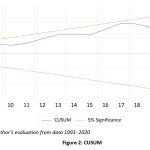 |
Figure 2: CUSUMClick here to view Figure |
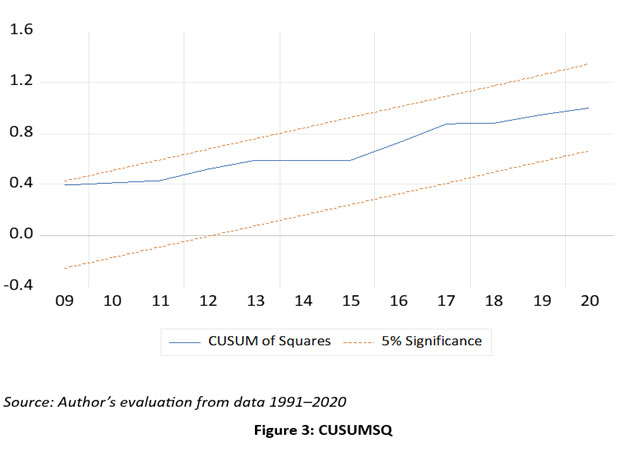 |
Figure 3: CUSUMSQClick here to view Figure |
Discussion
The current research intends to analyse the impact of climatic (rainfall, temperature, CO₂ emission) and non-climatic factors (fertilizer application and area under production) on horticultural production. According to the descriptive data in Table 2, the mean fertilizer consumption throughout the period was 132.92 kg/ha. The lowest usage of fertilizer was in 1992 at 74.70 kg/ha, while the highest usage was in 2020 at 210.65 kg/ha. Likewise, the average temperature for the research period was 23.42°C, with a range of 25.6°C in 1997 to 26.21°C in 2016. With a range of 1146 mm to 1295.6 mm, the mean rainfall recorded in the study region was 1142.56 mm. The mean area under horticulture was 202,750.5 million hectares. The mean carbon dioxide emission during the period was 1382742 metric tonnes, with a maximum of 2458176 in 2018 and a minimum of 607224 in 1991. A unit root test was undertaken as the initial step in conducting an ARDL test. Using the ADF test, it was identified that except for rainfall, all other parameters, like temperature, carbon dioxide emissions, production area and fertilizer use, are all stable at I(1). Since the factors included in the study are stationary at different levels, the current study should apply the ARDL approach. It is crucial to select the proper lag order for the variables before executing the ARDL bound test to determine whether or not there is cointegration among factors. The study used the vector autoregression (VAR) optimal lag model, and based on AIC (Akaike information criterion), it is identified that the model functions more effectively at lag two than it does at lag 1. ARDL-bound tests were undertaken to determine the long-term cointegration among the variables. The f-statistic obtained is 14.1045. The outcome is higher than the upper limit critical value at the 1, 2.5, 5 and 10 percent significance levels. This suggests that the null hypothesis of no cointegrating association may be rejected, in line with Pesaran et al.27 This implies that horticulture production is cointegrated with temperature, precipitation, fertilizer use and carbon dioxide variables. The result also implies a long-term relationship between the variables.
This research estimated the long and short-run elasticities using the ARDL method. In the long run, all the variables except carbon dioxide have a positive relationship with HP. Rainfall has the highest and most significant impact on HP: a one percent increase in rainfall will increase HP by 0.24 per cent. Adequate rainfall ensures plants receive the water they need for photosynthesis, nutrient uptake and overall growth, leading to higher crop yields. It also reduces the need for irrigation, which can be costly and inefficient. When rainfall is optimal, it supports the entire growth cycle, from seed germination to fruit development. Insufficient rainfall, on the other hand, can lead to drought stress, decreased yields, and poor crop health. Thus, consistent and timely rainfall is a key driver of higher horticultural productivity. Chandio et al.31 have a similar finding. This positive relationship was contradicted by the studies of Dixon et al.15 and Minet et al.32 Changing precipitation patterns, such as more substantial or erratic downpours, are another effect of climate change. High rainfall can cause soil erosion and waterlogging. Excessive wetness might promote the spread of illness in horticulture crops, as it provides a suitable condition for pathogen growth.15 The impact of climate change on water and nitrogen use efficiency in the processing of tomato crops grown in Italy was assessed by Cammarano et al.16 According to their findings, the phenology of tomatoes was shortened by 1.5 to three days due to an anticipated increase in air temperature and changes in precipitation, which eventually resulted in a 15 per cent decrease in tomato yield. A similar study by Minet et al.32 assessed the potential for global warming in an intensive vegetable cropping system that considered crop rotation and nitrogen rate. According to their findings, by including legumes in vegetable crop rotation and modifying nitrogen application rates, agricultural economic gains can be preserved while mitigating the risk of global warming.
A positive relationship exists between temperature and horticultural production in the long run, with a coefficient of 0.02 per cent. The positive impact of temperature can be justified because optimal temperatures promote faster growth, increase photosynthesis efficiency, and shorten growing cycles, all of these contributed to higher yields. Studies were undertaken by Hatfield et al.,13 Deuter,33 Stevens et al.,34 and Dixon et al.15 Temperature variations can affect horticultural crops at several phases of development, from fruiting, flowering and total crop growth. According to Hatfield et al.,13 high temperatures can cause heat stress in plants, changing their metabolism and lowering their photosynthetic efficiency. Fruit quality may also change as a result, and crop yield may be reduced; furthermore, the geographic distribution of horticulture crops may be impacted by rising temperatures. As temperature rises in temperate zones, several crops that have traditionally been grown there may encounter difficulties. Many crops (such as sweet corn, carrots and tomatoes) have poor pollination, especially under conditions of low humidity and high temperatures, along with a decrease in the variety of pollinator insect species.33 Pollen germination in tomatoes is impacted by temperatures higher than 27°C. Smaller, lower-quality fruits with a decreased fruit set are the outcomes.34 High temperatures induce various morpho-anatomical changes in plant-affecting processes such as pollen variability, gametic fertilisation, the size, weight and quality of fruit, and seed germination and plant development.15 An increase in temperature by 1°C will result in a 3.5 per cent–15 per cent loss in yield in the bulb crop, as identified by Stevens et al.34 On the other hand, warmer weather may allow some crops to flourish for longer, providing chances for greater yields in previously sold areas.14
Similarly, the research identified a positive relationship between area and horticultural production (0.08 per cent). More acreage makes it possible to plant more crops, improves crop rotation capabilities, and offers more chances to scale up output. More significant regions can accommodate more sophisticated infrastructure and farming methods, increasing output. This connection, however, is predicated on the extra land being manageable and appropriate for farming. Growing agricultural land can also result in economies of scale, which raise horticulture productivity by lowering production costs per unit as overall output rises. This finding aligned with the study by Sharma et al.35 In other words, the availability of arable land for horticulture production is impacted by changes in land use patterns brought about by urbanisation, infrastructural development, and evolving agricultural techniques. The amount of land under cultivation can directly impact market dynamics, agricultural landscape ecology services, and crop production. Planning for strategic land use is crucial to preserving agricultural resources and promoting robust food systems that can fulfil demand in the future. This was supported by the research undertaken by Kumar et al.36 while analysing the trends in horticultural production in Uttar Pradesh.
The application of fertilizer has been found to have a positive association with the production of horticulture, with a coefficient value of 0.17. Fertilizers help replenish soil nutrients that may be depleted through continuous farming, ensuring that plants receive the proper nutrients at each growth stage. Additionally, fertilizers can enhance the efficiency of water and light utilisation, leading to faster growth and increased productivity. However, it is important to use fertilisers sustainably, as excessive usage can lead to environmental issues like soil degradation or water pollution, which can harm long-term agricultural productivity. This outcome was supported by Ganeshamurthy et al.,17 Wang et al.,18 Mukhango et al.19 and Mathushika37 Many horticultural crops require many nutrients, and high yields can be maintained only by applying adequate fertilizer. Most crops were given random and often irregular fertilizer applications; for instance, mango and guava are two crops that rarely receive any fertilizer.17 In the investigation of fertilizer application on Stravaesia davidiana Dcne, Wang et al.18 identified that improved seedling development was contingent upon the kind, quality, and combination of fertilizer applied. Plant height grew by 2.63 cm to 12.26 cm, basal diameter increased by 0.39 cm to 0.75 cm and chlorophyll content increased by 5.66 cm to 19.86 cm after fertilizer treatment. On the other hand, in sandy clay soil, commercial Rhizotech biofertiliser (consisting of four types of AMF) increased sweet potato yield from 12.8 to 20 t/ha. However, sandy soil yields only improved from 7.6 to 14.9 t/ha during the short rainy season [19]. However, though the impact of carbon dioxide emission is negative, its influence is insignificant. Such a weak correlation has been identified in the study undertaken by Otim et al.38
In the short run, variables such as CO₂ emissions and rainfall positively impact the production of horticulture. It was observed that when there is 1 per cent increase, rainfall and carbon dioxide emissions increase by 0.18 per cent and 0.34 per cent, respectively. According to the short-run coefficient of fertilizer, area and temperature significantly negatively impact HP. When area, average temperature, and fertilizer increased by 1 per cent, HP fell by 0.11 per cent, 0.20 per cent, and 0.12 per cent, respectively. The model is very well fitted, as indicated by 92 per cent of the R-square value and 88 per cent of the adjusted R-square. With a high coefficient and a negative statistical significance at the 1% significance level, the error correction term (ECTt-1) indicates that even in the absence of previous-year shocks in explanatory variables, the disequilibrium may be adjusted to the long run more quickly. According to the coefficient of the ECM, which is -11.023, the current year’s correction for errors and shocks from the previous year will be made at a rate of 110.23 per cent. CUSUM and CUSUMQ tests were employed to check the model’s fitness. The ARDL model’s stability and high fitness are confirmed by the horticultural production lines CUSUM and CUSUMSQ, which are consistently at the 5 per cent significance level.
Conclusion
The study used the ARDL technique developed by Pesaran et al. (2001)[27] to investigate the long- and short-term effects of climate and technological factors on horticultural production in India from 1991 to 2020. In order to test the integration order of the research factors, the ADF unit root test was applied. The results show that the computed F tests in the ARDL bound testing technique for cointegration were higher than the upper limit value at 1 per cent and 5 per cent significant levels. As a result, this empirical investigation concludes that all the independent factors except carbon dioxide emissions have a positive impact in the long run. The study also found that, in the short run, rainfall has a positive effect, whereas fertilizer has a negative and significant relationship with horticultural production. Similarly, rainfall and fertilizer have a positive relationship, and carbon dioxide has a negative relationship in the long run.
The study highlights several key strategies to enhance horticultural productivity while ensuring sustainability and resilience. Firstly, leveraging advanced technologies such as precision farming, greenhouse cultivation and efficient irrigation systems can significantly maximize resource use and minimize environmental impact. Precision farming, with tools like GPS mapping and soil sensors, optimizes the application of water, fertilizers and pesticides, leading to higher yields and reduced ecological footprints. Greenhouse technologies enable year-round crop production and protection from extreme weather, while efficient irrigation systems like drip irrigation conserve water and improve crop performance. Additionally, climate-adapted horticultural interventions tailored to specific regions are crucial for improving productivity under challenging environmental conditions. Understanding the unique climate challenges faced by different regions is essential, as India’s diverse agro-climatic zones experience varying weather patterns. Developing robust crop varieties resistant to pests, diseases and climatic stresses, along with adopting adaptive farming techniques like crop rotation and intercropping, can help farmers manage these challenges effectively. Furthermore, investing in research to develop innovative, region-specific pest and disease management strategies is vital to reduce crop losses. Strengthening post-harvest infrastructure, including cold storage and transportation networks, can decrease spoilage, improve market access and enhance farmers’ income potential. Fourthly, strong legislative support in the form of market linkages, financial assistance and subsidies are critical to encourage the adoption of modern agricultural practices. Lastly, introducing improved and high-yielding crop varieties through formal agricultural institutions can significantly enhance productivity and resilience. These institutions should operate under relaxed regulatory conditions and offer low borrowing rates to make modern farming techniques accessible to small-scale farmers. Policymakers must promote climate-resilient crops by providing low-interest loans and continuous institutional support, thereby strengthening the sector’s adaptability to climate change. Additionally, encouraging organic farming practices can improve long-term soil fertility while reducing dependence on harmful chemical fertilisers. Investing in carbon capture technologies within the agricultural sector is also vital, as it can help mitigate climate-related impacts and ensure consistent horticultural productivity despite environmental uncertainties. Future research should explore region-specific impacts of climatic and non-climatic factors on horticulture, incorporate more granular data, and assess adaptation strategies at the farm level. Investigating the role of technological innovations, farmer awareness, and policy implementation effectiveness can further guide sustainable horticultural development under changing climate conditions.
Acknowledgement
The authors would like to thank the authorities of the institutions that the authors belong to for granting the academic freedom and help in publishing this paper. Our thanks are due particularly to the library of The Gandhigram Rural Institute-DTBU for providing access to data for this study.
Funding Sources
The author(s) received no financial support for the research, authorship, and/or publication of this article.
Conflict of Interest:
The authors do not have any conflict of interest.
Data Availability Statement:
The datasets used and analysed during the current study are available from the author, Ms Reshma Vattekkad, upon reasonable request.
Ethics Statement
This research did not involve human participants, animal subjects, or any material that requires ethical approval.
Author Contributions
Reshma Vattekkad, Reji Krishna, Sowmya Sahadevan: Conceptualization;
Reshma Vattekkad, Dhanya Krishna: Methodology;
Reshma Vattekkad, Dhanya Renuka, Reji Krishma: Formal analysis and investigation;
Dhanya Renuka, Manikandan Krishnan: Writing – original draft preparation;
Manikandan Krishnan, Sowmya Sahadevan: Writing – review and editing;
Manikandan Krishnan: Supervision;
Reference
- Mitra A., & Panda, S. Horticulture and economic growth in India: An econometric analysis. Journal of Applied Horticulture. 2020: 22(3): 240- 245.
- Gupta, Y. C., Gupta, R. K., Moona, M., & Dhiman, S. R. Stability analysis of different biostimulant applications to flowering characters of rose (Rosa hybrida) cultivar first red. The Indian Journal of Agricultural Sciences. 2012: 82(2): 106-11. https://doi.org/10.56093/ijas.v82i2.15267
CrossRef - The future of food and agriculture: Trends and challenges. Rome. 2017
- Stamenković, S., Beškoski, V., Karabegović, I., Lazić, M., & Nikolić, N. Microbial fertilizers: A comprehensive review of current findings and future perspectives. Spanish Journal of Agricultural Research. 2018: 16(1): e09R01. https://doi.org/10.5424/sjar/2018161-12117
CrossRef - Kozai, T., Niu, G., & Takagaki, M. Plant factory: An indoor vertical farming system for efficient quality food production. Academic Press. 2019
- Sousaraei, N., Mashayekhi, K., Mousavizadeh, S. J., Akbarpour, V., Medina, J., & Aliniaeifard, S. Screening of tomato landraces for drought tolerance based on growth and chlorophyll fluorescence analyses. Horticulture, Environment, and Biotechnology.2021. https://doi.org/10.1007/s13580-020-00328-5
CrossRef - Rani, L., Thapa, K., Kanojia, N., Sharma, N., Singh, S., Grewal, A. S., Srivastav, A. L., & Kaushal, J. An extensive review on the consequences of chemical pesticides on human health and environment. Journal of Cleaner Production. 2021:283: 124657. https://doi.org/10.1016/ j.jclepro.2020.124657
CrossRef - Holling, C. S. Resilience and stability of ecological systems. Annual Review of Ecology, Evolution, and Systematics. 1983: 4(1). https://doi.org/10.1146/annurev.es.04.110173.000245
CrossRef - Gunderson, L. H., Holling, C. S., & Light, S. S. Barriers and bridges to the renewal of ecosystems and institutions. The Journal of Wildlife Management. 1997: 61(4): 1437. https://doi.org/10.2307/3802148
CrossRef - Walker, B., Gunderson, L., Kinzig, A., Folke, C., Carpenter, S., & Schultz, L. A handful of heuristics and some propositions for understanding resilience in social-ecological systems. Ecology and Society. 2006: 11(1). https://doi.org/10.5751/es-01530-110113
CrossRef - Javadinejad, S., Dara, R., & Jafary, F. Analysis and prioritization the effective factors on increasing farmers resilience under climate change and drought. Agricultural Research. 2020: 10(3): 497-513. https://doi.org/10.1007/s40003-020-00516-w
CrossRef - Meuwissen, M. P., Feindt, P. H., Spiegel, A., Paas, W., Soriano, B., Mathijs, E., Balmann, A., Urquhart, J., Kopainsky, B., Garrido, A., & Reidsma, P. SURE-farm approach to assess the resilience of European farming systems. Resilient and Sustainable Farming Systems in Europe. 2022: 1-17. https://doi.org/10.1017/9781009093569.002
CrossRef - Hatfield, J. L., Boote, K. J., Kimball, B. A., Ziska, L. H., Izaurralde, R. C., Ort, D., Antle, J. M. Climate impacts on agriculture: Implications for crop production. Agronomy Journal. 2011:10(2):351-370.
CrossRef - Deryng, D., Conway, D., Ramankutty, N., Price, J., & Warren, R. Global crop yield response to extreme heat stress under multiple climate change futures. Environmental Research Letters. 2014: 9(3): 034011. https://doi.org/10.1088/1748-9326/9/3/034011
CrossRef - Dixon,G. R., Aldous,D. E., and Bateman, G. L. The challenge of sustainable white rust resistance in oilseed rape (Brassica napus) in the UK. Plant Pathology. 2009: 58(5): 873-884.
- Cammarano, D., Ronga, D., Di Mola, I., Mori, M., & Parisi, M. Impact of climate change on water and nitrogen use efficiencies of processing tomato cultivated in Italy. Agricultural Water Management. 2020:241: 106336. https://doi.org/10.1016/j.agwat.2020.106336
CrossRef - Ganeshamurthy, A.N., Rupa, T.R., Kalaivanan, D., Raghupathi, H.B., Satisha, G.C., Srinivasa, R.G., and Mahendra, M.B.K. Fertiliser Management Practices for Horticultural Crops. Indian Journal of Fertilisers. 2016: 12(11).
- Wang, X., Zhu, Y., Wang, J., Wang, S., Bai, W., Wang, Z., Zeng, W., & Peng, P. Effects of fertilizer application on the growth of Stranvaesia davidiana seedlings. PeerJ. 2024: 12: e16721. https://doi.org/10.7717/peerj.16721
CrossRef - Mukhongo, R. W., Tumuhairwe, J. B., Ebanyat, P., AbdelGadir, A. H., Thuita, M., & Masso, C. Combined application of Biofertilizers and inorganic nutrients improves sweet potato yields. Frontiers in Plant Science. 2017:8. https://doi.org/10.3389/fpls.2017.00219
CrossRef - India Meteorological Department. 2023: Retrieved October 2024, from https://mausam.imd.gov.in/
- Ministry of Agriculture and Farmers Welfare. 2022: https://agriwelfare.gov.in/
- World Bank. World Development Indicators. World Bank Open Data. 2024: Retrieved December 8, 2024, from https://data.worldbank.org/
- Kwofie C., & Ansah, R. K. International Journal of Mathematics and Mathematical Sciences. International Journal of Mathematics and Mathematical Sciences. 2018:1-8. https://doi.org/10.1155/2018/7016792
CrossRef - Dickey, D. A., & Fuller, W. A. Distribution of the estimators for autoregressive time series with a unit root. Journal of the American Statistical Association. 1979: 74(366): 427. https://doi.org/10.2307/2286348
CrossRef - Engle, R. F., & Granger, C. W. Co-integration and error correction: Representation, estimation, and testing. Econometrica. 1987: 55(2): 251. https://doi.org/10.2307/1913236
CrossRef - Johansen, S., Juselius, K. Testing structural hypotheses in a multivariate cointegration analysis of the purchasing power parity and the uncovered interest parity for U.K. Journal of Econometrics.1992: 53: 211-244.
CrossRef - Rahman, S., & Anik, A. R. Productivity and efficiency impact of climate change and agroecology on Bangladesh agriculture. Land Use Policy. 2020: 94: 104507. https://doi.org/10.1016/ j.landusepol.2020.104507
CrossRef - Pesaran, M. H., Shin, Y., & Smith, R. J. Bounds testing approaches to the analysis of level relationships. Journal of Applied Econometrics. 2001:16(3): 289-326. https://doi.org/10.1002/jae.616
CrossRef - Brooks, C. Introductory econometrics for finance. Cambridge University Press. 2002
- Brown, R. L., Durbin, J., & Evans, J. M.Techniques for testing the constancy of regression relationships over time. Journal of the Royal Statistical Society Series B: Statistical Methodology. 1975: 37(2): 149-163. https://doi.org/10.1111/j.2517-6161.1975.tb01532.x
CrossRef - Chandio, A. A., Ozdemir, D., & Tang, X. Modelling the impacts of climate change on horticultural crop production: Evidence from Turkiye. Food and Energy Security. 2025: 14(1). https://doi.org/10.1002/fes3.70040
CrossRef - Minet, E., Jahangir, M., Krol, D., Rochford, N., Fenton, O., Rooney, D., Lanigan, G., Forrestal, P., Breslin, C., & Richards, K. Amendment of cattle slurry with the nitrification inhibitor dicyandiamide during storage: A new effective and practical N2O mitigation measure for landspreading. Agriculture, Ecosystems & Environment. 2016: 215: 68-75. https://doi.org/10.1016/j.agee.2015.09.014
CrossRef - Deuter, P. Dening the impact of climate change on horticulture in Australia. Garnaut Climate Change Review. Department of Primary Industries and Fisheries, Queenslan 2008: 1–23
- A and Rudich, M., & Rudich, J. Genetic potential for overcoming physiological limitations on adaptability, yield, and quality in the tomato. Horticulture Science. 1972: 13(6) 673-678. https://doi.org/10.21273/hortsci.13.6.673
CrossRef - Sharma, M., Singh, I. J., & Gupta, S. Horticulture in Kashmir Valley: Opportunities and challenges. Current Agriculture Research Journal. 2024: 11(3): 1057-1067. https://doi.org/10.12944/carj.11.3.34
CrossRef - Kumar, S., Joshi, D., & Upadhyay, S. Horticulture sector in Uttar Pradesh (India): Regional trends and its determinants. Journal of Applied Horticulture. 2019: 21(03): 237-243. https://doi.org/10.37855/jah.2019.v21i03.41
CrossRef - Mathushika, J. M. Emerging concepts and practices in post-harvest management of horticultural crops revisited. International Journal of Current Science Research and Review. 2021: 04(08). https://doi.org/10.47191/ijcsrr/v4-i8-04
CrossRef - Otim, J., Watundu, S., Mutenyo, J., Bagire, V., & Adaramola, M. S. Effects of carbon dioxide emissions on agricultural production indexes in East African community countries: Pooled mean group and fixed effect approaches. Energy Nexus. 2023: 12: 100247. https://doi.org/10.1016/j.nexus.2023.100247
CrossRef