


 PDF Downloads:
425
PDF Downloads:
425


Introduction
Amaranth has higher nutritional values, with high protein and well-balanced essential amino acid levels among cereals.1 This traditional food is a protein-rich C4 pseudo-cereal with various adaptations.2 Amaranth leaves and stems are a great and cost-effective source of carotenoids, as well as proteins, dietary fibre, various minerals, and vital amino acids including lysine and methionine.3-6
Amaranth grains contain 15.4-16% protein with a balanced composition of amino acids as compared to wheat (13.5-14.5%), maize (10.6-13.8%), barley (10-14.9%), and oats (12.4-12.9%).15 Amaranth leaves offer a complete protein profile, including all essential amino acids and when analyzed for amino acid composition, the levels of leucine and valine were comparable to those found in animal proteins.16
The limited studies showed that amino acid content of amaranth stems have a lower protein content (approximately 8-10% dry weight) compared to the grains and leaves with glutamic acid and aspartic acid in abundant while leucine, valine, and threonine were present in smaller amounts compared to the leaves.17-18 Glycine content in amaranth seeds is typically around 0.4 to 0.5 grams per 100 grams, while in amaranth leaves, it ranges from 0.5 to 0.6 grams per 100 grams of fresh weight and in amaranth stems ranging between 0.2 to 0.3 grams per 100 grams.19-20
Additionally, amaranth is rich in natural antioxidant phytochemicals including vitamin C, beta-carotene, flavonoids, and phenolic acids, as well as several colouration agents including amaranthine, anthocyanins, betalains, betaxanthins, and betacyanins.3-6
Amaranth is gluten-free by its amino acid side, which has different health benefits such as muscle recovery and hormone regulators, immune system performance, antitumor activity, reduced blood glucose levels, and improving conditions of hypertension and anaemia.7
Studies have shown that amaranth extracts function as traditional medicinal plants, particularly as antibacterial, antiviral, antidiabetic, anthelminthic, and antiviral antidotes for snakes.3-4 Despite its health benefits, it is considered as an underutilized food in many areas of the World with consumption more common in rural areas than urban areas.8
For this reason, we assessed the amaranth leaf and stem in terms of amino acids as proteins. Thus, the current study aimed to determine the amount of amino acids found in various amaranth cultivars. However, the study has shown that amaranth is a future crop of the world.
Materials and Methods
Plant Material
Nine cultivar seeds were obtained from the Botanical Garden of the Ural Federal University. Then, they were grown in indoor controlled pots in the biological laboratory of Ural Federal University (Institute of Natural Sciences and Mathematics). The seeds were sown in a randomized complete pot design. On the 15th day, seedlings were transplanted into small pots.
Table 1: Amaranth cultivar descriptions assessed during the study.
| No | Species | Cultivar | Origin | Registration number |
| 1 | Amarantus caudatus L. | cv. Edulis | Germany | 49406-16 |
| f. Yellow brown | Germany | 45378-16 | ||
| R-124 | Austria | 28893-95-05-16 | ||
| 2 | Amarantus cruentus L. | cv. Hopi Red Dye | France | 29844-97-04 |
| cv. Nodoja | Romania | 44628-09-10-16 | ||
| cv. Pygmy &Torch | Romania | 49471-16 | ||
| 3 | Amarantus hybridus L. | cv. Oeschberg | Germany | 41398-03-08-12-16 |
| 4 | Amarantus hypochondriacus L. | Unknown | Poland | 49785-18 |
| cv. Black leaved | Germany | 47668-16 |
Collecting of amaranth Leaves and stems
After a month and a half, the healthy leaves and stems of nine amaranth cultivars were harvested and dried in an oven UN 75(Germany) for about 8 hours at 80 ºC.
Amino acids extraction from leaves and stems of amaranth cultivars
The dried leaves and stems were ground to a fine powder using a pestle and mortar. After precisely weighing out 150 mg of powder made from leaves and stems separately, 3 ml of 80% ethanol was used for extraction. The mixture was then shaken by hand and incubated for 20 minutes at 45oC in an ultrasonic water bath. After centrifuging the amaranth extracts for ten minutes at 10,000 rpm in a digital centrifuge, the supernatants were moved to fresh test tubes. The pellets were similarly extracted with 3 ml of 60% ethanol, and also the supernatants were kept in the same test tubes. In the third step, the pellets were similarly extracted with 3 ml of 40% ethanol and the supernatants were taken. Finally, the pellets were similarly extracted with 3 ml of distilled water to collect the supernatants.
Determination of amino acids
The quantity of amino acids was estimated using the Ninhydrin method,9 with glycine as a standard amino acids compound. To create the standard stock solution, 50 mg of glycine were dissolved in 10 ml of 40% ethanol and 40 ml of distilled water, yielding a concentration of 1 mg/ml (1000µg/ml). In order to create standard calibration solutions of 10, 20, 40, 60, 80, and 100µg/ml of glycine solution, the primary stock solution was diluted with distilled water.
The absorbance was measured at wavelength of 570 nm, against the reagent blank to construct a standard plot curve (Figure 1 &Table 2). Experimental, 0.5 ml of leaf and stem extract solution separately was mixed with 0.5 ml of 0.2% Ninhydrin solution (100 mg in 50 ml of 40% ethanol), followed by heating using a thermostat at 95oC for 1 hour. After cooling the absorbance was quantified at 570 nm. The concentration of the sample was calculated using the regression line of a calibration curve. The mean values were expressed in µg/mg of extract.
Data analysis
The data were analyzed using one-way analysis of variance (ANOVA) and regression analysis. The results were expressed as the means ± standard error (SE).
Results and Discussion
The total amino acid content in nine amaranth cultivar extracts for both leaf and stem extracts was determined by the Ninhydrin method using glycine as the standard. The absorbance values obtained at different concentrations of glycine were used to construct the calibration curve (Table 2 & Figure 1). The total amino acids content of the leaf and stem extracts was calculated from the regression equations of calibration curves, Y═ 0.0053x – 0.0033, R2═0.9974 and Y═ 0.015x –0.0236, R2═0.9994 respectively, and expressed as µg glycine equivalents (GE) per ml of sample in extract solution (µg/ml). The results are presented in Table 3.
Table 2: The absorbance of Glycine for calibrating amino acid concentration in leaves and stems.
| Concentration of glycine µg mL-1 | Absorbance (for leaf amino acid calibration) 570 nm | Absorbance (for stem amino acid calibration) 570 nm |
| 100 | 0.5438 | 1.4906 |
| 80 | 0.4083 | 1.1839 |
| 60 | 0.307 | 0.8645 |
| 40 | 0.2008 | 0.5752 |
| 20 | 0.1045 | 0.2772 |
| 10 | 0.056 | 0.1089 |
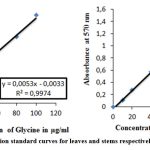 |
Figure 1: Glycine Calibration standard curves for leaves and stems respectively. Source: Authors, 2023.Click here to view Table |
Amaranth cultivars ‘total amino acids in the leaves were in the range of 151.667 ± 3.74 to 349.73 ± 5.85 µg GE/ ml (g) extract. In proper order, the total amino acids in the leaves were 151.667 ± 3.74; 160.434 ± 2.18; 184.182 ± 5.00; 198.107 ± 3.63; 220.994 ± 4.29; 236.371 ± 4.39; 256.893 ± 4.03; 268.642 ± 3.52 and 349.73 ± 5.85 µg GE/ ml (g) extract for Amarantus hypochondriacus L; Amarantus caudatus Lf. Yellow-brown; Amarantus hypochondriacs L cv. Black leaved; Amarantus caudatus L. R-124; Amarantus caudatus L. cv. Edulis; Amarantus cruentus L. (cv. Nodoja; Amarantus cruentus L. cv. Pygmy & Torch; Amarantus hybridus L. (cv. Oeschberg and Amarantus cruentus L cv. Hopi Red Dye respectively. For the cultivars of the same species, there was a wide variation, in terms of total amino acid content but the cultivars of Amaranthus cruentus and Amaranthus hybridus showed higher amino acid content than others.
Table 3: The means and standard errors of leaf and stem amino acids (a.a) content were calculated from their absorbance.
| No. | Plant | Leaf Abs (Mean ± SE) | Stem Abs (Mean ± SE) | Leaf a. a conc. (Mean ± SE) in µg mL | Stem a. a conc. (Mean ± SE) in µg mL |
| 1 | A.ca R-124 | 1.04667 ± 0.11 | 1.0031 ± 0.34 | 198.107 ± 3.63 | 68.4467 ± 3.93 |
| 2 | A.ca Ed | 1.16797 ± 0.20 | 0.17797 ± 0.01 | 220.994 ± 4.29 | 13.4378 ± 0.86 |
| 3 | A.ca Yb | 0.847 ± 0.11 | 0.99967 ± 0.42 | 160.434 ± 2.18 | 68.2178 ± 4.66 |
| 4 | A.cru HRD | 1.85027 ± 0.62 | 0.2049 ± 0.06 | 349.73 ± 5.85 | 15.2333 ± 3.69 |
| 5 | A.cru N | 1.24947 ± 0.25 | 0.68513 ± 0.44 | 236.371 ± 4.39 | 47.2489 ± 2.93 |
| 6 | A.cru PT | 1.35823 ± 0.08 | 1.98187 ± 1.03 | 256.893 ± 4.03 | 133.698 ± 4.01 |
| 7 | A.hyb O | 1.4205 ± 0.24 | 2.28633 ± 0.65 | 268.642 ± 3.52 | 153.996 ± 4.34 |
| 8 | A.hypo P | 0.80053 ± 0.12 | 0.6731 ± 0.25 | 151.667 ± 3.74 | 46.4467 ± 4.98 |
| 9 | A.hypo Bl | 0.97287 ± 0.14 | 1.95997 ± 1.04 | 184.182 ± 5.00 | 132.238 ± 2.93 |
Compared to the findings of amino acids in the leaves, the amino acids in the stems were lower and ranged from 13.4378 ± 0.86 to 153.996 ± 4.34 µg GE/ ml (g) extract. From the lowest to the highest, the amino acids in the stems were 13.4378 ± 0.86; 15.2333 ± 3.69 ; 46.4467 ± 4.98 ; 47.2489 ± 2.93 ; 68.2178 ± 4.66 ; 68.4467 ± 3.93 ; 132.238 ± 2.93 ; 133.698 ± 4.01 and 153.996 ± 4.34 µg GE/ ml (g) extract for Amarantus caudatus L. cv. Edulis; Amarantus cruentus L. cv. Hopi Red Dye; Amarantus hypochondriacus L ; Amarantus cruentus L. cv. Nodoja; Amarantus caudatus L. f. Yellow brown; Amarantus caudatus LR-124 ; Amaranthus hypochondriacus L cv. Black Leaved ; Amaranthus cruentus L cv. Pygmy & Torch and Amarantus hybridus L.cv. Oeschberg respectively. With a very wide variation of amino acids in comparison to the same species, the highest amino acid levels have been found in Amaranthus hybridus. The data of leaves and stems were not correlated with a very low correlation coefficient and greater p-value than 0.05 (P˃0.05), P ═ 0.857, R ═ 0.071, and R2═ 0.0050.
We quantified amino acids using only one amino acid, glycine, as a standard calibration curve, thus this could be the limiting factor for quantifying all amino acids. In this case, our results were low but very low in stem extract than in leaves and ranged from 13.4378 to 153.996 µg GE/ ml (g) extract and 151.667 to 349.73 µg GE/ ml (g) extract respectively. Glycine is one of the non-essential amino acids, making amaranth a valuable dietary component, and the glycine content ranges between 0.1 to 0.15 grams per 100 grams of fresh weight and 0.05 to 0.08 grams per 100 grams of fresh weight in amaranth leaves and stems respectively.19 The glycine content with10, was 0.423 mg/ 100g in the dry leaf and 0.187 mg/100g in the dry stem of amaranth, thus the total amino acid content was 7.332 mg/ 100g and 6.227mg / 100g in the dry leaf and stem of Amaranth respectively. Glycine content in dried matter increased from 1.5 to 2.5 grams per 100 grams of dry weight and from 0.5 to 1.0 grams per 100 grams of dry weight in dried leaves and stems respectively.19
The study of Sarker and Oba reported the protein content in stem Amaranth from 5.76 to 1.47 g/100g fresh weight.5 Many researchers have used the different amino acids as the standard calibration curves to specify each amino acid.11 The studies found that the amino acid content varied in a manner conforming to the age of the plant (leaves/stems). The leafy components of amaranth have not had as much research done on their proteins. Their nutritional worth was also demonstrated to be fairly high: the albumins (73.42%), globulins (6.60%), prolamins (6.47%), and glutelins (6.41%) from the proteins of the leaves of A. dubius flour had a chemical score of 92.83% for necessary amino acids.12
The protein levels of the leaves of 61 accessions of the grain and vegetable types Amaranthus (a total of 10 species) were assessed. The leaf protein variations for the vegetable and grain types were 14 to 30 and 15 to 43 g/kg (fresh weight), respectively. Certain high-carotenoid lines’ leaf proteins exhibited a high lysine content (40–56 g/kg) and an amino acid composition that was well-balanced.2,13
The protein content of Amaranthus cruentus, Amaranthus caudatus, and Amaranthus hypochondriacus is 13.2-18.2g/100g, 17.6-18.4g/100g, and 17.9g/100g respectively.14 Amaranthus hypochondriacus and Amaranthus cruentus are on the top for high protein content in leaves with 25% to 30% and 20% to 25%.20 In our results, Amaranthus Cruentus was on the top where the cultivars of Amaranthus cruentus and Amaranthus hybridus showed higher amino acid content than others. The lysine content is a high amino acid in pseudo-cereals (amaranth). Among the protein composition, only lysine contents are high and range from 3.2-6.4g/100g. Protein content and amino acid composition depend on genotype and growing conditions.14
As previously stated, amaranth proteins are rich in several important amino acids. However, Amino acids, have a variety of vital physiological and nutritional roles in humans and are closely associated with both health and illness as well as bodily growth and development. This is because their contents vary depending on the species and cultivars of plants. Amino acids serve several vital purposes besides their involvement in plant physiological systems and protein synthesis. They serve as intracellular pH regulators and are crucial nutrients and developmental regulators for plants. They help plants withstand biotic and abiotic stress and promote metabolic energy.1
Conclusion
It can be concluded that the amaranth cultivars show a wide array of highly nutritional characteristics, also higher in leaves than in stems espacialy the cultivars of Amaranthus cruentus and Amaranthus hybridus. Moreover, the values of glycine as the title of total amino acid determined here in the leaves and stems of the amaranth cultivars are close to the normal findings.
The amaranth species studied, particularly their leaves and stems are the good source of glycine, additive plant’s value as a nutritious food for both human and animal consumption. Therefore, these results show that apart from the seeds, all other parts of Amaranth especialy stem sometimes treated as waste can be utilized as a natural source of protein and can be proposed to be part of nutritional values.
Acknowledgment
The authors would like to acknowledge the support of providing the seeds of Amaranth cultivars from the Ural Federal University Botanical Garden.
Funding Sources
The author(s) received no financial support for the research, authorship, and/or publication of this article.
Conflicts of Interest
The authors do not have any conflict of interest.
Data Availability Statement
The corresponding author can provide the supporting data of this study upon a reasonable request.
Ethics Statement
This research did not involve human participants, animal subjects, or any material that requires ethical approval.
Informed Consent Statement
This study did not involve human participants, and therefore, informed consent was not required.
Permission to reproduce material from other sources
Not Applicable
Author Contributions
Sylvestre Havugimana: conceptualization, investigation, methodology, data analysis, and writing and supervision
Daniel Nsengumuremyi: original draft and writing,
Adjira Umukwiye: original draft and writing.
Irina Sergeevna Kiseleva: Review and supervision.
Emmanuel Victor Hakizimana: Review and supervision.
Elena Petrovna Artemyeva: Review and editing.
Elysee Hitayezu: Review and editing.
References
- Magdalena K, Gai F, Longato E, Meineri, G, Janiak M.A, Amarowicz R, and Peiretti, P.G . Antioxidant Activity and Phenolic Composition of Amaranth (Amaranthus caudatus) during Plant Growth; Antioxidants 2019, 8(6), 173; https://doi.org/10.3390/antiox8060173
CrossRef - Julio A. Massange-Sánchez,Paola A. Palmeros-Suárez,Eduardo Espitia-Rangel,Isaac Rodríguez-Arévalo,Lino Sánchez-Segura,Norma A. Martínez-Gallardo,Fulgencio Alatorre-Cobos,Axel Tiessen,John P. Délano-Frier. Overexpression of Grain Amaranth (Amaranthus hypochondriacus) AhERF or AhDOF Transcription Factors in Arabidopsis thaliana Increases Water Deficit- and Salt-Stress Tolerance, Respectively, via Contrasting Stress-Amelioration Mechanisms, PLoS One. 2016; 11(10): e0164280. 10.1371/journal.pone.0164280
CrossRef - Sarker, U., Oba, S. & Daramy, M.A. Nutrients, minerals, antioxidant pigments and phytochemicals, and antioxidant capacity of the leaves of stem amaranth. Scientific Reports, 2020; 10, 3892 https://doi.org/10.1038/s41598-020-60252-7
CrossRef - Sarker, U., Hossain, M.M. & Oba, S . Nutritional and antioxidant components and antioxidant capacity in green morph Amaranthus leafy vegetable. Scientific Reports,2020; 10, 1336 https://doi.org/10.1038/s41598-020-57687-3
CrossRef - Sarker, U and Oba, S . Polyphenol and flavonoid profiles and radical scavenging activity in leafy vegetable Amaranthus gangeticus; BMC Plant Biology, 2020;20, 499 https://doi.org/10.1186/s12870-020-02700-0
CrossRef - Sarker, U., & Oba, S. Antioxidant constituents of three selected red and green color Amaranthus leafy vegetable; Scientific reports, 2019; 9(1), 18233. https://doi.org/10.1038/s41598-019-52033-8
CrossRef - Caselato-Souza, V. M and Amaya-Farfán, J . State of Knowledge on Amaranth Grain: A Comprehensive Review. Journal of Food Science, 2012; 77(4) R93-R104,PMid: 22515252. http://dx.doi.org/10.1111/j.1750-3841.2012.02645.x
CrossRef - Aderibigbe, O. R; Ezekiel, O. O; Owolade, S. O; Korese, J. K; Sturm, B & Hensel, O . Exploring the potentials of underutilized grain amaranth (Amaranthus spp.) along the value chain for food and nutrition security: A review, Critical Reviews in Food Science and Nutrition, 2022;62(3), 656-669, DOI: 10.1080/10408398.2020.1825323
CrossRef
- Yemm E.W & Cocking E. C.The determination of amino acids with ninhydrin. Analyst, 1955; 80, 209.
CrossRef - Jude C.I, Catheline C.I & Mercy O.I . Nutrient and bioactive compounds composition of Pandiaka heudolotii: 2019. A wild vegetable Vol 5, issue 4. University of Port Harcourt Nigeria.
CrossRef - Trinidad Pérez-Palacios, Miguel A. Barroso, Jorge Ruiz, Teresa Antequera. A Rapid and Accurate Extraction Procedure for Analyzing Free Amino Acids in Meat Samples by GC-MS”. International Journal of Analytical Chemistry, vol. 2015, Article ID 209214, 8 pages, 2015. https://doi.org/10.1155/ 2015/209214
CrossRef
- Khandaker, Laila & Oba, Shinya. Total Polyphenol and Antioxidant Activity of Red Amaranth (Amaranthus tricolor L.) as Affected by Different Sunlight Level; Journal of the Japanese Society for Horticultural Science – J JPN SOC HORT SCI. 2008; 77. 395-401. 10.2503/jjshs1.77.395.
CrossRef - Vasundhara, M & Gujaran, Sheetal & Marappa, N & Murthy, Niranjana & Lakshmi, & Priyanka, RuhiScreening and Identification of Genotypes for Natural Color from Grain Amaranth (Amaranth sp.). International Journal of Agriculture, Environment and Biotechnology,2017; 10. 443. 10.5958/2230-732X.2017.00055.9.
CrossRef - Eloho, P., Adunni, O., & Adedapo, M. Assessment of the protein quality of twenty-nine-grain Amaranths (Amaranthus spp. L.) accessions using amino acid analysis and one-dimensional electrophoresis. African Journal of Biotechnology, 2013; 12, 1802-1810.
CrossRef
- Malik, M., Sindhu, R., Dhull, S. B., Bou-Mitri, C., Singh, Y., Panwar, S., & Khatkar, B. S. Nutritional Composition, Functionality, and Processing Technologies for Amaranth. Journal of Food Processing and Preservation 2023, no. 1 (2022): 1753029. Accessed October 17, 2024. https://doi.org/10.1155/2023/1753029.
CrossRef
- Ouedraogo, S. S., Bationo, J. B., Bassole, I. H. N., Nacoulma, O. G. Nutrient and Amino Acid Composition of Different Amaranth Species in Burkina Faso.Journal of Agricultural and Food Chemistry, 2021; 7(3), e06530.https://doi.org/10.1016/j.heliyon.2021.e06530
CrossRef - Rajić, M., & Mandić, V. Comparative Nutritional Analysis of Amaranth Species (Amaranthus cruentus and Amaranthus hypochondriacus). Journal of Agricultural Sciences, 2017; 62(1), 83-92. https://doi.org/10.2298/JAS1701083R
- Uebersax, F., Smith, A., Jones, D., & Singh, J. Utilization of Amaranth Plant Residues for Sustainable Food and Feed Production. Journal of Agricultural and Food Chemistry, 2022; 70(14), 4110-4120. https://doi.org/10.1021/acs.jafc.2c00430
- Bekele, S., Abebe, T., & Tadesse, E. Nutritional Value of Amaranth Plant Parts: A Comparative Study of Leaves, Stems, and Seeds. African Journal of Agricultural Research, 2017; 12(10), 841-848. https://doi.org/10.5897/AJAR2016.11732
CrossRef - Serrano, C., García, M., López, J., & Rivera, E. Protein and Amino Acid Composition in Amaranth By-products: Implications for Nutritional Value and Food Applications. Journal of Food Composition and Analysis, 2019; 82, 103238. https://doi.org/10.1016/j.jfca.2019.103238
CrossRef