


 PDF Downloads:
411
PDF Downloads:
411


Introduction
Cabbage is a highly proteinaceous vegetable crop that requires adequate water and nutrient management for optimal growth and yield. Among irrigation practices, surface irrigation—including basin, border, furrow, and flood methods—is one of the most widely used approaches, relying on gravity to distribute water across the soil surface. Furrow irrigation, in particular, channels water along ridges or furrows, reducing waterlogging and improving water distribution efficiency.
Improving crop yield and quality in cabbage cultivation requires integrated agronomic practices. Mulching, the application of a protective layer of organic or inorganic material on the soil surface, is a proven strategy to conserve soil moisture, regulate temperature, and suppress weeds. Jute agrotextiles, derived from natural jute fibers, are eco-friendly mulching materials that can modify the crop micro-environment effectively.
In addition to water management, nutrient enrichment through vermicompost and urea application can significantly influence cabbage growth, yield, and nutritional quality. Vermicompost enhances protein content and overall nutritional value, while mulching contributes to better water-use efficiency and lower fat and sugar accumulation.
This study evaluates the combined effects of furrow irrigation, mulching, and nutrient management on water consumption, yield, and nutrient composition of cabbage, aiming to identify sustainable practices that maximize both productivity and crop quality.
Many agronomic approaches are used to boost the production capacity of this very versatile crop, with mulching proving to be the most effective. In order to change the growing microenvironment and boost crop yield, mulching usually involves adding an organic or inorganic layer to the soil surface surrounding the target crop.
Materials such as wheat straw, rice straw or husk, grass, weeds, leaves, leaf mold, animal manures, compost, sawdust and woodchips are usually used as organic mulches and that of plastic or polyethylene film, sand, gravel, pebbles, etc. are used as inorganic mulches.1-3 Commercially spaced crops and vegetables, such as tomatoes, lettuce, and other vegetables, are produced by mulching with synthetic (polyethylene film) or organic (crop residue) materials others.4 Geotextiles or agrotextiles the best materials for altering the soil environment, controlling weeds, and boosting crop yield are mulches, permeable textiles made of polypropylene, or biodegradable materials like jute and other textiles5.In this context, jute agro textile, made from 100% natural bust fibre has the same potential to improve crop yield as well as soil fertility and productivity status. Application of jute agro textile mulches increased the yield of capsicum and pointed gourd6 and that of sweetlime and turmeric7 compared to control in which no mulching materials were applied.
Mulch helps to regulate soil temperature by keeping it cool in the summer and sheltering it from cold winds in the winter. Mulches are one of the most effective ways for increasing agricultural production while also shielding plants from particular elements that influence agricultural productivity and yield. Although it is normal practice to mulch using synthetic (polyethylene film) or organic (crop leftovers) materials, geotextiles or agrotextiles are more effective at changing the soil environment, reducing weeds, and increasing crop yields. Non-woven jute agrotextiles are more effective at suppressing weed growth than woven agrotextiles, requiring less physical effort and herbicide use while enhancing agricultural yields of groundnuts, broccoli, and other crops while maintaining soil moisture. Woven jute agrotextiles can also be effectively utilized to control soil erosion and weed growth.
The invasion of wild animals and birds into farmers’ crop fields is one of the many difficulties they face; it poses a serious threat to agricultural productivity and financial stability.8,9 Large flocks of birds invade farms and feast on crops, grains, and vegetables, resulting in a significant loss in overall farm productivity and production. In addition to reducing overall output, the birds also harm crops by crushing plants and contaminating them with their droppings, which is harmful to human health and reduces the produce’s marketability.
The use of bird protection nets played an important role in safeguarding cabbage crops during the growing season. Plots without bird netting experienced greater crop damage due to bird feeding, which directly reduced marketable yield. By contrast, plots protected with netting showed significantly higher yields, as losses from bird pecking and partial consumption of heads were minimized. Reflective tapes, noise cannons, scarecrows, netting, and the use of drones for deterrence are some of the ways farmers attempt to address these issues.10, 11 Physical barriers, such as netting (which covers crops with bird netting and is especially helpful for high-value crops like fruits), are frequently observed methods in farmers’ fields. Vermicompost plays a crucial role in altering the physical, chemical, and biological characteristics of soil through earthworm activity; for this reason, it is referred to as soil managers.12 Mulching has a major impact on crop productivity, water efficiency, and soil health in a variety of agroclimatic zones, according to recent studies. By creating a favorable microclimate for plant growth, mulching improved soil moisture retention and increased crop yield in the Mexicali Valley’s cabbage cultivation13. organic mulches performed better at maintaining soil fertility and minimizing water loss, while other mulch types had a significant impact on soil temperature regulation, nutrient use efficiency, and overall cabbage productivity14.
By modeling the effects of different irrigation schedules and mulching techniques on strawberry cultivation in the arsenic-contaminated Bengal Basin, extended these findings to another crop and showed that mulching not only increased water use efficiency but also mitigated the effects of environmental stress on plant growth. When taken as a whole, these studies highlight how mulching can improve soil quality, maximize resource use, and increase crop yields in a variety of environmental settings15.
Materials and Methods
The present investigation, which was conducted at the Water Resources Engineering and Management Institute, Training cum demonstration farm, Samiala, Vadodara district, Gujarat, India. Samiala is located between 22.250 N and 73.110 E, with a general elevation of 30 meters above mean sea level and an average annual rainfall of 930mm.
Infiltration rate is determined using an infiltrometer test in the field, and soil type is determined using sedimentation analysis. According to sedimentation studies, the soil in the research region is loamy, and the infiltration rate is 8 mm/hr.
The cabbage was sowed on December 15, 2023, and grew for four months (end of April, 2024) until the crop matured. Throughout the season, urea and vermi compost are applied at regular intervals of 15 days. Four combinations. 1) Mulching (jute) 2) No mulching 3) Vermi compost and 4) Urea had been used in the development of cabbage crops. Each plot had a 4 square meter area and was spaced apart by 50 cm X 50 cm.
Experimental Site and Design
The study was conducted under a furrow irrigation system to evaluate the effects of mulching, vermicompost, and urea on cabbage growth, yield, and nutritional quality. A Randomized Block Design (RBD) was used to set up the experiment with multiple treatment combinations, including:
Mulching (Jute)
Without Mulching
Vermicompost application
Urea application
Each treatment was replicated to ensure statistical reliability of the results.
Surface irrigation was applied through furrows, allowing water to flow along the ridges to maintain soil moisture. Irrigation schedules were adjusted according to crop water requirements, soil type, and climatic conditions. Water usage was recorded for each treatment to assess water-use efficiency.
Mulching Application
Mulching involved placing a layer of jute agrotextiles on the soil surface around cabbage plants. This layer helped reduce soil evaporation, regulate temperature, and suppress weed growth.
Nutrient Management
Vermicompost was applied at recommended rates to enrich soil nutrients and improve crop quality.
Urea was applied as a nitrogen source according to standard agronomic guidelines.
Data Collection
Growth Parameters: Leaf Area Index (LAI), plant height, and canopy development were measured at regular intervals.
Yield Parameters: Total yield (Q/ha) was recorded at harvest.
Nutritional Analysis: Carbohydrates, protein, fat, sugar, and overall nutritional value were determined using standard laboratory procedures at the Food and Drugs Laboratory, Vadodara.
Soil Analysis: pH, electrical conductivity (EC), and micronutrients (S, Zn, Fe, Mn, Cu) were analyzed at the Gujarat State Fertilizers & Chemicals Limited, Vadodara.
Statistical Analysis
Data were analyzed using appropriate statistical tools to evaluate differences between treatments. Significant variations in growth, yield, water use, and nutritional quality were identified and interpreted to determine the most effective treatment combinations.
Results
All statistics, such as crop yield and amount of water utilized, were acquired from the field.
LEAF AREA INDEX
Leaf Area Index (LAI), a value of 0 represents no leaves on the ground, while 1 indicates that the total area of leaves on one side equals the area of the ground they cover. Values between 0 and 1 represent a range of leaf cover, with a value of 0.5 suggesting that the projected leaf area is half the ground area, and so on. These values indicate a range of leaf cover, with a higher value meaning more leaves and a lower value meaning fewer leaves. Leaf Area Index is the ratio of Leaf area (Sq. m) to the Ground area (Sq. m).
The results of Cabbage crop grown from December, 2023 to April, 2024 using Furrow irrigation System with different combinations effect on Plant height (cm), No. of leafs in plants, Canopy area of plant (Sq. cm), and Leaf Area Index are presented in Table 1. Plant height varies from 22 cm to 33 cm respectively. The Leaf Area Index values vary from 0.94 to 1.64.
Table 1: Effect of different combinations were used for Cabbage on Leaf Area Index (LAI)
| Sr. No. | Combinations | Plant height (cm) | No. of leafs in plants | Canopy area of plant (cm2) | Leaf Area Index (LAI) |
| 1 | Urea | 26 | 23 | 0.36 | 1.44 |
| 2 | Mulching (Jute) | 23 | 17 | 0.32 | 1.28 |
| 3 | Without Mulching | 22 | 15 | 0.23 | 0.94 |
| 4 | Vermicompost | 33 | 24 | 0.41 | 1.64 |
Total water use (mm) and Total Yield (Q/ha)
Total water use (mm) due to differences in different combinations in soils grown with cabbage was monitored on a daily basis, and the findings are shown in Table 2. Total water use (mm) varied consistently between combinations.
Maximum water used in Urea based plot (330.42 mm) and lowest water used in Mulching (Jute) based plot (264.73 mm). i.e. The following order is observed in the water use pattern:
Urea based plot (330.42 mm) > Vermicompost based plot (306.15 mm) > Without mulching plot (290.31 mm) > Mulching based plot (264.73 mm) are represented in Table 2. Total yield varies from 6.3 Q/ha to 9.8 Q/ha.
Table 2: Effect of different combinations were used for Cabbage on Total water use (mm) and Total Yield (Q/ha)
| Sr. No. | Combinations | Total Water Use (mm) | Total Yield (Q/ ha) |
| 1 | Urea | 330.42 | 9.5 |
| 2 | Mulching (Jute) | 264.73 | 7.5 |
| 3 | Without Mulching | 290.31 | 6.3 |
| 4 | Vermicompost | 306.15 | 9.8 |
Different Nutrients effect on Cabbage
All analytical testing was carried out at the Public Food and Drugs Laboratory, Vadodara Municipal Corporation, Vadodara, Gujarat, India, following quality control protocols to assure accuracy and reproducibility of results obtained from various combinations, as shown in Table 3. The results indicate how different combinations can affect the carbohydrate, fat, protein, nutritional value, and sugar content of different cabbage crop samples. The Nutrition value generally varies from 35.39 % Urea based plot to 47.21 % Vermicompost based plot as shown in Figure 2. Carbohydrate values vary from 0.96 to 5.84, Fat values vary from 0.78 to 1.17, Protein values vary from 1.21 to 3.29 and Sugar values vary from 2.08 to 2.71 as shown in Figure 1.
Table 3: Effect of different combinations were used for Cabbage on different nutrients
| Sr. No. | Combinations | Carbohydrate (%) | Fat (%) | Protein (%) | Nutrition Value (%) | Sugar (%) |
| 1 | Urea | 4.92 | 1.15 | 1.34 | 35.39 | 2.66 |
| 2 | Mulching (Jute) | 1.09 | 0.78 | 2.11 | 43.82 | 2.08 |
| 3 | Without Mulching | 5.84 | 0.84 | 1.21 | 45.36 | 2.71 |
| 4 | Vermicompost | 0.96 | 1.17 | 3.29 | 47.21 | 2.63 |
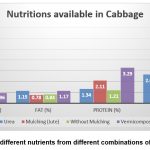 |
Figure 1: different nutrients from different combinations of Cabbage |
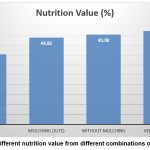 |
Figure 2: different nutrition value from different combinations of Cabbage |
From a nutritional perspective, the best treatment was vermicompost, which provided the highest protein (3.29%) and nutritional value (47.21%), along with balanced fat and sugar levels, making it the most effective for enhancing crop quality. The second best was the without mulching plot, which recorded the highest carbohydrate content (5.84%) and a strong nutritional value (45.36%), although its very low protein (1.21%) reduced overall quality. The third best was mulching (jute), which maintained a balanced profile with moderate protein (2.11%) and nutritional value (43.82%) while keeping fat (0.78%) and sugar (2.08%) at the lowest, favoring health benefits. The least effective was urea, which resulted in the lowest nutritional value (35.39%) and weak protein content (1.34%), despite providing higher carbohydrates and moderate sugar.
Soil report
After harvesting the cabbage crop from all plots, soil samples were obtained from all different combinations of plots and sent to Gujarat State Fertilizers & Chemicals Limited, Vadodara to verify the soil’s health and the various micro elements available in soil from table 4. The usual PH ranges from 6 to 7.5, which allows for the most readily available plant nutrients. According to the study, the soil is normal to alkaline, allowing the plant to absorb more nutrients.EC (mmhos/cm) runs from 2 to 3.5 mmhos/cm; a number outside this range indicates a lack of nutrients or excess salts in the soil. Here, EC (mmhos/cm) values range from 0.36 to 2.30 mmhos/cm.
Table 4: Effect of different combinations were used for Cabbage on soil
| Sr. No. | Combinations | PH | EC, (mmhos/cm) | S, ppm | Zn, ppm | Fe, ppm | Mn, ppm | Cu, ppm |
| 1 | Urea | 7.30 | 2.30 | 19.60 | 3.62 | 36.15 | 8.02 | 6.18 |
| 2 | Mulching (Jute) | 8.23 | 0.36 | 7.60 | 3.22 | 39.62 | 4.20 | 6.24 |
| 3 | Without Mulching | 8.30 | 0.45 | 7.30 | 1.98 | 24.34 | 5.28 | 4.86 |
| 4 | Vermicompost | 7.80 | 0.60 | 9.50 | 3.0 | 26.74 | 4.62 | 5.78 |
Normally, the essential level for Sulphur in soil is 10 ppm; below this range, the soil is in Sulphur deficit. Sulphur concentrations range from 7.30 to 19.60 ppm. Zinc levels in soil should be higher than 1.5 ppm to be beneficial to all crops. The ppm value for zinc ranges from 1.98 to 3.62. Iron levels in soil typically range from 20 ppm to 200 ppm, although PH, organic matter, and minerals can all have an impact on iron availability. If iron levels fall below 3.5 ppm, the soil is iron deficient. Iron ppm ranges from 24.34 to 39.62.
Manganese levels in soil typically range between 20 and 3000 ppm. If manganese levels exceed 1000 ppm, the soil is poisonous. Manganese levels should be high in acidic soil and low in alkali soil. Manganese ppm ranges from 4.20 to 8.02. Copper levels in soil typically range from 2 ppm to 50 ppm; if Copper levels exceed 100 ppm, the soil is considered hazardous. Copper ppm ranges from 4.86 to 6.24.
Based on the soil analysis, the best treatment overall was vermicompost, as it maintained a near-neutral pH (7.80), safe EC (0.60 mmhos/cm), and provided balanced nutrient availability, particularly moderate sulphur, zinc, and copper levels. This balance ensures sustainable soil health without salinity risks. The second best was mulching (jute), which improved iron (39.62 ppm) and copper (6.24 ppm) availability while maintaining very low EC (0.36 mmhos/cm), though it shifted soil pH toward alkalinity (8.23) and supplied relatively low sulphur. Urea ranked third, as it enhanced sulphur (19.60 ppm), zinc, and manganese levels but created potential risks of high EC (2.30 mmhos/cm) and long-term soil degradation despite its immediate nutrient supply. The least effective was the plot without mulching, which recorded the highest alkalinity (pH 8.30), the lowest zinc (1.98 ppm) and iron (24.34 ppm), and moderate but inconsistent micronutrient levels, making it the weakest treatment for sustaining soil fertility.
Discussion
The Leaf Area Index (LAI) of the cabbage crop developed from 0.94, 1.28, 1.44, and 1.64 as a result of the various combinations of Mulching based plot, no Mulching based plot, Vermicompost based plot, and Urea based plot. The vermicompost-based plot had the highest LAI, while the plot without mulching had the lowest LAI. The total water needed for cabbage increased from 264.73 mm to 290.31 mm, 306.15 mm, and 330.42 mm as a result of the various combinations of Mulching based plot, no Mulching based plot, Vermicompost based plot, and Urea based plot. Water use was higher in the Urea-based plot and lower in the Mulching-based plot.
Cabbage Total Yield (Q/ha) increased from 6.3 Q/ha to 7.5 Q/ha, 9.5 Q/ha, and 9.8 Q/ha as a result of various combinations of Mulching based plot, no Mulching based plot, Vermicompost based plot, and Urea based plot. The highest yield (Q/ha) was seen in the vermicompost-based plot, whereas the lowest yield (Q/ha) was observed in the plot without mulching. It is concluded that a mulching-based plot uses less water than other combinations, and a vermicompost-based plot produces the highest yield when compared to other combinations.
Carbohydrate (%) values increase from 0.96, 1.09, 4.92, and 5.84 as a result of the various combinations of without Mulching, Urea, Mulching, and Vermicompost based plots. The fat (%) values increase from 0.78, 0.84, 1.15, and 1.17 due to the diverse combinations of Mulching based plot, no Mulching based plot, Urea based plot, and Vermicompost based plot. Protein (%) values rise from 1.21, 1.34, 2.11, and 3.29 due to various combinations of Vermicompost based plot, Urea based plot, Mulching based plot, and no Mulching based plot.
The nutritional value (%) values increase from 35.39, 43.82, 45.36, and 47.21 due to the various combinations of Urea-based plot, Mulching-based plot, Mulching-free plot, and Vermicompost-based plot, respectively. Sugar (%) values rise from 2.08, 2.63, 2.66, and 2.71 due to the various combinations of Mulching based plot, Vermicompost based plot, Urea based plot, and no Mulching based plot, respectively. According to the various nutrient reports, the vermicompost plot has less carbohydrate (%) and maximum protein (%) than the other combinations, the mulching plot has less fat (%) and less sugar (%) than the other combinations, and the vermi compost plot has more nutrition value (%) than the other combinations.
According to the examination of different components available in soil for different combinations, PH values increase from 7.30, 7.80, 8.23, and 8.30 (Normal to Alkali) due to the varied combinations of Urea-based plot, Vermicompost-based plot, Mulching-based plot, and no Mulching-based plot, respectively. The diverse combinations of Mulching based plot, no Mulching based plot, Vermicompost based plot, and Urea based plot result in EC (mmhos/cm) values ranging from 0.36, 0.45, 0.60, and 2.30 (Normal to greater). Sulphur (S, ppm) values rise from 7.30, 7.60, 9.50, and 19.60 (little to medium) due to various combinations of without Mulching, Mulching, Vermicompost, and Urea based plots.
Zinc (Zn, ppm) levels increase from 1.98, 3.00, 3.22, and 3.62 (More) due to the various combinations of without Mulching, Vermicompost, Mulching, and Urea based plots. The iron (Fe, ppm) values increase from 24.34, 26.74, 36.15, and 39.62 (More) due to the
diverse combinations of without Mulching, Vermicompost, Mulching, and Urea based plots. Manganese (Mn, ppm) values increase from 4.20, 4.62, 5.28, and 8.02 (Less to Medium) due to the various combinations of Mulching based plot, Vermicompost based plot, no Mulching based plot, and Urea based plot, respectively. Copper (Cu, ppm) readings rise from 4.86, 5.78, 6.18, and 6.24 (More) due to different combinations of without Mulching based plot, Vermicompost based plot, Urea based plot and mulching based plot respectively.
According to the results, it is determined that Vermicomposts and Mulching-based plots get better results in crop water used and total yield acquired from field, Vermicomposts and Mulching-based plots get better result in Different nutrients available from plant.
Conclusion
The findings of the study clearly demonstrate that the application of vermicompost and mulching plays a significant role in improving cabbage growth, yield, and quality while enhancing water-use efficiency. Vermicompost-based plots recorded the highest leaf area index, total yield, protein, and overall nutritional value, showing its superior capacity to improve crop performance through enhanced nutrient availability and better soil health. Similarly, mulching proved effective in conserving soil moisture, reducing total crop water requirement, and improving yield compared to no mulching, highlighting its role in sustainable water management.
In contrast, urea-based plots, while contributing to higher nutrient levels in soil and moderate yield improvement, also resulted in increased water demand and elevated EC values, raising concerns of long-term soil salinity. Plots without mulching consistently underperformed in terms of yield, growth, and nutrient quality. Thus, integrating vermicompost application with mulching emerges as the most effective strategy, ensuring high productivity, improved nutritional content, and sustainable soil and water management practices for cabbage cultivation.
Acknowledgement
I would like to thank The Maharaja Sayajirao University of Baroda, Vadodara for granting the Ph.D. research work. The Department of Water Resources Engineering and Management Institute, Faculty of Technology & Engineering, The Maharaja Sayajirao University of Baroda, is highly appreciated for allowing the performance at Training cum demonstration farm, Samiala, Vadodara.
Funding Sources
The author(s) received no financial support for the research, authorship, and/or publication of this article.
Conflict of Interest
The authors do not have any conflict of interest.
Data Availability Statement
The manuscript incorporates all datasets generated and analyzed during the course of this research study.
Ethics statement
This research did not involve human participants, animal subjects, or any material that requires ethical approval.
Informed Consent Statement
This study did not involve human participants, and therefore, informed consent was not required.
Permission to reproduce material from other sources
This study did not reproduce material from other sources, and therefore, permission was not required.
Author Contributions
T.M.V. Suryanarayana: Conceptualization, Methodology.
Inayatali Shah: Data Collection, Analysis, Writing – original draft.
References
- Khurshid, K., Iqbal, M., Arif, M. S., & Nawaz, A. Effect of tillage and mulch on soil physical properties and growth of maize. International journal of agriculture and biology. 2006;8(5):593-596.
- Seyfi, K. & Rashidi, M., Effect of drip irrigation and plastic mulch on crop yield and yield components of cantaloupe. International Journal of Agriculture and Biology,2007;9(2):247– 249.
- Quilty, J. R. & Cattle, S. R., Use and understanding of organic amendments in Australian agriculture: a review. Soil Research, 2011;49(1):1-26.
CrossRef - Albert, T., Karp, K., Starast, M., & Paal, T. The effect of mulching and pruning on the vegetative growth and yield of the half-high blueberry. Agronomy Research,2010;8: 759-768.
- Manna, K., Kundu, M.C., Saha, B. et al., Effect of nonwoven jute agrotextile mulch on soil health and productivity of broccoli (Brassica oleracea L.) in lateritic soil. Environmental Monitoring and Assessment. 2018; 190(2):1-10.
CrossRef - Saha, B., Prasad, L. K., Harris, A. et al., Effect of geo-textile mulch on soil moisture, temperature and yield of vegetable crops grown in planes of Bihar. International Journal of Tropical Agriculture, 2006; 24(1–2): 153–157.
- Nag, D., Choudhury, T. K., Debnath, S. et al., Efficient management of soil moisture with jute non-woven as mulch for cultivation of sweetlime and turmeric in red lateritic zone. Journal of Agricultural Engineering, 2008; 45(3):59–62.
CrossRef - Bapat, V., Kale, P., Shinde, V. et al., WSN application for crop protection to divert animal intrusions in the agricultural land. Computers and electronics in agriculture, 2017; 133: 88-96.
CrossRef - Praveen, M., IOT-based wild animal intrusion detection system. International Journal on Recent and Innovation Trends in Computing and Communication, 2008; 6(7): 06-08.
- Rivadeneira, P., Kross, S., Navarro-Gonzalez, N. et al., A review of bird deterrents used in agriculture. Proceedings of the Vertebrate Pest Conference, 28(28). International Journal of Agriculture & Biology, 2018; 8(5): 593-596.
CrossRef - Mohamed, W. M. W., Naim, M. N. M., & Abdullah, A. The efficacy of visual and auditory bird scaring techniques using drone at paddy fields. IOP Conference Series: Materials Science and Engineering, 2020; 834(1): 012072.
CrossRef - Ismail SA. Vermicology: The biology of Earthworms. Orient Longman Limited, Chennai, 1997, 92.
- Escobosa-García, I., Vázquez-Medina, M. M., Samaniego-Gámez, B. Y.et al. (2022). Effect of mulching on cabbage grown in the Mexicali Valley. Revista mexicana de ciencias agrícolas, 2023; 13(SPE28), 197-206.
CrossRef - Mu, X., Gao, H., Li, H., et al., Effect of different mulch types on soil environment, water and fertilizer use efficiency, and yield of cabbage. Applied Sciences, 2023;13(7), 4622.
CrossRef - Biswas, B., Tridiv G., & Chakraborty D. et al., Modelling the impact of different irrigation regimes and mulching on strawberry crop growth and water use in the arsenic-contaminated Bengal basin. Scientific Reports 14, no. 1 2024; 9586.
CrossRef