


 PDF Downloads:
383
PDF Downloads:
383


Introduction
Tea is one of the most popular agricultural products and a popular beverage.1,2 Tea plays a significant role in people’s lives, particularly in countries where it is produced. It helps provide livelihoods, shape regional identities, and contribute to national economies. Tea plays a significant role in day-to-day life and the social context of tea-producing countries.3
Tea research has become a significant area of focus in the current research landscape. In the face of climate change and shifting market demands, the need for sustainable tea production practices has come into focus. Scientific studies on improving tea cultivation techniques, processing methods, and quality control are essential for the industry’s growth and resilience.
Among the various fields contributing to tea research, agricultural engineering is also a necessary discipline.4 It supports the tea industry by developing innovative technologies and mechanised solutions for plantation management, harvesting, irrigation, soil conservation, post-harvest processing, and all the related elements of tea production. Integrating agricultural engineering into tea cultivation ensures environmental sustainability, productivity, and integration of the new era of agriculture, making it essential in today’s changing agricultural landscape and promoting tea production without harming the environment.5 In this context, the study was undertaken to identify the study areas, authors, organisations, and keywords related to agricultural engineering in tea research using the Web of Science database. The study is limited to the Web of Science database. No other database was used in this study.
Objectives of the Study
The study’s objective is to identify the diversity of research areas, year-wise output, authors, organisations, and keywords in the context of agricultural engineering in tea research.
Methodology
The dataset for this study was retrieved from the Web of Science (WoS) database using the search term “Tea” under the WoS category Agricultural Engineering, covering the period 1990–2025. The dataset was analysed using Biblioshiny (an R-based implementation of Bibliometrix) and comprised 188 documents published across 11 sources.6 The collection exhibited an annual growth rate of 2%, an average document age of 7.6 years, and an average of 31.59 citations per document, totalling 7,537 references. The content analysis revealed 721 Keywords Plus and 735 author-supplied keywords, reflecting the literature’s thematic scope. Authorship analysis indicated contributions from 910 authors, with only three documents being single-authored, resulting in an average of 5.65 co-authors per document and an international collaboration rate of 15.43%. Regarding document types, the dataset consisted predominantly of 183 research articles, 1 proceedings paper, 1 editorial, and 3 review articles, which collectively served as the basis for the Scientometric analysis undertaken in this study.7,8
Results and Discussion
Annual Scientific Production of Agricultural Engineering in Tea Research
The following figure shows the year-wise distribution of research publications in this subject domain. The year-wise distribution of the included articles shows a clear upward trend. From 1990 to 2000, only a small number of studies were published, with several years showing no publications at all (e.g., 1991–1997, 2002, 2007). A modest increase is observed in the early 2000s, with annual counts ranging from 1 to 4 publications. A marked growth begins in 2012, with 5 publications, followed by a steady increase through 2013–2016, each year contributing between 8 and 11 studies. After a slight dip in 2017, the number of publications rises again, peaking at 14 in 2019.
Since 2020, research activity has risen consistently and substantially. The number of articles per year increased from 12 in 2020 to 21 in 2023, with the highest output recorded in 2024 (32 publications). This demonstrates a strong recent interest and expansion of research in this field.
The trend indicates that scholarly output has been steadily increasing, particularly over the past decade, suggesting that research and academic contributions are becoming increasingly important.9,10
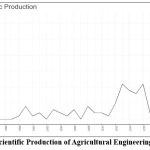 |
Figure 1: Annual Scientific Production of Agricultural Engineering in Tea Research |
Most relevant Sources in Agricultural Engineering in Tea Research
The following figure shows the most relevant sources in this subject domain. The leading journals play a crucial role in promoting and disseminating scholarly content to researchers and policymakers worldwide. Among them, Industrial Crops and Products stands out prominently with 92 documents, making it the most significant and frequently used source. It indicates that the journal closely aligns with the core themes of the research area, possibly focusing on agricultural innovations and crop-based studies. The second most relevant source is Bioresource Technology, with 28 documents, suggesting its importance in renewable resources and sustainable technologies. Other journals include the International Journal of Agricultural and Biological Engineering, with 16 papers, followed by Biomass & Bioenergy and Biosystems Engineering, each with 11 papers. These sources reflect a strong focus on bioenergy and engineering applications in agriculture. Journals such as Applied Engineering in Agriculture (8 papers), Journal of Agricultural Engineering Research, and Transactions of the ASABE (7 papers each) also demonstrate a consistent, though moderate, contribution level. Additionally, specialised or regionally focused journals such as AMA-Agricultural Mechanisation in Asia, Africa, and Latin America (5 documents) and the Journal of Agricultural Engineering (2 papers) make relevant contributions.11
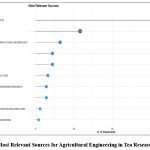 |
Figure 2: Most Relevant Sources for Agricultural Engineering in Tea Research |
Most prolific authors of Agricultural Engineering in Tea Research
The analysis of leading contributors in the field of agricultural engineering in tea research reveals a core group of highly active authors. As shown in Figure 3, He Y and Li XL top the list, each with seven publications, underscoring their central role in advancing the field. They are followed by Temple SJ and Van Boxtel AJB, who have each published six documents, further highlighting their sustained engagement in this domain.
Other notable contributors include Chen XQ, Hu YG, and Wang J, each with five publications, reflecting consistent participation and influence in the literature. Additionally, authors such as Han Y, Wu ZQ, and Zhang Y have each published four works, indicating their emerging impact and growing presence in this research area.12
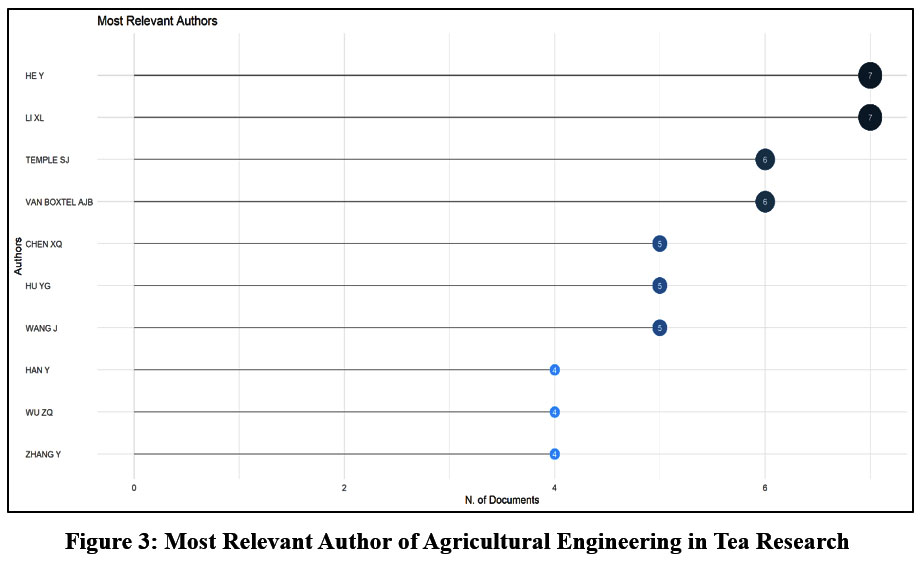 |
Figure 3: Most Relevant Author of Agricultural Engineering in Tea Research |
Most Relevant Affiliation on Agricultural Engineering in Tea Research
The institutional analysis of publications in agricultural engineering related to tea research reveals a significant contribution from Chinese and Indian institutions, alongside notable international contributors (Figure 4). Zhejiang University leads with 17 publications, underscoring its central role in advancing research within this domain. Jiangsu University (12 publications) and Anhui Agricultural University (11 publications) follow closely, further emphasising the leadership of Chinese institutions in this area.
Other significant contributors include Northwest A&F University (10 publications), the Chinese Academy of Agricultural Sciences (9 publications), and the Council of Scientific and Industrial Research (CSIR), India (9 publications). The Chinese Academy of Sciences contributed 8 publications, while both the Indian Institute of Technology (IIT) System and Wageningen University & Research (Netherlands) published 7 articles each. Zhejiang Sci-Tech University also demonstrated strong engagement with 7 publications.13
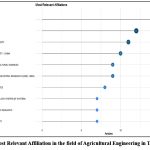 |
Figure 4: Most Relevant Affiliation in the field of Agricultural Engineering in Tea Research |
Word Frequency Over Time Agricultural Engineering in Tea Research
The following figure shows the cumulative occurrences of selected keywords from 1990 to 2024. This suggests that the top 10 keywords have evolved within scholarly publications in agricultural engineering related to tea research during the selected period. The terms include antioxidant, antioxidant activity, biomass, green tea, leaves, optimisation, polyphenols, quality, removal, and tea.
Figure 5 shows the minimal number of keyword occurrences before 2004. The research landscape and integration of new concepts in this domain shifted after 2005, with a steady rise in keyword usage from 2010 onwards. Green Tea, Tea, and Biomass exhibit significant and sustained increases, reaching their highest cumulative frequency by 2024, indicating growing interest and focus on tea- and biomass-related research from various angles.
The development of studies on the health benefits and chemical analysis of plant-based materials is reflected in a significant increase in keywords such as antioxidant, antioxidant activity, polyphenols, and quality after 2012. In other words, terms such as optimisation, elimination, and leaves show a time-to-time increase, pointing to a stronger tendency towards environmental concerns and more efficient processing methods in tea.
Overall, Figure 5 shows a strong upward trajectory in the frequency of all terms, particularly after 2015, indicating a rapidly growing body of research. The increase in term frequency also suggests a multidisciplinary focus encompassing food science, agriculture, bioenergy, and environmental engineering.14
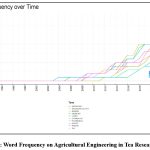 |
Figure 5: Word Frequency on Agricultural Engineering in Tea Research |
Trends Topic on Agricultural Engineering in Tea Research
The following figure visually represents the evolution and prominence of various research areas from around 2006 to 2024. Each term is plotted against a timeline, with horizontal bars indicating the years during which the term appeared in publications and bubble size representing its frequency of occurrence. Larger bubbles indicate higher term frequency.
The figure highlighted that some topics, such as “antioxidant activity,” “green tea,” “extraction,” “catechins,” and “tea waste,” started emerging strongly around the period from 2014 to 2015, reflecting an increasing research interest in the health-related and biochemical aspects of tea and plant extracts. These terms have remained relevant until 2024, as indicated by their long timelines and medium-to-large frequency sizes.
More recent research trends, particularly since 2018, have focused on terms such as “adsorption,” “removal,” “biomass,” “degradation,” “leaves,” “quality,” “biochar,” and “activated carbon.” These keywords are associated with the research field, such as environmental sustainability, material science, and green technology, suggesting direction toward eco-friendly practices and applications in agriculture and industry.
In recent years (2021–2024), terms such as “identification,” “yield,” and “performance” have gained importance, possibly indicating more refined, data-driven, and performance-oriented approaches in this domain.
The diversity of terms, ranging from biochemical compounds such as “flavonoids” and “caffeine” to technical concepts such as “optimisation” and “activated carbon”, illustrates the multidisciplinary integration of topics spanning agriculture, environmental science, health, and engineering. The figure shows a clear, chronological expansion of interest in the topic, accompanied by a strong surge in environmentally focused, application-oriented research in recent years.15
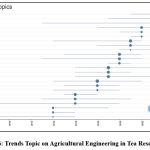 |
Figure 6: Trends Topic on Agricultural Engineering in Tea Research |
Factorial Analysis
The defined map of research areas (Figure 7) demonstrates the multidimensional nature of agricultural engineering in tea research and its close integration with other scientific domains. Keywords cluster around four major themes:
Health Benefits and Bioactive Properties
Terms such as antibacterial, antioxidant, and pharmacological highlight the growing emphasis on exploring tea’s health-promoting properties. This reflects efforts to monetise tea’s bioactive compounds through nutraceuticals and functional foods.
Plant Science and Cultivation
Keywords such as Camellia sinensis, leaves, growth, yield, tea saponin, plant, and evolution indicate research directed at improving crop productivity, stress resistance, and product quality. This cluster emphasises traditional agronomic and plant biology studies, which are central to sustaining tea production.
Technological Innovations and Data-Driven Approaches
The presence of words like extraction, optimisation, classification, identification, computer vision, and infusions reflects the emergence of precision agriculture, machine learning, and image analysis. These tools are increasingly applied for quality assessment, grading, and efficient processing of tea products.
Environmental and Sustainability Concerns
Terms such as tea waste, biomass, biochar, activated carbon, adsorption, removal, pyrolysis, and carbon sequestration point toward research on waste valorisation, pollution control, and resource efficiency. The focus on water purification and soil restoration illustrates integration with green chemistry and environmental engineering.
Additionally, studies on stability, degradation, lignin, polysaccharides, chemical composition, and components highlight ongoing investigations into the structural and functional properties of plant-derived chemicals.16, 17
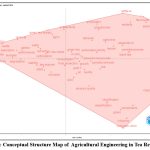 |
Figure 7: Conceptual Structure Map of Agricultural Engineering in Tea Research. |
Conclusion
This study provides an assessment of trends and the contributions of agricultural engineering to tea research, based on data from the Web of Science database. The analysis highlights a distinct increase in publications within the field. This suggests an increase in the interest of scholars and research institutions in sustainable technology and tea agro-processing.
Leading journals such as Industrial Crops and Products and Bioresource Technology disseminate impactful research. He Y and Li XL have made essential contributions to the field and are affiliated with prominent institutions, including Zhejiang University, Jiangsu University, and CSIR–India.
The focus on sustainability, biochar, antioxidant activity, and biomass utilisation indicates a shift towards more eco-friendly, health-focused research. Furthermore, computer vision, classification, and optimisation demonstrate the increasing use of specialised cross-field research structural technologies that blend agricultural engineering with food science, plant biology, and environmental engineering.
Factorial and trend analyses show the integration of multiple disciplines in tea research. Recent disciplines, such as green technology, waste management, and precision agriculture, are transforming the research landscape by developing novel approaches to enhance yield, processing efficiency, and ecological impact.
Agricultural engineering in tea research has evolved into a dynamic and interdisciplinary field of study. The results of this research highlight the importance of integrating traditional agricultural knowledge with modern engineering and scientific tools to achieve global sustainability targets, enhance processes, and foster integrated growth in the tea industry.
Acknowledgement
We are grateful to each of the anonymous reviewers for their valuable comments on improving the manuscript.
Funding Sources
The author(s) received no financial support for the research, authorship, and/or publication of this article.
Conflict of Interest
The authors do not have any conflicts of interest.
Data Availability Statement
The data were collected from the Web of Science Database.
Ethics Statement
This research did not involve human participants, animal subjects, or any material that requires ethical approval.
Informed Consent Statement
This study did not involve human participants, and therefore, informed consent was not required.
Clinical Trial Registration
This research does not involve any clinical trials.
Author Contributions
Both authors are equally involved in all works of this paper.
References
- Wen M, Zhu M, Han Z, et al. Comprehensive applications of metabolomics on tea science and technology: Opportunities, hurdles, and perspectives. Comprehensive Reviews in Food Science and Food Safety. 2023;22(6):4890-4924
CrossRef - Hazra A, Dasgupta N, Sengupta C, Bera B, Das S. Tea: A worthwhile, popular beverage crop since time immemorial. In: Agronomic Crops. Volume 1: Production Technologies. Singapore: Springer Singapore; 2019:507-531.
CrossRef - Su MM, Wall G, Wang Y. Integrating tea and tourism: a sustainable livelihoods approach. J Sustain Tour. 2019;27(10):1591-1608.
CrossRef - Chen Z, Sui Y, Wisniewski M. Current and future perspectives on tea production. Ind Crops Prod. 2025;235:121663.
CrossRef - Le, V. S., Lesueur, D., Herrmann, L., Hudek, L., Quyen, L. N., & Brau, L. (2021). Sustainable tea production through agroecological management practices in Vietnam: a review. Environmental Sustainability, 4(4), 589-604.
CrossRef - Aria M, Cuccurullo C. bibliometrix: An R-tool for comprehensive science mapping analysis. J Informetr. 2017;11(4):959-975.
CrossRef - Zhang Y, Zhao D, Liu H, et al. Research hotspots and frontiers in agricultural multispectral technology: Bibliometrics and scientometrics analysis of the Web of Science. Frontiers in Plant Science. 2022;13:955340.
CrossRef - Sarkar A, Wang H, Rahman A, Memon WH, Qian L. A bibliometric analysis of sustainable agriculture: based on the Web of Science (WOS) platform. Environ Sci Pollut Res. 2022;29(26):38928-38949.
CrossRef - Altarturi HH, Nor ARM, Jaafar NI, Anuar NB. A bibliometric and content analysis of technological advancement applications in agricultural e-commerce. Electronic Commerce Research. 2025;25(2):805-848
CrossRef - Bhagat PR, Naz F, Magda R. Artificial intelligence solutions enabling sustainable agriculture: a bibliometric analysis. PLoS One. 2022;17(6):e0268989.
CrossRef - Jamal A, Elango B, Joseph MK. A bibliometric analysis of sustainability transitions in agrifood systems. Cogent Social Sciences. 2025;11(1):2556226.
CrossRef - McKercher B. A study of prolific authors in 25 tourism and hospitality journals. Journal of Hospitality & Tourism Education. 2007;19(2):23-30.
CrossRef - Abafe EA, Bahta YT, Jordaan H. Exploring biblioshiny for historical assessment of global research on sustainable use of water in agriculture. 2022;14(17):10651.
CrossRef - Lu W, Huang S, Yang J, Bu Y, Cheng Q, Huang Y. Detecting research topic trends by author-defined keyword frequency. Information Processing & Management. 2021;58(4):102594.
CrossRef - Banerjee P, Singh D, Kunja SR. Circular economy in agro food supply chain: bibliometric and network analysis. Business Strategy & Development. 2024;7(2):e360.
CrossRef - Pangriya R, Pandey S. Development in rural entrepreneurship and future scope of research: a bibliometric analysis. Journal of Global Entrepreneurship Research. 2024;14:27.
CrossRef - Idamokoro EM, Niba AS. Descriptive mappings of global‐related research studies on invertebrates in the context of agriculture. The Scientific World Journal. 2024;2024(1):7571101.
CrossRef