


 PDF Downloads:
382
PDF Downloads:
382


Introduction
Phalsa (Grewia asiatica L.) is a commercially nutritional promising berry of family Tiliaceae . It is still considered as an underutilized fruit crop acquiring the chromosomal status of 2n = 181. It is a minor fruit crop native to south Asia widely confined to tropical and subtropical regions. Phalsa is a fruit packed with nutritional attributes. The fruits are reported to have anti-diabetic, anti-hyperglycemic, radioprotective, antimicrobial, antipyretic, anti-fungal, analgesic , antioxidant, anticancerous and anti-viral effects2. In India Although phalsa is propagated through seed but due to its long juvenile phase its multiplication through hardwood cuttings is also possible. The findings of3 revealed that the time of cutting preparation in phalsa greatly affected the root initiation and the prevailing environment and nutrient availability shows variation in the rooting success survival percentage of cuttings4 . Studies on the effect of season on rooting of stem cuttings have also been conducted in various plant species5 .Rooting media plays an integral part in the plant propagation creating a suitable environment, acts as a reservoir for plant nutrients, hold plant available water and provide a means for gaseous exchange and good anchorage for the plants resulting in the successful root production6. However, the research results related to phalsa cuttings have not yet produced a media composition that can accelerate the multiplication process which necessitates its further studies. Hence, the present research was undertaken with an objective to study the effect of rooting medium and planting time on the performance of phalsa cuttings under sub tropical conditions.
Materials used and Methodology
Cutting procurement and their planting
Hardwood cuttings of phalsa 20 cm long were collected from 4 to 5 year old plants and were planted in the polybags of size of 16×10 inches filled with four rooting media (R1– Canadian peat moss, sterilized river sand and soil (3mix) (1:1:1) (v/v/v) ; R2– Fermented pine bark and sterilized river sand (Bark mix) (1:1) (v/v) ; R3– Soil and sterilized river sand (Peat mix) (2:1) (v/v) ; R4– Soil (Control) and planted at the three timings (T1– Last week of June ; T2– Last week of July ; T3– Last week of August ) times comprising of twenty treatment combinations. During plantation, 8 x 8 inch sized were filled with the respective rooting media with holes on the bottom and sides of polythene bags for drainage of water. The cuttings were planted on the prescribed planting timings with 2/3rd length of the cuttings buried in the media, leaving 1/3rd part exposed to the environment.
Methodology
Number of days to sprouting were recorded by observing daily and calculating their mean. Sprouting per cent was calculated at 30 DAP (Days after planting) by dividing number of sprouted cuttings by total cuttings planted multiplied by 100. Survival percentage was worked out by dividing survived cuttings by total planted ones and their percentage was taken. Total number of shoots formed were calculated per plant for all the five selected and later on averaged. Shoot fresh weight was taken on electronic balance with average calculated in grams. Using destructive method all the five tagged shoots were collected and placed in paper bags and were dried in oven at 60° C till constant weight for calculation in grams of shoot dry weight. Roots arising from the base of the cuttings were counted. Root length was measured from the base to growing tip of root in centimetres with the help of scale and later on averaged.
Data Collection and Statistical Analysis
Data on sprouting and growth parameters of cuttings were analysed were calculated and processed in MS-Excel. The statistical analysis of data which comprised of 20 treatment combinations with three replications were analyzed by Factorial Randomized Block Design (p≤0.05) using R software. 4.1.1. Test of least significance was calculated at the 5% level of significance.
Results and Discussion
Days to sprouting
The earlier sprouting (4.74 days) was reported in the cuttings planted in the last week of July followed by August planting commencing 5.58 days while the sprouting was late within (6.63 days) in the cuttings planted in last week of June. Planting time in phalsa cuttings play a significant role in the sprouting. Variation in planting time exhibits variation according to various places and their environmental condition. Monsoon planting time initiated earlier sprouting due to the higher humidity7. The research findings of3 revealed earlier sprouting of phalsa cuttings in July. The results of8 also reported earlier sprouting of phalsa cuttings in the month of August. Among various rooting media the mixture of soil and sterilized river sand initiated earlier (4.21 days) sprouting followed by 5.78 days in the cuttings under mixture of Canadian peat moss, sand and soil. The cuttings planted under the fermented pine bark and sterilized river sand sprouted late within (6.49 days). Rooting media of soil and sand initiated earlier germination as the sand when added to soil facilitated proper drainage and aeration for gaseous exchange9. The interaction between planting time and rooting media showed that the treatment combination T3R4 (August planting in soil) resulted in earlier sprouting (4.03 days) while T1R4 (June planting in soil) sprouted late.
Sprouting percent
Maximum (61.35 %) sprouting of cuttings was noticed in the planting time of June which reduced to a greater extent (8.91 %) in the August planting and further (5.24 %) in July planting time of cuttings. The increased sprouting in June might be due to the several factors such as temperature, humidity, light and nutrient availability to cuttings which served as the favourable conditions to enhance the percentage of sprouted cuttings10. According to4 buds start to force out in the rainy season which acts as an optimal period for rooting of many species for maximizing the sprouting. The cuttings planted in only soil resulted in the maximum (30.22 %) followed by the media mixture of fermented pine bark and river sand while the least sprouting (21.78 %) was reported from the cuttings planted in the media mixture of Canadian peat moss, sterilized river sand and soil. Increased sprouting might be due to increased aeration and drainage leading to increased porosity that promotes root growth and development, also that nutrients in the soils are mostly found at top soil. According to11 top soil supported the sprouting percentage of cuttings probably due to the high level of moisture content of the soils. Interaction of planting time and rooting media exerted significant variations with maximum (70.47 %) sprouting in the treatment combination of TIR4 (June planting of cuttings in soil) while the lowest (4.83 %) was generated from T3R3(August planting under soil and river sand mixture).
Survival per cent
Maximum plant survival (32.79 %) was observed in the cuttings planted on last week of July whereas (26.35 %) plant survival was witnessed in the cuttings planted on last week of June. The cuttings planted on the last week of August sprouted but did not survive at all. Augmentation of cell elongation and division in appropriate environmental conditions pertaining to light, temperature and nutrient availability to the rooting led to the maximum survival percentage of cuttings12.Better partitioning coefficient in cuttings was observed higher when planted on 30th July planting time13. No survival of phalsa cuttings in the month of August might be due to the high humidity along with the excess of rain but these results are in contradiction to the findings of 14 who recorded that the maximum survival percentage of cuttings in phalsa recorded under August planting time. Among the various rooting media maximum survival (42.55 %) was noted in R1 (Canadian peat moss+ sterilized river sand +soil) followed by a huge reduction in R3 (Soil+sterilized river sand) and R2(Fermented pine bark+ sterilized river sand) with 15.82 and 13.02 per cent while minimum survival (8.53 %) was found in the cuttings planted in R4 (Soil). Various factors such as oxygen, water and nutrient availability interacts within a growth medium affects the survival15 6. The success in survival with Canadian peat moss+ sterilized river sand +soil could be attributed to the positive interaction of aeration and water-holding capacity creating a well balance of oxygen and water-holding capacity thus promoting oxygen availability, transpiration, nutrient uptake, growth and aeration resulted in better survival as compared to other rooting media16. Also, the fine-texture and small pores in peat moss when combined with river sand created a good aerated environment which might have increased respiration at the base of the cuttings thus increasing the survival rate17. Significant interaction was noticed among the treatment combination of planting time and rooting media with maximum (99.67%) survival in T2R1 (July planting in Canadian peat moss+ sterilized river sand +soil) while no survival was reported in T2R3 (July planting in soil + sterilized river sand) and in the August planting under all the rooting media.
Shoots per cutting
Maximum shoot formation (1.00) was registered in the cuttings from the June planting than July planting with (0.94) shoots respectively. The cuttings planted in August failed to survive hence no data can be generated from it. The prevailing congenial environmental conditions in terms of temperature and humid sunny days might have influenced the vegetative growth as well as the emergence of a higher number of shoots per plant18. The research findings of19also reported the same in phalsa cuttings. The research outcome of non formation of shoots due to failure of survival in August planting cuttings are in contradiction with the findings of20 who showed the highest shoot development in the cuttings of phalsa when planted in the month of August21. Fermented pine bark when mixed with sterilized river sand (Bark mix 1:1) produced the plants with more ( 0.91) shoots followed with a slight difference (0.89 and 0.88) shoot production from the cuttings planted in only soil and Canadian peat moss mixed with river sand and soil . The least (0.84) shoots were generated from the cuttings planted in media mixture of soil and sand. (Figure-1). The increased vegetative properties was noticed when sand was used with the pine bark the content of nitrogen, carbon and C/N % was increased due to the good content of C and N in their content of chemical compounds might be the reason for greater shoot formation22. The interaction effect of planting time and rooting media cannot show variation among them regarding shoot formation except the August planting cuttings which due to non survival did not form any shoot.
Shoot fresh weight per cutting (g)
Maximum fresh shoot weight (0.94 g) was observed in the cuttings planted on the last week of June followed in a decreasing trend attaining (0.63 g) in the cuttings of July plantation. Due to the failure of cuttings in the August planting data on shoot fresh weight could not be generated. The best performance in terms of shoot fresh weight might be due to the congenial environmental conditions assuring the proper hydrolysis of enzymes and allowing the availability of efficient supply of nutrients leading to vigorous growth with higher shoot weight11. The rooting media mixture of Canadian peat moss in combination with river sand and soil resulted in the production of the heaviest shoots (1.03 g) with reduction in other media being the lightest (0.54 g) shoots produced in the cuttings planted only in the soil. Superiority of Canadian peat moss can be attributed to high cation exchange capacity and appropriate moisture holding capacity of the medium21. The suitability of physical and chemical characteristics pertaining to density, porosity, air capacity, pH, electrical conductivity, cation exchange capacity and carbon to nitrogen ratio peat is a suitable medium for planting most horticultural species as reported by23 .The treatment combination registered significant variation with the heaviest (1.24 g) shoots in T1 R1 (June planting under Canadian peat moss in combination with river sand and soil) whereas the lightest (0.29 g) shoots were from the plants under T2R4 (July planting under only soil).
Shoot dry weight (g)
It is evident from the data that June planting of cuttings produced the shoots with higher (0.42 g) dry weight whereas, the minimum (0.21 g) shoot dry weight was obtained under the July planting time. No data generation in August planting time due to the failure of cuttings. The favourable environmental conditions producing vigorous growth of the shoots might be responsible for higher dry matter in them4. Regarding the rooting media Canadian peat moss, sterilized river sand and soil (3mix) (1:1:1) (v/v/v) sterilized river sand and soil resulted in the highest (0.60 g) dry matter content followed by (0.44g) in the media mixture of fermented pine bark and sterilized river sand (Bark mix) (1:1) (v/v) with the lowest (0.27 g) from the cuttings planted in the only soil. The increase in photosynthetic rate with increasing moisture and chlorophyll content was translated into plant growth21. This was probably the reason why the sole top soil and river sand treatments with higher photosynthetic efficiency resulted in seedlings that had larger stem volumes, indicating better dry matter production and accumulation22 23 . The highest (0.37g) dry matter was noticed in the treatment combination 0f T1 R3 (June planting under river sand and soil) whereas the lowest (0.11 g) shoot dry weight was from the plants under T2R4 (July planting under only soil).
Number of leaves per cutting
On comparing the data for different cuttings it is clear that the more (6.92) leaves were produced in the cuttings planted in the last month of June while the lesser (3.42) were counted from the cuttings of July planting. Data from August planting cannot be generated due to the failure of the cuttings to survive. Increased leaf production by plants raised through cuttings planted in the last week of June can be attributed to maximum aerial as well as underground growth acquired by the cuttings resulting in more uptake of nutrients and accumulation of photosynthates due to the favorable environment which aids in the contribution to the vigorous growth with more leaves24. Regarding rooting media fermented pine bark when mixed with sterilized river sand (Bark mix 1:1) resulted in the raised plants with maximum (4.83) leaves following a decreasing trend (4.11 and 2.96 ) in the plants from the cuttings planted in only soil and Canadian peat moss mixed with river sand and soil. Lesser (2.88) leaf production were from the plants generated from the cuttings planted in the media mixture of soil and sterilized river sand. Increase in the content of chemical compounds pertaining to nitrogen, carbon and C/N % I along with ideal air filled porosity in the media mixture of pine bark and sterilized river sand might have contributed to the vigorous plant growth with a good leaf production17.With significant variation among the treatment combination maximum leaf formation (8.83) leaves were produced in T1R2 (June planting under fermented pine.
Roots per cutting
Maximum number of roots (6.83) was counted in the plants raised from the cuttings planted on last week of June while lesser (3.52) root production was witnessed in cuttings of July planting. The data on root formation through August planting time cannot be presented due to the failure of their survival. Divergence in rooting is due to the environmental circumstances. Congenial prevailing environmental conditions might be the reason for more root production during June4. The studies of24 revealed the increased rooting in the rainy season months. The research outcome of the present investigation regarding failure of the cuttings and absence of roots from the August planting time is in contradiction with the findings of8 who reported that the phalsa cuttings enhanced rooting percentage observed in the period of mid-August. In context to the rooting media maximum (4.14) roots were produced from R1 (Canadian peat moss+ sterilized river sand +soil) followed by a reduction in R2 (Fermented pine bark+ sterilized river sand) with 4.05 roots while lesser (2.59) were from the cuttings planted in R3 (Soil and sterilized river sand). Due to the adequate physical and chemical characteristics pertaining to density, porosity, air capacity, water holding capacity, pH, electrical conductivity, cation exchange capacity and carbon to nitrogen ratio, peat might have acted as a suitable medium along with river sand and soil for enhanced root formation20.Significant interaction was registered among the treatment combination of planting time and rooting media with maximum (7.33) root formation in T1R1 (June planting in Canadian peat moss+ sterilized river sand +soil) while no rooting was reported in the combination of August planting cuttings under all the rooting media used in the research study.
Root length (cm)
The maximum (20.41 cm) of average root length per cutting was found in the June planting time followed by a reduction indicating (11.25 cm) in July planting time. The data regarding planting time of August did not predict any data due to failure of cuttings. The favourable environmental conditions in terms of suitable temperature, humidity, sunshine and adequate aeration in the month of June might have helped in the better absorption of water by root, which subsequently increase in length22. .The cuttings planted in only soil produced the longest (17.39 cm) roots followed by (10.79 cm) under the fermented pine bark when mixed with sterilized river sand (Bark mix 1:1). The shortest (6.51 cm) roots were produced from the cuttings planted in Canadian peat moss mixed with soil and river sand. Interaction of time of planting and treatments was found to be significant. Longest root (28.90 cm) was reported from the treatment combination T1R4 (June planting under only soil) while the shortest (10.27 cm) roots were from T1R1 (June planting in Canadian peat moss mixed with soil and river sand.
Table 1: Effect of rooting media on sprouting and survival in phalsa cuttings at different planting dates
| Treatment | Days to sprouting | Sprouting percent | Survival percent | Shoots per cutting |
| T1 | 6.63 | 61.35 | 26.35 | 1.00 |
| T2 | 4.74 | 5.24 | 32.79 | 0.94 |
| T3 | 5.58 | 8.91 | 0.00 | 0.00 |
| SEm± | 0.05 | 0.12 | 0.12 | 0.02 |
| C.D. (5%) | 0.15 | 0.35 | 0.36 | 0.05 |
| R1 | 5.78 | 21.78 | 42.55 | 0.88 |
| R2 | 6.49 | 25.00 | 13.02 | 0.91 |
| R3 | 4.21 | 23.67 | 15.82 | 0.84 |
| R4 | 6.11 | 30.22 | 8.53 | 0.89 |
| SEm± | 0.06 | 0.14 | 0.14 | 0.02 |
| C.D. (5%) | 0.17 | 0.40 | 0.41 | 0.06 |
| T1R1 | 7.03 | 54.67 | 27.17 | 1.00 |
| T1R2 | 6.27 | 54.77 | 18.13 | 1.00 |
| T1R3 | 5.00 | 65.50 | 46.00 | 1.00 |
| T1R4 | 8.20 | 70.47 | 14.10 | 1.00 |
| T2R1 | 5.07 | 5.17 | 99.67 | 1.00 |
| T2R2 | 7.10 | 10.17 | 20.13 | 1.00 |
| T2R3 | 0.00 | 0.00 | 0.00 | 0.00 |
| T2R4 | 6.10 | 4.97 | 10.67 | 1.00 |
| T3R1 | 5.23 | 5.50 | 0.00 | 0.00 |
| T3R2 | 6.10 | 10.07 | 0.00 | 0.00 |
| T3R3 | 6.93 | 4.83 | 0.00 | 0.00 |
| T3R4 | 4.03 | 15.23 | 0.00 | 0.00 |
| SEm± | 0.10 | 0.24 | 0.24 | 0.03 |
| C.D. (5%) | 0.30 | 0.70 | 0.71 | 0.10 |
T1-Last week of June ; T2-Last week of July; T3-Last week of August ; R1– Canadian peat moss, sterilized river sand and soil (1:1:1); R2– Fermented pine bark and sterilized river sand (Bark mix) (1:1); R3– Soil and sterilized river sand (2:1) ; R4– Soil (Control).
Table 2: Effect of rooting media on shoot and root traits in phalsa cuttings at different planting dates
| Treatment | Shoot fresh weight (g) | Shoot dry weight (g) | Leaves per cutting | Roots per cutting | Root length (cm) |
| T1 | 0.94 | 0.42 | 6.92 | 6.83 | 20.41 |
| T2 | 0.63 | 0.21 | 3.42 | 3.52 | 11.25 |
| T3 | 0.00 | 0 | 0.00 | 0.00 | 0.00 |
| SEm± | 0.01 | 0.05 | 0.09 | 0.24 | 0.25 |
| C.D. (5%) | 0.04 | 0.16 | 0.27 | 0.69 | 0.74 |
| R1 | 1.03 | 0.60 | 2.96 | 4.14 | 6.51 |
| R2 | 0.67 | 0.38 | 4.83 | 4.05 | 10.79 |
| R3 | 0.83 | 0.44 | 2.88 | 2.59 | 8.48 |
| R4 | 0.54 | 0.27 | 4.11 | 4.02 | 17.39 |
| SEm± | 0.02 | 0.06 | 0.11 | 0.27 | 0.29 |
| C.D. (5%) | 0.05 | 0.19 | 0.31 | 0.80 | 0.86 |
| T1R1 | 1.24 | 0.36 | 5.13 | 7.33 | 10.27 |
| T1R2 | 0.76 | 0.31 | 8.83 | 6.67 | 18.57 |
| T1R3 | 1.18 | 0.34 | 7.07 | 6.33 | 23.90 |
| T1R4 | 0.58 | 0.18 | 6.63 | 7.00 | 28.90 |
| T2R1 | 1.12 | 0.37 | 2.90 | 4.33 | 8.50 |
| T2R2 | 0.45 | 0.15 | 5.03 | 4.67 | 13.13 |
| T2R3 | 0.00 | 0.00 | 0.00 | 0.00 | 0.00 |
| T2R4 | 0.29 | 0.11 | 4.97 | 4.33 | 22.53 |
| T3R1 | 0.00 | 0 | 0.00 | 0.00 | 0.00 |
| T3R2 | 0.00 | 0 | 0.00 | 0.00 | 0.00 |
| T3R3 | 0.00 | 0 | 0.00 | 0.00 | 0.00 |
| T3R4 | 0.00 | 0 | 0.00 | 0.00 | 0.00 |
| SEm± | 0.03 | 0.11 | 0.19 | 0.47 | 0.51 |
| C.D. (5%) | 0.08 | 0.07 | 0.30 | 1.38 | 1.49 |
T1-Last week of June ; T2-Last week of July; T3-Last week of August ; R1– Canadian peat moss, sterilized river sand and soil (1:1:1); R2– Fermented pine bark and sterilized river sand (Bark mix) (1:1); R3– Soil and sterilized river sand (2:1) ; R4– Soil (Control).
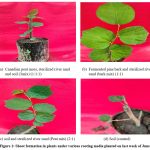 |
Figure 1: Shoot formation in plants under various rooting media planted on last week of June. |
Conclusion
The present research study provides preliminary results concerning growth of phalsa cuttings in different rooting media at various time intervals. Our findings suggest to multiply phalsa through cuttings at the last week of June. However, a declining trend in the vegetative growth was observed over time, more probably due to the change in climatic conditions. The outcomes suggest the soil to be a good option when mixed with other rooting media. Due to the differences in rooting success as affected by the rooting media and planting dates it is therefore recommended that rooting of the cuttings be optimized under both the factors before commercialization which needs further studies.
Acknowledgment
The authors are thankful to the Department of Horticulture, Khalsa College, Amritsar, India for the help and support rendered.
Funding Sources
The authors received no financial support for this research.
Conflict of Interest
The authors do not have any conflict of interest.
Data Availability Statement
This statement does not apply to this article.
Ethics Approval Statement
This research did not involve human participants, animal subjects, or any material that requires ethical approval.
Informed Consent Statement
This study did not involve human participants, and therefore, informed consent was not required.
Permission to reproduce material from other Sources
Not Applicable
Author,s Contribution
Amarjeet Kaur: Conceptualization of research work and Designing of work, Preparation of manuscript.
Krishankant Malgotra: Execution of field/Lab experiments and execution of data.
Amarjeet Kaur and Krishankant Malgotra: Analysis of data and interpretation Both authors read and approved the final manuscript.
References
- Pundlik, S.P. (2020). The study on proximate composition of different species of Genus Grewia from western Maharashtra. European Journal of Molecular and Clinical Medicine, 7, 3919-3924.
- Jyoti, S., Purwar, S., Chuhan, S.K. & Rai, G. (2015). Nutritional and medicinal potential of Grewia subinaequalis (syn. G. asiatica.) (Phalsa). Jounal of Medicinal Plant Research, 9: 594-612. https://doi.org/10.5897/jmpr2015.5724.
CrossRef - Jadhav, A.K.S.(2007). Study on propagation of Phalsa (Grewia subinaequalis) by cuttings. Ph.D. Thesis, Univ. of Agri. Sci., Dharwad.
- Hartmann, H.T., Kester, D.E., Davies, F.T .& Geneve, R.L. (1997). Plant propagation: principle and practices, 6:770-772.
- Bushal, R.C., Mizutani, F., Moon, D.G.,& Rutto, K.L.( 2001). Propagation of citrus by stem cuttings and seasonal variation in rooting capacity. Pakistan Journal of Biol ogical Sciences, 4(11), 1294-1298.
CrossRef - Bhardwaj, R.L .(2014). Effect of growing media on seed germination and seedling growth of papaya cv. ‘Red Lady’ African Journal of Plant Science, 8(4), 178-184.
CrossRef - Joshi, V., Ali, S.I., Kumar, A.K., Kumar, T.S., Kumar, B.N. (2020). Studies on effect of different concentrations of IBA and length of cuttings on rooting and shoot growth performance in dragon fruit (Hylocereus) -red flesh with pink skin under Telangana conditions. Pharma innovation Journal, 11, 738-743.
- Singh, K.K. & Chouhan, J.S. (2016). The effect of different times collecting cutting, growing conditions and auxin treatments of the rooting in Phalsa (Grewia Asiatica) Stem cutting under valley conditions of Garahwal. Plant Archives, 16(2),781-788.
- Biswas, C. & Mukherjee, B, (2009). Textbook of Soil Science, Tata McGraw-Hill Publishing Company Limited, New Delhi.
- Singh, K.K., Choudhary, T., Kumar, P.(2017). Effect of IBA concentrations of growth and rooting of Citrus limon cv. Pant Lemon cuttings. Hort Flora Research Spectrum 2, 268-270.
- Uddin, G., Pandith, S.A., Gupta, A.P., Chandra, S. & Sharma, N. (2017). Grewial in and Opttvanin new constituents from the stem bark of Grewia optiva Drummond ex Burret (Tiliaceae). Natural Products Research 27, 215-220 https://doi.org/10.1080/14786419. 2012.666749.
CrossRef - Kumar, G. & Rai, P.K. (2007). EMS induced karyomorphological variations in maize (Zea mays) inbreds. Turkish Journal of Biology, 31,187-195.
- Devidas, T., Sharad, T.,Sapre, S., & Nagesh, D. (2012). An efficient regeneration protocol for pomegranate (Punica granatum) cv Bhagwa from nodal and meristem explants. The Bioscan, 11(2), 230-232.
- Alikhani, L., Ansari, K., Jamnejad, M. & Tabatabaie, Z. (2011). The effect of different mediums and cuttings on growth and rooting of pomegranate cuttings. Iranian Journal of Plant Physiology, 1(3),199-203.
- Mabizela, G.S., Slabbert, M.M. & Bester, C.(2017). The effect of rooting media, plant growth regulators and clone on rooting potential of honeybush (Cyclopia subternata) stem cuttings at different planting dates. South African Journal of Botany,110, 75-79.
CrossRef - Akakpo, D.B., Amissah, N., Yeboah, J., & Blay, E. (2014). Effect of indole 3-butyric acid and media type on adventitious root formation in sheanut tree (Vitellaria paradoxaF. Gaertn.) stem cuttings. American Journal of Plant Sciences, 5, 313-318. 10.4236/ ajps.2014.53043.
CrossRef - Ahmed, Q.R., Adil ,A.M. & Jalal, A.J. (2019). Effect of IBA and Pine Bark as Media on the Rooting and Growth of Ficus Nitida. CPQ Nutrition, 3(3), 01-09.
- Ercisli, S., Celik, K. & Turgut, N. (2005). Some physical, pomological and nutritional properties of Kiwifruit cv. Hayward. International Journal of Food Science and Nutrition, 58(6), 411-413.
CrossRef - Abad, M., Noguera, V., Martinez, M.Z., Fornes, F. & Martinez, J. (2001). Physical and chemical prop-erties of sedge-based media and their relation to plant growth. Acta Horticulturae, 238, 45–56.
CrossRef - Shinji, N., Schelbert, S., Kanwischer, M., Goldschmidt, E.E., Dörmann, P. & Hörtensteiner, S. (2007). The chlorophyllases at CLH1 and at CLH2 are not essential for senescence-related chlorophyll breakdown in Arabidopsis thaliana. FEBS Letters. 581,5517–5525.doi: 10.1016/j.febslet.2007.10.060.
CrossRef - Afaf, P., Dreissen, A., Luo, F.L.,& Matsubara, S. (2012). Acclimatory responses of Arabidopsis to fluctuating light environment: comparison of different sunfleck regimes and accessions. Photosynthesis Research, 113,221–237.
CrossRef - Khan, M., Rozhon, W. & Poppenberger, B. (2016) .The role of hormones in the aging of plants a mini-review. Gerontology, 60,49–55. doi: 10.1159/000354334.
CrossRef - Satpal, Manju, Rawat, S.S. & Singh, K.K. (2014). Effect of various concentrations of IBA, type of cuttings and planting time on the rooting of cuttings of lemon. International Journal of Current Research, 6(12), 10974-10976.
- Yazıcı, K., Dal, B., Gozlekci, S., Kaynak, L.,& Ersoy, N. ( 2009). Effects of cutting type andduration time on rooting of three cherry laurel (Prunus laurocerasus) genotype. Acta Horticulturae, 818, 199-204.
CrossRef