


 PDF Downloads:
360
PDF Downloads:
360


Introduction
Forests are integral components of the global carbon cycle, playing a vital role in climate regulation through carbon sequestration.1 They act as carbon sinks by storing carbon in both aboveground and belowground biomass, thereby mitigating rising atmospheric CO₂ levels .2,3 In India, forests collectively hold an estimated 3 billion metric tons of carbon, representing approximately 40% of the country’s total carbon pool.4,5 The Indian Himalayan forests alone sequester nearly 65 million metric tonnes of carbon annually.6 Within this region, Uttarakhand forests contribute significantly, with an estimated 378.16 million tonnes of carbon stock across all carbon pools .7 Particularly, Community-managed forests, such as Van Panchayat Forests in Uttarakhand, are crucial for sustaining local livelihoods while maintaining ecosystem functions and biodiversity.8 Pine and oak dominate these forests, covering significant portions of the state’s land area and contributing substantially to regional carbon storage.
Forest biomass and productivity are key indicators of carbon sequestration potential. Biomass reflects the total dry matter of vegetation per unit area, while productivity measures the rate of dry matter accumulation over time. Variations in species composition, growth rates, and site conditions influence carbon accumulation, with fast-growing species sequestering more carbon than slow-growing species.9,10 Previous studies in Himalayan forests have highlighted substantial variability in biomass and carbon stocks, depending on species composition, forest type, and management practices.11,12
Van Panchayat Forests (VPFs) represent a unique and century-old model of community-based forest governance in Uttarakhand, where local villagers collectively manage forests for fuelwood, fodder, timber, and grazing needs. This strong livelihood dependence has resulted in continuous anthropogenic pressure, influencing forest structure, species composition, and regeneration patterns. Unlike state-managed forests, VPFs operate through a shared administrative mechanism between village committees and the Forest Department, making them a critical interface of local governance and natural resource management. Understanding biomass and carbon potential in these forests is therefore essential, not only in the context of climate change, but also to evaluate how community management, resource extraction, and local dependency shape forest productivity and carbon dynamics. This context underscores the necessity of the present study and strengthens the relevance of assessing pine- and oak-dominated VPFs under real socio-ecological conditions.
Despite the increasing research on Himalayan forests, there are limited studies that specifically compare biomass, productivity, and carbon sequestration between pine-dominated and oak-dominated Van Panchayat forests under similar management conditions. This gap hinders our understanding of how species composition affects carbon dynamics in community-managed systems. Consequently, this study hypothesises that pine-dominated Van Panchayat forests will have higher biomass, productivity, and carbon sequestration compared to oak forests, due to their faster growth rates and reduced extraction pressure.
Considering the increasing importance of forests in climate change mitigation and sustainable management, this study was undertaken to assess tree biomass, productivity, and carbon sequestration potential in pine and oak dominated Van Panchayat forests of Bageshwar, Kumaun Himalaya. The results are expected to provide baseline data for sustainable forest management and enhance understanding of the role of community-managed forests in regional carbon dynamics.
Materials and Methods
Study area description
The selected three forest sites were located in the Bageshwar district, 2246 km², and lie between 29º42′ to 30º48′ N latitude and 79º28′ to 80º01′ E longitude in Uttarakhand. The selected sites, i.e., Agar, Joshi Palari, and Bhatkhola van panchayat forests, are situated between 29°46′1.66″ and 29°47′6.07″ N latitude and 79°44′36″ and 79°56′24″ E longitude, at elevations ranging from 1460 m asl to 1800 m asl. The climate of the study area is subtropical, characterized by three distinct seasons: winter (November–February), summer (April–mid-June), and the rainy season (mid-June–mid-September). However, the months of October and March are transitional periods, known as autumn and spring, respectively. During the study period, the average monthly rainfall ranged from 1.2 mm in February to 307.5 mm in August (Figure 1). The annual average minimum and maximum temperatures ranged from 12.37 °C in January to 29.01 °C in July, respectively (Figure 1).
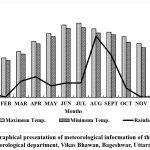 |
Figure 1: Graphical presentation of meteorological information of the study sites (source: Meteorological department, Vikas Bhawan, Bageshwar, Uttarakhand, India) |
Sampling Design
To assess biomass, carbon stock, and sequestration at each selected Van Panchayat forests (VPF’s) site, a systematic sampling approach was adopted. Two forest types, pine and oak-dominated VPFs, were chosen for biomass and carbon stock estimation. Vegetation analysis was first conducted to identify tree species, followed by measurements of tree density and diameter at breast height (DBH, taken at 1.37 m above ground level using a meter tape). The quadrat method was applied, with 10 × 10 m transects established in each forest site. Biomass estimation was carried out using allometric regression equations developed by previous researcher for oak-mixed forests.11,12 These equations were of the form y = a + b ln x, where y represents the dry weight of a component (kg), x represents the girth at breast height (DBH), a is the intercept, and b is the regression coefficient. The biomass of different components (bole, branch, twig, foliage, stump root, lateral root, and fine roots) was calculated in 2023 (B1) and in 2024 (B2). Component-wise biomass was calculated for each species and summed to obtain the total tree biomass per sites. To estimate tree productivity, 1ha plots were permanently marked at breast height and re-measured annually to record increments in diameter, which were then used to assess biomass accumulation for each component (ΔB = B₂ – B₁). Carbon stock and sequestration were subsequently determined by multiplying the biomass values by a carbon conversion factor of 0.475.13 The total carbon stock was obtained by summing the carbon values of all tree components.
Statistical analysis
The collected data from each Van Panchayat forest were analyzed using SPSS (version 16) and Microsoft Excel 2021. ANOVA was conducted to assess the variation in tree components across the sites. A 95% confidence interval was used to determine the statistical significance of differences.
Results
Present study findings of biomass, productivity, Carbon stock, and carbon sequestration of VPF’s were assessed at three forest sites located in the Bageshwar district of Uttarakhand. These results highlight the critical role of Van Panchayat forests in carbon sequestration and climate change mitigation. Despite non-significant differences among sites (biomass: F=4.388, p>0.05; carbon stock: F=4.440, p>0.05; productivity: F=1.377, p>0.05; carbon sequestration: F=1.435, p>0.05) (Table 5), observed trends indicate that mature and well-managed stands have higher carbon storage potential. Effective community-based management can further enhance carbon stocks and ecosystem services in these forests. The forest tree biomass across the Van Panchayat Forests ranged from 119.8 to 238.1 t ha⁻¹. Of this, aboveground biomass accounted for 77 to 82%, while the below-ground biomass shared 18-23% (Table 3). Among the studied VPFs, the highest biomass was 238.14 t ha⁻¹ for Agar village site, followed by Joshi Palari VPF’s (228.6 t ha⁻¹) and Bhatkhola VPF’s (119.8 t ha⁻¹) (Table 1). The relative contribution of tree biomass components across the VPF sites ranged from 42.1-54.1% for bole, 17.8-19.1% for branches, and 14.8-18.76% stump roots (Table 1).
Table 1: Component-wise tree biomass and productivity of van panchayat forests.
| Tree Component | Biomass storage | ΔB (Productivity)(t ha-1) | |
| B1 (Initial Biomass)(t ha⁻¹) | B2 (Biomass After increment) (t ha⁻¹) | ||
| 1. Van Panchayat Forests (Agar Village) | |||
| Bole | 128.75 (54.06) | 131.64 (54.2) | 2.886 |
| Bole bark | 0.28 (0.12) | 0.29 (0.12) | 0.01 |
| Branches | 43.41 (18.22) | 44.4 (18.28) | 0.988 |
| Twig/Cone | 10.85 (4.56) | 10.98 (4.52) | 0.136 |
| Foliage | 11.59 (4.87) | 11.78 (4.85) | 0.19 |
| Stump root | 35.11 (14.76) | 35.77 (14.73) | 0.66 |
| Lateral Root | 7.34 (3.09) | 7.5 (3.09) | 0.16 |
| Fine root | 0.79 (0.33) | 0.81 (0.33) | 0.02 |
| 2. Van panchayat forests (Joshi Palari Village) | |||
| Bole | 96.14 (42.1) | 102.86 (42.07) | 6.725 |
| Bole bark | 0.24 (0.11) | 0.32 (0.13) | 0.12 |
| Branches | 43.69 (19.13) | 47.55 (19.45) | 3.864 |
| Twig/Cone | 14.38 (6.3) | 14.87 (6.08) |
0.923 |
| Foliage | 20.98 (9.19) | 22.91 (9.37) | 1.971 |
| Stump root | 42.85 (18.76) | 45.46 (18.59) | 2.61 |
| Lateral Root | 9.28 (4.06) | 9.78 (4) | 0.5 |
| Fine root | 1.05 (0.46) | 1.08 (0.44) | 0.03 |
| 3. Van panchayat forests (Bhatkhola village) | |||
| Bole | 60.69 (51.14) | 62.24 (51.22) | 1.546 |
| Bole bark | 1.16 (0.97) | 1.16 (0.95) | 0.045 |
| Branches | 21.17 (17.84) | 21.64 (17.81) | 0.488 |
| Twig/Cone | 5.75 (4.85) | 5.8 (4.77) | 0.066 |
| Foliage | 5.99 (5.04) | 6.1 (5.02) | 0.11 |
| Stump root | 19.31 (16.27) | 19.69 (16.2) | 0.38 |
| Lateral Root | 4.99 (4.21) | 5.08 (4.18) | 0.09 |
| Fine root | 0.78 (0.66) | 0.97 (0.8) | 0.19 |
(Note: value in parenthesis are in percentage)
The carbon stock of trees in Van Panchayat Forests (VPFs) varied among forest sites. It ranged from 56.9 to 113.1 t C ha⁻¹ (Table 2). Of this, the aboveground carbon stock accounted for 77 to 82%, while the below-ground carbon stock shared 18-23% (Table 3). Among the VPFs, the highest carbon stock was (113.1 t C ha⁻¹ for Agar village, followed by Joshi Palari (108.6 t C ha⁻¹) and Bhatkhola (56.9 t C ha⁻¹; 1.4 t C ha⁻¹ yr⁻¹). The relative contribution of tree carbon stock across sites ranged from 42.09–54.1% for bole, 17.8–19.1% for branches, 14.8–18.8% for stump root, 4.9–9.2% for foliage, and 4.5–6.3% for twigs/cones (Table 2).
Table 2: Component-wise tree carbon stock and carbon sequestration of van panchayat forests.
| Tree Component | Carbon Content | ΔC (Sequestration) (t C ha-1 yr-1) | |
| C1 (Initial Carbon Stock)(t C ha⁻¹) | C2 (Final Carbon stock)(t C ha⁻¹) | ||
|
1. Van Panchayat Forests (Agar Village) |
|||
| Bole | 61.16 (54.12) | 62.54 (54.17) | 1.38 |
| Bole bark | 0.13 (0.12) | 0.14 (0.12) | 0.01 |
| Branches | 20.63 (18.25) | 21.1 (18.28) | 0.5 |
| Twig/Cone | 5.16 (4.57) | 5.23 (4.53) | 0.12 |
| Foliage | 5.51 (4.88) | 5.61 (4.86) | 0.16 |
| Stump root | 16.67 (14.75) | 17 (14.73) | 0.33 |
| Lateral Root | 3.49 (3.09) | 3.57 (3.09) | 0.08 |
| Fine root | 0.39 (0.35) | 0.39 (0.34) | 0.001 |
| 2. Van Panchayat Forests (Joshi Palari Village) | |||
| Bole | 45.66 (42.09) | 48.87 (42.04) | 3.21 |
| Bole bark | 0.12 (0.11) | 0.13 (0.11) | 0.01 |
| Branches | 20.76 (19.14) | 22.46 (19.32) | 1.71 |
| Twig/Cone | 6.83 (6.3) | 7.31 (6.29) | 0.48 |
| Foliage | 9.98 (9.2) | 10.87 (9.35) | 0.89 |
| Stump root | 20.35 (18.76) | 21.59 (18.57) | 1.24 |
| Lateral Root | 4.4 (4.06) | 4.64 (3.99) | 0.24 |
| Fine root | 0.5 (0.46) | 0.51 (0.44) | 0.01 |
| 3. Van Panchayat Forests (Bhatkhola village) | |||
| Bole | 28.83 (51.15) | 29.57 (51.24) | 0.74 |
| Bole bark | 0.55 (0.98) | 0.55 (0.95) | 0.001 |
| Branches | 10.05 (17.83) | 10.28 (17.81) | 0.23 |
| Twig/Cone | 2.73 (4.84) | 2.76 (4.78) | 0.03 |
| Foliage | 2.84 (5.04) | 2.89 (5.01) | 0.05 |
| Stump root | 9.18 (16.29) | 9.35 (16.2) | 0.17 |
| Lateral Root | 2.36 (4.19) | 2.41 (4.18) | 0.05 |
| Fine root | 0.37 (0.66) | 0.45 (0.78) | 0.08 |
(Note: values in parentheses are in percentage)
Table 3: Total biomass, productivity, carbon stock, and carbon sequestration in van panchayat forests.
| Tree Component | Biomass storage |
Productivity (t ha⁻¹) |
Carbon Content | Carbon Sequestration
(t C ha-1 yr-1) |
||
| Above Ground
(t ha⁻¹) |
BelowGround
(t ha⁻¹) |
AboveGround
(t C ha⁻¹) |
BelowGround
(t C ha⁻¹) |
|||
| 1. Van Panchayat Forests (Agar Village) | 194.89 (81.83) | 199.09 (81.87) | 4.21 (83.36) | 92.59 (81.93) | 94.62 (81.96) | 2.03 (83.19) |
| 43.25 (18.16) | 44.08 (18.12) | 0.84(16.81) | 20.55 (18.19) | 20.96 (18.16) | 0.41(16.80) | |
| Total | 238.14 | 243.17 | 5.05 | 113.14 | 115.58 | 2.44 |
| 2. Van Panchayat Forests (Joshi Palari Village) | 175.42 (76.74) | 188.51 (76.99) | 13.6 (83.79) | 83.35 (76.83) | 89.64 (77.11) | 6.38 (81.06) |
| 53.17 (23.25) | 56.31 (23.00) | 3.14 (19.34) | 25.25 (23.28) | 26.74 (23) | 1.49 (18.93) | |
| Total | 228.59 | 244.82 | 16.23 | 108.6 | 116.04 | 7.87 |
| 3. Van Panchayat Forests (Bhatkhola village) | 94.76 (79.06) | 96.93 (79.01) | 2.17 (76.67) | 45 (79.84) | 46.05 (79.8) | 1.05 (78.72) |
| 25.09 (20.93) | 25.75 (20.98) | 0.66 (23.32) | 11.91 (21.13 | 12.21 (21.16) | 0.31 (21.99) | |
| Total | 119.85 | 122.68 | 2.83 | 56.91 | 58.26 | 1.41 |
(Note: values in parentheses are in percentage)
Disscussion
The present biomass values of VPF’s fall within the values 159.4–298.0 t ha⁻¹ reported for pine forests14 and 50.64–514.97 t ha⁻¹ of western Himalaya,15 but lower side than the values of 246.1–440.8 t ha⁻¹ reported fort natural forests of Kumaun Himalaya16 and 256.8–437.0 t ha⁻¹ of protected reserve forests Uttarakhand,17 387.3 t ha⁻¹ of oak forests,11 and 481.05–568.99 t ha⁻¹ oak forests of Kumaun Himalaya.18 However, present values are on the higher side than the 81.2 t ha⁻¹ reported for pine forests9 and 283.4 t ha⁻¹ for oak forests14 (Table 4). The variation in biomass values among other forest types indicated that this forest vegetation was located in different geographical areas with varying tree species compositions, as well as different management inputs and stakeholder ownership of forests. Ecologically, lower biomass in VPFs suggests reduced standing carbon reserves, which may make these forests more vulnerable to disturbances such as fire, soil erosion, and reduced habitat quality. From a management perspective, this highlights the need for controlled harvesting, enrichment planting, and reduced biomass extraction to enhance long-term forest resilience and carbon retention.
The productivity of the studied Van Panchayat Forests ranged from 2.8 to 16.2 t ha⁻¹ yr⁻¹ (Table 1). The highest productivity was recorded in 16.23 t ha⁻¹ yr⁻¹ for Joshi Palari village, 5.05 t ha⁻¹ yr⁻¹ for Agar village and 2.83 t ha⁻¹ yr⁻¹ for Bhatkhola village. The productivity values align with those observed in 5.68 to 9.04 t ha⁻¹ yr⁻¹ for pine forests in the Kumaun Himalaya.19 Similarly, the productivity value falls within the lower ranges reported for pine and oak forests16,20 (6.5–12.8 t ha⁻¹ yr⁻¹; 10.1 t ha⁻¹ yr⁻¹) (Table 4). However, the present productivity values are lower than those of the mixed oak forests18 (16.9–20.8 t ha⁻¹ yr⁻¹) (Table 4). The study revealed considerable variation in productivity across different VPFs, primarily influenced by tree species composition, stand age, and density. The Agar VPFs were dominated by pine, while the Bhatkhola VPFs comprised mainly conifers, such as pine and deodar. In contrast, the Joshi Palari VPFs, which recorded the highest productivity, were dominated by oak along with several associated broadleaf species. Oak forests are ecologically more productive due to faster nutrient cycling and greater litter decomposition, and they also provide multiple ecosystem services, including fuel, fodder, and a wide range of non-timber forest products (NTFPs).21 Due to these livelihood benefits, local communities often demonstrate a more substantial commitment to conserving and managing oak-dominated forests compared to coniferous stands. This ecological and socio-economic interplay explains the higher productivity observed in Joshi Palari relative to the other sites.
The carbon sequestration of Van Panchayat Forests ranged from 1.41 to 7.9 t C ha⁻¹ yr⁻¹ (Table 2). The highest carbon sequestration was 7.9 t C ha⁻¹ yr⁻¹ for Joshi Palari village, 2.4 t C ha⁻¹ yr⁻¹ for Agar village, and 1.4 t C ha⁻¹ yr⁻¹ for Bhatkhola village (Table 2). The present carbon stock values of Van Panchayat Forests (VPFs) fall within the range reported for different Himalayan forests. Present values are lower than 81.2–302.9 t C ha⁻¹ and 122-207 t C ha⁻¹ respectively, reported for Pine forests.9,17 While present values are lower than 50.64–568.99 t C ha⁻¹ and 228.50-270.27 t Cha⁻¹ for oak forests11,18 (Table 4). However, somewhat similar to 106.3 t C ha⁻¹ reported for pine forests of the region.20 The carbon sequestration value fall within the range 7.9-9.9 t C ha⁻¹ yr⁻¹ reported for oak forests,18 but higher than 3.99-4.83 t C ha⁻¹ yr⁻¹, 3.1 -6.1 t C ha⁻¹ yr⁻¹, and 2.64 -3.9 t C ha⁻¹ yr⁻¹ reported for pine forests in Kumaun Himalaya20,16,19 (Table 4).
Table 4: Comparisons of dry matter production and carbon parameters with other forest vegetation of the region and elsewhere.
| Forests | Tree Biomass (t ha⁻¹) | Productivity (t ha-1) | Carbon Stock (t C ha⁻¹) | Carbon Sequestration (t C ha-1 yr-1) | References |
| Oak forest | 387.3 | – | 50.64-568.99 | – | 11 |
| Oak forest | 159.3-298.0 | – | 73.30-137.10 | – | 20 |
| Pine Natural Forest | 246.1-440.8 | 6.5-12.8 | – | 3.1-6.1 | 16 |
| Oak forests | – | 5.68-9.04 | – | 2.64-3.9 | 19 |
| Oak forest | 283.4 | – | – | – | 14 |
| Oak dominated forest | 481.05-568.99 | 16.9-20.8 | 228.50-270.27 | 7.9-9.9 | 18 |
| Pine forest | – | 10.17 | 106.3 | 3.99-4.83 | 20 |
| Pine forest | 81.2 | – | 81.2-302.9 | – | 9 |
| Pine forest | 50.64-514.97 | – | 22.78-233.03 | – | 15 |
| Pine Reserve Forest | 256.8-437.0 | – | 122-207 | – | 17 |
The variation in carbon stock and sequestration across the studied Van Panchayat Forests (VPFs) can be attributed to differences in species composition, tree density, and community management practices, as well as resource extraction by villagers. Higher sequestration in oak-dominated sites reflects greater net biomass accumulation, indicating their potential role as priority zones for climate mitigation initiatives such as carbon credit programs. Conversely, lower carbon stock in Bhatkhola suggests that continued biotic pressure could lead to long-term declines in carbon storage capacity, necessitating stricter grazing controls, community monitoring, and restoration activities. Thus, the increasing pressure on VPFs not only impacts dry matter production but also reduces the rate of carbon sequestration in oak and pine forests.
Table 5: Analysis of variance (ANOVA) for different tree parameters
| ANOVA | |||
| Parameter | Mean Square | F | Sig. |
| Biomass | 8827.278 | 4.388 | .067ns |
| Carbon stock | 2015.639 | 4.440 | .066 ns |
| Productivity | 24.138 | 1.377 | .322 ns |
| Carbon sequestration | 5.604 | 1.435 | .310 ns |
ns=not significant, Significant level p= <0.05.
Conclusion
The present study highlights that the Van Panchayat Forests (VPFs) of the Kumaun Himalaya exhibit considerable variation in biomass, productivity, and carbon sequestration, primarily governed by species composition, stand characteristics, and management practices. Oak forests, such as Joshi Palari, demonstrated higher productivity and carbon sequestration owing to faster nutrient cycling, efficient litter decomposition, and the provision of multiple ecosystem services, including fuel, fodder, non-timber forest products (NTFPs), water conservation, and biodiversity support. In contrast, pine forests exhibited relatively lower productivity and sequestration potential, further constrained by anthropogenic pressures such as grazing, fuel wood, fodder extraction, and litter removal. Despite the absence of formal government-supported schemes like JFM, FDA, CAMPA, or JYACA, traditional community management practices have played a crucial role in sustaining these ecosystems. Overall, the findings underscore the ecological and socio-economic importance of oak-based VPFs, while also emphasizing the need for site-specific, sustainable management interventions and enhanced community participation to reduce anthropogenic pressures. Such measures can further strengthen the role of VPFs in mitigating climate change and sustaining rural livelihoods in the Himalayan region.
Acknowledgement
I am grateful to Dr. L. S. Lodhiyal from the Department of Forestry and Environmental Science for his valuable guidance and encouragement. I also extend my gratitude to the village Sarpanch for granting permission to conduct research in the community forest.
Funding Sources
The author(s) received no financial support for the research, authorship, and/or publication of this article.
Conflict of Interest
The authors do not have any conflict of interest.
Data Availability Statement
The manuscript incorporates all datasets produced or examined throughout this research study.
Ethics Statement
This research did not involve human participants, animal subjects, or any material that requires ethical approval.
Informed Consent Statement
This study did not involve human participants, and therefore, informed consent was not required.
Permission to reproduce material from other sources
This study did not reproduce material from other sources, and therefore, permission was not required.
Author Contributions
Inder Singh Rautela: Conceptualization, Methodology, Data Collection, Analysis, Writing – Original Draft.
Laxman Singh Lodhiyal: Supervision, Validation, Review & Editing.
Neelu Lodhiyal: Methodology, Visualization, Review & Editing
Yumnam Johnson Singh: Data Curation, Formal Analysis, and Technical Support.
References
- Hurteau M. D. The role of forests in the carbon cycle and in climate change. In: Climate Change. Elsevier; 2021:561-579. doi:10.1016/B978-0-12-821575-3.00027-X
CrossRef - Srivastava P., Kumar A., Behera S. K, Sharma Y. K, Singh N. Soil carbon sequestration: An innovative strategy for reducing atmospheric carbon dioxide concentration. Biodivers Conserv. 2012;21(5):1343-1358.
CrossRef - Malhi Y., Franklin J., Seddon N., et al. Climate change and ecosystems: threats, opportunities, and solutions. Philos Trans R Soc B. 2020;375(1794):20190104.
CrossRef - Verma P., Ghosh K. P. REDD+ strategy for forest carbon sequestration in India. Holist Approach Environ. 2022;12(3):117-130.
CrossRef - Bherwani H., Banerji T., Menon R. Role and value of urban forests in carbon sequestration: review and assessment in Indian context. Environ Dev Sustain. 2024;26(1):603-626.
CrossRef - Gauni N., Ram J., Lodhiyal L. S. Carbon dynamics in community-managed forests across an altitudinal gradient in Central Himalaya, India. Indian J Ecol. 2025;52(4):701-707.
- Bisht N., Lodhiyal L. S., Lodhiyal N. Stand structure, species richness, and diversity of community forests with reference to the soil characteristics in Western Himalaya, India. Indian J Ecol. 2025;52(4):675-687.
- Vashum K. T., Jayakumar S. Methods to estimate above-ground biomass and carbon stock in natural forests: a review. J Ecosyst Ecogr. 2012;2(4):1-7.
CrossRef - Kumar M., Kumar A., Kumar R., et al. Carbon stock potential in Pinus roxburghii forests of Indian Himalayan regions. Environ Dev Sustain. 2021;23(8):12463-12478.
CrossRef - Lodhiyal N., Lodhiyal L. S. Tree layer composition and carbon content of oak and pine in Lohaghat forest of Kumaun Himalaya. J Plant Dev Sci. 2012;4(1):55-62.
- Rawat Y. S, Singh J. S. Structure and function of oak forests in Central Himalaya I: dry matter dynamics. Ann Bot. 1988;62(4):397-411.
CrossRef - Adhikari B. S., Rawat Y. S., Singh S. P. Structure and function of high-altitude forest of Central Himalaya I: dry matter dynamics. Ann Bot. 1995;75:237-248.
CrossRef - Magnussen S., Reed D. Modeling for estimation and monitoring. FAO–IUFRO; 2004.
- Sharma C. M., Tiwari O. P., Rana Y. S., Krishan R., Mishra A. K. Plant diversity, tree regeneration, biomass production, and carbon storage in different oak forests on ridge tops of Garhwal Himalaya. J For Environ Sci. 2016;32(4):329-343.
CrossRef - Haq S. M., Rashid I., Waheed M., Khuroo A. A. From forest floor to tree top: partitioning of biomass and carbon stock in multiple strata of forest vegetation in Western Himalaya. Environ Monit Assess. 2023;195(7):812.
CrossRef - Pant H., Tewari A. Carbon sequestration potential of chir pine (Pinus roxburghii) forest on two contrasting aspects in Kumaun Central Himalaya between 1650–1860 m elevation. Appl Ecol Environ Sci. 2013;1(6):110-112.
CrossRef - Upadhyay G., Tewari L. M., Tewari A, et al. Species diversity, biomass production, and carbon sequestration potential in the protected area of Uttarakhand, India. 2025;14(2):291.
CrossRef - Lal B.., Lodhiyal L S. Stand structure, productivity, and carbon sequestration potential of oak-dominated forests in Kumaun Himalaya. Curr World Environ. 2016;11(2):466.
CrossRef - Gosain B. G., Negi G. C., Dhyani P. P., Bargali S. S., Saxena R. Ecosystem services of forests: carbon stock in vegetation and soil components in a watershed of Kumaun Himalaya, India. Int J Ecol Environ Sci. 2015;41(3-4):177-188.
- Joshi V. C., Sundriyal R. C., Arya D. Forest floor diversity, distribution and biomass pattern of oak and chir-pine forest in the Indian Western Himalaya. Indian J Ecol. 2021;48(1):232-237.
- Naudiyal N., Schmerbeck J. The changing Himalayan landscape: pine–oak forest dynamics and the supply of ecosystem services. J For Res. 2017;28(3):431-443.
CrossRef