


 PDF Downloads:
386
PDF Downloads:
386


Introduction
India is one of the world’s leading agricultural-oriented countries, with a large portion of its population involved in the field of agriculture and associated. The widespread use of chemical pesticides in modern agriculture has significantly increased crop productivity and reduced post-harvest losses.1 However, the indiscriminate and sometimes unregulated use of pesticides, especially organochlorine pesticides, has raised serious environmental and public health concerns.2 Organochlorine pesticides (OCPs), including aldrin, dieldrin, heptachlor, and the benzene hexachloride (BHC) isomers persist in environmental matrices for extended periods and progressively build up in living organisms, posing toxic risks to humans and other unintended species.3,4 Although their application has been globally restricted through agreements like the Stockholm Convention, measurable residues continue to appear in food commodities from several developing regions due to inadequate implementation of pesticide regulatory policies. 5-7 Several studies have reported the continued presence of these residues in agricultural produce across different regions of India.8,9 Their lipophilic nature allows them to accumulate in fatty tissues, making even trace levels dangerous with chronic exposure.10
The consumption of fruits and vegetables contaminated with OCPs may trigger severe health concerns, including hormonal imbalance, neurotoxic responses, reproductive impairments, and possible carcinogenic outcomes.11,12 Young children exhibit heightened vulnerability because their physiological systems are still developing and their dietary intake relative to body weight is higher.13
This study involves the determination of concentrations of twenty organochlorine pesticides in widely consumed summer-season fruits and vegetables sourced from local markets of Agra. Residue quantification was carried out using GC-ECD, an analytical method known for its excellent sensitivity and selectivity toward halogenated pesticides and its suitability for food residue determination.14,15 Additionally, dietary exposure risks were evaluated through calculations of EDI, ADI, HQ, and HI to gauge the possible non-carcinogenic effects associated with long-term consumption, thereby establishing a comprehensive framework for evaluating consumer risk.16,17
This research is significant in identifying contamination patterns in fresh produce and contributes to national and international efforts to regulate pesticide use, promote safe agricultural practices, and inform public health policies.18,19
Materials and Methods
Chemicals and Standards
All solvents employed in the analytical procedures—n-hexane, acetone, acetonitrile, and dichloromethane were of AR grade and procured from Merck, India. Activated charcoal, silica gel, Florisil and anhydrous sodium sulfate were purchased from Fisher Scientific, United Kingdom. Highly pure chemicals and reagents were selected and procured to ensure accuracy and reliability of the analyses. Certified mixed standards of the twenty targeted OCPs were procured from RESTEK (USA) and preserved under recommended storage conditions. All analytical chemicals and reagents were maintained as per supplier guidelines to ensure quality and stability.
Sample Collection and Preparation
Total eight fresh samples were collected during the peak summer months (April–June 2023) from different local markets of Agra, Uttar Pradesh. The sampling included five fruits—pineapple (Ananas comosus), apricot (Prunus armeniaca), peach (Prunus persica), Sweet lime (Citrus limetta), and lime (Citrus aurantifolia)—along with three vegetables: green chilli (Capsicum annuum), capsicum (Capsicum annuum var. grossum), and okra (Abelmoschus esculentus). Around 250 g of each sample were taken in clean polyethylene bags, and then transported to the lab, where they were refrigerated at 5 °C prior to analysis. Before extraction, samples were then washed with tap water for a few minutes, dried with the help of filter paper, and finally chopped into small pieces.
Extraction from Fruits
Extraction of pesticides from all fruits was done using a modified method described in previous studies.20 Approximately 50 g of fruit sample was ground into a fine paste using a blender and then thoroughly mixed with 50 mL of acetonitrile. This method was then again done three times to ensure complete extraction of the mixture. The acetonitrile extract was filtered using a Buchner funnel to remove all residues. The filtrate obtained was concentrated under reduced pressure to nearly 5 mL and subsequently shifted into a separating funnel. 150 mL saline solution 2% (w/v) was added after that dichloromethane (3 × 50 mL) was added to separate the concentrated extract using a liquid-liquid partitioning process. The dichloromethane layers were then separated collected and passed through a layer of 5 g Na2SO4 to absorb the remaining water content. Next, a rotary evaporator was used to evaporate the dichloromethane extract to a volume of 2-5 ml. Finally, the concentrated residue was reconstituted using hexane–acetone mixture (9:1, v/v) of 10 mL
Extraction from Vegetables
Pesticide residues were extracted from each vegetable sample following a modified standard extraction procedure.21,22 Approximately 25 g of homogenized vegetable sample was mixed with 15 g of anhydrous Na2SO4 to remove moisture. The mixture was then extracted using 50 mL of acetone on a mechanical shaker for 1 hour to ensure efficient release of pesticide residues. The supernatant was collected under vacuum, and the extraction was repeated three times to ensure optimal residue extraction. The pooled extracts were reduced to roughly 50 mL using a rotary evaporator, followed by liquid–liquid partitioning with n-hexane in a 500 mL separating funnel. The extract was isolated and then filtered through anhydrous Na2SO4 to eliminate any remaining moisture. This layer was then evaporated to approximately 10 mL.
Purification Process
The collected samples were subjected to a purification process using columns filled with a mixture of a mixture of silica gel and activated charcoal in a weight ratio of 5:1. The extract was purified by eluting with 50 mL of n-hexane to facilitate the removal of impurities. After elution, the solvent was evaporated until the volume was approximately 5 ml. These concentrated extracts were transferred to GC vials for organochlorine pesticide determination.
Instrumental Analysis
The chromatographic separation was done by using an Agilent 7890A GC system fitted using a 63Ni ECD detector equipped with HP-5 capillary column (30 m lgth, 0.25 mm with interior diameter, 0.25 µm film width). In the oven the temperature program was started at 150 °C for the initial one minute, and then gradually increased to 280 °C at a rate of 10 °C per minute, and the closing temperature was held constant for another 10 minutes. Nitrogen gas act as the carrier as well as the make-up gas, maintaining a steady flow of 30 mL/min throughout the run. The temperatures of both the injector and the detector were maintained at 250 °C during analysis. Extract of every sample (2 µL portion) was inserted in split less mode, which helped in achieving better detection of trace-level residues.
Health Risk Assessment
Non-carcinogenic health hazards were evaluated through the Hazard Index (HI), which indicates the combined exposure to multiple pesticide residues present in a single sample. HI values were derived by adding the individual hazard quotients (HQ = EDI/ADI) corresponding to each OCP detected. An HI greater than 1 implies a potential risk of negative health implications.
Results
The chromatographic analysis of the organochlorine pesticide (OCP) standard revealed 20 distinct peaks with well-resolved retention times, confirming the identity and separation efficiency of the compounds. Retention times ranged from 7.192 minutes for α-BHC to 26.777 minutes for Endrin Ketone. All pesticides showed a concentration near 200 µg/mL, indicating accurate standard preparation and instrument calibration. Notably, Endrin (114,555,679 area units) and Dieldrin (112,523,650) exhibited the highest peak areas, reflecting strong detector responses. This standardized chromatogram serves as a reference for comparison with fruit and vegetable samples, validating the method’s capability to simultaneously quantify multiple OCPs using GC-ECD with high sensitivity.
Table 1. Details the peak characteristics, retention times, peak areas, and concentrations for the OCP standard mixture.
|
Peaks |
Targeted Pesticides |
Ret. time |
Area |
Concentration (µg/mL) |
|
Hexachlorocyclohexane group (HCH isomers): |
||||
|
1 |
α-BHC |
7.192 |
7690122 |
200.4 |
|
2 |
γ-BHC |
8.396 |
1481212 |
200.0 |
|
3 |
β-BHC |
9.696 |
5069241 |
199.9 |
|
4 |
δ-BHC |
10.580 |
65952153 |
200.8 |
|
Cyclodiene Series: |
||||
|
5 |
Heptachlor |
11.876 |
44732994 |
200.8 |
|
6 |
Aldrin |
12.011 |
62032860 |
200.4 |
|
7 |
Heptachlor-epoxide |
13.424 |
63775778 |
200.0 |
|
8 |
γ-chlordane |
15.152 |
61627749 |
200.4 |
|
9 |
α-chlordane |
16.748 |
78485930 |
200.0 |
|
10 |
Dieldrin |
20.273 |
112523650 |
200.3 |
|
11 |
Endrin |
21.468 |
114555679 |
200.0 |
|
12 |
Endrin aldehyde |
23.373 |
59739640 |
200.0 |
|
13 |
Endrin Ketone |
26.777 |
64579094 |
200.4 |
|
DDT-Derived metabolites: |
||||
|
14 |
4,4’-DDE |
19.681 |
76999753 |
200.0 |
|
15 |
4,4’-DDD |
22.384 |
64014262 |
200.0 |
|
16 |
4,4’-DDT |
23.641 |
56737299 |
200.0 |
|
Other organochlorines: |
||||
|
17 |
Endosulfan-I |
18.571 |
63961322 |
200.0 |
|
18 |
Endosulfan-II |
22.951 |
70030191 |
200.0 |
|
19 |
Endosulfan sulfate |
24.746 |
71908605 |
200.3 |
|
20 |
Methoxychlor |
25.042 |
62186776 |
200.4 |
Estimation of Organochlorine Pesticide Levels in Selected Fruit and Vegetable Samples
Out of the twenty targeted organochlorine pesticides (OCPs), only a subset was detected in the analyzed summer season produce. The detected compounds included γ-BHC, β-BHC, α- chlordane, γ-chlordane, endosulfan-I, methoxychlor, heptachlor, and aldrin. The residue levels varied depending on the commodity type, with certain fruits and vegetables showing higher contamination levels than others.
Among the fruits, apricot showed the highest diversity of pesticide residues, with measurable amounts of γ-BHC (0.0056 µg/µL), β-BHC (0.00096 µg/µL), α-chlordane (0.000043 µg/µL), endosulfan-I (0.0104 µg/µL), methoxychlor (0.000014 µg/µL), aldrin, and heptachlor. Peach and Sweet lime also exhibited detectable concentrations of endosulfan-I and α-chlordane, while lime was found to contain γ-BHC, β-BHC, and endosulfan-I. Pineapple presented relatively lower contamination, with γ-BHC and endosulfan-I as the only detected compounds.
Table 2: Detected Organochlorine Pesticides and Concentration (mg/kg) of OC Pesticides residues in summer season Fruit samples by using GC-ECD.
|
Pesticides |
Pineapple |
Apricot |
Peach |
Sweet lime |
Lime |
MRL |
|
Hexachlorocyclohexane group (HCH isomers): |
||||||
|
α-BHC |
“0” |
“0” |
“0” |
“0” |
“0” |
1.0 |
|
γ-BHC |
0.00341 |
0.00564 |
“0” |
“0” |
0.00428 |
1.0 |
|
β-BHC |
“0” |
0.00095 |
“0” |
“0” |
0.00062 |
1.0 |
|
δ-BHC |
“0” |
“0” |
“0” |
“0” |
“0” |
1.0 |
|
Cyclodiene Series: |
||||||
|
Heptachlor |
“0” |
0.00005 |
“0” |
“0” |
“0” |
0.05 |
|
Aldrin |
“0” |
0.000009 |
“0” |
“0” |
“0” |
0.10 |
|
Heptachlor-epoxide |
“0” |
“0” |
“0” |
“0” |
“0” |
0.05 |
|
γ-chlordane |
“0” |
“0” |
“0” |
“0” |
“0” |
0.1 |
|
α-chlordane |
0.00001 |
0.00004 |
0.000009 |
0.00001 |
0.00013 |
0.1 |
|
Dieldrin |
“0” |
“0” |
“0” |
“0” |
“0” |
0.1 |
|
Endrin |
“0” |
“0” |
“0” |
“0” |
“0” |
0.05 |
|
Endrin aldehyde |
“0” |
“0” |
“0” |
“0” |
“0” |
0.05 |
|
Endrin ketone |
“0” |
“0” |
“0” |
“0” |
“0” |
0.05 |
|
DDT-Derived metabolites: |
||||||
|
4,4’-DDE |
“0” |
“0” |
“0” |
“0” |
“0” |
– |
|
4,4’-DDD |
“0” |
“0” |
“0” |
“0” |
“0” |
– |
|
4,4’-DDT |
“0” |
“0” |
“0” |
“0” |
“0” |
– |
|
Other organochlorines: |
||||||
|
α-Endosulfan or (Endosulfan-I) |
0.00631 |
0.01040 |
0.00761 |
0.00285 |
0.00698 |
2.0 |
|
β-Endosulfan or (Endosulfan-II) |
“0” |
“0” |
“0” |
“0” |
“0” |
2.0 |
|
Endosulfan sulfate |
“0” |
“0” |
“0” |
“0” |
“0” |
2.0 |
|
Methoxychlor |
“0” |
0.00001 |
0.00002 |
“0” |
“0” |
– |
|
“0”: Not Detected |
||||||
Among the vegetables, okra was the most contaminated, with a significantly high concentration of endosulfan-I (0.0314 µg/µL) and notable levels of α-chlordane and methoxychlor. Capsicum contained endosulfan-I (0.0072 µg/µL) and α-chlordane, while green chillies had traces of γ-chlordane, endosulfan-I, and methoxychlor.
Table 3: Detected organochlorine Pesticides and Concentration (mg/kg) of OCPs residues in summer season Vegetable samples by using GC-ECD.
|
Pesticides |
Green chilli |
Shimla mirch |
Okra |
MRL |
|
Hexachlorocyclohexane group (HCH isomers): |
||||
|
α-BHC |
“0” |
“0” |
“0” |
0.02 |
|
γ-BHC |
“0” |
“0” |
“0” |
0.02 |
|
β-BHC |
“0” |
“0” |
“0” |
0.02 |
|
δ-BHC |
“0” |
“0” |
“0” |
1.00 |
|
Cyclodiene Series: |
||||
|
Heptachlor |
“0” |
“0” |
“0” |
0.02 |
|
Aldrin |
“0” |
“0” |
“0” |
0.05 |
|
Heptachlor-epoxide |
“0” |
“0” |
“0” |
0.02 |
|
γ-chlordane |
0.000005 |
“0” |
“0” |
– |
|
α-chlordane |
“0” |
0.000009 |
0.00001 |
– |
|
Dieldrin |
“0” |
“0” |
“0” |
0.05 |
|
Endrin |
“0” |
“0” |
“0” |
0.01 |
|
Endrin aldehyde |
“0” |
“0” |
“0” |
0.01 |
|
Endrin Ketone |
“0” |
“0” |
“0” |
– |
|
DDT-Derived metabolites: |
||||
|
4,4’-DDE |
“0” |
“0” |
“0” |
0.50 |
|
4,4’-DDD |
“0” |
“0” |
“0” |
0.50 |
|
4,4’-DDT |
“0” |
“0” |
“0” |
0.50 |
|
Other Organochlorines: |
||||
|
α-Endosulfan or (Endosulfan-I) |
0.00170 |
0.00724 |
0.03138 |
0.10 |
|
β-Endosulfan or (Endosulfan-II) |
“0” |
“0” |
“0” |
0.10 |
|
Endosulfan sulfate |
“0” |
“0” |
“0” |
0.10 |
|
Methoxychlor |
0.00003 |
0.00002 |
0.00001 |
0.10 |
|
“0”: Not Detected |
||||
Comparison with Maximum Residue Limits
Detected concentrations were compared with Codex Alimentarius and FAO/WHO MRLs for each pesticide. Although most pesticide levels were below their respective MRLs, the frequent occurrence of banned compounds such as aldrin, heptachlor, and methoxychlor indicates potential misuse of restricted pesticides. In particular, the levels of endosulfan-I in okra and apricot approached the upper safety threshold, suggesting environmental persistence or unauthorized use.
Health Risk Analysis
The Hazard Index (HI) and Hazard Quotient (HQ) were used to evaluate the possible health risks connected to the found pesticide residues. These indices were calculated by comparing each pesticide’s estimated daily intake (EDI) to its matching acceptable daily intake (ADI). For the majority of analyzed samples, HQ values remained below 1, suggesting negligible health risk at present consumption rates. In contrast, okra and apricot exhibited cumulative HI values that were close to or marginally above 1, indicating the possibility of long-term health concerns, particularly for sensitive populations such as children and individuals with weakened immunity.
Possible Sources and Implications
The detection of banned or severely restricted OCPs in both fruits and vegetables suggests continued use, legacy contamination in agricultural soils, or cross-contamination during storage and transportation. The summer season’s high temperatures may also accelerate pesticide degradation, influencing residue patterns. These results call for enhanced awareness among farmers, stricter pesticide usage regulations, and regular surveillance programs to ensure compliance with food safety standards.
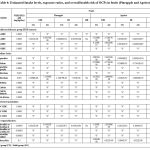 |
Table 4: Estimated Intake levels, exposure ratios, and overall health risk of OCPs in fruits (Pineapple and Apricot).
|
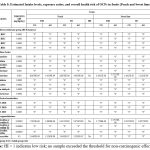 |
Table 5: Estimated Intake levels, exposure ratios, and overall health risk of OCPs in fruits (Peach and Sweet lime).
|
Note: HI < 1 indicates low risk; no sample exceeded the threshold for non-carcinogenic effects.
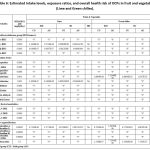 |
Table 6: Estimated Intake levels, exposure ratios, and overall health risk of OCPs in fruit and vegetable (Lime and Green chilies).
|
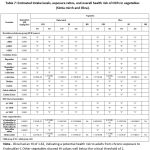 |
Table 7: Estimated Intake levels, exposure ratios, and overall health risk of OCPs in vegetables (Simla mirch and Okra).
|
Note – Okra had an HI of 1.62, indicating a potential health risk to adults from chronic exposure to Endosulfan-I. Other vegetables showed HI values well below the critical threshold of 1.
Table 8: Combined Health Risk (HI) of OCPs in Fruits (Summer Season)
|
Fruits |
HI (Children) |
HI (Adults) |
Risk Level |
|
Apricot |
0.2145 |
0.1072 |
Low |
|
Peach |
0.1473 |
0.0736 |
Low |
|
Lime |
0.1447 |
0.0723 |
Low |
|
Pineapple |
0.1286 |
0.0643 |
Low |
|
Sweet lime |
0.0552 |
0.0276 |
Low |
Interpretation: All fruits exhibited combined HI values below the threshold of 1, suggesting no immediate health risk for either children or adults based on the detected pesticide levels.
Table 9: Combined Health Risk (HI) of OCPs in Vegetables (Summer Season)
|
Vegetables |
HI (Children) |
HI (Adults) |
Risk Level |
|
Okra |
3.2430 |
1.6215 |
High |
|
Simla mirch |
0.7485 |
0.3742 |
Moderate |
|
Green chillies |
0.1758 |
0.0879 |
Low |
Interpretation: While most vegetables fell within the safe limit, okra exceeded the HI threshold (HI > 1) in both children and adults. This suggests a notable public health concern, primarily linked to elevated concentrations of Endosulfan-I.
Discussion
During the monitoring it has been found that the majority of samples exhibited residue levels below the MRLs established by International Regulatory Agencies. The detection of OCPs such as Endosulfan-I, 4,4ʹ-DDE, 4,4ʹ-DDD, and Heptachlor epoxide indicates their continued presence in the environment, despite long-standing restrictions on their usage. Similar findings have been reported in several studies from India and other developing regions, where the persistence, bioaccumulation potential, and illegal application of OCPs remain a concern.
The health risk analysis based on Estimated Daily Intake (EDI) and Hazard Index (HI) revealed distinct risk differences between commodities. Fruit samples showed combined HI values <1 for both adults and children, indicating no immediate health concerns from dietary consumption. Comparatively vegetable samples comparatively higher exposure risk as compare to fruits. Among these, okra demonstrated HI >1 for both children and adults, signifying potential chronic health risks. This elevated risk was mainly attributed to higher concentrations of Endosulfan-I, a pesticide known for endocrine and neurotoxic effects in humans.
Children exhibited higher HI values than adults across most samples due to their underweight and higher diet intake-to-body mass ratio, making them a more vulnerable group to toxic exposure. Although other vegetables such as Simla mirch and green chili displayed HI values below the threshold of concern, their detection of multiple OCPs suggests potential cumulative effects with long-term consumption.
The continued detection of banned OCPs in the present study highlights gaps in enforcement, monitoring, and public awareness. Environmental persistence due to historical agricultural use, coupled with possible unauthorized applications, likely contributes to their residues in food supply chains. Considering the harmful characteristics of OCPs – including bioaccumulation, environmental stability, and human toxicity—regular surveillance and stringent residue management practices are essential for consumer safety.
Recent studies have highlighted that xenobiotics such as organochlorine pesticides may interfere with anti-aging regulatory pathways, particularly Sirtuin-1 (SIRT1), which plays a crucial role in metabolic regulation and prevention of chronic diseases.23,24 Organochlorine pesticide residues have been reported as potential SIRT1 inhibitors, and their persistent presence in food commodities may contribute to long-term health implications. Although SIRT1 expression or plasma levels were not evaluated in the present study, the detectable concentrations of organochlorine pesticides observed in summer fruits and vegetables suggest a possible biological relevance that warrants further biomonitoring and molecular-level investigations in exposed populations.
Conclusion
This research demonstrates that summer fruits and vegetables contain trace levels of organochlorine pesticide (OCP) residues. α-Chlordane and endosunfan-I were found in all fruits samples and Endosulfan-I and methoxychlor were found in all vegetable samples. Health risk assessment revealed that okra and Simla mirch could pose health risks, especially to children, based on their hazard index values. These findings call for increased surveillance and enforcement of pesticide regulations to ensure food safety. Overall, the findings indicate a moderate to high chronic exposure risk, particularly from leafy and fruiting vegetables like okra. Strengthened regulatory controls, good agricultural practices (GAP), and awareness programs for farmers and vendors are necessary to reduce pesticide contamination in food commodities and safeguard public health.
Acknowledgment
The authors gratefully acknowledge the Head, Department of Chemistry,Institute of Basic Sciences (IBS), DR. Bhimrao Ambedkar University, Agra for providing the necessary research facilities. We also extend our sincere thanks to the Advanced Instrumentation Research Facility (AIRF) for supporting the sample analysis and generation of chromatographic graphs.
Funding Sources
The author(s) received no financial support for the research, authorship, and/or publication of this article.
Conflict of Interest
The authors do not have any conflict of interest.
Data Availability Statement
This statement does not apply to this article.
Ethics Statement
This research did not involve human participants, animal subjects, or any material that requires ethical approval.
Informed Consent Statement
This study did not involve human participants, and therefore, informed consent was not required.
Permission to reproduce material from other sources
The manuscript does not contain any reproduced material, therefore there is no need of permission.
Authors’s Contribution
Jagtendra Singh: Conceptualization, methodology development, sample collection, laboratory analysis, data curation, writing – original draft preparation, and manuscript editing.
Devendra Kumar: Supervision, project administration, critical review and revision of the manuscript, validation of results, and final approval for publication.
References
- Kaushik R. S., Meena, Srivastava N. Monitoring of organochlorine pesticide residues in vegetables from India. Environ. Sci. Health B; 2022; 57:362. https://doi.org/10.1080/03601234.2022.2030147
- Jilani S., Ameer S., Akhtar M., Zafar N., Ahmad I. Occurrence and ecological risk of pesticides in environmental matrices of Pakistan. Pollut.; 2023; 319:120900. https://doi.org/10.1016/j.envpol.2023.120900
- Kaur P., Sharma S. Pesticide residues and dietary risk assessment in Indian food commodities. Agric. Food Chem.; 2021; 69:120. https://doi.org/10.1021/acs.jafc.0c05921
CrossRef - Ahmed S., Bashir S., Nasreen S. Environmental monitoring of pesticide residues in agricultural soils. Pollut.; 2023; 318:120857. https://doi.org/10.1016/j.envpol.2022.120857
CrossRef - Stockholm Convention on Persistent Organic Pollutants. United Nations Environment Programme, Geneva; 2009. https://doi.org/10.18356/ae1cbb2d-en
- Status of pesticide use and monitoring in India. Central Pollution Control Board, New Delhi; 2020. http://cpcb.nic.in/status-of-pesticide-use-in-india/
- Pandit G., Wagh S., Keshav N., Rao S. Monitoring of pesticide residues in Indian food and water samples. Food Addit. Contam. Part B; 2020; 13:25. https://doi.org/10.1080/19393210.2019.1705272
- Ansari M., Kumar R., Gupta N., Kumar A. Organochlorine pesticide residues in fruits and vegetables of Northern India. Environ. Biol.; 2021; 42:677. https://doi.org/10.22438/jeb/42/3(SI)/GN-15
- Khan A., Ahmad F., Ali M., Hussain R. Exposure assessment of pesticide residues in human blood and food items. Chemosphere; 2023; 320:137602. https://doi.org/10.1016/j.chemosphere.2023.137602
- Kishi M., Hirschhorn L., Djumaeva J., Ibragimova D. Health implications of pesticide exposure among agricultural workers. World Health Organ.; 2019; 97:205. https://doi.org/10.2471/BLT.18.220251
- Kumar V., Bhardwaj R., Giri A., Singh M. Pesticide exposure and human health risk in rural India. Int.; 2020; 136:105503. https://doi.org/10.1016/j.envint.2019.105503
- European Food Safety Authority report on pesticide residues in food. EFSA J.; 2021; 19:6599. https://doi.org/10.2903/j.efsa.2021.6599
CrossRef - Yang Y., Liu Z., Wang H., Zhang J. Determination of pesticide residues in vegetables using GC–MS/MS. Food Chem.; 2024; 399:134032. https://doi.org/10.1016/j.foodchem.2022.134032
CrossRef - Sharma A., Chauhan P., Mehta V., Rajput N. Assessment of pesticide residues in fruits and vegetables and associated risk to human health. Agric. Chem. Environ.; 2025; 14:32. https://doi.org/10.4236/jacen.2025.141004
CrossRef - Fawell J., Nieuwenhuijsen M. J. Human health risk from exposure to chemical contaminants in food and water. Lett.; 2022; 367:12. https://doi.org/10.1016/j.toxlet.2021.10.016
CrossRef - Liu C., Zhang W., Zhou H., Chen X. Global occurrence and fate of organochlorine pesticides in food and environment. Total Environ.; 2023; 857:160155. https://doi.org/10.1016/j.scitotenv.2022.160155
CrossRef - WHO/FAO. Guidelines for the estimation of dietary intake of pesticide residues. World Health Organization, Geneva; 2020. https://www.fao.org/3/y5846e/y5846e00.htm
- Kumar R., Singh A., Sharma V., Tomar P. Pesticide residues in vegetables and health risk assessment from Agra markets. Indian J. Agric. Sci.; 2024; 94:401. https://doi.org/10.56093/ijas.v94i4.121123
- Kumar B., Mukherjee D. P. Monitoring of pesticide residues in vegetables and their implications for food safety. J. Veg. Sci.; 2012; 18:121. https://doi.org/10.1080/19315260.2011.590571
CrossRef - Mukherjee I., Singh S., Sharma P. K., Jaya M., Gopal M., Kulshrestha G. Pesticide persistence in soil and plant systems in Indian agriculture. Environ. Contam. Toxicol.; 2007; 78:380. https://doi.org/10.1007/s00128-007-9203-x
CrossRef - WHO/IPCS. Inventory of IPCS and other WHO pesticide evaluations and summary of toxicological evaluations performed by the JMPR through 2009. World Health Organization, Geneva; 2009. https://www.who.int/ipcs/publications/pesticides/en/
- Singh J., Kumar D. Monitoring of pesticide residues in fruits and vegetables of Agra region. J. Agric. Sci.; 2024; 15(4):1068.
- Single gene inactivation with implications to diabetes and multiple organ dysfunction syndromes. Clin. Epigenet.; 2017; 3(3):24.
- Sirtuin 1, A diagnostic protein marker and its relevance to chronic disease and therapeutic drug interventions. EC Pharmacol. Toxicol.; 2018; 6(4):209–215.