


 PDF Downloads:
528
PDF Downloads:
528


Introduction
The economy of Assam heavily depends on the tea cultivation as it offers significant amount of employment to people and also makes substantial contributions to the state revenues. Assam is the biggest tea producing state in India as it produces more than half of the total tea production in India. The agro climatic factors in the state, which include humidity, lot of rainfall and fertile alluvial soils, provide an optimal environment where tea is produced especially ‘Camellia Assamica’, which has a strong flavor and bright liquor. The tea industry in Assam is also involved in the tea exports in India. The size of land under tea cultivation in the state has been on constant growth indicating continuous growth in the sector. This growth underscores the necessity to have proper forecasting models that would be able to predict future production trends. These predictions are essential in making sound policies, the proper distribution of resources and making the tea industry sustainable. Time series analysis, especially the Auto Regressive Integrated Moving Average (ARIMA) model is very popular in agricultural forecasting as it is capable of dealing with non stationary data and the underlying production trends. Past research has effectively used the ARIMA models in predicting production of tea in different regions, showing that they are useful in planning and decision making in agricultural sector.
Literature Review
The ARIMA model, which is a time series model, has been widely applied in predicting agricultural yields, such as tea production. Assam ARIMA techniques have been used to analyze and predict the trends in tea production in several studies of Assam. Mahanta (2023) suggested time series analysis of tea production in South Assam (1961-2013) with ARIMA (1,1,1) model as the most suitable to predict future output. 1 Likewise, Mahanta and Bordoloi (2021) examined the records of tea production at the Kondoli Tea Estate (2008-2019) with the exponential methods of smoothing data and predicted the production to 2024. Their research also placed emphasis on the effect of the climatic factors (rainfall and temperature) on the productivity of tea.2 At the national level, Niranjan et al. (2022) studied tea production in India (1918- 2015) through ARIMA and state-space models, and forecasted their growth and decline in 2027, which proved that these models were effective in predicting a long-term forecast.3 The other studies in the tea industry of Assam have highlighted the need to have proper forecasting and have noted that this has been a challenge with climatic changes.4,5 Altogether, these works confirm the relevance and effectiveness of ARIMA and other time series methods in tea production prediction, which gives a base on the improvement of prediction efficiency and policy making in the areas where tea production is economically significant.6–10 In this background, this present attempted to evaluate the trends in the tea production in Assam since the year 2001 to 2024, in order to predict the future tea production in Assam using an ARIMA Model and to give some insights and policy recommendations to the stakeholders on the basis of the forecasted trends.
Materials and Methods
The study takes the quantitative time-series forecasting research methodology, based on Box-Jenkins ARIMA model, to examine the production of tea in Assam. The data on the annual production of tea between 2001 and 2024 was obtained through the Directorate of Economics and Statistics (Assam) and the Tea Board of India.11,12 The analysis started off with data visualization and stationarity test based on Augmented Dickey-Fuller (ADF) test, then proceeded to the step of difference where stationarity had to be met. The identification of the model was conducted by the study of Autocorrelation Function (ACF) and Partial Autocorrelation Function (PACF) plots to identify appropriate ARIMA (p, d, q) model settings. Several ARIMA models were fit and the most suitable one chosen on the basis of minimum Akaike Information Criterion (AIC) value. The Ljung-Box Q-test results and the analysis of the model residues were used to perform the diagnostic checks to be sure that model residues had white noise characteristics. Mean Absolute Percentage Error (MAPE) was used to determine the accuracy of the model in making predictions. Lastly, the ARIMA model chosen was used to predict the tea production of Assam between 2025 and 2029.
Results
Trend of Tea Production in Assam (2001-2024).
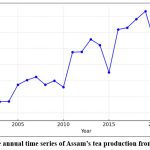 |
Figure 1: The annual time series of Assam’s tea production from 2001–2024. |
Figure 1 presents the annual time series of tea production in Assam from 2001 to 2024. The series exhibits a clear upward trajectory over the study period. Tea production increased from the early 2000s level of around 450 million kg to more than 700 million kg in recent years, indicating long-term growth in the sector. However, short-term fluctuations are observed, particularly after 2020. A noticeable decline occurs during 2020–2021, followed by irregular movements in subsequent years. These deviations correspond to periods of production disruption reflected in the historical data.
To model the observed trend and fluctuations, the series was differenced once to achieve stationarity. Based on the ACF and PACF plots, several ARIMA specifications were estimated. Among them, the ARIMA (2,1,2) model yielded the lowest Akaike Information Criterion (AIC ≈ 179.8) and was therefore selected as the optimal model. The estimated ARIMA (2,1,2) model demonstrated strong in-sample forecasting accuracy, with a Mean Absolute Percentage Error (MAPE) of approximately 2.0 percent, indicating a close fit between actual and predicted values.
Figure 2 presents the residual diagnostics of the fitted ARIMA (2,1,2) model. The residual series does not exhibit any systematic pattern over time. The Ljung–Box Q-test confirms the absence of significant autocorrelation in the residuals, as p-values remain well above conventional significance levels.
The normal Q–Q plot shows that residuals closely follow the reference line, suggesting approximate normality. These results indicate that the residuals behave as white noise and confirm the adequacy of the selected model.
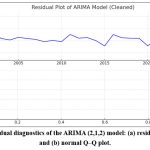 |
Figure 2: Residual diagnostics of the ARIMA(2,1,2) model: (a) residuals over time and (b) normal Q–Q plot. |
Using the validated ARIMA (2,1,2) model, tea production in Assam was forecast for the period 2025–2029. Figure 3 illustrates the projected values along with 95 percent confidence intervals.
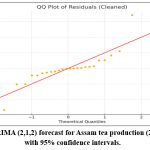 |
Figure 3: ARIMA (2,1,2) forecast for Assam tea production (2025–2029) with 95% confidence intervals. |
The forecast results are summarized in Table 1. Tea production is projected to increase steadily from 741.3 million kg in 2025 to 778.5 million kg by 2029. The confidence intervals widen gradually over the forecast horizon, reflecting increasing uncertainty over time, while still maintaining a stable upward trajectory.
Table 1: Projected Tea Production in Assam (2025–2029) using ARIMA (2,1,2) Model
| Year | Forecast(million Kg) |
| 2025 | 741.3 |
| 2026 | 750.8 |
| 2027 | 760.1 |
| 2028 | 769.3 |
| 2029 | 778.5 |
Discussion
The empirical results reveal a sustained long-term growth trend in Assam’s tea production, consistent with the historical expansion of cultivated area and rising domestic and export demand. The upward trajectory observed in Figure 1 confirms the structural importance of tea cultivation in the state’s agrarian economy. The short-term disruptions evident after 2020 are economically significant. The production decline during this period coincides with external shocks such as the COVID-19 pandemic, which caused labor shortages, factory shutdowns, and disruptions in tea auctions. Additionally, extreme climatic events particularly the severe floods of 2022–2023 contributed to temporary output contractions, as reflected in the data. These fluctuations represent exogenous shocks rather than a reversal of the long-term production trend.
The ARIMA (2,1,2) model’s strong diagnostic performance and low MAPE value indicate that it effectively captures the underlying dynamics of Assam’s tea production. The absence of residual autocorrelation and the normal distribution of residuals suggest that the model specification is statistically sound. These findings are consistent with earlier empirical studies that applied Box–Jenkins methodologies to tea production forecasting in Assam and other tea-producing regions.1,2,4
The forecast results suggest that tea production in Assam will continue to grow modestly over the next five years, with an average annual growth rate of approximately 1.3 percent. While this indicates stability, the relatively slow growth also underscores structural constraints within the sector. Small and marginal tea growers dominate production in many regions of Assam, often operating without economies of scale, adequate access to credit, or modern irrigation facilities.
Furthermore, the widening forecast confidence intervals highlight the increasing uncertainty associated with climate variability. Rising temperatures, erratic rainfall patterns, and flood risks pose persistent threats to yield stability. These risks imply that the projected growth path is contingent upon the absence of major climatic or institutional disruptions. From a policy perspective, the findings emphasize the need to complement forecasting-based planning with climate-resilient interventions. Investments in irrigation, adoption of drought tolerant tea clones, replanting of ageing bushes, and strengthening of extension services could enhance productivity and reduce vulnerability to shocks. Integrating time-series forecasts with agro-meteorological advisory systems may further improve adaptive capacity among tea growers.
Overall, while the ARIMA-based projections indicate continued growth in Assam’s tea production, sustaining this trajectory will depend on addressing climatic risks, structural bottlenecks, and smallholder constraints through targeted policy support.
Conclusion
Thus, ARIMA (2,1,2) projection shows that the tea production in Assam will show minimal variation up to 2029 and will remain around its current level (around 0.7 million tones), unless there will be an improvement in productivity. This comparatively parallel projection in accordance with earlier researches that confirm the validity of ARIMA-based projections serves to highlight the vulnerability of this sector to external shocks. Specifically, the threat of climate variability is overruling: empirical data indicate that almost all Assam smallholders view unfavorable weather conditions to be a direct risk to the yield. In the Assam studies record high temperatures (up to 42 °C) and unpredictable rainfall patterns which minimize growing seasons and heighten pressure on pests. Recent occurrences are evidence of this weakness as an example, the 2023 intense monsoon flooding caused damage to more than 48,000 ha of tea gardens and another indicator that can be seen is a reduction of production by 9% in August alone. Assam of India contributes to about half of the national production of tea and is the highest country in the climate-vulnerability scales, justifiably explaining why relatively small climatic shocks have such large effects on aggregate output.
Meanwhile, climatic pressures are escalated in the tea belts in Assam (Upper Assam, South/North Bank and Cachar regions) by structural constraints. Much of tea plantations is on marginal plots, including small gardens (mostly <5 ha), which do not have economies of scale and which are not under formal assistance. Such small growers are usually characterized by low bargaining power (depending on bought-leaf factories and auction prices), compounded by inadequate outreach with extensions, limited access to credit, and divided land titles. Infrastructure disparities in the rural areas (lack of irrigation, poor roads to farm to-market and processing plants) also limits resilience and access to the market. In many hilly countries and plateau country of the Northeast, a barrier of language and special rules of land tenure impede even. the introduction of the available support programs. Overall, the outlooks and projections of the tea industry, ground research has shown that despite the baseline growth, small tea growers of Assam clearly susceptible to yield shocks and income volatility.
In order to reinforce the outlook as depicted by the ARIMA forecast, there is a need to use evidence-based adaptive strategies. Climate-smart cultivation must also be part of Agronomic adaptation: e.g. by planting shade trees, using drought-resistant clones and soil-moisture conservation can help mitigate extreme heat and dry periods. The industry stakeholders specifically call to increase use of irrigation and rain water harvesting, as well as systematic planting of shade trees, which can soak up heat and to reduce the fluctuation of monsoons.
Cropping systems (e.g. inter-cropping or agroforestry with tea) could be diversified, as well, which can increase the ecological resilience. The technical support is also significant: the reinforcement of the extension services and agro-meteorological advice would enable growers to arrange the planting and fertilization and harvesting time with seasonal predictions. As an example, integrating ARIMA output with real-time weather forecasts and phenological observations may allow giving prompt warnings (e.g. of late monsoon onset) and initiate adaptive input feedback. Interventions should be carried out to include small and marginal growers on a socio-economic level. Streamlined financial sources and subsidies are essential – according to growers, schemes reimbursement-only will not work when the smallholders do not have immediate capital. The increase in direct payment schemes (similar to the CESS fund system in Assam) would enhance the adoption of new inputs and machinery. Extension and credit schemes must be made as comprehensive as possible amongst tea growers (cutting across the not-farmer category which makes them ineligible to several welfare programs). Small-farmer cooperatives and plantation development agencies (e.g. the proposed Small Tea Growers’ Directorate) could be formed or given special authority by the government and industry agencies to provide customized assistance. The other area of priority is the replacement of old tea bushes with specific subsidies: by replacing ageing plantations, it is possible to increase the yield significantly. Improvements of the value-chain are also required – such as encouraging farmer collectives or buyer groups can also stabilize farm-gate prices and investing an improvement of quality processing and branding (a safe Assam tea certification) would better capture higher market value and lessen the variation in prices.
Lastly, such actions should be well coordinated with the policy initiatives in Assam and the Northeast. The national Tea Board schemes and the recently unveiled Tea Mission of the state, such as, modernization, research and grower support, are just but a few examples, and our recommendations support these objectives. Stakeholders also focus more on targeted outreach throughout the entire Northeast (e.g. Nagaland, Manipur) so that benefits are extended to all areas with tea plantations to coordinate infrastructure infrastructural investments (roads, cold storage, internet connectivity in the agri-services) will ease non-climatic bottlenecks. Overall, an ARIMA informed planning with on the ground adaptation is justified. Assam can remain sustainable in its growth of tea production despite the increase in climate variability through adopting climate-resilient agronomy, strengthening support of smallholders, filling infrastructural gaps and incorporating agro-climatic forecasting. Such measures will assist in preserving the lives of millions of people who rely on the tea industry of Assam, as well as the future production of the crop in the Northeast of India.
Acknowledgement
The authors would like to acknowledge Mizoram University, Aizawl for providing institutional and academic support for this work. The authors also extends sincere thanks to the reviewer for valuable suggestions.
Funding Sources
The author(s) received no financial support for the research, authorship, and/or publication of this article.
Conflict of interest
The authors do not have any conflict of interest.
Data Availability Statement
The manuscript incorporates all datasets produced or examined throughout this research study.
Ethics Statement
This research did not involve human participants, animal subjects, or any material that requires ethical approval.
Informed Consent Statement
This study did not involve human participants and therefore consent was not required.
Permission to reproduce material from other sources
Not Applicable.
Authors Contribution
Nandita Debnath: Conceptualization, methodology, data curation, writing-original draft
Giribabu Mahasamudram: validation, formal analysis, Supervision
Dipankar Saha : writing-review editing
References
- Mahanta KK. A time series analysis of tea production in South Bank of Assam from 1961 to 2013 using Arima model. IJASS. Published online 2023:725.
CrossRef - Kuki Kalpita Mahanta, Rimzim Bordoloi. A Time Series Analysis on Tea Production of Kondoli Tea Estate, Assam. Unpublished. Preprint posted online 2021. doi:10.13140/RG.2.2.12348.41607
- Niranjan K, Natarajan P, Kumar B. Timeseries forecasting of India’s tea production using ARIMA and state-space models. Int J Agric Res. 2022;14(2):89-102.
- Talukdar B, Chakravartty PK, Sharma B. Tea Industry of Assam and India: Statistical Analysis and Its FutureTrends. jaz. Published online January 25, 2023. doi:10.53555/jaz.v44i1.4368
CrossRef - Biggs H, Ferreira S, Freitag -Ronaldson Stefanie, Grant -Biggs Rina. Taking stock after a decade : does the “thresholds of potential concern” concept need a socio-ecological revamp? : essay. Koedoe : African Protected Area Conservation and Science. 2011;53(2):1-9. doi:10.10520/EJC132240
CrossRef - Katangodage BT, Wijeratne AW. Value-weighted price return index for plantation sector of Colombo Stock Exchange of Sri Lanka. IJARGE. 2016;12(1):27. doi:10.1504/IJARGE.2016.074678
CrossRef - Lopez-Rodriguez I, Hernandez-Tejera M, Lopez AL. Methods for the management of distributed electricity networks using software agents and market mechanisms: A survey. Electric Power Systems Research. 2016;136:362-369. doi:10.1016/j.epsr.2016.03.016
CrossRef - Lawgali FF. Forecasting water demand for agricultural, industrial and domestic use in Libya. International Review of Business Research Papers. 2008;4(5):231-248.
- Abdullah L. ARIMA model for gold bullion coin selling prices forecasting. International Journal of Advances in Applied Sciences. 2012;1(4):153-158.
CrossRef - Montgomery DC, Jennings CL, Kulahci M. Introduction to Time Series Analysis and Forecasting. John Wiley & Sons; 2015. Accessed January 1, 2026. https://books.google.com/books?hl=en&lr=&id=JCFi BwAAQBAJ&oi=fnd&pg= PR11&dq=Montgomery+DC,+Jennings +CL,+Kulahci +M.+Introduction+to+Time+Series+Analysis+ and+Forecasting.+Hoboken,+ NJ:+John+ Wiley+%26+Sons%3B+2008.&ots= hkkQsZL1Lp&sig=_1G1TOj UnBWvctgUgQ70lZK3XQo
- MoDoNER. Assam: Tea | NER DATABANK. 2025. Accessed January 1, 2026. https://databank.nedfi.com/assam-agriculture/tea
- Government of Assam. Directorate of Economics and Statistics, Assam. Statistical Handbook of Assam 2024. Published online 2024. Accessed May 15, 2025. https://des.assam.gov.in/portlets/ statistical-handbook
Appendix 1
Table A1: Trend in area, production, and average yield of Tea in Assam
| Year | Total Area(in ‘000 Hectare) | Tea Production(in 000 Kg.) | Average Yield (Kg/Hectare) |
| 2001 | 269 | 453587 | 1685 |
| 2002 | 271 | 433327 | 1601 |
| 2003 | 272 | 434759 | 1601 |
| 2004 | 272 | 435649 | 1603 |
| 2005 | 301 | 487487 | 1622 |
| 2006 | 312 | 502041 | 1610 |
| 2007 | 321.3 | 511885 | 1593 |
| 2008 | 321.4 | 487497 | 1517 |
| 2009 | 321.7 | 499997 | 1554 |
| 2010 | 322 | 480286 | 1492 |
| 2011 | 322 | 589110 | 1830 |
| 2012 | 322 | 590120 | 1833 |
| 2013 | 322 | 629050 | 1953 |
| 2014 | 304 | 610970 | 2010 |
| 2015 | 316 | 526185 | 1665 |
| 2016 | 311 | 659740 | 2121 |
| 2017 | 314 | 665330 | 2119 |
| 2018 | 338 | 691910 | 1047 |
| 2019 | 337 | 716490 | 2126 |
| 2020 | 347 | 618200 | 1781 |
| 2021 | 347 | 667730 | 1923 |
| 2022 | 348 | 688700 | 1822 |
| 2023 | 351 | 391910 | 916 |
| 2024 | 359 | 675880 | 1884.42 |
Source: Compiled from NER Databank/Assam/Agriculture/Tea https://databank.nedfi.com/assam-
agriculture/tea