


 PDF Downloads:
377
PDF Downloads:
377


Introduction
The climate represents a highly intricate and interconnected system, influenced by natural processes such as rising global temperatures, variations in atmospheric composition, fluctuations in solar radiation, and anthropogenic activities.1 Climate change, a global phenomenon, is contributing to the depletion of natural resources, reduced productivity, disruptions in socio-economic structures, and accelerated rural migration, posing significant challenges to agricultural sustainability. Over the past two decades, its impacts have been increasingly recognized in global forums. Global warming alters climatic patterns, affects rainfall distribution, accelerates sea level rise, and generates far-reaching consequences for ecosystems and human societies. In India, average temperatures have risen by 0.4°C over the last century. Projections suggest that an increase of 2.0-3.5°C, coupled with changes in precipitation, could reduce agricultural GDP by 9-28%. The South-West monsoon is particularly crucial, as it delivers rainfall to 75% of the geographical area and sustains 78% of the nation’s gross cropped land. Rainfed Kharif crops, which contribute over half of India’s food grain output and two-thirds of its oilseed production, play a pivotal role in ensuring food security. However, monsoon failures can reduce national food grain production by 10-20%.
Among the natural disasters exacerbated by climatic factors, tropical cyclones remain among the most devastating in India due to the country’s geographical setting, topography, climate, and population density.1 Despite suffering significant losses, farmers display resilience by drawing upon prior experiences to inform strategies for mitigation and management. They increasingly rely on ICT tools, social media platforms, and organizational networks to disseminate cyclone-related information.
The India Meteorological Department (IMD), the apex body for weather forecasting, issues cyclone warnings through a four-stage, color-coded system.2 The first stage, Pre-Cyclone Watch, is issued 72 hours before the expected onset of adverse conditions in the North Indian Ocean. The second stage, Cyclone Alert, is disseminated 48 hours before landfall, providing details on intensity, trajectory, location, and expected movement, which are relayed to coastal communities, mass media, and fisherfolk. The third stage, Cyclone Warning, is issued at least 24 hours in advance, with updates every three hours on the cyclone’s path, landfall location, and associated impacts. Finally, the Post-Landfall Outlook is released 12 hours before landfall, providing information on rainfall intensity, wind speeds, and storm surges to prepare coastal areas for imminent hazards.
Social media platforms represent dynamic, evolving digital tools for communication, interaction, and information exchange.3 ICT demonstrates immense potential in strengthening agricultural livelihoods by enhancing efficiency, productivity, and farm income.4 Additionally, ICT-enabled services facilitate farmer participation and feedback within agricultural knowledge systems.5 However, despite rapid advancements, several barriers continue to limit ICT’s impact, including inadequate infrastructure, low awareness, poorly located information centers, and limited motivation among farmers.6 To expand the role of ICT in agricultural extension and increase farmer adoption, it is vital to examine the constraints currently faced and to understand farmers’ perceptions of ICT use in agriculture. Government initiatives such as broadcasting cyclone warnings via All India Radio, telecasting alerts through Doordarshan, and evacuating vulnerable populations complement these efforts. Against this backdrop, the present study investigates the extent of ICT adoption among coastal farmers for coping with tropical cyclones.
| GREEN | YELLOW | ORANGE | RED |
| No WarningPre Cyclone Watch | Cyclone Alert | Cyclone Warning | Post LandfallOutlook |
Various colour codes to determine cyclone warning stage by the national disaster management since 2006.(IMD 2013)
Recent advancements in ICT-enabled weather dissemination and early warning systems provide promising opportunities to enhance farmer preparedness in cyclone-prone regions. The India Meteorological Department (IMD) is currently developing Mausam GPT, an AI-driven platform designed to deliver localized forecasts through both text and voice messages to basic feature phones, thereby overcoming accessibility barriers faced by smallholders with limited literacy and without smartphones.7 Similarly, the National Disaster Management Authority has introduced the Sachet mobile application, which supports 12 regional languages and offers real-time, geo-tagged alerts for disasters, including cyclones, to improve the reach of early warnings.8 However, persistent challenges such as limited digital literacy, inadequate ICT infrastructure, and low trust in the accuracy of forecasts continue to hinder widespread farmer adoption of these innovations.9 Bridging these gaps is crucial to ensure that ICT-based systems can effectively strengthen agricultural resilience and safeguard livelihoods in districts like SPSR Nellore.
Materials and Methods
The study was conducted during 2022-23 in coastal areas of SPSR Nellore district. SPSR Nellore District is one of the nine Coastal districts of Andhra Pradesh and it is the southernmost one. It lies between 130 25′ and 150 55′ N of the Northern Latitude and 790 9′ and 800 14′ of the Eastern Longitude. It spreads over a territory of 13,076 Sq.Km and these records for 4.75% of aggregate region of the State. The rainfall pattern of SPSR Nellore district is heavily dependent on the North-East Monsoon (October-December), which contributes nearly 60% of the annual precipitation and is frequently accompanied by cyclonic activity that causes flooding. In comparison, the South-West Monsoon (June-September) plays a relatively minor role, averaging only about 207.8 mm against a normal of 320.4 mm in 2023, reflecting a 35.1% deficit. The district’s normal annual rainfall ranges between 700 mm and 1,080 mm, but in 2023-24 it recorded an overall deficit of 25.6%, as both the South-West and North-East Monsoons underperformed, with the latter delivering 535 mm against a normal of 645.9 mm (-17.2%). Although the proximity to the Bay of Bengal moderates’ temperatures, the region remains highly vulnerable to extremes, alternating between droughts and floods depending on monsoon performance, thereby exerting a critical influence on agricultural productivity and livelihoods.( District Agriculture Portal, SPSR Nellore; Government of Andhra Pradesh, 2024). The study area comprised of five mandals which are located in coastal areas of Nellore district.viz. Alluru, Vidavaluru, Indukurupeta, Thotapalli Guduru, Muthukuru and Ulavapadu. Two villages from each mandal were selected randomly using a computer-based research randomizer technique. Ten farmers were randomly selected from each village, resulting in a sample size of 120 farmers for the study.
A well-structured interview schedule was created to collect primary data on the ownership and usage of ICT tools. The possession of ICT tools and receipt of warnings were
assessed using frequency and percentage. Access to information was classified into four categories: Daily, Weekly, Fortnight Occasionally and Never. Respondents’ access to different social media sources was ranked using weighted mean scores.
Results
From an overview of Table 01, it was evident that 96.67% of the participants owned a mobile phone, followed by 88.33% who owned a television, 70.00% who owned smart phones, 31.67% who had access to information kiosks, 24.17% who owned a radio, 20.00% who owned a laptop, 15.83% who owned a tablet, and 13.33% who owned personal computers respectively.
Table 1: Possession of ICT tools by farmers of study area (n=120)
| S.No | ICT Tool | Frequency | Percentage |
| 1 | Radio | 29 | 24.17 |
| 2 | Television | 106 | 88.33 |
| 3 | Mobile phone | 116 | 96.67 |
| 4 | Smart phones | 84 | 70.00 |
| 5 | Tablet | 19 | 15.83 |
| 6 | Laptop | 24 | 20.00 |
| 7 | Personal Computers | 16 | 13.33 |
| 8 | Information kiosk | 38 | 31.67 |
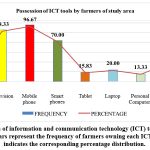 |
Figure 1: Possession of information and communication technology (ICT) tools among farmers in the study area. Bars represent the frequency of farmers owning each ICT tool, while the line indicates the corresponding percentage distribution. |
It is evident from the table-02 that most of farmers (90.00%) regularly accessed Mobile phones for information during cyclone warning stages either by SMS or through phone calls and voice messages etc. Similarly (85.00%) of farmers regularly accessed television news for information during cyclone warning stages. Various news channels broadcast hourly updates to keep viewers informed about cyclone warnings. In the sample selected for the study, (71.67%) of farmers regularly used WhatsApp for cyclone updates, followed by (65.83%) who accessed YouTube for cyclone alerts, and (28.33%) who used Instagram for cyclone alert information. Only (6.67%) of farmers regularly listened to Radio, and the least (4.17%) accessed twitter for cyclone-related information in the study area. The usage of radio has declined in contrast to mobile phones and television. This shift can be attributed to radio being more popular among elderly family members in rural households. At present, WhatsApp and Instagram dominate the information and communication sector. WhatsApp, a social networking platform, facilitates the connection of progressive and small farmers for information dissemination.
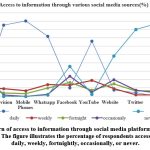 |
Figure 2: Pattern of access to information through social media platforms and ICT tools among farmers. The figure illustrates the percentage of respondents accessing information daily, weekly, fortnightly, occasionally, or never. |
From Table 02, it was observed that (19.17%) of farmers accessed YouTube weekly, followed by (15.00%) for Instagram, (14.17%) for WhatsApp, and (13.33%) for Facebook. Additionally, (26.67%) of farmers occasionally accessed Radio for cyclone alert information, followed by (24.17%) for Facebook and (20.00%) for websites. Unfortunately, it was discovered that the majority of respondents (87.50%) never used email for cyclone alert information, followed by (80.00%) for Twitter, (48.33%) for websites, (45.00%) for Instagram, (40.83%) for Radio, and (35.83%) for Facebook, respectively, to stay informed during cyclone warnings.
Table 2: Access to information through various social media sources (n=120).
| S.No | Mass media | Daily | Weekly | Fortnight | Occasionally | Never | |||||
| f | % | f | % | f | % | f | % | f | % | ||
| 1 | Radio | 8 | 6.67 | 12 | 10.00 | 19 | 15.83 | 32 | 26.67 | 49 | 40.83 |
| 2 | Television | 102 | 85.00 | 11 | 9.17 | 5 | 4.17 | 2 | 1.67 | 0 | 0.00 |
| 3 | Mobile Phones | 108 | 90.00 | 8 | 6.67 | 4 | 3.33 | 0 | 0.00 | 0 | 0.00 |
| 4 | 86 | 71.67 | 17 | 14.17 | 12 | 10.00 | 3 | 2.50 | 2 | 1.67 | |
| 5 | 12 | 10.00 | 16 | 13.33 | 20 | 16.67 | 29 | 24.17 | 43 | 35.83 | |
| 6 | YouTube | 79 | 65.83 | 23 | 19.17 | 9 | 7.50 | 6 | 5.00 | 3 | 2.50 |
| 7 | Website | 9 | 7.50 | 11 | 9.17 | 18 | 15.00 | 24 | 20.00 | 58 | 48.33 |
| 8 | 5 | 4.17 | 2 | 1.67 | 8 | 6.67 | 9 | 7.50 | 96 | 80.00 | |
| 9 | 0 | 0.00 | 2 | 1.67 | 8 | 6.67 | 5 | 4.17 | 105 | 87.50 | |
| 10 | 34 | 28.33 | 18 | 15.00 | 6 | 5.00 | 8 | 6.67 | 54 | 45.00 | |
It is evident from the figure that among various social media sources accessed by farmers during cyclone alert stages Mobile phones ranked first with weighted mean value of 4.55 followed by television with mean value of 4.24, Whatsapp with value of 3.89, YouTube with value of 3.64 and Instagram ranked fifth with weighted mean score of 2.89 respectively.
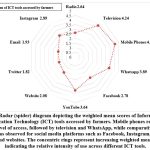 |
Figure 3: Radar (spider) diagram depicting the weighted mean scores of Information and Communication Technology (ICT) tools accessed by farmers. Mobile phones recorded the highest level of access, followed by television and WhatsApp, while comparatively lower access was observed for social media platforms such as Facebook, Instagram, Twitter, email, and websites. |
Discussion
The findings of the present study clearly indicate a high level of ICT tool penetration among farmers in the study area, with mobile phones (96.67%) and television (88.33%) emerging as the most commonly owned devices. This widespread ownership reflects the rapid diffusion of basic and advanced communication technologies in rural areas, largely driven by affordability, network expansion, and the perceived usefulness of these tools in accessing timely information. The comparatively high ownership of smartphones (70.00%) further suggests a gradual shift from conventional communication devices to internet-enabled platforms, enabling farmers to access multimedia-based and real-time information. In contrast, the low ownership of personal computers, tablets, and laptops highlights the limited relevance of such devices for farmers due to higher costs, lack of technical skills, and infrastructural constraints such as unreliable power supply and internet connectivity.
Access patterns during cyclone warning stages reveal that mobile phones and television played a pivotal role in disseminating early warning information. A large majority of farmers regularly accessed cyclone-related information through mobile phones (90.00%) and television (85.00%), underscoring their reliability and immediacy during disaster situations. Television channels, with their continuous and hourly updates, served as a trusted source of official cyclone warnings, while mobile phones enabled direct and personalized communication through SMS, voice calls, and messaging services. These findings reaffirm the critical role of conventional mass media and mobile-based communication in disaster preparedness and risk reduction among farming communities.
The increasing reliance on social media platforms such as WhatsApp and YouTube further highlights a significant transformation in farmers’ information-seeking behaviour. More than two-thirds of the respondents regularly accessed WhatsApp (71.67%) and YouTube (65.83%) for cyclone alerts. WhatsApp, in particular, has emerged as a dominant platform for rapid information dissemination, peer-to-peer communication, and sharing of location-specific advisories among farmers. The platform’s group-based communication facilitates quick circulation of warnings, videos, and advisories from fellow farmers, extension personnel, and local authorities. Similarly, YouTube’s visual content provides easy-to-understand explanations of cyclone impacts and precautionary measures, making it especially useful for farmers with varying literacy levels.
On the other hand, traditional media such as radio showed a marked decline in usage, with only 6.67% of farmers accessing it daily and a substantial proportion either using it occasionally or not at all. This decline may be attributed to the preference for more interactive and real-time media such as mobile phones and television. Radio usage was largely confined to elderly members of rural households, indicating a generational divide in media preference. Likewise, platforms such as Twitter and email were rarely used, with a majority of respondents reporting ‘never’ accessing them for cyclone-related information. This could be due to language barriers, limited awareness, lack of perceived relevance, and the more text-centric nature of these platforms. The weighted mean scores further validate these observations, with mobile phones ranking first, followed by television, WhatsApp, and YouTube. This hierarchy reflects farmers’ prioritization of media that provide instant, reliable, and easily accessible information during emergency situations. Instagram, though used by a smaller proportion of farmers, indicates a gradual diversification of information sources, particularly among younger and more digitally literate farmers.
Overall, the study highlights a clear transition from traditional information sources to mobile-based and social media platforms for accessing cyclone warning information. The dominance of mobile phones and social media underscores the need for disaster management agencies and agricultural extension systems to strengthen mobile-centric and social media-based communication strategies. Integrating official cyclone advisories with widely used platforms such as WhatsApp, television, and YouTube can enhance the reach, timeliness, and effectiveness of early warning systems, thereby improving farmers’ preparedness and resilience to cyclonic disasters.
Conclusion
The study highlights the critical role of ICT tools, particularly mobile phones and television, in disseminating timely and reliable cyclone warnings to coastal farmers in SPSR Nellore district. The findings indicate a clear transition from traditional communication channels like radio to modern digital platforms such as WhatsApp and YouTube. However, gaps remain in reaching the most vulnerable groups, especially small and marginal farmers with limited digital literacy. Strengthening mobile-based early warning systems, promoting community-based ICT interventions, and improving rural ICT infrastructure are essential to enhance resilience. Collaborative efforts between government agencies, agricultural extension services, and private digital platforms can bridge the communication divide and ensure last-mile connectivity. Future interventions must prioritize localized content delivery in regional languages, farmer training on ICT use, and affordable access to digital tools to maximize the benefits of technology in disaster preparedness and agricultural sustainability.
Acknowledgement
We extend our gratitude to Acharya N.G. Ranga Agricultural University, Guntur and ATARI Zone-X for their valuable contribution to the successful completion of the study.
Funding Sources
The author(s) received no financial support for the research, authorship, and/or publication of this article.
Conflict of Interest
The authors do not have any conflict of interest.
Data Availability Statement
This statement does not apply to this article.
Ethics Statement
This research did not involve human participants, animal subjects, or any material that requires ethical approval.
Informed Consent Statement
This study did not involve human participants, and therefore, informed consent was not required.
Permission to reproduce material from other sources
Not Applicable
Author Contributions
S.Lokesh Babu : Conceptualization, Methodology, Writing ,Data Collection – Original Draft.
Kasa Kiran Kumar Reddy and Hari Sadu: Review & Editing
Gundala Lalitha Siva Jyothi: Reviewing
Borra Mukunda Rao : Supervision, Project Administration
Genikala Sivanarayana: Resources, Supervision
References
- Mallick B, Lal SP, Gaur RS. Utilization pattern of diverse ICT tools by coastal farmers during the warning stages of cyclones. Gujarat J Ext Educ. 2023;36(1):90-96. doi:10.56572/gjoee.2023.36.1.0017
CrossRef - Indian Meteorological Department (IMD). Four stage warning. Regional Specialized Meteorological Centre for Tropical Cyclones over North Indian Ocean. New Delhi, India: Ministry of Earth Sciences, Government of India; 2013.
- Barau AA, Afrad MSI. An overview of social media use in agricultural extension service delivery. J Agric Inform. 2017;8(3):50-61.
CrossRef - Sangeetha V, Burman RR, Dubey SK, Sharma JP, Singh I. Attitude of agricultural stakeholders on use of short message service (SMS) in transfer of technology. Indian J Ext Educ. 2015;51:60-65.
- Glendenning CJ, Babu S, Asenso-Okyere K. Review of Agricultural Extension in India: Are Farmers’ Information Needs Being Met? IFPRI Discussion Paper No. 01048. Washington, DC: International Food Policy Research Institute; 2010.
- Maningas RV. Mainstreaming farmers and intermediaries into information and communications technology (ICT): a strategy towards adopting ICT for rural development and agricultural extension. In: Proceedings of the 4th World Congress on Computers in Agriculture and Natural Resources; 2006; United States.
- Ravichandran M. Farmers to get weather updates on feature phones with IMD’s upcoming AI service. May 28, 2025.
- National Disaster Management Authority (NDMA). Sachet (mobile application). Accessed April 2025.
- Manzar A, et al. Weather forecasting improves but access remains uneven for farmers. Mongabay India.