


 PDF Downloads:
388
PDF Downloads:
388


Introduction
Grain storage insect pests typically consume grains that have been stored, bore into kernels, damage the germ, generate heat, and ultimately destroy grain products that have been stored. The Food and Agriculture Organization (FAO) estimates that approximately 10% of the world’s food production is destroyed by insects while it is being stored. Significant losses result from this, mostly in the form of nutritional depletion and a drop in market value. Furthermore, the grains may become contaminated by their excretory products, could be harmful to human health. Therefore, rather than quantity, insect infestations mostly result in losses in terms of quality.1 The cohabitation of primary and secondary pests in one item, the infestation of cereal grain becomes more severe. The most prevalent insect pests on rice are Sitophilus oryzae (rice weevil), Oryzaephilus surinamensis (saw-toothed grain beetle), and Tribolium castaneum (red flour beetle).. Ability to eat on the whole grain, S. oryzae could be the major primary pest in storage products. O. surinamensis and T. castaneum are secondary pests that feed on grain infested by other pests, contaminating stored products with dead insects and feces.2 S. oryzae, Rhyzopertha dominica, T. castaneum, Sitotroga cerealella (Angoumois grain moth) infest wheat, sorghum, and millets, threshed sorghum is particularly vulnerable to these pests.3,4 Research on sorghum, pearl millet, or finger millet crop variants reveals variations in insect damage susceptibility; different cultivars and genotypes are being invested for their potential to combat stored grain insect pests.5-7 Managing stored grain pests is primarily dependent upon synthetic insecticides,8,9 however, regular and improper use of these compounds can lead to health issues, environmental contamination, and pest resistence.10,11 In light of this, it is necessary to develop and make easily available alternative environmentally acceptable control strategies for stored grain pests, such as the use of botanicals, plant extracts, essential oils, etc.
In addition to other primary crops, the Kolhapur district grows cereals and legumes. Cereal grains like rice, wheat, sorghum, and millet are mainly used for human consumption and animal feed. The world’s population gets energy, protein, vitamins B and E, and minerals from cereals which are staple foods. They are essential for nutrition in both developed and developing nations and are inexpensive to produce, easily stored, and transportable. An infestation may begin before storage itself, as the crop matures in the field, or after it is harvested and laid out to dry in the sun, insects may infest it by migrating from nearby granaries.3 After harvest, proper grain storage (moisture: ≤ 13–15.5%, temp: < 15 0C) is essential for food security because it prevents mould growth, pest infestation, and grain germination, ensuring the safety of stored grains.12-14 Ten to twenty percent of agricultural products are destroyed annually, and the situations is made worse by inadequate warehouse management or commodity storage.15 It has been determined to focus on stored grain pests because diversity of stored grain pests for the management of stored grains and their pests. In order to offer a foundation for creating efficient integrated pest control techniques, the objective of this study is to investigate the species diversity of insect pests infesting stored cereal grains in Kolhapur district.
Materials and Methods
In order to collect samples of stored grain insect pests, surveys were carried out in certain grain storage sites, such as farmers’ residences, godowns, markets, and grocery shops, between 2019-2023. Using forceps, fine brushes (0no., 1no., 2no., 3no.) or aspirator, samples were hand-picked from stored commodities such as rice, wheat, maize, sorhum and millets. Grain samples (100–200 g) were drawn randomly from different depths and locations within storage units using a grain sampler to ensure representative sampling. Clean, micro centrifuge tubes (1.5ml and 2ml) and airtight plastic containers (50ml, 100ml, 500ml, 1000ml.) were used to keep samples and they were labelled with the date, grain type, and collection location. Samples that are collected were taken to the laboratory for further analysis. Ethyl acetate or chloroform were used to kill the sampled specimens. The sampled specimens were preserved using 70% ethyl alcohol. They were preserved dry after being pinned (with entomological pins numbers 0, 00 and 4) and properly dried for 48 hours at 40–45 °C for effective dehydration in an insect drying chamber. In order to facilitate future taxonomic verification and study, all preserved specimens were labelled with collection details and kept in the laboratory reference collection. Standard taxonomic keys and reference literature of Pratt and Scott,16 Sengupta et al.,17 Gorham,18 Klimaszewski and Watt,19 Rees,20 Duff,21 Friedman et al.,22 Park et al.,23 Washington,24 Kumar,25 Tyagi et al.,26 images on the bug guide website27 and GBIF website28 were used to identify specimens. The Olympus CX31RTSF microscope, which was connected to the HDMI digital camera, was used to take photos using TCapture software. The photos were stacked in Helicon Focus 7 and then edited using Photoshop CS3. The measurements were taken using Image J program.
Results
During the investigation, 20 species from the Coleoptera, Lepidoptera and Psocoptera insect orders were recorded as pests of cereals. The primary and secondary stored grain pests found in cereal grains (rice, wheat, emmer wheat, great millet, pearl millet, finger millet and sorghum) from the Kolhapur district are listed in Table 1. The current study reports, cereals contain sixteen species belong to the order Coleoptera (Image 1 a-j, Image 2 k-p), three species belong to the order Lepidoptera (Image 2 q-s), and one belongs to the order Psocoptera (Image 2 t). Of the 20 species of stored cereal pests, seven are primary and thirteen are secondary. Sitophilus oryzae, Rhyzopertha dominica, Tribolium castaneum, Tribolium confusum, Sitotroga cerealella, Corcyra cephalonica, and Cadra cautella are documented as the primary pests of stored cereals. Oryzaephilus surinamensis, Cryptolestes pusillus, Cryptolestes pusilloides, Lophocaterus pusillus, Lophocaterus spp., Carpophilus dimidiatus dimidiatus, Carpophilus cheesmani, Carpophilus oculatus gilloglyi, Holoparamecus caularum, Alphitobius diaperinus, Tenebroides mauritanicus, and Tenebrio molitor are the documented secondary pest species. The most damaging cereal pests in the study area were determined to be the rice weevil S. oryzae, lesser grain borer R. dominica, and almond moth C. cautella which attack variety of cereals, including rice, wheat, maize, great millet, pearl millet, finger millet, and emmer wheat. T. castaneum, T. confusum, O. surinamensis, C. pusillus, A. diaperinus, T. mauritanicus, and T. molitor attack rice, wheat, and great millet secondarily. S. cerealella was the major lepidopteran pest found only on rice. C. pusilloides, L. pusillus, Lophocaterus spp., C. dimidiatus dimidiatus, C. cheesmani, C. oculatus gilloglyi, H. caularum, and C. cephalonica feed on only rice or wheat. C. pusilloides, Lophocaterus spp., C. cheesmani, H. caularum, A. diaperinus, T. mauritanicus, T. molitor, C. oculatus gilloglyi, and C. cephalonica are rare species, as only one or two specimens of these species were found from a single collection locality. Millet and maize had the highest pest population, whereas rice and sorghum had the lowest.
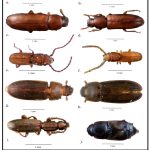 |
Image 1: Habitus of Sitophilus oryzae (a), Rhyzopertha dominica (b), Tribolium castaneum (c), T. confusum (d), Cryptolestes pusillus (e), C. pusilloides (f), Lophocaterus pusillus (g), Lophocaterus spp. (h), Oryzaephilus surinamensis (i), Carpophilus dimidiatus dimidiatus (j). |
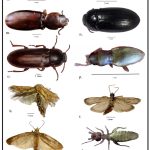 |
Images 2: Habitus of Carpophilus cheesmani (K), Carpophilus oculatus gilloglyi (L), Tenebroides mauritanicus (m), Alphitobius diaperinus (n), Tenebrio molitor (o), Holoparamecus caularum (p), Sitotroga cerealella (q), Cadra cautella (r), Corcyra cephalonica (s), Liposcelis spp. (t). |
Three of the 20 recorded species- C. oculatus gilloglyi, C. cheesmani, and H. caularum, are reported for the first time from India as secondary pests of rice and wheat. On the other hand, seven beetle species- T. confusum, C. pusilloides, L. pusillus, C. dimidiatus dimidiatus, T. mauritanicus, T. molitor and A. diaperinus have been identified as secondary pests of rice, great millet and wheat (Table 1). Due to a unavailability of more specimens, Lophocaterus spp. could only be identified at the genus level.
Table 1: Diversity of stored grain insect pests of cereal grains of Kolhapur district.
| Sr. No. | Stored grain insect pests | Host cereals | Pest status | Orders | Families |
| 1 | Sitophilus oryzae | Rice, Wheat, Great Millet, Maize, Emmer Wheat, Sorghum | Primary pest | Coleoptera | Curculionidae |
| 2 | Rhyzopertha dominica | Rice, Wheat, Great Millet, Pearl Millet, Finger millet, Sorghum | Primary pest | Coleoptera | Bostrichidae |
| 3 | Tribolium castaneum | Rice, Wheat, Maize | Primary pest | Coleoptera | Tenebrionidae |
| 4 | Tribolium confusum | Wheat, Great Millet, Sorghum | Primary pest | Coleoptera | Tenebrionidae |
| 5 | Cryptolestes pusillus | Rice, Wheat | Secondary pest | Coleoptera | Laemophloeidae |
| 6 | Cryptolestes pusilloides | Wheat | Secondary pest | Coleoptera | Laemophloeidae |
| 7 | Lophocaterus pusillus | Rice | Secondary pest | Coleoptera | Lophocateridae |
| 8 | Lophocaterus spp. | Rice | Secondary pest | Coleoptera | Lophocateridae |
| 9 | Oryzaephilus surinamensis | Rice, Great Millet, Sorghum | Secondary pest | Coleoptera | Silvanidae |
| 10 | Carpophilus dimidiatus dimidiatus | Rice | Secondary pest | Coleoptera | Nitidulidae |
| 11 | Carpophilus cheesmani | Wheat | Secondary pest | Coleoptera | Nitidulidae |
| 12 | Carpophilus oculatus gilloglyi | Rice flour | Secondary pest | Coleoptera | Nitidulidae |
| 13 | Holoparamecus caularum | Rice | Secondary pest | Coleoptera | Endomychidae |
| 14 | Tenebroides mauritanicus | Rice, Wheat, Great Millet | Secondary pest | Coleoptera | Trogositidae |
| 15 | Alphitobius diaperinus | Rice, Wheat, Great Millet | Secondary pest | Coleoptera | Tenebrionidae |
| 16 | Tenebrio molitor | Rice, Wheat, Great Millet | Secondary pest | Coleoptera | Tenebrionidae |
| 17 | Sitotroga cerealella | Rice | Primary pest | Lepidoptera | Gelechiidae |
| 18 | Corcyra cephalonica | Wheat | Primary pest | Lepidoptera | Pyralidae |
| 19 | Cadra cautella | Rice, Wheat, Maize, Great Millet, Emmer Wheat, Sorghum | Primary pest | Lepidoptera | Pyralidae |
| 20 | Liposcelis spp. | Rice, Wheat, Great Millet, Maize | Secondary pest | Psocoptera | Liposcelididae |
Discussion
In Bohemia, Central Europe, Stejskal et al.29 compared the risk of pest infestation in 147 grain stores, focusing on vertical silo stores and horizontal flat stores. Both grain store types were infested with beetles, mites, and psocids. In both kinds of shops, the primary grain pests were S. oryzae, R. dominica, O. surinamensis, Lepidoglyphus destructor, Acarus siro, Tyrophagus putrescentiae, Lachesilla pedicularia, and C. ferrugineus. The present study reports 16 coleopteran species, three lepidopteran species, and one psocid. Similar findings were reported by Rajendran and Chayakumari,30 who investigated insect infestation on eight types of stored sorghum and millets and identified six coleopterans, three lepidopterans, and one psocid species as cereal-damaging insects during storage, resulting in loss of quantity and nutritional quality. Raoul and Leonard31 recorded 12 stored grain insect species from Logone Valley, Africa. According to their studies, eight species are known to attack cereals, including five primary pests and five Coleopterans that harm the legume seeds. Major pests of legumes are members of the Bruchidae family, with Sitophilus being the main cereal pest and Callosobruchus causing legume. According to survey conducted by Askira et al.32 in Maiduguri’s main grain markets, four insect pests have a major impact on stored cereal grains, including rice, sorghum, millet, and maize. An overview of damage symptoms and the biology of 11 major pests of stored grains, such as rice weevil, S. oryzae, lesser grain borer, R. dominica, T. granarium, etc., was given by Srivastava and Subramanian.33 These pests can be categorized based on their feeding behavior or severity of damage. Based on literature reviewed,28,34-37 three species- C. oculatus gilloglyi, C. cheesmani, and H. caularum, recorded during the study validate its new record for India. Furthermore, seven species found during the study: T. confusum, C. pusilloides, L. pusillus, C. dimidiatus dimidiatus, T. mauritanicus, T. molitor and A. diaperinus confirm thenew records for Maharashtra. The documentation of new records of stored grain pests from India (three species) and Maharashtra (seven species) is therefore scientifically significant. These records help to improve our knowledge of the biodiversity and biogeographical distribution of the pest, and they may reveal recent import, range expansions, or previously overlooked species. Due to shortage of specimens, Lophocaterus spp. Could only be identified at the genus level.
Conclusion
This study records three species of beetles from India and seven species from Maharashtra as secondary pests on stored grains for the first time. If the focus is on in-depth examination of pests that attack grains over a long period, more species from stored grains will be added to this work. The results show that a variety of primary and secondary stored grain pests, including internal feeders and external feeders, are found among stored grain pests, causing contamination and indirect damage. Studying the life cycles of these pests will help in managing stored grain pests through efficient control methods.
Acknowledgement
The authors are thankful to the Head, Department of Zoology, Shivaji University, Kolhapur, for providing laboratory facilities.
Funding Sources
DRS received the Chatrapati Shahu Maharaj National Research Fellowship (CSMNRF-2020), Government of Maharashtra, India for research work.
Conflict of Interest
The authors do not have any conflict of interest.
Data Availability Statement
This statement does not apply to this article.
Ethics Statement
This research did not involve human participants, animal subjects, or any material that requires ethical approval.
Informed Consent Statement
This study did not involve human participants, and therefore, informed consent was not required.
Permission to Reproduce Material from Other Sources
Not applicable.
Author Contributions
Sunil Madhukar Gaikwad: is involved in research design, specimen identification, and manuscript writing.
Dhanashree Ramchandra Salunkhe: collected, identified, photographed, and gathered biological data of species under study.
References
- Shakya A, Kumar S, Kumar A. Major Insect-pest of Stored Seed and Their Management. Compendium of seed science and technology. Zittau, Germany: Weser books; 2023: 159-174.
- Belloa GD, Padina S, Lastrab CL, Fabrizio M. Laboratory evaluation of chemical biological control of rice weevil (Sitophilus oryzae ) in store grain. J. Stored Prod. Res. 2000; 37:77-84.
CrossRef - Giles PH. Control of insects infesting stored sorghum in Northern Nigeria. Stored Prod. Res.1965; 1(2):145-158.
CrossRef - Wongo LE, Pedersen JR. Effect of threshing different sorghum cultivars on Sitotroga cerealella (Oliv.) and Sitophilus oryzae (L.) (Lepidoptera: Gelechiidae and Coleoptera: Curculionidae). Stored Prod. Res.1990; 26(2):89-96.
CrossRef - Pant KC, Susheela TP. Effect of storage and insect infestation on the chemical composition and nutritive value of grain sorghums. Sci. Food Agric.1977; 28(11):963-970.
CrossRef - Ratna Sudhakar T, Sreerama Murthy K, Narayana Rao PV. Relative susceptibility of Jowar varieties to rice weevil, Sitophilus oryzaeBull. Grain technol. 1988; 26(3):208-213.
- Khattak SU, Hamed M, Sattar A, Khan AU, Shakoori AR. Screening of new genotypes against Khapra beetle, Trogoderrma granarium. Nuclear Institute for Food and Agriculture, Tarnab, Peshawar, Pakistan. Fifteenth Pakistan Congress of Zoology, Islamabad, Pakistan. 1995; 15: 87-93.
- Hosseininaveh V, Bandani A, Azmayeshfard P, Hosseinkhani S, Kazzazi M. Digestive proteolytic and amylolytic activities in Trogoderma granarium Everts (Dermestidae: Coleoptera). Stored Prod. Res. 2007; 43(4):515-522.
CrossRef - Wasala WMCB, Dissanayake CAK, Gunawardhane CR, Wijewardhane RMNA, Gunathilake DMCC, Thilakarathne BMKS. Efficacy of insecticide incorporated bags against major insect pests of stored paddy in Sri Lanka. food sci. 2016; 6:164-169.
CrossRef - Rossi E, Cosimi S, Loni A. Insecticide resistance in Italian populations of Tribolium flour beetles. Insectol. 2010; 63(2):251-258.
- Nath NS, Bhattacharya I, Tuck AG, Schlipalius DI, Ebert PR. Mechanisms of phosphine toxicity. toxicol.2011; (1):494168.
CrossRef - McKevith B. Nutritional aspects of cereals. Bull.2004; 29(2):111-142.
CrossRef - Nalawade DB, Hajare RV, Ghurake BB. Spatial analysis of cropping pattern in Kolhapur District: a geographical study. Gold. Res. Thoughts. 2015; 4(9):1-6.
- Islam W, Nazir I, Noman A, Zaynab M, Wu Z. Inhibitory effect of different plant extracts on Trogoderma granarium (Everts) (Coleoptera: Dermestidae). J. Agric. Environ. Res.2017; 3(1):121-130.
- Khoobdel M, Marouf A, Farajzadeh D, Vatani H, Riazipour M, Joneydi N. Abundance and diversity of pest arthropods in stored cereals in a military unit. Mil. Med.2011; 13(2):81-87.
- Pratt HD, Scott HG. A key to some beetles commonly found in stored foods. Proc. Entomol. Soc. Wash. 1962; 64(l):43-50.
- Sengupta T, Mukhopadhyay P, Sengupta R. Major beetle pests of stored food products in India. Records of the Zoological survey of India. Miscellaneous publication occasional paper no. 62, Calcutta: Director, Zoological Survey of India; 1984: 1-65.
- Gorham JR. Insect and mite pests in food: an illustrated key. Washington: US Government Printing Office; 1991: 1-778.
- Klimaszewski J, Watt JC. Coleoptera: family-group review and keys to identification. Fauna of N. Z. 1997; 37:202.
- Rees DP. Insects of stored products, CSIRO publishing. 2004; 1-192.
CrossRef - Duff A. Checklist of Beetles of the British Isles. United Kingdom: Pemberley Books Publishing; 2012: 1-171.
- Friedman ALL. The Silvanidae of Israel (Coleoptera: Cucujoidea). J. Entomol. 2015; 44(45):75-98.
- Park S, Lee S, Hong KJ. Review of the family Bostrichidae (Coleoptera) of Korea. Asia-Pac. Biodiv.2015; 8(4):298-304.
CrossRef - Washington DC. Stored grain insect reference, United States Department of Agriculture. 2015; 1-76.
- Kumar R. Insect pests of stored grain: Biology, behavior, and management strategies. USA: Apple Academic Press; 2017: 1-413.
CrossRef - Tyagi SK, Guru PN, Nimesh A, et al. Post-harvest stored product insects and their management. Ludhiyana, Punjab, India: ICARAICRP on PHET, Central Institute of Post-Harvest Engineering and Technology; 46.
- Bug guide. 2025. https://bugguide.net accessed on 21 Jan 2025.
- Global biodiversity information facility. 2025. https://www.gbif.org accessed on 21 Jan 2025.
- Stejskal V, Hubert J, Kucerova Z, Munzbergova Z, Lukas J, Zd’arkova E. The influence of the type of storage on pest infestation of stored grain in the Czech Republic. Plant Soil Environ.2003; 49(2):55-62.
CrossRef - Rajendran S, Chayakumari C. Insect infestation and control in stored grain sorghum and millets. J. Food Sci. Technol. 2003; 40(5): 451-457.
- Raoul TB, Leonard NTS. Diversity of stored grain insect pests in the Logone valley, from northern Cameroon to western Chad Republic in Central Africa. Africa. Agric. Sci. Technol. A. 2013; 3(9A): 724.
- Askira AB, Mala KK, Dawud MA, Wali AS, Mustapha A. A survey on the effect of pests of stored products on some cereal grains in Maiduguri Borno state Nigeria. J. Agric. Res.2013; 3(1):97-103.
- Srivastava C, Subramanian S. Storage insect pests and their damage symptoms: an overview. Indian J. Entomol. 2016; 78:53-58.
CrossRef - Brown SD, Armstrong KF, Cruickshank RH. Molecular phylogenetics of a South Pacific sap beetle species complex (Carpophilus, Coleoptera: Nitidulidae). Mol. Phylogenet. Evol.2012; 64: 428-440.
CrossRef - Ewing CP, Cline AR. Key to adventive sap beetles (Coleoptera: Nitidulidae) in Hawaii, with notes on records and habits. Bull.2005; 59:167-183.
CrossRef - Gupta D, Chandra K, Banerjee D, et al. Fauna of India Checklist: Arthropoda: Insecta: Coleoptera-Version 1.0. Kolkata: Zoological survey of India. 2024; 263-392.
- Zoological survey of India. 2025. https://www.zsi.gov.in accessed on 23 Feb 2025.