


 PDF Downloads:
403
PDF Downloads:
403


Introduction
A vital component of Indian agriculture, cotton sustains millions of farmers, supports the country’s export and textile industries, and makes it the world’s largest producer of the commodity.1-3 Cottonseed is a significant by-product of cotton farming, with an annual production of more than 44 million tonnes, along with lint. Although cottonseed has uses inedible oil, animal feed, and industrial products and is rich in oil and high-quality protein, its use is still restricted, mainly because of the presence of toxic gossypol and insufficient value- addition pathways.4-7 As a result, much of the cottonseed in India is confined to low-value ruminant feed or underutilized, representing a missed economic and environmental opportunity. Cottonseed has great potential for human nutrition and higher-value food, feed, and non-food applications thanks to recent developments in detoxification technologies, fermentation, and genetic engineering, such as tissue-specific gossypol reduction and innovative solvent-based extraction.1,5,6,8 From the standpoint of environmental assessment, traditional attributional life cycle assessment (ALCA) techniques usually distribute environmental burdens among co- products according to mass, energy, or economic value. This can be arbitrary and deceptive for by-products like cottonseed that have high latent utility but currently have low market value.9-11 These allocation-based methods may consistently undervalue underutilized co-products and frequently miss larger system consequences. By modeling how changes in cottonseed utilization affect overall production systems, substitute products, and downstream markets, consequential life cycle assessment (CLCA) with system expansion, on the other hand, offers a more robust and policy-relevant framework. This prevents arbitrary allocation and captures actual environmental consequences.10-12 Thus, employing CLCA with system expansion is especially suitable for evaluating cottonseed valorization in India, as it facilitates a more thorough assessment of both the environmental trade-offs and the sustainability prospects linked to the improved use of this presently under- utilized by-product.
Objectives of the study
To assess the consequential environmental and energy impacts of cottonseed as a by- product of cotton fibre production in India using system expansion.
To analyse the sensitivity of results to processing and energy
To evaluate the policy relevance of cottonseed valorisation in
This study represents one of the first India-focused consequential LCAs to quantify cottonseed valorisation across energy, feed, and biomass substitution pathways using a unified system- expansion framework.
Materials and Methods
Goal and Scope of the Study
Goal of the Assessment
The goal of this study is to use a consequential life cycle assessment (LCA) approach to assess the energy and environmental effects of cottonseed valorization as a by-product of cotton fiber production in India. The evaluation seeks to evaluate the effects of alternate applications of cottonseed, such as the production of biodiesel, the replacement of livestock feed, and the recovery of biomass energy, on the system’s total greenhouse gas emissions and energy balance. Rather than average historical production impacts, the research focuses on the marginal effects of increased cottonseed utilization.
Scope
Using a consequential life cycle assessment (CLCA) approach with system expansion, this study assesses the energy and environmental effects of cottonseed valorization as a by-product of cotton fiber production in India. The scope includes the production and ginning of cotton, the processing of cottonseed, and downstream substitution pathways for biomass energy, livestock feed, and biofuel. The study offers system-level insights pertinent to sustainable agriculture, bioenergy development, and circular bioeconomy policy by measuring avoided emissions and energy offsets.
Decision-Oriented (Policy Relevance)
The goal of this study is to assist strategic planning and policy pertaining to biocircularity activities in India. The analysis concentrates on the system-level effects of increased use of cottonseed by- products rather than evaluating the environmental impact of a single production unit. Therefore, sustainability frameworks that take into account mandates for renewable fuels, low-carbon feed systems, and agricultural residue valorization techniques can benefit from the findings.
Consequential LCA
Cottonseed is a byproduct of the manufacturing of cotton fiber and its use directly affects external systems including the use of fossil fuels, the availability of livestock feed, and the need for biomass energy, a consequential life cycle assessment (LCA) methodology was used. Traditional allocation-based or attributional LCAs divide environmental costs between lint and seed, but they fail to account for the consequences that by-product substitution avoids. Conversely, consequential life cycle assessment (LCA) employing system expansion enables the modeling of displaced goods such coal or firewood, fossil diesel, and soybean meal, so offering a more accurate depiction of the environmental effects of decisions pertaining to the use of cottonseed. This method is in line with accepted best practices for evaluating bioenergy and by-product systems, and it is especially appropriate for policy analysis.
Functional Unit
There are two functional units in use. While FU2 (1 t (1000 kg) cottonseed processed) records downstream valorization and substitution impacts, FU1 (1 t seed-cotton at gin gate) connects the stages of agriculture and ginning. A seed fraction of 0.62 is the basis for conversion between FUs.
System Boundary
The system boundary for the consequential life cycle assessment (CLCA) of cottonseed, a byproduct of the manufacture of cotton fiber in India, is shown in Figure 1. Cotton cultivation and ginning, cottonseed processing, and offset product systems are the three interrelated subsystems that make up the framework. System expansion is used to account for displaced products, such as coal or firewood, fossil diesel, and soybean meal, while material, energy, and emission flows are tracked from agriculture to seed processing within a cradle-to-gate boundary. Under a consequential LCA framework, this representation makes it possible to quantify the net energy recovery and greenhouse gas offset impacts resulting from cottonseed valorization.
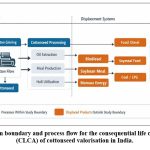 |
Figure 1: System boundary and process flow for the consequential life cycle assessment (CLCA) of cottonseed valorisation in India. |
The framework covers downstream displacement systems, cottonseed processing, and cotton farming and ginning. System expansion allows for the assessment of net energy recovery and greenhouse gas offset effects by accounting for avoided products such as coal or LPG, fossil diesel, and soybean meal. Because of their negligible impact on comparable system outcomes, capital infrastructure, farm machinery manufacturing, and post-consumer end-of-life stages were left out.
Life Cycle Inventory (LCI)
The whole life cycle inventory was created utilizing secondary data from reputable studies, peer-reviewed journal articles, and reputable sources of emission factors related to cottonseed processing, ginning, and farming. Tables 1 and 2 display the study’s LCI data. In keeping with consequential LCA’s decision-oriented approach, data were chosen to reflect average production circumstances typical of cotton-growing regions in India. To guarantee representativeness, mid-range or frequently quoted values were used when several values were published in the literature. Since all flows that significantly contributed to energy and GHG balances were kept, no cut-off criteria were used. The use of secondary data is consistent with national-scale consequential LCA practice, where the objective is to represent marginal and average system behaviour rather than site-specific performance.
Inventory for cultivation and ginning
Since the study uses a consequential LCA approach, no allocation of cultivation and ginning burdens was used at this point. In downstream stages, cottonseed is handled as a co-product whose environmental significance is captured through system extension and substitution.
Inventory for cottonseed processing
Solvent extraction was only assessed as a sensitivity scenario; expeller pressing was selected as the baseline processing method because it is the most popular technique in small and medium-sized cottonseed processing plants in India.
Key assumptions and emission factors
Emission factors for diesel, electricity, and solid fuels were obtained from published Indian and international sources and represent average values suitable for national-scale analysis. Substitution efficiencies for biodiesel, livestock feed, and biomass energy were selected conservatively based on reported ranges in the literature. To address uncertainty, key assumptions related to energy conversion efficiency, electricity mix, and substitution effectiveness were evaluated through sensitivity analysis.
Results
Table 1: Cotton Cultivation and Ginning Inventory (per FU1: 1 t (1,000 kg) seed-cotton at gin gate)
| Process stage | Input / operation | Amount per FU | Unit | Literature substantiation |
| Land preparation & sowing | Diesel for tillage | 16.5 | L | Tillage is among the most fuel-intensive field operations; conventional cotton systems typically report 35–80 L ha⁻¹ depending on number of passes and machinery, making 16.5 L per FU plausible when FU <1 ha.13-16 |
| Labour for tillage | 12.5 | man-h | Human labour commonly accounted as 1.96 MJ h⁻¹ in agricultural energy LCAs for row crops, consistent with this magnitude.13-15 | |
| Seed (Bt / non-Bt hybrid) | 4 | kg | Certified cotton hybrid seed rates under conventional densities (non-HDPS) are typically a few kg ha⁻¹ across India and Africa.17-21 | |
| Fertilization & organic amendments | Nitrogen (N) | 55 | kg | N application rates of 50–100 kg ha⁻¹ are common in conventional cotton LCAs; fertilizers are dominant energy and emission hotspots.22-24 |
| Phosphorus (P₂O₅) | 22.5 | kg | Typical P₂O₅ rates reported in cotton and energy-crop LCAs. 22,23,19 | |
| Potassium (K₂O) | 27.5 | kg | Within literature-reported K₂O application ranges for cotton.22,23 | |
| Farmyard manure (FYM) | 6.25 | t | FYM rates of 5–10 Mg ha⁻¹ combined with mineral fertilizers are common, improving soil properties and yields in arid and semi-arid cotton systems.22-24 | |
| Irrigation & energy | Irrigation water | 2,000 | m³ | Seasonal cotton water requirements range 4,000–10,000 m³ ha⁻¹; this value reflects partial, deficit, or efficient irrigation per FU.25-28 |
| Diesel for pumping | 50 | L | Pumping energy (diesel or electricity) is a recognized hotspot in irrigated cotton LCAs.14,25,26 | |
| Electricity for pumping | 50 | kWh | Mixed diesel–electric pumping reflects typical irrigation practice in many cotton-growing regions. 27,28 | |
| Pesticides & residues | Pesticides (active ingredient) | 0.175 | kg a.i. | Bt cotton substantially reduces bollworm insecticides; remaining applications for sucking pests and fungicides often total a few hundred grams a.i. ha⁻¹.17,29-31 |
| Cotton stalk residue | 1.25 | t | Cotton leaves significant stalk biomass; residue handling (burning, removal, composting) is a key LCA parameter.28,14,24 | |
| Harvest, ginning & transport | Harvest labour | 80 | man-h | Manual picking in smallholder cotton systems is highly labour intensive, often exceeding tens of hours per FU.17,23,29 |
| Ginning electricity | 25 | kWh | Electricity use for lint–seed separation is routinely included in cotton LCAs and is moderate per FU.25,14 | |
| Seed transport | 62 | t·km | Transport distance and mass yield a CO₂ intensity consistent with standard agricultural freight factors.25,14 | |
| Transport emissions | 6.2 | kg CO₂ | Based on 0.1 kg CO₂ t⁻¹ km⁻¹, a common emission factor in agri-LCAs.25,14 | |
| Outputs (co-products) | Cotton lint | 330 | kg | Lint output consistent with reported yields and lint–seed ratios used in multi-output LCA allocation.25,23,26 |
| Cotton seed | 620 | kg | Seed output aligned with gin recovery ratios reported in literature.24,32 | |
| Trash / waste | 50 | kg | Represents gin trash and impurities removed during processing.28,23 |
Values are normalized to 1 t seed-cotton assuming a field yield of 2.0 t ha⁻¹. Seed-cotton composition is lint 0.33 t (33 %), seed 0.62 t (62 %), and trash 0.05 t (5 %) per tonne of harvested seed-cotton. These fractions link the cultivation and ginning stages to subsequent seed-processing and offset systems in the consequential LCA boundary.
Table 2: Typical Inputs, Outputs, and Energy Use in Cottonseed Oil Processing
| Process stage / parameter | Flow type | Amount per t (1,000 kg) cottonseed | Unit | Function / notes | Literature substantiation |
| Cleaning and screening | Activity | 1 | t seed processed | Removal of dust, stones, and foreign matter prior to delinting and decortication | Described as first step in cottonseed post‑harvest and oil extraction (cleaning before delinting, hull removal, oil extraction).33,34 |
| Delinting and decortication | Activity | – | – | Mechanical separation of residual lint and hulls to improve oil recovery and meal quality | Cottonseed process includes cleaning, delinting, hull removal, kernel flaking, oil extraction, and meal formation.33,34 |
| Electricity consumption | Input (energy) | 80 | kWh t⁻¹ | Drives for delinter, decorticator, expeller press, conveyors, pumps, and filtration units | Cardoon pilot plant shows 0.36 MJ kg⁻¹ seed (≈0.10 kWh kg⁻¹) mechanical‑oilseed range, supporting this magnitude.35 |
| Thermal energy (steam) | Input (energy) | 120 | MJ t⁻¹ | Seed cooking and conditioning prior to mechanical pressing to improve oil yield | Frying/cooking is among the most energy‑intensive cottonseed operations (Turdiboyev & Akbarov, 2020); roasting temperature 100–105 °C in conventional lines.36 |
| Process water | Input (resource) | 0.5 | m³ t⁻¹ | Washing, cooling, and heat exchange; largely recycled in continuous systems | Typical for oilseed plants with cooling and heat exchange; water use and recycling discussed in industrial TEA and process analyses.36,37 |
| Filter aid / bleaching earth | Input (material) | 1 | kg t⁻¹ | Consumed during crude oil filtration and clarification | Cottonseed oil bleaching with 1–2.5% local adsorbents (palygorskite, bentonite) reported for refining.38 |
| Potential energy efficiency improvement | Process optimization | – | – | Advanced techniques (e.g., electropulse or enzyme-assisted extraction) can reduce energy demand by 15–20% | Electric‑pulse treatment increases oil yield by 4.5–6% and allows roasting temperature reduction from 100–105 °C to 70–75 °C, cutting energy use and operating costs per t oil by 25–30%.39-41enzyme‑assisted and aqueous enzymatic extraction highlighted as lower‑energy, greener alternatives to conventional pressing/hexane.42-45 |
| Losses (moisture, fines) | Output (residual) | 70 | kg t⁻¹ | Dust, volatiles, and uncollected material during processing | Mass loss <1% of seed mass in a prototype seed‑oil plant; rest appears as residues and slurry.39 |
| Crude cottonseed oil | Output (product) | 160 | kg t⁻¹ | Primary product; corresponds to ≈16–17% oil content of cottonseed | Cottonseed oil content typically 20–30% on dry basis; industrial chain yields 17% in mechanical systems.34,35 |
| Oil cake / meal | Output (co-product) | 450 | kg t⁻¹ | Protein-rich livestock feed; major nitrogen carrier in allocation | Meal is main co‑product and key revenue driver in oilseed TEA; high‑protein feed use emphasized.34,40 |
| Hulls / shells | Output (by-product) | 320 | kg t⁻¹ | Used as biomass fuel, animal roughage, or raw material in composites | Hulls described as major by‑product used for feed, fuel, and materials.34,37 |
| Optional recovered linters | Output (secondary) | 1–3 | kg t⁻¹ | Short fibers recovered during delinting; used in cellulose products | Delinting produces short lint fiber streams from cottonseed; secondary fiber uses covered in cottonseed reviews.34 |
Functional Unit FU2 = 1 t cottonseed entering the processing plant; expeller pressing is the base case. Yields reflect typical Indian mill conditions (oil 16%, meal 45%, hulls 32%, losses 7% by mass). Electricity and thermal energy include pressing, seed conditioning/cooking, filtration, and routine handling. Solvent route (alternative scenario, not shown in table): makeup hexane ≈ 2 kg t⁻¹ seed, electricity ≈ 90 kWh t⁻¹, thermal ≈ 900 MJ t⁻¹; higher oil recovery (≈18–19%) with reduced residual oil in meal.
Table 3: Offset Credits from Cottonseed By-Products under System Expansion (per FU2: 1 t (per 1,000 kg) cottonseed processed).
| By-Product / Co-Product | Substitution Pathway / Displaced Product | Effective Output | Energy Equiv. | Emission Credit (avoided CO₂-eq) | Basis / Assumptions | Literature substantiation |
| Oil cake / meal | Soybean meal (45% protein) displacement | 450 kg | – | 400 kg CO₂-eq | Equivalent feed value; no additional processing energy assumed | Cottonseed cake can replace soybean meal up to 100% in diets of goat kids and lambs without loss of performance or digestibility, supporting 1:1 protein-equivalent substitution.46-48 |
| Hulls / shells | Biomass combustion replaces fossil diesel for heat | 320 kg hulls @ HHV 16 MJ/kg | 5.1 GJ gross (4.1 GJ useful (80% η)) | 310 kg CO₂-eq (= 4.1 GJ × 75 kg/GJ) | Industrial heat. 80% boiler efficiency. Assumed negligible CH₄/N₂O slip. Biogenic CO₂ treated as climate-neutral. | Cotton residues (stalks, hulls, etc.) are suitable solid biofuel feedstocks, proposed to replace fossil energy and mitigate GHG emissions.49-51 |
| Linters (optional) | Substitution for cellulose pulp in paper/textiles | 2 kg | – | 3 kg CO₂-eq | Low-mass fraction (<0.3%) negligible energy impact | Cotton linters and other cotton by‑products are viable dissolving‑pulp / cellulose sources for films, acetates and composites, so linters can substitute small amounts of conventional pulp.52-56 |
| Cotton seed oil-based biodiesel conversion | Replaces mineral diesel in farm operations | 160 kg oil yields 144 kg biodiesel (@ 37.8 MJ kg⁻¹) | 5.44 GJ (144×37.8 MJ/kg) | 408 kg CO₂-eq (= 5.44 GJ × 75 kg/GJ) | 90% conversion yield; diesel EF = 2.68 kg CO₂ L⁻¹ | Cottonseed oil biodiesel can meet or exceed on‑farm diesel demand; 7 900 t biodiesel 304 million MJ vs. 145 million MJ diesel use, fully covering sectoral needs.57-60 |
| Total offset credit (upper-bound potential) | — | — | 10.5 GJ | 1120 to 1200 kg CO₂-eq avoided | Aggregated across co-products under system expansion | Synthesized from feed-substitution, biomass-fuel and biodiesel potentials above |
System Expansion follows consequential LCA logic. Each by-product displaces an equivalent external product (e.g., fossil diesel or soy meal). Emission factors: diesel = 75 kg CO₂ GJ⁻¹; grid electricity = 0.7 kg CO₂ kWh⁻¹ (FAO, 2022). Energy credit basis: heating value of hulls = 16 MJ kg⁻¹ (dry basis); biodiesel = 37.8 MJ kg⁻¹. Total offset credit (upper-bound potential) represents the maximum technical mitigation potential achievable through alternative cottonseed co-product valorization pathways. The reported offset is derived under a consequential system-expansion framework, where individual substitution routes (feed, industrial heat, and biodiesel) are conditional on market uptake and operational feasibility and may be mutually exclusive. Accordingly, the total offset should be interpreted as an upper-bound potential rather than a simultaneously realized net credit, unless concurrent implementation of all pathways can be explicitly demonstrated.
Discussion
The life-cycle inventory framework and the corresponding consequential offset potential for cotton cultivation, ginning, and cottonseed valorization are detailed in Tables 1–3. Table 1 presents the foreground inventory for cotton cultivation and ginning, normalized to FU1: 1 t (1,000 kg) of seed-cotton at the gin gate, capturing primary material and energy inputs up to seed separation. Table 2 details the typical inputs, outputs, and energy use involved in cottonseed oil processing, providing the process-level basis for downstream co-product generation. Building on these inventories, Table 3 quantifies the potential offset credits from cottonseed by-products under a system-expansion framework, expressed per FU2: 1 t (1,000 kg) of cottonseed processed. Together, these tables enable a consistent interpretation of both the direct burdens and the upper-bound mitigation potential achievable through alternative valorization pathways for cottonseed co-products, forming the basis for the discussion of substitution effects, conditional offsets, and their implications for consequential life-cycle assessment.
Fibre Production
As a by-product of the manufacturing of cotton fiber, cottonseed’s life cycle is a tightly linked bioresource system that includes four interrelated stages: cultivation, ginning, seed processing, and downstream valorization pathways. Land preparation, seeding, fertilizer and pesticide treatment, irrigation, and harvesting are all part of cotton farming. Through improved carbohydrate metabolism in developing embryos, which results in greater oil and protein content, integrated agronomic techniques including enhanced nitrogen management and high- yielding cultivars increase both lint and seed productivity.61,62 The major product, lint, and the co-product, cottonseed, are separated during the ginning process, which acts as a central interface between the fiber and bioresource chains. The fiber quality and physical integrity of the seed are influenced by the ginning technology and operating conditions, which in turn decide whether the seed is suitable for oil extraction, feed, or replanting.63-65 Cleaning, delinting, decortication, oil extraction, and meal formation are all part of post-harvest management and seed processing after ginning. Proper drying and storage are crucial for seed quality; technologies such zeolite bead drying and hermetic storage have been demonstrated to maintain viability and avoid rancidity or microbial degradation.66-69 The cottonseed derivatives oil, meal, and hulls are converted into energy, feed, or industrial inputs via offset and valorization pathways in the downstream subsystem. Meal can replace soymeal in animal feed, hulls can be used as solid biofuel in thermal systems, and cottonseed oil can be refined for consumption or turned into biodiesel.70-73
These routes are modeled utilizing system extension in the consequential LCA framework to include avoided burdens like the replacement of coal or firewood, the substitution of protein meals, and the displacement of fossil fuels. The entire range of economic and environmental connections between the cotton fiber and seed subsystems are captured by this method. These connections between the three main stages that include cotton cultivation and ginning, seed processing and refining, and downstream offset systems are depicted in the flow diagram (Figure 1). A closed-loop representation of energy recovery and carbon offset potential within the Indian cotton sector is created by tracing inputs (diesel, fertilizers, electricity, water) and outputs (lint, seed, oil, cake, hulls, emissions) across the cradle-to-gate boundary and connecting by-products to avoided systems through consequential extensions.
Cottonseed Recovery and Processing
The cottonseed recovery and processing subsystem, which uses mechanical and thermal processes to transform a secondary output into useful co-products, is an essential part of the full life cycle of cotton fiber manufacturing. Delinting and decortication, which remove leftover lint and hulls to prepare seeds for oil extraction, are important procedures.74,75 Expeller pressing, solvent extraction, ultrasound-assisted, or supercritical CO2 procedures are used to extract oil; each has a different extraction efficiency, oil yield, and environmental profile. It has been demonstrated that using ultrasound-assisted methods and green solvents can improve oil yield and quality while lowering energy consumption and solvent residue.76-79 The oil’s oxidative stability and safety for edible or industrial applications are enhanced by subsequent filtration and refining processes that eliminate contaminants, gossypol, and free fatty acids.80-82
Cottonseed oil, oil cake (meal), and hulls/shells are the system’s three main byproducts, each of which has unique advantages for the environment and the economy. When used in the production of biodiesel, cottonseed oil has relatively lower climate impacts than other vegetable oils, according to life cycle studies.83,84 Cottonseed oil is used as an edible oil, biofuel feedstock, and industrial input. Although its gossypol and aflatoxin levels need to be carefully regulated to maintain food-chain safety, oil cake offers a high-protein livestock feed that replaces soymeal and lessens the environmental impact of conventional feed crops.85,86 The lignocellulosic fraction of cottonseed hulls and shells is utilized as biomass for energy production, soil amendments, or feedstock for pyrolysis and bio-oil production, supporting the goals of the circular bioeconomy and renewable energy.87-90 By replacing fossil fuels, synthetic fertilizers, and feed proteins, these co-products collectively offer several energy and carbon offset options, extending the system boundaries and lowering the net greenhouse gas burden in a consequential LCA framework. Cottonseed can change from a conventional by- product to a multipurpose bioresource by integrating innovative extraction methods and valorization pathways, which is in line with sustainable production objectives. While combining co-product usage with avoided-burden modeling offers a comprehensive assessment of environmental performance across the food, feed, and energy sectors, mechanical and solvent system optimization increases economic value and process efficiency.
System Expansion and Substitution
The environmental advantages of cottonseed by-product valorization can be more accurately quantified by incorporating system expansion and substitution into a consequential life cycle assessment (LCA) framework. This method captures the avoided burdens and resource savings resulting from their alternative usage in energy, feed, and industrial systems by giving by- products credit for replacing traditional fossil- or crop-based products. Cottonseed oil is the most adaptable offset pathway among them. It can be transesterified into biodiesel or refined for edible usage, providing a nearly total replacement for fossil diesel in industrial and agricultural processes. Research indicates the potential for energy self-sufficiency and net greenhouse gas (GHG) reduction within the industry, as the annual output of cottonseed biodiesel can surpass the fuel energy need of cotton agriculture itself.91-93 When utilized as an edible oil, it can take the place of vegetable oils with comparable calorific value, such soybean or palm oil, reducing the environmental impact of the land and input intensities of those crops.94,95
The cottonseed cake fraction serves as a high-protein livestock feed that can replace soybean meal, which is frequently associated with high-emission supply chains and deforestation in tropical areas. Cottonseed cake can completely replace soymeal in the diets of goats, cattle, and ruminants without negatively affecting digestibility, nitrogen balance, or growth performance, according to experimental feeding studies.96-98 As a result, this substitution promotes regional feed autonomy while lowering the total carbon footprint associated with feed. In the meantime, the lignocellulosic residue from processing cottonseed hulls and shells is used as a feedstock for renewable bioenergy. According to Cui et al., Özbay et al., and Ozbay et al.,99-101 they can be used in place of coal or firewood in industrial boilers to provide thermal energy while minimizing the use of fossil fuels and the strain on unsustainably harvested wood resources.
The consequential LCA paradigm goes beyond the traditional cotton production limit by including avoided GHG emissions, fossil energy displacement, and land-use savings through the adoption of various offset mechanisms. Every substitution scenario like biodiesel for diesel, cake for soymeal, and hulls for solid fuels adds a quantifiable carbon and energy credit to the cotton system. This comprehensive accounting shows that cottonseed valorization not only improves economic circularity but also turns the crop into a net contributor to low-carbon development and renewable energy. In rising economies like India, where agricultural residues and by-products have substantial potential for decarbonization and resource efficiency, the application of system expansion thus offers a more realistic and policy-relevant portrayal of cotton’s sustainability performance. Instead of mass-based replacement, protein-equivalent substitution is assumed, in line with feed LCA practice.
Inputs, Outputs, and Energy Use in Cottonseed Oil Processing
For the expeller pressing route, which is a common small- to medium-scale industrial practice, the life cycle inventory for cottonseed processing was created. Before oil is extracted, the procedure involves cleaning and screening, then delinting and decortication to get rid of any remaining lint and hulls. With the exception of electricity needed to run the machinery, these processes mostly entail mechanical handling and separation with no direct material consumption.102,103 It was estimated that the processing line’s expeller presses, conveyors, pumps, and filtration units would consume 80 kWh t⁻¹ of electricity for cottonseed, and that the cooking and conditioning of the seed before pressing would require 120 MJ t⁻¹ of thermal energy. The amount of water used in the process was estimated to be 0.5 m³ t⁻¹ cottonseed, mostly for cooling, washing, and heat exchange. This water is usually recycled inside the facility. For oil clarification, a little material input of 1 kg t⁻¹ bleaching earth or filter assistance was added.104,105
The primary product of the expeller process is crude cottonseed oil (≈160 kg t⁻¹), which is followed by oil cake or meal (≈450 kg t⁻¹), which is used as a protein-rich livestock feed, and hulls or shells (≈320 kg t⁻¹), which can be used for biomass energy or material uses. While a limited number of recovered linters (1–3-kilogram t⁻¹) may be collected during delinting, residual losses from moisture evaporation, fines, and handling were estimated to be approximately 70 kg t⁻¹.106-108 The scenario analysis, as opposed to the base inventory, took into consideration qualitative improvements in processing energy efficiency, such as electropulse-assisted extraction, which have been reported to reduce energy demand by about 15–20%.107,109, 110
The significant energy and carbon offset potential of cottonseed by-products within the Indian cotton production system is highlighted by the system expansion analysis. With about 5.4 GJ of renewable energy and 408 kg CO2-eq averted per tonne of processed cottonseed, the conversion of cottonseed oil to biodiesel offers the biggest environmental credit among the substitution paths. This shows that the cotton system can move toward net energy positivity if the energy recovered from oil surpasses the fossil energy used during cultivation and processing. When utilized as a culinary oil, cottonseed oil offers further co-benefits by displacing vegetable oils that require a lot of land and resources, such soybean or palm oil, which lowers the demand for fertilizer and deforestation in rival systems.
A minor but important credit of about 382 kg soymeal-equivalent per tonne of cottonseed is provided by the cottonseed meal pathway. By using this protein substitute, the emissions and land use related to soybean farming which is known to have a significant risk of deforestation in tropical areas are avoided. As a result, meal usage improves feed self-sufficiency and nutritional circularity in India’s cattle industry.
The potential of leftover biomass as a renewable energy carrier is demonstrated by the hulls and shells approach, which produces an additional 144 kg coal displacement, or approximately 346 kg CO2 averted. Hulls provide a low-carbon substitute for fossil solid fuels when burned in industrial boilers or co-fired with coal, supporting India’s objectives for waste valorization and biomass energy.
A minor but important credit of about 382 kg soymeal-equivalent per tonne of cottonseed is provided by the cottonseed meal pathway. By using this protein substitute, the emissions and land use related to soybean farming which is known to have a significant risk of deforestation in tropical are avoided. As a result, meal usage improves feed self-sufficiency and nutritional circularity in India’s cattle industry.
The potential of leftover biomass as a renewable energy carrier is demonstrated by the hulls and shells approach, which produces an additional 144 kg coal displacement, or approximately 346 kg CO2 averted. Hulls provide a low-carbon substitute for fossil solid fuels when burned in industrial boilers or co-fired with coal, supporting India’s objectives for waste valorization and biomass energy.
Energy and Carbon Offset Assessment
The extent to which cottonseed by-products lessen the overall environmental burden of cotton production is measured by the integration of system expansion in this consequential LCA. As Table 3 summarizes, the primary offset pathway originates from cottonseed-oil biodiesel, which yields approximately 5.4 GJ t⁻¹ cottonseed and avoids approximately 408 kg CO₂-eq by replacing fossil diesel used in agricultural and industrial operations. The cotton system can become a net positive energy contributor by using this one replacement to offset a significant portion of the upstream energy used during growing and ginning. Cottonseed oil extends the advantages beyond the farm gate to global food-energy systems when it is redirected to edible- oil markets, further displacing vegetable oils that require a lot of land and fertilizer, like palm or soybean. By replacing feed proteins, the cottonseed-meal substitution method adds value. For every tonne of seed processed, about 382 kg of soymeal-equivalent protein are offset, reducing the expansion of soybeans linked to deforestation and the resulting emissions of nitrous oxide. By combining the production of fiber and feed into a single agricultural footprint, this strengthens cotton’s position in India’s circular bioeconomy. The use of hulls and shells as solid biofuels is a third offset channel; for each tonne of cottonseed processed, 144 kilograms of coal (about 346 kg CO2) are avoided. Hulls provide a renewable thermal energy alternative that concurrently diverts lignocellulosic leftovers from waste streams when used in industrial boilers or co-firing systems.
Combining these offset contributions reveals that, depending on the allocation strategy and local energy mix, cottonseed valorization can lower cotton’s cradle-to-gate global-warming potential (GWP) by 20–35%. These findings establish cotton as an integrated bio-resource platform that supports India’s goals for low-carbon agriculture and renewable energy, rather than just a fiber crop. These sustainability gains could be amplified at scale by policy incentives that recognize by-product credits, such as the inclusion of biodiesel in renewable fuel mandates and the certification of cottonseed cake under low-carbon feed programs. These decreases are not absolute reductions in the footprint of lint production, but rather net system-level effects.
Scenario and Sensitivity Analysis
Numerous scenario and sensitivity assessments including process technology, regional energy mixes, and allocation strategies were carried out in order to evaluate the robustness of the findings. For the cottonseed processing subsystem, two representative scenarios were modeled: a solvent-extraction route, a hybrid pre-press + solvent configuration frequently found in large Indian mills, and the baseline expeller route. The ranking of the valorization paths did not vary in any of the scenarios, demonstrating the conclusions’ structural robustness.
Technology Scenarios
The baseline expeller instance produced 16% oil, 45% meal, and 32% hulls with an average processing energy consumption of 200 MJ t⁻¹ seed (80 kWh electricity + 120 MJ steam). The solvent approach achieved higher oil recovery (18–19%) and slightly reduced residual oil in meal (from 7% to 1-2%), even though it required over 1000 MJ t⁻¹ of heat energy and a solvent composition of 2 kg t⁻¹. When used on India’s fossil-dominated thermal grid, this approach increased oil output by around 12%, but the additional fuel and solvent energy neutralized much of the GHG benefit, resulting in a net 3–5% higher carbon intensity. Solvent extraction outperformed the expeller system in terms of emissions and energy efficiency only in situations including waste-steam integration or renewable process heat. In accordance with scenario- based consequential LCA approach, these technology scenarios were assessed by altering important foreground parameters (energy demand, oil recovery, and residual oil content) based on reported literature ranges while keeping the same upstream system boundary. Cottonseed’s importance as a strategic bioresource rather than a secondary by-product is reinforced by the fact that cottonseed valorization can offset up to one-third of the cradle-to-gate GHG emissions of cotton production.
Allocation and Substitution Sensitivity
Other coproduct allocation techniques were also examined. Due to the lower market value of cottonseed compared to lint, only 38% of cultivation and ginning burdens were allocated to seed under economic allocation, compared to 62% under mass allocation. Nonetheless, system growth with replacement consistently produced the lowest net GWP, confirming its suitability for consequential modeling. Without affecting the overall ranking of paths, variations of ± 20% in replacement efficiency (for biodiesel and soymeal) changed total offsets by ± 10%.
A systematic parameter-variation technique was used for the scenario and sensitivity studies instead of plant-specific re-modeling. To evaluate the robustness of the results, important energy, yield, and substitution parameters were changed within ranges published in the literature. This method enables for the reliable comparison of various routes without over- specifying ambiguous foreground systems, and it is consistent with consequential LCA practice when primary data are missing.
According to the analysis, the most operationally viable and sustainable approach for India’s cottonseed business, especially for small and medium-sized processors, is expeller pressing with energy recovery from hulls. The cottonseed subsystem may be able to achieve net-zero or energy-positive operation under ideal circumstances if regional power decarbonization and the use of renewable or waste-derived steam systems are further improved. In accordance with consequential LCA principles, allocation results are only provided for comparison, and policy interpretation is solely predicated on system-expansion outcomes.
National-Average Life Cycle Assessment Summary and Policy Implications
An indicative national-average consequential LCA profile for cottonseed, a byproduct of India’s cotton fiber production system, is produced by combining the findings from the previous sections. Cotton production is expected to need around 7.8 GJ ha⁻¹ of energy input and emit about 2.0 t CO₂-eq ha⁻¹ under current input regimes, based on an average field output of 2.0 t seed-cotton ha⁻¹. More than half of all energy use and greenhouse gas (GHG) emissions come from the production and use of fertilizer, especially nitrogen inputs; irrigation energy and fuel for plowing are secondary sources. Although ginning adds only a little amount of energy (25 kWh t⁻¹ seed-cotton), it is nonetheless a crucial link between the systems of fiber and cottonseed products.
Cradle-to-gate emissions are significantly decreased when cottonseed by-product valorization is integrated through system expansion. The net GHG footprint is reduced by 20–35% when biodiesel, soymeal, and hull-based energy substitution are taken into account. This results in an average carbon credit of roughly 0.25–0.30 t CO₂-eq t⁻¹ seed-cotton. In terms of energy, the integrated cotton system can approach energy neutrality or, under ideal circumstances, achieve a modest net-positive balance thanks to the combined offset potential of roughly 5.4 GJ t⁻¹ cottonseed processed (from oil, meal, and hulls).
Cottonseed co-products are estimated to offer a bioenergy potential of about 0.25 EJ yr⁻¹ at the national level, which is equivalent to about 5% of industrial fuel oil consumption, as well as a carbon mitigation potential of 20–25 million tonnes CO₂-eq yr⁻¹, assuming conservative recovery and substitution efficiencies. This is based on an estimated 12.5 million hectares of cotton cultivation. The crucial importance of cottonseed valorization within India’s low-carbon and circular bioeconomy is highlighted by these indicative figures. Specifically, cottonseed meal can lessen reliance on imported protein feeds, hulls offer a feasible feedstock for decentralized biomass-based energy systems, and cottonseed-based biodiesel can partially replace imported fuel in agricultural operations.
Policy Implications
According to the results, if enabling policies acknowledge and encourage the use of cottonseed by-products, India’s cotton industry may transition from a fiber-centric system to a multi-output biorefinery model. Important steps consist of:
The incorporation of biodiesel derived from cottonseed into frameworks for carbon credits and renewable fuel mandates;
Cottonseed meal’s quality certification and institutional backing as a sustainable animal feed component to stabilize feed supply chains;
Incentives for decentralized hull-based boiler systems and biomass co-firing in textile and oilseed processing clusters; and
Promotion of region-specific life cycle assessment (LCA) databases and emission benchmarks to support data-driven policymaking under programs like the GHG Platform India and India’s Life Cycle Assessment Network (ILCAN).
India may assist national goals under the National Bioenergy Mission and India’s 2070 Net- Zero Vision by formally integrating these paths, positioning cotton as a pillar of its textile business as well as a contributor to low-carbon feed systems and renewable energy.
Conclusion
This study shows that cottonseed valorization can transform cotton production from a fiber- dominated system into a multipurpose bioresource platform by using consequential LCA with system expansion. The findings demonstrate that, in Indian conditions, energy recovery from cottonseed can significantly lower net greenhouse gas emissions and enhance system-level energy performance.
Acknowledgement
The authors sincerely acknowledge the institutional support provided during the conduct of this research. The authors also thank colleagues and domain experts whose scholarly discussions contributed to the development of the methodological framework and interpretation of results.
Funding Sources
The authors received no financial support for the research, authorship, and/or publication of this article.
Conflict of Interest
The authors declare that they have no conflict of interest, including financial, personal, or professional relationships that could have influenced the work reported in this paper.
Data Availability Statement
All data analyzed during this study are derived from published literature and publicly available sources, which are fully cited within the article. No new primary datasets were generated.
Ethics Statement
This research did not involve human participants, animal subjects, or any material that requires ethical approval.
Informed Consent Statement
This study did not involve human participants, and therefore, informed consent was not required.
Clinical Trial Registration
This research does not involve any clinical trials.
Permission to Reproduce Material from Other Sources
This manuscript does not contain any figures, tables, or text excerpts reproduced from previously published sources. All content is original and created by the authors. Therefore, no permission was required.
Author Contributions:
- Aslesha Bhargava Ravindranath: Conceptualization, Methodology, System expansion modelling, Life cycle assessment analysis, Writing – Original Draft, Visualization.
- Selvadass M: Data curation, Literature review, Validation, Writing – Review & Editing,
References
- Parthiban, R., Somasundaram, S., Vadivel, N., Anantharaju, P., Bharathiraja, S., Manibharathi, S., & Karthik, M. (2025). SWOT analysis of cotton in India. Plant Science Today. https://doi.org/10.14719/pst.8525
CrossRef - Singh, A., & Kumar, R. (2025). Resource utilization and economic analysis of cotton farming in northern India. Journal of Krishi Vigyan. https://doi.org/10.5958/2349-4433.2025.00027.2
CrossRef - Gyan, P., Sharma, H., & Kalamkar, S. (2024). The growth and export competitiveness of cotton in India. Current Agriculture Research Journal, 11(3). https://doi.org/10.12944/carj.11.3.32
CrossRef - Sunilkumar, G., Campbell, L. M., Puckhaber, L., Stipanovic, R. D., & Rathore, K. S. (2006). Engineering cottonseed for use in human nutrition by tissue-specific reduction of toxic gossypol. Proceedings of the National Academy of Sciences of the United States of America, 103(48), 18054–18059. https://doi.org/10.1073/pnas.0605389103
CrossRef - Kumar, M., Hasan, M., Choyal, P., Tomar, M., Gupta, O., Sasi, M., Changan, S., Lorenzo, J. M., Singh, S., Sampathrajan, V., Dhumal, S., Pandiselvam, R., Sharma, K., Satankar, V., Waghmare, R., Senapathy, M., Sayed, A., Dey, A., Amarowicz, R., & Kennedy, J. F. (2022). Cottonseed feedstock as a source of plant-based protein and bioactive peptides: Evidence based on biofunctionalities and industrial applications. Food Hydrocolloids, 131, 107776. https://doi.org/10.1016/j.foodhyd.2022.107776
CrossRef - Bharimalla, A., C, S., Shukla, S., Saxena, S., & Mukherjee, S. (2025). Value addition to cotton by-products. Agricultural Engineering Today. https://doi.org/10.52151/aet2022464.1613
CrossRef - Yan, Z., Li, T., Zou, G., Zhang, X., Qu, L., & Wei, Y. (2025). Probiotic fermentation of defatted cottonseed meal for sustainable foods and non-food applications. Microorganisms, 13(5). https://doi.org/10.3390/microorganisms13051020
CrossRef - Wang, T., Yu, D., Wang, J., Yang, B., & Xu, S. (2025). Sustainable utilization of cottonseed meal: Integrated protein extraction and detoxification using deep eutectic solvents. Food Chemistry, 485, 144499. https://doi.org/10.1016/j.foodchem.2025.144499
CrossRef - Ardente, F., & Cellura, M. (2012). Economic allocation in life cycle assessment. Journal of Industrial Ecology, 16(3), 387–398. https://doi.org/10.1111/j.1530-9290.2011.00434.x
CrossRef - Ekvall, T. (2019). Attributional and consequential life cycle assessment. In Sustainability Assessment at the 21st Century. IntechOpen. https://doi.org/10.5772/intechopen.89202
CrossRef - Aldama, D., Grassauer, F., Zhu, Y., Ardestani-Jaafari, A., & Pelletier, N. (2023). Allocation methods in life cycle assessments (LCAs) of agri-food co-products and food waste valorization systems: Systematic review and recommendations. Journal of Cleaner Production, 138488. https://doi.org/10.1016/j.jclepro.2023.138488
CrossRef - Zhao, X., & You, F. (2021). Consequential life cycle assessment and optimization of high-density polyethylene plastic waste chemical recycling. ACS Sustainable Chemistry & Engineering, 9(32), 10976–10989. https://doi.org/10.1021/acssuschemeng.1c03587
CrossRef - Saldukaitė-Sribikė, L., Šarauskis, E., Buragienė, S., Adamavičienė, A., Velička, R., Kriaučiūnienė, Z., & Savickas, D. (2022). Effect of Tillage and Sowing Technologies Nexus on Winter Wheat Production in Terms of Yield, Energy, and Environment Impact. Agronomy. https://doi.org/10.3390/ agronomy 12112713
CrossRef - Vatsanidou, A., Kavalaris, C., Fountas, S., Katsoulas, N., & Gemtos, T. (2020). A Life Cycle Assessment of Biomass Production from Energy Crops in Crop Rotation Using Different Tillage System. Sustainability, 12, 6978. https://doi.org/10.3390/su12176978
CrossRef - Liang, X., Rehman, S., Zhiqi, W., Raza, M., Haider, I., Khalid, M., Saeed, A., Iqbal, Z., Fatima, S., Siddiqa, A., Ansar, M., Ijaz, S., & , Z. (2024). Impacts of Conservation Tillage on Agricultural Land Development: A Review. Journal of Soil Science and Plant Nutrition, 25, 428 – 449. https://doi.org/10.1007/s42729-024-02142-9
CrossRef - Juraev, F., KHamroyev, G., KHaydarova, Z., KHamroyev, I., & Ibodov, I. (2021). The usage of a combined machine in the process of preparing the land for planting. **, 264, 04092. https://doi.org/10.1051/e3sconf/202126404092
CrossRef - Peshin, R., Hansra, B., Singh, K., Nanda, R., Sharma, R., Yangsdon, S., & Kumar, R. (2021). Long-term impact of Bt cotton: An empirical evidence from North India. Journal of Cleaner Production, 312, 127575. https://doi.org/10.1016/j.jclepro.2021.127575
CrossRef - Kedisso, E., Guenthner, J., Maredia, K., Elagib, T., Oloo, B., & Assefa, S. (2023). Sustainable access of quality seeds of genetically engineered crops in Eastern Africa – Case study of Bt Cotton. GM Crops & Food, 14, 1 – 23. https://doi.org/10.1080/21645698.2023.2210134
CrossRef - Zhang, Z., Wang, J., Huang, W., Han, Y., Wang, G., Feng, L., Li, X., Xiong, S., Xin, M., Li, Y., & Wang, Z. (2024). Respective Advantages of Growing Different Green Manure With Nitrogen Fertilization in Cotton‐Based Cropping Systems: Insights From a Three‐Year Field Study. Food and Energy Security. https://doi.org/10.1002/fes3.70015
CrossRef - Gutierrez, A., Kenmore, P., & Ponti, L. (2023). Hybrid Bt cotton is failing in India: cautions for Africa. Environmental Sciences Europe, 35, 1-8. https://doi.org/10.1186/s12302-023-00804-6
CrossRef - Muhammad, A., Wei, Y., Meng, Z., Wang, Y., Ye, Y., Wang, Y., He, H., Zhou, Q., Li, Y., Wang, P., Li, X., Yan, L., Malik, W., Guo, S., Chu, C., Zhang, R., & Liang, C. (2022). Increasing floral visitation and hybrid seed production mediated by beauty mark in Gossypium hirsutum. Plant Biotechnology Journal, 20, 1274 – 1284. https://doi.org/10.1111/pbi.13805
CrossRef - Ramazanoğlu, E., Beyyavaş, V., Cevheri, C., Sakin, E., & Yilmaz, Ş. (2024). Effects of farmyard manure and chemical fertilizer application rates on soil biology, cotton and fiber yield. Notulae Botanicae Horti Agrobotanici Cluj-Napoca. https://doi.org/10.15835/nbha52313838
CrossRef - Ahmad, S., Ghaffar, A., Rahman, M., Hussain, I., Iqbal, R., Haider, G., Khan, M., Ikram, R., Hussnain, H., & Bashir, M. (2021). Effect of Application of Biochar, Poultry and Farmyard Manures in Combination with Synthetic Fertilizers on Soil Fertility and Cotton Productivity under Arid Environment. Communications in Soil Science and Plant Analysis, 52, 2018 – 2031. https://doi.org/10.1080/00103624.2021.1908324
CrossRef - Zhao, Y., Bian, Q., Dong, Z., Rao, X., Wang, Z., Fu, Y., & Chen, B. (2025). The input of organic fertilizer can improve soil physicochemical properties and increase cotton yield in southern Xinjiang. Frontiers in Plant Science, 15. https://doi.org/10.3389/fpls.2024.1520272
CrossRef - Koudahe, K., Aguilar, J., Djaman, K., & Sheshukov, A. (2024). Evapotranspiration, fiber yield and quality, and water productivity of cotton (Gossypium hirsutum L.) under different irrigation technologies in a semiarid climate. Irrigation Science, 42, 575 – 594. https://doi.org/10.1007/s00271-024-00922-w
CrossRef - Sivanesan, M., Somasundaram, S., Raju, M., Anantharaju, P., Raja, B., & Rani, T. (2025). Advancing irrigation practices for sustainable cotton production: A comprehensive review of methods, models and water use efficiency. Plant Science Today. https://doi.org/10.14719/pst.7750
CrossRef - Shareef, M., Gui, D., Zeng, F., Waqas, M., Zhang, B., & Iqbal, H. (2018). Water productivity, growth, and physiological assessment of deficit irrigated cotton on hyperarid desert-oases in northwest China. Agricultural Water Management, 206, 1-10. https://doi.org/10.1016/j.agwat.2018.04.042
CrossRef - Koudahe, K., Sheshukov, A., Aguilar, J., & Djaman, K. (2021). Irrigation-Water Management and Productivity of Cotton: A Review. Sustainability. https://doi.org/10.3390/su131810070
CrossRef - Khan, M., Mahmood, H., & Damalas, C. (2015). Pesticide use and risk perceptions among farmers in the cotton belt of Punjab, Pakistan. Crop Protection, 67, 184-190. https://doi.org/10.1016/ j.cropro. 2014.10.013
CrossRef - Nageswari, R., Kumar, T., Anitha, R., Dhanushkodi, V., Sujatha, K., Satheeshkumar, N., Rajarathinam, P., Somasundaram, S., Rathika, S., & , R. (2025). Impact of weed management practices on weed control efficiency and fibre quality in cotton under the high-density planting system. Plant Science Today. https://doi.org/10.14719/pst.6221
CrossRef - Brookes, G. (2022). Genetically Modified (GM) Crop Use 1996–2020: Environmental Impacts Associated with Pesticide Use Change. GM Crops & Food, 13, 262 – 289. https://doi.org/10.1080/ 21645698.2022.2118497
CrossRef - Zhang, T., Xuan, L., Mao, Y., & Hu, Y. (2023). Cotton heterosis and hybrid cultivar development. Theoretical and Applied Genetics, 136, 1-14. https://doi.org/10.1007/s00122-023-04334-w
CrossRef - Bridges, C., Hardin, R., & McClurkin-Moore, J. (2024). Changes in cottonseed meal quality during post-harvest processing of cottonseed. Journal of Stored Products Research. https://doi.org/10.1016/j.jspr.2024.102371
CrossRef - Riaz, T., Iqbal, M., Mahmood, S., Yasmin, I., Leghari, A., Rehman, A., Mushtaq, A., Ali, K., Azam, M., & Bilal, M. (2021). Cottonseed oil: A review of extraction techniques, physicochemical, functional, and nutritional properties. Critical Reviews in Food Science and Nutrition, 63, 1219 – 1237. https://doi.org/10.1080/10408398.2021.1963206
CrossRef - Turdiboyev, A., & Akbarov, D. (2020). The new production of electrotechnology cottonseed oil and energy efficiency rating. IOP Conference Series: Materials Science and Engineering, 883. https://doi.org/10.1088/1757-899x/883/1/012115
CrossRef - Ibragimov, M., Turdiboyev, A., & Akbarov, D. (2021). Effects of electric pulse processing in increasing the efficiency of cotton oil from technical seeds. IOP Conference Series: Earth and Environmental Science, 939. https://doi.org/10.1088/1755-1315/939/1/012004
CrossRef - Cravotto, C., Claux, O., Bartier, M., Fabiano‐Tixier, A., & Tabasso, S. (2023). Leading Edge Technologies and Perspectives in Industrial Oilseed Extraction. Molecules, 28. https://doi.org/10.3390/molecules28165973
CrossRef - Suvanova, F., Kholmurodova, Z., & Saidov, A. (2024). Features of bleaching cottonseed oil with local adsorbents. E3S Web of Conferences. https://doi.org/10.1051/e3sconf/202453902012
CrossRef - Temporim, R., Petrozzi, A., Coccia, V., Cotana, F., & Cavalaglio, G. (2020). A Prototype Plant for Oilseed Extraction: Analysis of Mass and Energy Flows. Sustainability. https://doi.org/10.3390/su12229786
CrossRef - Lavenburg, V., Rosentrater, K., & Jung, S. (2021). Extraction Methods of Oils and Phytochemicals from Seeds and Their Environmental and Economic Impacts. Processes. https://doi.org/10.3390/pr9101839
CrossRef - Kalkan, E., & Maskan, M. (2025). A Green Approach: Optimization of Ultrasound and Homogenization-Assisted Ethyl Acetate Extraction of Cottonseed Oil Using Natural Deep Eutectic Solvent as a Novel Co-solvent. Food and Bioprocess Technology, 18, 5782 – 5813. https://doi.org/10.1007/s11947-025-03801-0
CrossRef - Liu, J., Gasmalla, M., Li, P., & Yang, R. (2016). Enzyme-assisted extraction processing from oilseeds: Principle, processing and application. Innovative Food Science and Emerging Technologies, 35, 184-193. https://doi.org/10.1016/j.ifset.2016.05.002
CrossRef - Dunford, N. (2022). Enzyme aided oil and oilseed processing: opportunities and challenges. Current Opinion in Food Science. https://doi.org/10.1016/j.cofs.2022.100943
CrossRef - Mwaurah, P., Kumar, S., Kumar, N., Attkan, A., Panghal, A., Singh, V., & Garg, M. (2020). Novel oil extraction technologies: Process conditions, quality parameters, and optimization. Comprehensive reviews in food science and food safety, 19 1, 3-20. https://doi.org/10.1111/1541-4337.12507
CrossRef - Vovk, H., Karnpakdee, K., Ludwig, R., & Nosenko, T. (2023). Enzymatic Pretreatment of Plant Cells for Oil Extraction. Food Technology and Biotechnology, 61, 160 – 178. https://doi.org/10.17113/ftb.61.02.23.7896
CrossRef - Assis, D., De Carvalho, G., Santos, E., De Oliveira, F., De Araújo, M., Pina, D., Santos, S., & De Almeida Rufino, L. (2018). Cottonseed cake as a substitute of soybean meal for goat kids. Italian Journal of Animal Science, 18, 124 – 133. https://doi.org/10.1080/1828051x.2018.1490633
CrossRef - De Assis, D., De Oliveira, F., Santos, E., De Gouvêa, A., De Carvalho, B., Nascimento, C., Cirne, L., Pina, D., Pires, A., Alba, H., & De Carvalho, G. (2021). Carcass and meat traits of goats fed diets containing cottonseed cake. Archives Animal Breeding, 64, 395 – 403. https://doi.org/10.5194/aab-64-395-2021
CrossRef - Silva, R., Carvalho, G., Pires, A., Pereira, M., Pereira, L., Campos, F., Perazzo, A., Araújo, M., Nascimento, C., Santos, S., Tosto, M., Rufino, L., & Carvalho, B. (2016). Cottonseed cake in substitution of soybean meal in diets for finishing lambs. Small Ruminant Research, 137, 183-188. https://doi.org/10.1016/j.smallrumres.2016.03.014
CrossRef - Bharimalla, A., C, S., Shukla, S., Saxena, S., & Mukherjee, S. (2025). Value Addition to Cotton By-Products. Agricultural Engineering Today. https://doi.org/10.52151/aet2022464.1613
CrossRef - Yong, K., & Wu, T. (2022). Second-generation bioenergy from oilseed crop residues: Recent technologies, techno-economic assessments and policies. Energy Conversion and Management. https://doi.org/10.1016/j.enconman.2022.115869
CrossRef - R, V., S., S., & Ar, V. (2021). Evaluation of Biogas Through Chemically Treated Cottonseed Hull in Anaerobic Digestion With/Without Cow Dung: an Experimental Study. BioEnergy Research, 16, 660-672. https://doi.org/10.1007/s12155-022-10436-y
CrossRef - Tiller, P., Park, S., Sanders, J., Treasure, T., & Park, S. (2025). Evaluating the quality and processability of cotton linter-derived cellulose acetate by characterization of native and artificial fines. Cellulose, 32, 2989 – 3005. https://doi.org/10.1007/s10570-025-06449-3
CrossRef - Yadollahi, R., Firouzabadi, M., Mahdavi, H., Resalati, H., Saraeyan, A., & Sixta, H. (2024). The effect of high crystallinity of pulp in the preparation of cellulose acetate film with iodine as a catalyst. Cellulose, 32, 763 – 774. https://doi.org/10.1007/s10570-024-06320-x
CrossRef - Zhang, X., Zhang, F., Li, P., & Tong, G. (2023). Synthesis of cellulose triacetate from softwood dissolving pulp using p-toluenesulfonic acid and its properties. Cellulose, 30, 6787 – 6797. https://doi.org/10.1007/s10570-023-05294-6
CrossRef - Cheng, H., Dowd, M., Selling, G., & Biswas, A. (2010). Synthesis of cellulose acetate from cotton byproducts. Carbohydrate Polymers, 80, 449-452. https://doi.org/10.1016/j.carbpol.2009.11.048
CrossRef - Lu, Y., Weng, L., & Cao, X. (2005). Biocomposites of plasticized starch reinforced with cellulose crystallites from cottonseed linter. Macromolecular bioscience, 5 11, 1101-7. https://doi.org/10.1002/mabi.200500094
CrossRef - Park, G., Park, J., Kim, J., Lee, D., & Kwon, E. (2025). Use of defatted cottonseed-derived biochar for biodiesel production: a closed-loop approach. Biochar, 7. https://doi.org/10.1007/s42773-024-00394-3
CrossRef - Naik, G., Dharmadhikari, H., More, S., & Sarris, I. (2025). The Optimization of a Ternary Blend Using Grey Relation Analysis with the Taguchi Method for the Improved Performance and Reduction of Exhaust Emissions. Fire. https://doi.org/10.3390/fire8020083
CrossRef - Silva, R., Carvalho, G., Pires, A., Pereira, M., Pereira, L., Campos, F., Perazzo, A., Bezerra, L., Moreira, J., & Rufino, L. (2016). Nitrogen balance, microbial protein synthesis and ingestive behavior of lambs fed diets containing cottonseed cake in substitution of soybean meal. Semina-ciencias Agrarias, 37, 2155-2166. https://doi.org/10.5433/1679-0359.2016v37n4p2155
CrossRef - Rajamohan, S., Suresh, S., Mallinathan, S., Harigopal, A., Nguyen, V., Engel, D., Ahmed, S., & Le, T. (2022). Optimization of operating parameters for diesel engine fuelled with bio-oil derived from cottonseed pyrolysis. Sustainable Energy Technologies and Assessments. https://doi.org/10.1016/j.seta.2022.102202
CrossRef - Yang, H., Zhang, X., Chen, B., Meng, Y., Wang, Y., Zhao, W., & Zhou, Z. (2017). Integrated management strategies increase cottonseed, oil and protein production: The key role of carbohydrate metabolism. Frontiers in Plant Science, 8, 48. https://doi.org/10.3389/fpls.2017.00048
CrossRef - Wu, M., Pei, W., Wedegaertner, T., Zhang, J., & Yu, J. (2022). Genetics, breeding and genetic engineering to improve cottonseed oil and protein: A review. Frontiers in Plant Science, 13, 864850. https://doi.org/10.3389/fpls.2022.864850
CrossRef - Majumdar, G., Singh, S., & Shukla, S. (2019). Seed production, harvesting, and ginning of cotton. In D. Basu (Ed.), Cotton Production (pp. 145–162). Wiley-Blackwell. https://doi.org/10.1002/9781119385523.ch8
CrossRef - Togola, M., Gourlot, J., Bachelier, B., Coulibaly, M., Traoré, A., & Gozé, E. (2024). Measuring the impact of ginning stages on cotton fiber quality in the context of West and Central Africa. Textile Research Journal, 94(11–12), 2528–2542. https://doi.org/10.1177/00405175241248426
CrossRef - Sharma, M. (2014). New trends in cotton ginning and cotton seed processing. Social Science Research Network. https://doi.org/10.2139/ssrn.2494777
CrossRef - Afzal, I., Kamran, M., Basra, S., Khan, S., Mahmood, A., Farooq, M., & Tan, D. (2020). Harvesting and post-harvest management approaches for preserving cottonseed quality. Industrial Crops and Products, 155, 112842. https://doi.org/10.1016/j.indcrop.2020.112842
CrossRef - Kamran, M., Afzal, I., Basra, S., Mahmood, A., & Sarwar, G. (2020). Harvesting and post-harvest management for improving seed quality and subsequent crop yield of cotton. Crop and Pasture Science, 71(11), 1041–1049. https://doi.org/10.1071/CP20129
CrossRef - Motevali, A., Hooshmandzadeh, N., Fayyazi, E., Valipour, M., & Yue, J. (2023). Environmental impacts of biodiesel production cycle from farm to manufactory: An application of sustainable systems engineering. Atmosphere, 14(2), 399. https://doi.org/10.3390/atmos14020399
CrossRef - Bridges, C., Hardin, R., & McClurkin-Moore, J. (2024). Changes in cottonseed meal quality during post-harvest processing of cottonseed. Journal of Stored Products Research, 107, 102371. https://doi.org/10.1016/j.jspr.2024.102371
CrossRef - Lima, Â., Torres, E., Kiperstok, A., & Santos, G. (2017). Environmental impacts of the biodiesel production chain of cotton seed in Bahia, Brazil. Clean Technologies and Environmental Policy, 19(6), 1523–1534. https://doi.org/10.1007/s10098-017-1347-8
CrossRef - Avadí, A., Marcin, M., Biard, Y., Renou, A., Gourlot, J., & Basset-Mens, C. (2020). Life cycle assessment of organic and conventional non-Bt cotton products from Mali. The International Journal of Life Cycle Assessment, 25(4), 678–697. https://doi.org/10.1007/s11367-020-01731-x
CrossRef - Daystar, J., Barrera, J., Pires, S., Wallace, M., Shah, P., Bayramova, J., Mertens, J., & Laurin, L. (2024). Beyond economic allocation: Investigating alternative coproduct treatment methods in cotton life cycle assessments. Journal of the ASABE, 67(3), 905–917. https://doi.org/10.13031/ja.15419
CrossRef - Mullenix, K., & Stewart, L. (2021). Cotton byproduct use in Southeastern beef cattle diets: Quality, intake, and changes in feed characteristics. Journal of Animal Science, 99(Supplement 1), 18–19. https://doi.org/10.1093/jas/skab096.031
CrossRef - Bridges, C., Hardin, R., & McClurkin-Moore, J. (2024). Changes in cottonseed meal quality during post-harvest processing of cottonseed. Journal of Stored Products Research, 107, 102371. https://doi.org/10.1016/j.jspr.2024.102371
CrossRef - Shahidi, F., Oh, W., Wan, P., & Wakelyn, P. (2020). Cottonseed oil. In Bailey’s Industrial Oil and Fat Products (Vol. 6). Wiley. https://doi.org/10.1002/047167849X.bio022.pub2
CrossRef - Riaz, T., Iqbal, M., Mahmood, S., et al. (2021). Cottonseed oil: A review of extraction techniques, physicochemical, functional, and nutritional properties. Critical Reviews in Food Science and Nutrition, 63, 1219–1237. https://doi.org/10.1080/10408398.2021.1963206
CrossRef - Rojo-Gutiérrez, E., Buenrostro-Figueroa, J., Natividad-Rangel, R., Romero-Romero, R., Sepulveda, D., & Baeza-Jiménez, R. (2020). Effect of different extraction methods on cottonseed oil yield. Revista Mexicana de Ingeniería Química, 19(3), 881–894. https://doi.org/10.24275/rmiq/alim1704
CrossRef - Kalkan, E., & Maskan, M. (2024). Ultrasound- and homogenization-assisted extraction of cottonseed oil using ethyl acetate: Optimization and evaluation of oil quality and energy aspect. Food and Bioprocess Technology, 17(5), 1456–1472. https://doi.org/10.1007/s11947-024-03582-y
CrossRef - Bhattacharjee, P., Singhal, R., & Tiwari, S. (2007). Supercritical carbon dioxide extraction of cottonseed oil. Journal of Food Engineering, 79(3), 892–898. https://doi.org/10.1016/j.jfoodeng.2006.03.009
CrossRef - Shahidi, F., Oh, W., Wan, P., & Wakelyn, P. (2020). Cottonseed oil. In Bailey’s Industrial Oil and Fat Products (Vol. 6). Wiley. https://doi.org/10.1002/047167849X.bio022.pub2
CrossRef - Ye, Y., Khushvakov, J., Boboev, A., Akramova, R., Yunusov, O., Dalimova, D., Turdikulova, S., Mirzaakhmedov, S., Engelsen, S. B., & Khakimov, B. (2022). Effect of refinement and production technology on the molecular composition of edible cottonseed oils from a large industrial-scale production. Journal of Functional Foods, 95, 105326. https://doi.org/10.1016/j.jff.2022.105326
CrossRef - Kumar, M., Zhang, B., Potkule, J., Sharma, K., R., H., Hano, C., Sheri, V., Chandran, D., Dhumal, S., Dey, A., Rais, N., Senapathy, M., Natta, S., Viswanathan, S., Mohankumar, P., & Lorenzo, J. (2022). Cottonseed oil: Extraction, characterization, health benefits, safety profile, and application. Food Analytical Methods, 16(1), 266–280. https://doi.org/10.1007/s12161-022-02410-3
CrossRef - Prado, V., Daystar, J., Pires, S., Wallace, M., & Laurin, L. (2021). Comparative life cycle assessment of edible vegetable frying oils. Transactions of the ASABE, 64(5), 1677–1689. https://doi.org/10.13031/trans.14515
CrossRef - Rajamohan, S., Suresh, S., Mallinathan, S., Harigopal, A., Nguyen, V., Engel, D., Ahmed, S., & Le, T. (2022). Optimization of operating parameters for diesel engine fuelled with bio-oil derived from cottonseed pyrolysis. Sustainable Energy Technologies and Assessments, 52, 102202. https://doi.org/10.1016/j.seta.2022.102202
CrossRef - Bridges, C., Hardin, R., & McClurkin-Moore, J. (2024). Changes in cottonseed meal quality during post-harvest processing of cottonseed. Journal of Stored Products Research, 107, 102371. https://doi.org/10.1016/j.jspr.2024.102371
CrossRef - De Oliveira Filho, J., Bertolo, M., Gautério, G., De Mendonça, G., Lemes, A., & Egea, M. (2021). Bioactive phytochemicals from cotton (Gossypium hirsutum) seed oil processing by-products. In Reference Series in Phytochemistry. Springer. https://doi.org/10.1007/978-3-030-63961-7_8-1
CrossRef - Ozbay, N., Pütün, A., & Pütün, E. (2006). Bio-oil production from rapid pyrolysis of cottonseed cake: Product yields and compositions. International Journal of Energy Research, 30(9), 615–625. https://doi.org/10.1002/er.1165
CrossRef - Özbay, N., Pütün, A., Uzun, B., & Pütün, E. (2001). Biocrude from biomass: Pyrolysis of cottonseed cake. Renewable Energy, 24(4), 615–625. https://doi.org/10.1016/S0960-1481(01)00048-9
CrossRef - Pütün, E., Uzun, B., & Pütün, A. (2006). Production of bio-fuels from cottonseed cake by catalytic pyrolysis under steam atmosphere. Biomass and Bioenergy, 30(7), 592–598. https://doi.org/10.1016/j.biombioe.2005.12.004
CrossRef - Afraz, M., Nisar, J., Shah, A., Ali, G., Muhammad, F., Anwar, F., & Ghani, W. (2024). Thermo-catalytic decomposition of cotton seed press cake over nickel doped zeolite Y, hydrogen: Enhanced yield of bio-oil with highly selective fuel-range hydrocarbons. RSC Advances, 14(47), 31549–31559. https://doi.org/10.1039/d4ra06163b
CrossRef - Park, G., Park, J., Kim, J., Lee, D., & Kwon, E. (2025). Use of defatted cottonseed-derived biochar for biodiesel production: A closed-loop approach. Biochar, 7(1), 32. https://doi.org/10.1007/s42773-024-00394-3
CrossRef - Vellaiyan, S. (2024). Experimental study on energy and environmental impacts of alcohol-blended water emulsified cottonseed oil biodiesel in diesel engines. Results in Engineering, 21, 102873. https://doi.org/10.1016/j.rineng.2024.102873
CrossRef - Motevali, A., Hooshmandzadeh, N., Fayyazi, E., Valipour, M., & Yue, J. (2023). Environmental impacts of biodiesel production cycle from farm to manufactory: An application of sustainable systems engineering. Atmosphere, 14(2), 399. https://doi.org/10.3390/atmos14020399
CrossRef - Daystar, J., Barrera, J., Pires, S., Wallace, M., Shah, P., Bayramova, J., Mertens, J., & Laurin, L. (2024). Beyond economic allocation: Investigating alternative coproduct treatment methods in cotton life cycle assessments. Journal of the ASABE, 67(3), 905–917. https://doi.org/10.13031/ja.15419
CrossRef - Motevali, A., Hooshmandzadeh, N., Fayyazi, E., Valipour, M., & Yue, J. (2023). Environmental impacts of biodiesel production cycle from farm to manufactory: An application of sustainable systems engineering. Atmosphere, 14(2), 399. https://doi.org/10.3390/atmos14020399
CrossRef - Assis, D., De Carvalho, G., Santos, E., De Oliveira, F., De Araújo, M., Pina, D., Santos, S., & De Almeida Rufino, L. (2018). Cottonseed cake as a substitute of soybean meal for goat kids. Italian Journal of Animal Science, 18(1), 124–133. https://doi.org/10.1080/1828051x.2018.1490633
CrossRef - Gonçalves, D., Lima, G., Chirinda, A., Silva, T., Saldanha, R., Mendes, R., Ribeiro, K., Alba, H., Araújo, M., Pina, D., Rodrigues, C., & Carvalho, G. (2025). Gliricidia hay replacing ground corn and cottonseed cake in total mixed rations silages based on spineless cactus. Agriculture, 15(8), 873. https://doi.org/10.3390/agriculture15080873
CrossRef - Mendes, R., Oliveira, G., De Araújo, M., Alba, H., Lima, C., Pina, D., Santos, E., Saldanha, R., Santos, S., & Carvalho, G. (2025). Microbial additive isolated from exotic semi-arid cactus and cottonseed byproduct in sustainable sorghum silage production. Sustainability, 17(10), 4595. https://doi.org/10.3390/su17104595
CrossRef - Cui, J., Fang, D., Tian, X., Peng, J., Chen, D., Xu, S., & Li, L. (2023). Sustainable conversion of cottonseed hulls to valuable proanthocyanidins through ultrasound-assisted deep eutectic solvent extraction. Ultrasonics Sonochemistry, 100, 106605. https://doi.org/10.1016/j.ultsonch.2023.106605
CrossRef - Ozbay, N., Pütün, A., & Pütün, E. (2006). Bio-oil production from rapid pyrolysis of cottonseed cake: Product yields and compositions. International Journal of Energy Research, 30(9), 615–625. https://doi.org/10.1002/er.1165
CrossRef - Özbay, N., Pütün, A., Uzun, B., & Pütün, E. (2001). Biocrude from biomass: Pyrolysis of cottonseed cake. Renewable Energy, 24(4), 615–625. https://doi.org/10.1016/S0960-1481(01)00048-9
CrossRef - Bridges, C., Hardin, R., & McClurkin-Moore, J. (2024). Changes in cottonseed meal quality during post-harvest processing of cottonseed. Journal of Stored Products Research, 107, 102371. https://doi.org/10.1016/j.jspr.2024.102371
CrossRef - Ibragimov, M., Turdiboyev, A., & Akbarov, D. (2021). Effects of electric pulse processing in increasing the efficiency of cotton oil from technical seeds. IOP Conference Series: Earth and Environmental Science, 939, 012004. https://doi.org/10.1088/1755-1315/939/1/012004
CrossRef - Turdiboyev, A., & Akbarov, D. (2020). The new production of electrotechnology cottonseed oil and energy efficiency rating. IOP Conference Series: Materials Science and Engineering, 883, 012115. https://doi.org/10.1088/1757-899x/883/1/012115
CrossRef - Ibragimov, M., Turdiboyev, A., & Akbarov, D. (2021). Effects of electric pulse processing in increasing the efficiency of cotton oil from technical seeds. IOP Conference Series: Earth and Environmental Science, 939, 012004. https://doi.org/10.1088/1755-1315/939/1/012004
CrossRef - Bridges, C., Hardin, R., & McClurkin-Moore, J. (2024). Changes in cottonseed meal quality during post-harvest processing of cottonseed. Journal of Stored Products Research, 107, 102371. https://doi.org/10.1016/j.jspr.2024.102371
CrossRef - Ibragimov, M., Turdiboyev, A., & Akbarov, D. (2021). Effects of electric pulse processing in increasing the efficiency of cotton oil from technical seeds. IOP Conference Series: Earth and Environmental Science, 939, 012004. https://doi.org/10.1088/1755-1315/939/1/012004
CrossRef - Riaz, T., Iqbal, M., Mahmood, S., et al. (2021). Cottonseed oil: A review of extraction techniques, physicochemical, functional, and nutritional properties. Critical Reviews in Food Science and Nutrition, 63, 1219–1237. https://doi.org/10.1080/10408398.2021.1963206
CrossRef - Turdiboyev, A., & Akbarov, D. (2020). The new production of electrotechnology cottonseed oil and energy efficiency rating. IOP Conference Series: Materials Science and Engineering, 883, 012115. https://doi.org/10.1088/1757-899x/883/1/012115
CrossRef - Ye, Y., Khushvakov, J., Boboev, A., Akramova, R., Yunusov, O., Dalimova, D., Turdikulova, S., Mirzaakhmedov, S., Engelsen, S. B., & Khakimov, B. (2022). Effect of refinement and production technology on the molecular composition of edible cottonseed oils from a large industrial-scale production. Journal of Functional Foods, 95, 105326. https://doi.org/10.1016/j.jff.2022.105326
CrossRef
Abbreviations List
ALCA – Attributional Life Cycle Assessment
CLCA – Consequential Life Cycle Assessment CO₂-eq – Carbon Dioxide Equivalent
FU – Functional Unit
GHG – Greenhouse Gas
GWP – Global Warming Potential HHV – Higher Heating Value LCA – Life Cycle Assessment
0 Replies to “Consequential Life Cycle Assessment of Cottonseed as a By- product of Cotton Fibre Production in India with Energy and Carbon Offset Evaluation”