


 PDF Downloads:
343
PDF Downloads:
343


Introduction
Cashew (Anacardium occidentale L.) a member of Anacardiaceae family, is also known as the Gold mine, Poor man’s crop and Rich man’s food.1 There are 33 countries that cultivate cashew globally, and India is one of the top producers. India produces more than 0.8 million tons of cashew nuts from 0.7 million hectares of land.2 Maharashtra, Goa, Karnataka, Kerala, Tamil Nadu, Andhra Pradesh, Odisha, West Bengal and some parts of North Eastern states grow cashew.3 In 2017, Maharashtra, Goa, Andhra Pradesh and Odisha produced 60% of India’s total cashew nut production with about 449 thousand MT.4
One of the main constraints for getting maximum production in cashew is prevalence of pests. The cashew stem and root borer, tea mosquito bug, inflorescence thrips and apple and nut borer are the major pests that damage cashew particularly in the west coast of Maharashtra.5 These insects cause 30–50% losses in cashew due to blossom blight, shoot necrosis and damage to apple and nuts.6 Tea mosquito bug alone contribute to 20-60% of the crop loss. Cashew growers lose more than 30% of their profits because of inflorescence blight. Fruit bats mainly transport cashew apples along with nuts and spread them where bats often go. Pteropus giganteus ate 18% of the cashews during the fruiting season.7 Mostly, cashew growers collect fallen nuts every day to keep rodents, birds and thieves away.
However, cashew producing areas like Konkan region of Maharashtra, Goa and northern parts of Karnataka have been plucking green cashew nuts for their soft, fresh kernels for culinary purpose. This traditional practice is now becoming more popular in the urban areas. Plucking green cashew nuts to get tender kernels could help to reduce the pre-harvest losses and maximize the returns due to with minimum requirement of processing. Identifying optimal harvest stage of green cashew nut for high quality tender kernels is quite difficult. Particularly in Konkan region of Maharashtra, early harvesting of tender cashew nuts led to poor size, inferior texture, reduced recovery and lowered the market value of the produce;8 while, late harvesting exhibited over maturity which resulted in loss in tenderness and increased hardness. Therefore, standardization of optimum harvest stage for tender cashew kernels is essential for obtaining quality produce, increase the market value and provide maximum returns to the cashew growers. So far, no studies have been conducted on the standardization of optimum harvest stage with respect to proximate composition including moisture, protein, fat and carbohydrates of tender kernel for culinary purposes. This study was conducted to enhance the income of cashew producers through minimizing pre-harvest losses.
Materials and Methods
The experiment was carried out during the cashew fruiting season in 2023 and 2024 at Cashew Farm of the Regional Fruit Research Station, Vengurla, Sindhudurg, Maharashtra. Vengurla-4, the most popular variety among the cashew growers, was chosen for the study. The experiment was conducted with five treatments, replicated four times in Randomized Block Design. The five different harvesting stages of cashew nuts were selected in accordance with BBCH scale.6 The hand pollination techniques standardized by ICAR-Directorate of Cashew Research, Puttur, Karnataka were followed.9
A digital vernier calliper was used to measure the mean length and diameter of set of five cashew apples. Further, mean length, breadth and width was determined with set of five cashew nuts and kernels extracted from same. A digital weighing scale was used to determine mean weight of cashew apple, nut and its cashew kernel. The shelling percentage for the set of 25 cashew nut and kernels were calculated by dividing total weight of the kernels (g) to total weight of the green nuts (g). The number of harvesting days were determined by days between date of pollination to the day of harvesting.
Analysis of Variance was carried out to determine the significance of treatment effects and to assess whether the differences observed among year and treatments were statistically significant at 5% level.
The per cent proximate analysis for tender cashew kernels including moisture, protein, fat and carbohydrate was conducted in accordance with Association of Official Analytical Chemists methods.10 Sensory qualities of tender cashew kernels for colour, taste, texture and overall acceptability at five different harvest stages were recorded through semi-trained panel of 6 to 8 judges using a 9-point Hedonic scale.11
Results and Discussion
From the Table 1, year to year and year to treatment interaction was found to be non-significant except cashew kernel breadth, indicating the consistence performance over the years. The treatment effect was found significant for all the characters. Mean values and values and critical difference is presented in Table 2, 3 and 4.
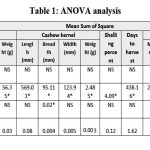 |
Table 1: ANOVA analysis |
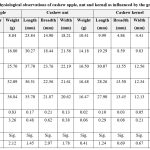 |
Table 2: Physiological observations of cashew apple, nut and kernel as influenced by the growth stage |
Physiological observations of cashew apple
Length and diameter of cashew apple varied significantly during the growth stages. The highest values for these parameters were recorded in T5 (50.36 mm and 39.54 mm), followed by T4 (40.84 mm and 31.66 mm), T3 (35.77 mm and 27.48 mm) and T2 (26.54 mm and 20.57 mm), respectively, whereas lowest (15.09 mm and 11.69 mm) was recorded in T1. The mean apple weight significantly increased with the advancement of maturity. The highest (36.84 g) cashew apple weight was recorded in treatment T5, followed by T4 (32.09 g), T3 (25.70 g) and T2 (16.80 g) respectively, whereas lowest (8.84 g) was recorded in T1. During initial phase of cashew development, there is rapid growth of the nut with little development of embryo and apple takes place, while in the second phase both nut and apple grow rapidly.12 During initial development of fruit, fruit size increases due to cell division and enlargement as well as tissue differentiation.13 The earlier study suggested that weight and length of cashew apple increased from 23.5 g to 86.2 g and 68.2 mm to 79.6 mm in red cultivar, while those increased from 17.3 g to 66 g and 62.3 mm to 75.7 mm in yellow cultivar, respectively.14 The findings of present investigation are in accordance with these findings. Guava shown a sigmoid growth pattern and fruit development, while differential growth pattern was observed in cashew apple and nut.15,16
Physiological observations of cashew nut
Cashew nut length, breadth and width significantly varied during growth stages. The highest nut length, breadth and width (37.70, 23.76 and 22.19 mm) were recorded in T3, whereas minimum (23.84, 14.90 and 18.21 mm) in treatment T1. However, in case of cashew nut weight, the maximum (16.50 g) nut weight was recorded in treatment T3, followed by T4 (16.48 g), T5 (16.47 g) and T2 (14.18 g) respectively. After attaining final developmental stage, cashew nuts start to mature. Their shell colour changes from dark green to grayish green. The dimensions of cashew nut changes due to loss of moisture present in the nut. The nut size gets reduced as they matured physiologically.7 Cashew nut size gets reduced due to shrinkage during advanced stage of maturity.17 However, the nut length, width and thickness have been reported to increase up to 40 days after fertilisation and decline in the later stages.18
Physiological observations of kernel
Tender cashew kernel length, breadth and width significantly varied and were found to be the highest (30.07, 13.55 and 12.56 mm) in T3, followed by T4 (28.26, 13.50 and 12.34 mm), T5 (27.90, 13.45 and 12.13 mm) and T2 (19.29, 8.59 and 9.83 mm). Similarly, tender cashew kernel weight was significantly the highest (3.00 g) in T3 followed by T4 (2.99 g), T5 (2.97 g) and T2 (2.53 g); whereas it was the lowest (1.71 g) in T1. The immature cashew kernels are known to have high moisture content than the mature nuts. Loss in moisture percent might have caused reduction in kernel dimensions. During advanced stage of maturity of cashew nut development, nut size decreased due to shrinkage.17 Similarly, the immature kernels have more dimensions than mature once.19 Cashew kernels after reaching physiological maturity show reduced moisture content, which lead to an increase in the recovery of kernels per kilogram.20
Shelling per-cent was significantly influenced by stages of nut development. The highest shelling per cent was observed in T3 (18.19%), which was found at par with T4 (17.99%) and T5 (17.93%). The shelling per cent increased throughout the physiological development stage but dropped at the advanced stages of maturity, probably because the moisture was lost during this phase. The moisture content in the shell, testa and kernel decreases as the accumulation of dry matter in the kernel occurs simultaneously. The shelling per-cent in maize increased during physiological maturity stages, while declined during advanced stage of maturity.21 Similarly, the shelling percentage was determined in immature nuts of six cashew varieties and they found that shelling percentages ranged between 14.83% to 17.88%.19 As per the earlier research, the shelling percentage in immature cashew nuts varied with varieties e.g. Madakkathara-1 (32.7%), Vridhachalam-3 (22.0%), Priyanka (20.7%), Dhana (18.3%), Poornima (18.0%) and Damodhar (17.0%).19
The mean numbers of days required for reaching different stages were: 58.50 days (T5), 55.88 days (T4), 52.75 days (T3), 45.63 days (T2) and 40.63 days (T1). Fruit developmental stage followed by fruit maturity stage. As per BBCH scale, stage code 715, 717 and 719 represented fruit development stage, while 811 and 813 represented fruit maturity stage.7 While, the researcher studied the various characters of six different immature cashew nut varieties harvested 55 days after anthesis.19 However, the cashew nuts required 8 to 10 weeks to attain physiological maturity.17
Proximate analysis
The proximate composition of tender cashew nut in different growth stages has been presented in Table 3. It is noticeable that there was significant difference in moisture content among the growth stages. The highest (92.40%) moisture was recorded in treatment T1, and it reduced with advancement of maturity i.e. T2 (80.77 %), T3 (70.51 %), T4 (60.58 %) and T5 (50.35). The seed contains high moisture content during initial stages for supporting embryo growth; and during maturation; the water content decreases due to accumulation of dry matter. Previous study on Physic nuts suggested high moisture content at initial stage (89-90%) and decreased to 86.90% at physiological maturity.22 The fully matured dried cashew nut contained 11.6% to 13.8% moisture.17
Table 3: Proximate analysis of cashew kernel as influenced by the growth stage
| BBCH Stage | Moisture (%) | Protein (%) | Fat (%) | Carbohydrate (%) |
| T1: 715 | 92.40 | 1.15 | 0.37 | 0.58 |
| T2: 717 | 80.77 | 4.81 | 3.70 | 4.22 |
| T3: 719 | 70.51 | 8.39 | 7.05 | 7.37 |
| T4: 811 | 60.58 | 12.96 | 9.75 | 9.53 |
| T5: 813 | 50.35 | 16.54 | 12.15 | 12.91 |
| S.Em.± | 0.12 | 0.04 | 0.04 | 0.04 |
| CD @ 5% | 0.36 | 0.13 | 0.11 | 0.12 |
| F test | Sig. | Sig. | Sig. | Sig. |
| CV | 0.49 | 1.43 | 1.64 | 1.72 |
The protein content in tender kernel varied significantly during cashew nut development. The highest protein (16.54%) was recorded in T5, followed by T4 (12.96 %), T3 (8.39 %) and T4 (4.81 %) respectively, whereas lowest protein was recorded in T1(1.15%). During development stages, protein accumulates in nut as storage compound for development of embryo and gets further utilized for germination and growth. The mature cashew nut contain high protein content than the immature nuts.19 Protein content in six different cashew varieties in an earlier study ranged between 7.29 % and 12.45%; while, the protein content in other study was 21.32 % and 21.00%.23,24 Similarly, another study reported 18.81 ± 0.06 g/100g of protein in mature cashew nut.25
Total fat content in tender cashew kernel significantly varied during different growth stages. The highest fat (12.15%) was recorded in treatment T5, followed by T4 (9.75 %), T3 (7.05 %) and T2 (3.70 %), whereas it was the lowest (0.37%) in T1. Total fat content in cashew kernel gets increased as they mature. The proximate composition of six varieties of immature cashew nut harvested after 55 days of anthesis suggested the fat percentage of varied between 5.08% to 9.08%.19 The fat content in cashew nut is one of the macro nutrients present in abundance accounting for 48.3 ± 1.6%.26
The total carbohydrates content in tender cashew kernel significantly varied during growth stages. The highest carbohydrates content (12.91%) was recorded in T5, followed by T4 (9.53 %), T3 (7.37 %) and T2 (4.22 %), whereas, it was the lowest (0.58%) in T1. Carbohydrate content may increase due to conversion of complex starches into simple sugars. The trend of changes in carbohydrates contents during different growth stages of cashew nut has not been recorded earlier. As per research findings, mature cashew nut kernel contains 25% carbohydrates.24 Similarly, carbohydrates content in immature cashew nut kernel harvested 55 days after anthesis ranged between 4.88% and 9.63%.19
Organoleptic sensory evaluation
Sensory score for different growth stages of tender cashew nut kernels showed a noticeable difference in colour, taste, texture and overall acceptance, as illustrated in Table 4. There was an increasing trend in colour, taste, texture and overall acceptance score during initial stages, however the trend showed reduction during advanced stages of maturity. The score for treatment T3 was recorded to be significantly highest for all the sensory attributes considered under the study. Tender cashew kernels have more sugars in them, which might make them more flavourful and sweeter. But, as the cashew nuts become mature, they tend to have more starches which might make them less sweet. The 7 months old tender coconuts were more preferable by consumers than 8 months because of quantity of less water and little harder endosperm to eat.27
Table 4: Organoleptic sensory evaluation of tender cashew kernel as influenced by the growth stage
| BBCH Stage | Colour | Taste | Texture | Overall acceptability |
| T1: 715 | 3.56 | 3.63 | 3.00 | 3.39 |
| T2: 717 | 5.56 | 4.81 | 5.06 | 5.14 |
| T3: 719 | 8.81 | 9.00 | 9.06 | 8.83 |
| T4: 811 | 8.06 | 8.06 | 8.31 | 8.14 |
| T5: 813 | 7.06 | 7.63 | 7.63 | 7.44 |
| S.Em.± | 0.16 | 0.18 | 0.23 | 0.12 |
| C.D. @ 5% | 0.46 | 0.53 | 0.65 | 0.36 |
| F test | Sig. | Sig. | Sig. | Sig. |
| CV | 6.87 | 7.86 | 9.64 | 5.37 |
Conclusion
Despite producing a significant amount of raw cashew nuts, farmers fail to get anticipated returns from the market. Tender cashew kernels extraction from mature green cashew nuts is an on-farm operation that has significant market value in rural and urban areas. From the present study harvesting tender cashew nuts at maturity of BBBCH 719 stage could help in retaining the quality of tender cashew kernels. The standardization of the harvest stage for tender cashew kernels could not only increase farmer’s income but also reduce pre-harvest losses. It is envisaged to develop storage and packaging methods to retain tenderness of harvested kernel throughout the year.
Acknowledgement
This work was supported by Dr. Balasaheb Sawant Konkan Krishi Vidyapeeth, Dapoli, Ratnagiri (Maharashtra), India.
Funding Sources
The author(s) received no financial support for the research, authorship and/or publication of this article.
Conflict of Interest
The authors do not have any conflict of interest.
Data Availability Statement
This statement does not apply to this article.
Ethics Statement
This research did not involve human participants, animal subjects or any material that requires ethical approval.
Informed Consent Statement
This study did not involve human participants and therefore, informed consent was not required.
Permission to reproduce material from other sources
Not applicable
Author Contributions
Siddhesh Pradip Salvi: Collection of Data, Methodology, Writing – Original Draft.
Laxmi Narayan Mahawer: Review & Editing.
Heera Lal Bairwa: Offered valuable insights and suggestions to improve it.
Ram Hari Meena: Resources, Supervision.
Pokhar Rawal: Supervision, Project Administration.
References
- Bhat, S.S., Praveen Kumar, B.H., & Ravisha, N.S. A study on profitability and performance evaluation model for cashew processing units- A study with special reference to kaladhar cashew industries. Think India; 2019; 22(33):218-223.
- Ajiesya, D.P., Adlin, M., Babima, M., & Jenit Hanson, G. A Study on technological advancements in cashew processing machines in India. Res. J. Adv. Engg. Manag.; 2024; 2(5):1345-1348.
CrossRef - Cashew nut industry and exports (The Cashew Export Promotion Council of India) https://www.ibef.org/exports/cashew-industry-india; 2023;12 March 2023.
- Rege, A., & Lee, J.S.H. (2022). State-led agricultural subsidies drive monoculture cultivar cashew expansion in northern Western Ghats, India. PLoS ONE; 2022; 17(6):e0269092. https://doi.org/10.1371/journal.pone.0269092
CrossRef - Zote, V.K., Salvi, S.P., Haldavnekar, P.C., & Narangalkar, A.L. Efficacy of insecticide for the management of cashew apple and nut borer (Nephopteryx). J. Entomol. Zool. Stud.; 2017; 5(2):578-580.
- Srikumar, K.K., & Bhat, P.S. Biology and feeding behaviour of Helopeltis antonii (Hemiptera: Miridae) on singapore cherry (Muntingia calabura) – A refuge host. Entomol. Res.; 2013; 37(1):11-16.
- Adiga, D.J., Muralidhara, B.M., Preethi, P., & Savadi, S. Phenological growth stages of the cashew tree (Anacardium occidentale) according to the extended BBCH scale. Ann. Appl. Biol.; 2019;175:246-252.
CrossRef - Jacob, S. & Sobhana, A. Qualitative and organoleptic evaluation of immature cashew kernels under storage. Horticultural Sci., 2021; 16(2): 287–291.
CrossRef - Eradasappa, E. & Mohana, G.S. Investigations on self-compatibility and extent of self and cross- pollination in cashew. Plantation Crops; 2019; 47(2):72-81.
- Official methods of analysis. 16th ed. Washington DC: Association of Official Analytical Chemists; 2020.
- Amerine, M.A., Pangborn, R.M., & Rossler, E.B. Principals of sensory evaluation of food. New York Academic Press; 1965; 104-110.
- Figueiredo, W.,Lajolo, F.M., Alves, R.E., & Filgueiras, H.A.C. Physical–chemical changes in early dwarf cashew pseudo fruits during development and maturation. Food Chem.; 2002; 77(3): 343-347.
CrossRef - Sharma, B., Das, K., & Bora, S.S. Physiology of fruit development. J. Curr. Microbiol. Appl. Sci.; 2020; 9(6):504-521.
CrossRef - Nor Hamizah, M.H., Wan Zaliha, W.S., & Yusnita, H. Postharvest performance and physico-chemical changes of two cashew apple (Anacardium occidentale) cultivars at different maturation stages. Trans. Malaysian Soc. Plant Physiol; 2014; 22:58-62.
- Datta, M.N., & Mukherjee, S.K. Studies on the changes during growth and development of guava (Psidium guajava) fruits. Indian J. Hortic.; 1980; 37:211-219.
- Chattopadhyay, P.K., Pal, B., Roy, K.K., Sadhu, M., & Bose, T.K. Some aspects of developmental physiology of cashew (Anacardium occidentale) fruit. Indian Agriculture; 1983; 27:149-215.
- Mog, B., Veena, G.L., Adiga, J.D., Hebbar, K.B., Shamsudheen, M., Manjesh, G.N., Eradasappa, E., Mohana, G.S., Thandaiman, V., Vanitha, K., & Yadav, A.K. Pollen morphological study and temperature effect on the pollen germination of cashew (Anacardium occidentale) varieties. Sci. Hortic.; 2023; 314:111957.
CrossRef - Pushpalatha, P.B. Morphology of cashew. In: Mathew, J., Mini, C. and Abraham, M. Cashew Research and Development in Humid Tropics with Emphasis on Cashew apple Processing. Cashew Research Station, Kerala Agricultural University, Thrissur; 2009;125-133.
- Jacob, S. Sobhana, A., & Joseph, P.M. Evaluation of cashew (Annacardium occidentale) varieties for immature kernel characters. J. Trop. Agric.; 2022; 60(2):235-239.
- Sobhana, A., & Jose, M. Studies on the utilization of immature cashew nuts. J. Trop. Agric.; 2014; 32(3-4):647-653.
- Estrada-Urbina, J., Canales-Sosa, E., Pérez-Heredia, O.S., Escobar-Álvarez, J.L., Molina-Moreno, J.C., & Estrada-Gómez, J.A. Kinetics of dry matter and physiological efficiency in maize seedlings of seeds with two different maturation and shelling conditions. Seed Sci. Technol.; 2025; 53(2):173-185.
CrossRef - Ngamprasitthi, S., Juntakool, S., Sooksatan, I., Sukprakarn, S., & Techapinyawat, S. (2011). Effect of seed development on seed quality of Physic Nut (Jatropha curcas). Thai J. Agric. Sci.; 2011; 44(5):175-181.
- Ogunsina, B.S. Crackability and chemical composition of pre-treated cashew nuts using a hand-operated knife cutter. Eng. Int. CIGR J.; 2013; 15(2);275-283.
- Nair, C.K. Cashew processing. In: Mathew J, Mini C and Abraham M. Cashew Research and Development in Humid Tropics with Emphasis on Cashew apple Processing. Cashew Research Station, Kerala Agriculture University, Trissur; 2003; 125-133.
- Venkatachalam, M., & Sathe, S.K. Chemical composition of selected edible nut seeds. Agric. Food Chem.; 2006; 54(13):4705-4714.
CrossRef - Rico, R., Bullo, M., & Salvado, S. (2016). Nutritional composition of raw fresh cashew (Anacardium occidentale) kernel from different origin. Food Sci. Nutri.; 2016; 4(2):329-338.
CrossRef - Apshara, S.E., Arunachalam, V., Jayabose, C., & Kumaran, P.M. Evaluation of coconut hybrids for tender nut purpose. Indian J. Hortic.; 2007; 64(3):320-323.