


 PDF Downloads:
389
PDF Downloads:
389


Introduction
Nowadays treatment of seeds by some physical methods have received great importance. These methods are not only friend lier to the environment but also accelerate sprouting,results in better percentage of germination as well as better root and shoot growth. Magnetic seed treatment is one such physical method that has been reported to enhance the performance of various plants. But the process of treatment of seeds by different authors in this regard varies considerably. Galland and Pazur1 exposed the seeds to both static and pulsed magnetic fields. Florez et al.2imbibed seeds in water and then exposed to magnetic fields. Saeed and Mutwali3 exposed seeds not to magnetic fieldsbut to magnetically treated water. Morejonet al.4 studied the effect of statically and dynamically treated magnetic water. Magnetic water has been applied on various plants such as common bean seeds, cowpea seeds,3Pinus tropicalis seeds,4 maize seeds,5 etc. Maheswari and Grewal6 found that the effects of magnetic treatment varied with plant type and type of water used.
We selected chickpea (Cicer arietinum L.) seeds as our study material and objective ofthe present investigation was to evaluate the effect of magnetically treated water (MTW), effect of MTW along with weak magnetic field (WMF) and MTW with strong magnetic field (SMF) on chickpea seeds after imbibing them in MTW.
Materials and Methods
Seeds of chickpea (Cicer arietinum L.) of uniform size and shape without visible defects and malformation were selected. Block magnets (54×13×9mm) [intensity 1000G at the surface=0.1T=100mT] were used to create a static magnetic field.
Petri-dishes (90 mmdiameter) filled with tap water was placed between a pair of magnets for 40 hours to be magnetized. Seeds were divided into four groups and each group contained 15 seeds.Seeds ofthe first group (Gr.-I) were imbibed with tap water (non- magnetized water) in petri-dishes (90 mm diameter) containing Whatman no.-1 filter paper soaked with tap water which were taken as control. Seeds in the second group (Gr.-II), third group (Gr.-III) and fourth group (Gr.-IV) were imbibed in the same manner as in the Gr.-I but on filter paper soaked with magnetized water (MTW). Besides, the petri-dishes ofGr.-III and Gr.-IV were placed between one pair and two pairs of bar magnets (of static magnetic field) to provide weak and comparatively strong magnetic fields respectively. All the four sets were kept in the laboratory at 23 ± 2ºC temperature in natural light. The number of seeds germinated was counted on a daily basis in all of the four groups. Germination ofseeds was completed within 6 days ofimbibition but experiment was continued for another 19 days. Totalnumber ofseeds germinated finallywere thenexpressed in percentage basis for each group. Seeds germinated in each daywere also counted for each group to note speed of germination of seeds. Emergence Index (EI) was calculated as described by Association of official Seed Analysis7

Mean emergence time (MET) was calculated according to the equation ofEllis and Roberts8
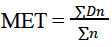
Where, D = number of days counted from the beginning of emergence, n = number of seeds emerged on day D.
To measure the speed of growth of shoot in length of seedlings of all the four groups, they were measured up to 25th day from the setting of experiment at an interval of 5 days. On the 25th day after the set-up of the experiment the final length of shoot andradicle were measured.
Fresh weight of radicle and shoot of the seedlings of each group was taken separately on the 25th day. Radicles and shoots of the seedlings of each group were dried separately overnight in an oven at 90℃ and the dry weight of the seedlings was measured. Seedling vigour was calculated following Abdul Baki and Anderson9
Vigour index I = germination % × seedling length (root + shoot).
VigourindexII=germination%×seedlingdryweight (root+shoot).
Charactersofthe seedlings ofeach ofthe four groups were also noted.
The experiment was conducted in the year 2024 in the Department of Microbiology, The University of Burdwan, Golapbag, Burdwan, West Bengal, India
Results
The germination of the seeds started on the third day (after about 72 hours) of setting up of the experiment (Table 1) in all of the four groups of seeds although the number of seeds germinated differed in different groups. When protrusion of radicle became evident then the seeds were regarded as germinated. Total numbers of seeds germinated finally were expressed in percentage basis for each group in Table 1. The speed of germination (Fig. 1) was thefastest under the influence of MTW (Gr. II) in comparison to the control samples. Although the percentage of germination was higher in control set initially i.e. on the third day but on the 4th day onwards a change occurred (Fig. 1) in the germination rate of the control samples which became lower than that ofthe seeds exposed to WMF (Gr. III). The speed ofgermination ofthe seeds (Fig. 1) in Gr.-IV was the slowest in which the seeds were watered with MTW and exposed to SMF. The highest percentage of seeds germinated on the 6th day when it was100% in the Gr.-II which was much higher than control (86.6%). In Gr.-III it was 93.3% while in Gr.-IV it was 73.3%. The seeds of Gr.-III and Gr.-IV were kept in MTW and exposed to WMF and SMF respectively.
Table 1: Percentage of germination of the Chickpea seeds
| Seeds set up (Treated Seeds) | No. and percentage of seeds emerged in Days | |||||||
| 3rd day | 4th day | 5th day | 6th day | |||||
| Seed count | % | Seed count | % | Seed count | % | Seed count | % | |
| Gr.-I | 7 | 46.6 | 8 | 53.3 | 11 | 73.3 | 13 | 86.6 |
| Gr.-II | 9 | 60 | 11 | 73.3 | 13 | 86.6 | 15 | 100 |
| Gr.-III | 6 | 40 | 9 | 60 | 12 | 80 | 14 | 93.3 |
| Gr.-IV | 3 | 20 | 6 | 40 | 9 | 60 | 11 | 73.3 |
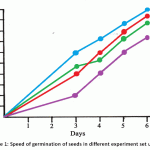 |
Figure 1: Speed of germination of seeds in different experiment set ups.
|
Emergence index (EI) was found (Table 2) to be the best in the seeds influenced by MTW (10.8) followed by Gr.-III (8.9) and control (8.7) and the least in the seeds exposed to SMF (6.1). MET (Table 3) was calculated to be the greatest in Gr.-IV (4.36) which is higher than in control (4.0). In Gr.-III it was almost similar to contro l(4.07) and the value is least in Gr.-II (3.8).
Table 2: The Emergence-Index (EI) of the Chickpea seeds
| Seeds set up (Treated Seeds) |
Seedling emergence Percentage (%) |
Emergence Index (EI) |
| Gr.-I | 86.6 | 8.7 |
| Gr.-II | 100 | 10.8 |
| Gr.-III | 93.3 | 8.9 |
| Gr.-IV | 73.3 | 6.1 |
Table 3: Mean Emergence Time (MET) for germination of Chickpea seeds
| Day | Number of first-time germinated seed | |||
| Gr.-I | Gr.-II | Gr.-III | Gr.-IV | |
| 1 | 0 | 0 | 0 | 0 |
| 2 | 0 | 0 | 0 | 0 |
| 3 | 7 | 9 | 6 | 3 |
| 4 | 1 | 2 | 3 | 3 |
| 5 | 3 | 2 | 3 | 3 |
| 6 | 2 | 2 | 2 | 2 |
| MET (days) | 4.0 | 3.8 | 4.07 | 4.36 |
Speed of growth of shoot was the maximum in control up to the 17th day and then a change occurred and it became lower in relation to Gr.-II and Gr.-III. Speed of growth of shoots of the seedlings of Gr.-II steadily increased from 17th day and these shoots ultimately attained the maximum length (Fig. 2). So, shoot length (Fig. 2) of the seeds of Gr.-IV was the minimum (22.4 cm) and maximumofthose ofthe Gr.-II (28.4 cm). Shoot length ofthe seeds subjected to MTW with exposure to WMF (28.1 cm) exceeded the performance of those of the control (27.4 cm) in this regard. Radicle length (Fig. 2) was measured on the 25th day and was found to be the maximum in Gr.-II (22.8 cm) which was very much longer in comparison to Gr.-III (18.4 cm), Gr.-I (9.9 cm) and Gr.-IV(2.2 cm). The growthof radicles ofthe seeds watered with MTW and exposed to SMF became very much retarded with few lateral roots.
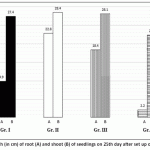 |
Figure 2: Length (in cm) of root (A) and shoot (B) of seedlings on 25th day after set up of experiments.
|
Freshweight of root and shoot ofallthe four groups were measured separately. Freshweight of shoot (Fig. 3) of Gr.-II (5.5 gm) was the greatest. Seeds kept in MTW and exposed to WMF showed higher fresh weight (5.4 gm) than those of control (4.7 gm).The fresh weight of shoot ofGr.-IV wasthe lowest (3.0 gm). Dryweight ofshoot (Fig. 3) ofGr.-II (0.37 gm) was even as Gr.-III butexceeded thatof control (0.32gm). In Gr.-IV itwas 0.24 gm.Fresh weight ofroot (Fig. 4) wasthe highest inGr.-II (1.6 gm) followed byGr.-III (1.5 gm), Gr.-I (1.4 gm) and Gr.-IV (0.9 gm) respectively. Dryweight of the root of the four groups studied followed the same trend as their fresh weight(Fig. 4). It was 0.09gm in control, 0.07 gm in Gr.- IV which were much lower than those of Gr.-II (0.13 gm) and Gr.-III (0.10 gm).
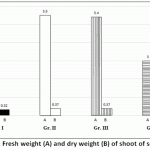 |
Figure 3: Fresh weight (A) and dry weight (B) of shoot of seedlings.
|
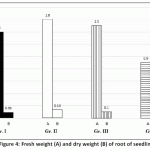 |
Figure 4: Fresh weight (A) and dry weight (B) of root of seedlings.
|
Vigour indexI (Table 4) was found to be 5120.0inGr.-II, 4338.0inGr.-III, 3230.0inGr.-Iand 1803.1 in Gr.-IV. Vigour index II (Table 4) repeated the same affinity.
Table 4: The Vigour Indices of the Chickpea seeds
| Seeds set up (TreatedSeeds) | Germination Percentage(%) | Seedling Length (cm)(Root + Shoot) | Vigour Index I | Seedling Dry Weight (gm)(Root + Shoot) | Vigour Index II |
| Gr.-I | 86.6 | (9.9+27.4) gm = 37.3 gm | 3230.02 | (0.09+0.32)gm = 0.41gm | 35.5 |
| Gr.-II | 100 | (22.8+28.4) gm = 51.2 gm | 5120.0 | (0.13+0.37)gm = 0.50gm | 50.0 |
| Gr.-III | 93.3 | (18.4+28.1) gm = 46.5 gm | 4338.4 | (0.10+0.37)gm =0.47gm | 43.8 |
| Gr.-IV | 73.3 | (2.2+22.4) gm = 24.6 gm | 1803.1 | (0.07+0.24)gm = 0.31gm | 22.7 |
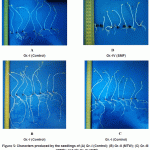 |
Figure 5: Characters produced by the seedlings of (A) Gr.-I (Control); (B) Gr.-II (MTW); (C) Gr.-III (WMF); and (D) Gr.-IV (SMF).
|
Discussion
From the present investigation (Fig. 4) it isevident that out of the12 parameters tested (speed of germination of seeds, percentage of germination, EI, MET, length of radicle and shoot, fresh weight and dry weight of radicle and shoot, and vigour indices), in eleven of those the performance was the best in chickpea seeds (Gr.-II) which were imbibed in MTW and also kept underthe constant influence ofit but not exposed to anymagnetic field. Inourstudythe seeds which were imbibed in MTW, watered with MTW and constantly exposed to WMF (Gr.-III) resulted better performance in comparison to control (Gr.-I) while the seeds with similar treatment but exposed to SMF (Gr.-IV), resulted in very poor performance in every parameter except the highest MET value of the seeds in this group. A similar type of result was obtained by Racuciu et al.10 who also observed inhibitory effect for all measured parameters when the seeds of Zea mays were treated with magnets. MET isthe parameter that represents the time required for seed emergence. Higher MET value indicates more time required for seed emergence.5 Beneficial effect of low frequency of magnetic field has been reported by various authors.11-14 Our result with chickpea shows better performance of the seeds influenced by WMF (Gr.-III) than of control in almost all the recorded parameters. The best result was obtained in all the parameters tested when chickpea seeds were watered with magnetized water(MTW) but not exposed to magnetic fields. Increased performance of seeds due to treatment with magnetized water has beenrecorded by variousworkers.14-16 MTW is more easily absorbed by the seed tissues and in this way it stimulates internal metabolic processes which are conducive to germination.4 The basic mechanism consisted in the change of physical and chemical properties of water under the influence of magnetic field, allowing MTW to be better incorporated to the inner part of the seeds, thus increasing the ability of germination.4 Greater incorporation of water may be responsible for the increase in physiological activity which may have resulted in overall increase in seedling length, seedling dry weight and vigour indices in our study. Several authors have reported the stimulatory effect of MTW on growth of seedlings of various plants.17,18
No complete and uniform theory exists which can explain how magnetic fields change property of water. There are some hypothetical explanations in this regard. According to Matwijczuk et. al.19 polarization of external electron shell ofwater molecules and ions occur under influence ofthe magnetic fields that change conditions of hydrations of ions. Magnetized water acts on calcium ions and thus increases cell membrane permeability in the seed. Magnetically treated water has been found to change some physical as well as chemical properties of water, such as polarity, hydrogen bonding, surface tension, pH20 and solubility of salt.21 These changes of properties of water affect the growth of plants. Irrigation of pea plants with MTW exhibited increased potassium content.22 Moussa15 showed that potassium has direct effect upon translocation efficiency as potassium ion is one of the three largest constituents of sap in sieve tube and it playsarole in the synthesis of plant hormones.23Sunflower plants treated with magnetized water exhibits increase in GA.24 According to Hozayn and Qados25 seeds of wheat when treated with magnetized water cytokinin content is increased which causes mitosis resulting growthofthe plants. Influence of magnetic water on roots is pronounced enhancing production of much more lateral roots from radicle in comparison to control. From the present investigation it is evident that roots are more sensitive to the effect of magnetic field than shoot. Strong magnetic field drastically reduced root growth. Growth of radicle as well as lateral root development was very poor in case of the seeds exposed to SMF. But the seeds exposed to MTW produced considerably long radicle. Serraj et al.26 stated that plants of Cicer arietinum having deep and prolific roots are suitable to tolerate drought situations. Therefore,the seeds exposed to MTW producing long radicle inour experiment mayper form better under rain fed (unirrigated) conditions because they are much suitable to absorb water fromthe deeper regions ofsoilwhile seeds treated with WMF producing profuse lateralroots would be more adaptive to irrigated areas.
Conclusion
Seeds of Cicer arietinum L. imbibed in magnetically treated water (MTW) and also kept under the constant influence of it but not exposed to magnetic field resulted the best performance in almost all the parameter tested. From the result obtained in the present investigation it can be concluded that for cultivation of chickpea under rain fed (unirrigated) conditions seeds should be treated with magnetized water (but not exposed to magnetic field) before sowing to produce long roots which would be suitable to absorb water from the deeper regions of soil, but for its cultivation in irrigated condition seeds should be treated with WMF for producing profuse lateral roots which would be more adaptive to such situations.
Acknowledgement
Authors gratefully acknowledge Department of Microbiology, The University of Burdwan, Burdwan, West Bengal, India for providing laboratory facilities.
Funding Sources
The author(s) received no financial support for the research, authorship, and/or publication of this article.
Conflict of Interest
The author(s) do not have any conflict of interest
Data Availability Statement
All datasets generated or analyzed during this study are included in the manuscript.
Ethics Statement
This research did not involve human participants, animal subjects, or any material that requires ethical approval.
Informed Consent Statement
This study did not involve human participants, and therefore, informed consent was not required.
Permission to Reproduce Material from other Sources
Not Applicable
Authors Contribution
Mayuk Bandyopadhyay: Data Collection, Methodology, Analysis
Susanta Mohan Roy: Data Collection, Analysis
Sayantan Jash: Data Collection, Analysis, Writing
Asit Baran De: Writing-Review & Editing.
References
- Galland P and Pouzar A. Magnetoreception in plants. Journal of Plant Research, 2005; 118(6): 371-389.
CrossRef - FlorezM, CarbonellMV and MartinezE. Exposure of maize seedsto stationary magnetic fields: Effects on germination and early growth. Environmental Exp. Bot. 2007; 59: 68-75.
CrossRef - Saeed OF and Mutwali EM. Effect of magnetized water on some growth characteristics ofcowpea (Vignaunguiculata ). AsianJournal of Agriculture and Food Sciences, 2019; 7(2):31-36.
CrossRef - Morejon LP, Castro Palacio JC, Velazquez Abad L and Govea AP. Stimulation of Pinus tropicalis seed by magnetically treated water. International Agrophysics, 2007; 21: 173-177.
- Mahmood S and Usman M. Consequences of magnetized water application on maize seed emergence in sand culture. Journal of Agricultural Science and Technology, 2014; 16: 47-55.
- Maheshwari BL and Grewal HS Magnetic treatment of irrigation water: its effect on vegetable crop yield and water productivity. Agricultural Water Management, 2009; 96: 1229-1236.
CrossRef - Association of Official Seed Analysis (AOSA), Seed Vigour Hand Testing Book, Contribution No. 32 to the Handbook on Seed Testing Association of Official Seed Analysis, Springerfield, IL, USA, (1983).
- Ellis RA and Roberts EH. The Quantification of Ageing and Survival in Orthodox Seeds, Journal of Seed Science and Technology, 1981; 9: 373-409.
- Abdul-Baki AA and Anderson JD. Vigour determination in soyabean by multiple criteria. Crop Science, 1973; 10: 31-34.
CrossRef - Racuciu M,Creanga D andHorgaI. Plant growth under staticmagnetic field Romanian Journal of Physics, 2008;53 (1-2):353-359.
- Marinkovic B, M. Grujiae N, Crnobarac J and Malesevic M. Received results in trials and production with biophysics application, University of Novi Sad, Tampograf. 2000.
- Marinkovic B, Grujiae M, Marinkoviae D,Crnobarac J, Marinkoviae J, Jaaeimoviae G and Mircov DV. Use of biophysical methods to improve yields and quality of agricultural products. Journal of Agricultural Science, 2008; 53: 235-241.
CrossRef - Rochalska MK, Grabowska K and Ziarmik A. Inspect of low frequency magnetic fields on yield and quantity of sugar beet. International Agrophysics, 2008; 23: 163-174.
- Vasilevski G. Prospectives of the application of biophysical methods in sustainable agriculture. Bulgarian Journal of Plant Physiology, 2003; 29: 179-186.
- Moussa HR. The impact of magnetic water application for improving common bean (Phaseolus vulgaris L.) production. New York Science Journal, 2011; 4(6): 15-20.
- Putti FF, Vicente EF, Chaves PPN, et al. Effect of magnetic water treatment on the growth, nutritional status, and yield of lettuce plants with irrigation rate. Horticulture, 2023 9:504.
CrossRef - Alattar EM, Elwasife KY, Radwan ES and Abuassi WA. Influence of magnetized water on the growth of corn (Zea mays) seedlings. J. Biophys. 2017; 29(2):39-50
- Alkhatib R, Abdo N, Al-Eitan L, Kafesha R and Rousan A. Impact of magnetically treated water on the growth and development of tobacco (Niatiana tabecum Turkish). Physiol. Mol. Biol. Plants, 2020; 26(5): 1047-1054.
CrossRef - MatwijczukA, Kornarzynski K and Pietruszewski S. Effect of magnetic field on seed germination and seedling growth of sunflower. InternationalAgrophysics, 2012; 26: 271-278.
CrossRef - Abdelsalam H, Mostafa H, El-Ansary M, Awad M and Sultan W. Magnetization treatment effect on some physical and biological characteristics of saline irrigation water. Scientific Reports, 2025; 25:19803.
CrossRef - Otsuka I andOzekiS. Does magnetic treatment of water change its properties? Journal of Physical Chemistry, 2006; 110(4): 1509-1512.
CrossRef - Grewal HS and Maheshwari BL. Magnetic treatment of irrigation water and snow pea and chickpea seeds enhances early growth and nutrient contents of seedlings. Bioelectromagnetics, 2011; 32: 58-65.
CrossRef - Hasanuzzaman M, Bhuyan MHMB, Nahar K, et al. Potassium: a vital regulator of plant responses and tolerance to abiotic stresses. Agronomy, 2018; 8:31
CrossRef - Turker M, Temirci C, Battal P and Erez ME. The effect of an artificial and staticmagnetic field on plant growth, chlorophyll and phytohormone levels in maize and sunflower plants. Ann. Rei. Botanicae. Horn, 2007; 46: 271-284.
- Hozayn M and Qados AMSA. Magnetic water application for improving wheat (Triticum aestivum ) crop production. Agric. Biol. J. N. Am. 2010; 1(4): 677-682.
- Serraj R, Krishnamurthy L, Kashiwagi J, Kumar J, Chandra S and Crouch JH. Variation in root traits of chickpea (Cicer arietinum) grown under terminal drought. Field Crop Research, 2004; 88: 115-117.
CrossRef
Abbreviations
MTW Magnetically treated water
WMF Weak magnetic field
SMF Strong magnetic field
EI Emergence index
MET Mean emergence time
Gr. Group
mT Millitesla
T Tesla