


 PDF Downloads:
277
PDF Downloads:
277


Introduction
Plants play a vital role in human life by providing oxygen, food, medicine, and more. Many people enjoy growing plants in their backyards, but due to limited space, they often use makeshift containers or old pots. For sustainable growth, plants require proper watering and adequate sunlight.1 However, with our busy schedules, we often forget to water them at the right time, leading to plant stress. Both insufficient and excessive watering can harm plant health.
Agriculture is the backbone of every nation and requires timely monitoring. The modules in this system assist farmers in identifying suitable crops based on their location.2 In farming, ensuring that plants receive the right amount of water at the right time is crucial for healthy growth. However, farmers often struggle with proper irrigation due to their busy schedules, making it difficult to monitor soil moisture levels across different areas. This can lead to overwatering in some areas and underwatering in others. Additionally, in backyard farming, there is a risk of accidental damage to plants by children and other external factors. Effective irrigation practices, proper water management, and precise timing of irrigation are essential to improve crop yield, optimize water use, and protect natural resources. Applying the correct amount of water at the right time is critical.3
Water scarcity is a major challenge for agricultural production, particularly in Ethiopia’s arid regions, where high evaporation rates and irregular, low rainfall create significant difficulties. Adopting deficit irrigation techniques can help conserve water while minimizing yield loss under such conditions.4 Precision agriculture leverages advanced technologies such as IoT, Data Mining, Artificial Intelligence, and Data Science. The Internet of Things (IoT) connects smart devices and sensors that communicate and share data.5 In agriculture, Wireless Sensor Networks (WSNs) are used to remotely monitor environmental and soil conditions, helping predict crop health. WSNs collect data on factors like pressure, humidity, temperature, soil moisture, salinity, and conductivity, enabling precise irrigation scheduling.6
Unequal water distribution across a farming field can lead to some plants receiving excessive water while others receive too little, negatively impacting plant growth. Additionally, crops are vulnerable to damage from birds and other external factors.
To address these challenges, an automated and efficient irrigation system is needed to regulate water distribution among plants. Our prototype, the “GARDUINO” system, ensures that each plant receives the appropriate amount of water, reducing water wastage and promoting healthy plant growth.
Problems in Farming
In Backyards
We struggle to water the plants at the appropriate times due to our busy schedules, and it’s difficult to gauge the moisture levels in the soil across various pots. Imagine if we overwater some plants while underwatering others. Additionally, in backyard farming, there’s the risk of children accidentally damaging the plants, among other concerns.
In Agriculture
We cannot determine the moisture levels in various sectors of agricultural land, leading to some crops receiving excessive water while others receive insufficient amounts, potentially damaging their growth. Additionally, we lack the ability to protect crops from bird attacks. Therefore, our prototype aims to address these issues and ensure user-friendly functionality.
Moto of this Work
In today’s era of advanced technology, human lifestyles should ideally be smarter, easier, and more user-friendly.7 Therefore, there is a growing need for automated systems to alleviate the demands of our daily lives. Many individuals encounter challenges, particularly when it comes to watering plants in the garden, especially when away from home. This model incorporates a microcontroller to create a smart switching device aimed at assisting millions of people.
Materials and Methods
Hardware Requirements
Node MCU
It is an open-source platform based on ESP8266, which can connect objects and facilitate data transfer using the Wi-Fi protocol. It serves as the motherboard for our prototype. Gpio, Pwm, Adc and etc. which stores the data to operate the prototype.
Moisture Sensor
Soil moisture sensors gauge soil water content and can estimate the amount stored in the soil horizon. Rather than directly measuring water in the soil, these sensors detect variations in other soil properties that reliably correlate with water content Fig 1.
Relay Module
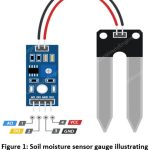 |
Figure 1: Soil moisture sensor gauge illustrating real-time moisture levels |
This automatic switch is commonly employed in automatic control circuits to regulate high currents with a low-current signal. The relay signal’s input voltage ranges from 0 to 5 volts. The ranges vary as the area covered by the irrigation for the farming. Which controls the DC pump Fig 2.
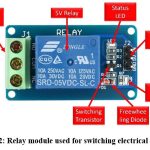 |
Figure 2: Relay module used for switching electrical circuits |
PUMP
The water pump operates using a suction method, drawing water through its inlet and releasing it through the outlet. Which is connected to the water flow pipe for the irrigation. Which is connected in the relay module for the user’s instruction Fig 3.
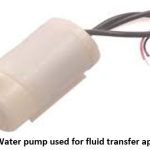 |
Figure 3: Water pump used for fluid transfer applications |
Power Source
A power supply is an electrical apparatus that furnishes electric power to an electrical load. Which gives the sufficient energy to our prototype to do the calibrated work. Therefore, the power supply might be different due to their conditions.8
 |
Figure 4: Power supply unit providing electrical energy to electronic components |
IR Sensor
An infrared sensor9 functions by applying voltage to a pair of IR light-emitting diodes, which subsequently emit infrared light. We can modify the range up to 40-50cm indoors and around 12-20cm outdoors. Which is calibrated to the buzzer so it protects the crop from birds in agriculture land and plants from children in backyard by giving the buzzer sound and get notified if it is disturbed by any obstacles.
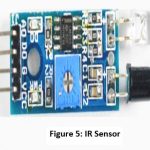 |
Figure 5: IR Sensor |
Softwares Used
Arduino IDE
It includes a code-writing text editor, a message area, a text console, a toolbar housing common function buttons, and a sequence of menus. Program to write code is called as sketches, once the code is completed it is now ready to upload the program in Node MCU.
 |
Figure 6: Arduino |
Blynk app
This app places a major role to our prototype which controls the user’s instruction. Now the app collects the data from the node mcu which is calibrated according to the problems. The whole prototype works under the internet which stores the data in the cloud, this app can be used in10 phones and in computers from the world anywhere at any time. This app gives the notification to the users i.e. (“Moisture is low water the plants”) after the plant reaches the moisture level, it is automatically turned off11 As like that the app will give the notification (buzzer sound) to the user if the plants got disturbed. And we can also check the moisture level at any time.
 |
Figure 7: Blynk app |
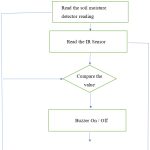 |
Flow chart 1: The flow chart was not cleaer |
Materials Needed
An automated plant watering system was developed using several electronic components. The setup included essential parts such as a NodeMCU (ESP8266) microcontroller, a soil moisture sensor (LM393), a 12V DC water pump, a 3-channel relay module, and tubing for distributing water.12 The soil moisture sensor was connected to the NodeMCU by wiring its VCC to a 5V output, GND to ground, and its analog output to an analog input pin on the NodeMCU. Similarly, the water pump was connected through the relay module, which was used to safely manage the high-voltage and high-current requirements of the pump.
To control the system, a program was written and uploaded using Arduino IDE version 2.2.1.13 This program monitored the moisture levels in the soil by reading data from the sensor. When the sensor detected that the moisture level had dropped below a set threshold, the program automatically activated the pump to water the plants. This ensured that the plants were only watered when necessary, making the system both efficient and water-conserving.
Advantages
SAVE TIME: System will do watering for the plants.
SAVE WATER: An automatic system uses less water than manually.
Weather efficiency 14
Less work no manual power.
It works under the soil condition.
Result and Discussion
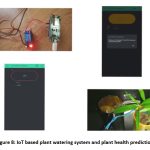 |
Figure 8: IoT based plant watering system and plant health prediction. |
The proposed system significantly reduces the effort required in large agricultural regions by automating irrigation and plant monitoring. Many aspects of the system can be customized, allowing users to modify codes based on the specific needs of different plant types. This results in a scalable and adaptable technology that supports both small-scale and large-scale farming operations.15 The integrated soil moisture sensor enables real-time monitoring, sending notifications to the app for timely action. Additionally, infrared (IR) technology helps protect plants from potential damage caused by birds and children. This system not only conserves water but also enhances crop yield by ensuring optimal growing conditions. With its user-friendly interface, even individuals with minimal technical knowledge can efficiently operate and benefit from it.
Conclusion
In a world where time is precious and sustainability is paramount, embracing IoT-based safeguards for plant care emerges as a beacon of innovation. With components like Node-MCU, sensors, and relays seamlessly integrated, the burden of nurturing plants diminishes while efficiency soars. Through calibrated soil moisture sensors and the intuitive Blynk app, remote oversight transforms into a reality, granting users control over watering regardless of location. From home gardens to vast agricultural fields, this system heralds a new era of cultivation, where technology nurtures growth and safeguards our green spaces. In just a few hours of setup, a revolution takes root, promising not just convenience, but a greener, more connected future for plant care.
Future Study
Future research in the realm of IoT-based plant safeguards could focus on several promising avenues. One potential direction is the integration of advanced machine learning algorithms to predict optimal watering schedules based on historical weather data, soil conditions, and plant types. This would enhance the system’s precision and efficiency, further reducing water usage and improving plant health. Another area of exploration could involve the development of more sophisticated sensors capable of measuring a broader range of environmental variables, such as nutrient levels and pH balance, thereby offering a more comprehensive approach to plant care. Additionally, expanding the system’s capabilities to include real-time video monitoring and pest detection could provide even greater protection for plants, both in home gardens and agricultural settings.
Acknowledgment
The authors express their gratitude to the Management of Sri Ramakrishna Institute of Technology, Coimbatore, Tamil Nadu, for facilitating the preparation of this manuscript by providing necessary facilities.
Funding Sources
The author(s) received no financial support for the research, authorship, and/or publication of this article.
Conflict of Interest:
The authors do not have any conflict of interest.
Data Availability Statement
Provide a clear data availability statement as required by our journal guidelines.
Ethics Statement
This research did not involve human participants, animal subjects, or any material that requires ethical approval
Author Contribution
Muthirulan Muthukrishnaveni: Conceptualization, Methodology, Formal Analysis, Writing, Funding Acquisition – Original Draft.
Ravikumar Niranjan: Investigation, Methodology, Visualization, Writing – Review & Editing.
Kavitha Ponnuswamy Pavinathish: Data Curation, Writing – Review & Editing.
Sevugarathinam Muthu Vijaya Pandian: Supervision, Project Administration, Funding Acquisition, Writing – Review & Editing.
Refernces
- Rajakumar. G, Sankari. M. S, Shunmugapriya .D, and Uma Maheswari. S.P, IoT Based Smart Agricultural Monitoring System. Asian J. Appl. Sci. Technol. 2018; 2; 474-480.
- Senthil Kumar Swami Durai and Mary Divya Shamili, Smart farming using Machine Learning and Deep Learning techniques, Decision Analytics Journal, 2022, 3.
CrossRef - Tamirneh Kifle, Evaluation of Irrigation Regime on Tomato (Lycopersicon Esculentum) Hadero Tunto Zuria Woreda and Ehiopia, Global Journal of Science Frontier Research: D Agriculture and Veterinary. 2019, 19(6), 27-32.
- Tamirneh Kifle, Evaluation of Tomato Response to Deficit Irrigation at Humbo Woreda, Ethiopia. International Journal of Research-Granthaalayah, 2018, 6(8), 57-68.
CrossRef - Mohammed Riyadh Abdmeziem, Djamel Tandjaoui and Imed Romdhani, Architecting the Internet of Things: State of the Art, Springer2016.
CrossRef - Akhter Ravesa, Ahmad Sofi Shabir, Precision Agriculture using IoT Data Analytics and Machine Learning, Elsevier, 2021.
- Al-Omary. A, Alsabbagh. H. M, and Al-Rizzo. H, Cloud based IoT for smart garden watering system using Arduino Uno. IET Conference Publications. 2018; 6.
CrossRef - Divani. D, Patil. P, and Punjabi. S. K, Automated plant Watering system, Int. Con. on Comp of Power, Energy, Inf and Comm, ICCPEIC. 2016.
CrossRef
- Vaishali. S, Suraj. S, Vignesh. G, Dhivya. S, and Udhayakumar. S, Mobile integrated smart irrigation management and monitoring system using IoT, IEEE Int. Conf. on Comm. and Signal Processing, ICCSP 2017, 2018; 52 (1).
CrossRef - Abhishek Gupta, Shailesh Kumawat & Shubham Garg, Automatic Plant Watering System, Int. J. Adv. Res. Innov. Ideas Educ. 2016; 2(4).
- S. V Devika, S. Khamuruddeen, S. Khamurunnisa, J. Thota, and K. Shaik, “Arduino Based Automatic Plant Watering System,” Int. J. Adv. Res. Comput. Sci. Softw. Eng., 2014, 5.
- Mritunjay ojha, Sheetal Mohite, Shraddha Kathole and Diksha Tarware, Microcontroller based automatic plant watering system, Int. J. Adv. Tech. in Engg. and Sci. 2016; 5(3); 25-36.
- Parwinder Singh Bains, Raman Kumar Jindal and Harpreet Kaur Channi, Modelling and Designing of Automatic Plant Watering System Using Arduino, Int. J. Scl. Res. Sci. Tech. 2017; (3)7; 676-680.
- Ipin Prasojo, Andino Maseleno, Omar tanane, Nishith Shahu, Design of Automatic Watering System Based on Arduino, J. Robotics & Ctl. 2020; 1(2); 55-58.
CrossRef
- Nermin Đuzić and Dalibor Đumić, Automatic Plant Watering System via Soil Moisture Sensing by means of Suitable Electronics and its Applications for Anthropological and Medical Purposes. Coll. Antropol. 2017; 41 (2): 169–172.