


 PDF Downloads:
391
PDF Downloads:
391


Introduction
Oak forests are essential components of the ecosystems in Arunachal Pradesh and Western Himalayas. While both forest types contribute significantly to biodiversity conservation and provide numerous ecosystem services, they face increasing challenges due to climate change. Oak forests, characterized by species like Quercus griffithii in Arunachal Pradesh, are highly sensitive to changing climatic conditions. As climate change alters temperature patterns and precipitation regimes, these forests undergo shifts in species distribution, structure, and function. This review examines the ecological and conservation significance of oak forests in Arunachal Pradesh and compares them with those in the Western Himalayas, particularly regarding their vulnerability to climate change.1,2
India is home to approximately 35 species of oaks (genus Quercus), with around 15 species occurring in the Eastern Himalayan region (including Arunachal Pradesh) and about 20 species in the Western Himalayas.3 In Arunachal Pradesh, dominant species include Q. griffithii, Q. lamellosa, Q. glauca, and Q. semicarpifolia, which co-occur with genera such as Castanopsis and Lithocarpus, forming biodiverse forest assemblages that are part of the Indo-Burma biodiversity hotspot.4,5 Some of these species, such as Q. griffithii and Q. lamellosa, are considered ecologically significant due to their restricted altitudinal ranges and their roles in supporting endemic fauna.6
In contrast, the Western Himalayas are dominated by Q. leucotrichophora, Q. floribunda, and Q. semecarpifolia, which serve as keystone species in temperate broadleaf forests and provide critical ecosystem services such as slope stabilization and microclimate regulation.7 Biodiversity patterns also differ markedly: the Eastern Himalayas, particularly Arunachal Pradesh, exhibit higher overall species richness and endemism, driven by complex topography, humid climate, and biogeographic overlap with Southeast Asia.8 Oak forests in this region support rich communities of birds, epiphytes, and arthropods. By comparison, Western Himalayan oak forests support region-specific species such as the Cheer pheasant (Catreus wallichii), the Himalayan black bear (Ursus thibetanus), and a diversity of bryophytes and lichens. These differences highlight the importance of regionally tailored conservation and research priorities.
Oak forests are ecologically critical across the Himalayan region, functioning as keystone ecosystems that support biodiversity, stabilize watersheds, and mitigate climate change.9,10 Estimates suggest that Himalayan oak forests can store between 150 to 250 Mg C ha⁻¹ in above- and below-ground biomass, making them significant carbon reservoirs in montane environments.11 The lower C storage (3.99 Mg C ha−1 yr−1) for mixed Oak forest. In terms of hydrological regulation, oak stands have been shown to enhance infiltration rates by 30–50% compared to adjacent coniferous forests and reduce surface runoff, thereby playing a pivotal role in maintaining year-round streamflow and groundwater recharge.12,13 Their deep-rooted systems improve soil structure, reduce erosion by up to 60%, and contribute to nutrient cycling through leaf litter decomposition. Moreover, oak forests serve as critical habitat for over 200 species of birds and mammals, many of which are endemic or threatened.14 These quantified ecological functions underscore the importance of oak forests as multifunctional ecosystems, which are increasingly vulnerable to anthropogenic pressures and climate change.
To ensure a structured and meaningful comparison, this review examines oak forests in Arunachal Pradesh and the Western Himalayas through four key parameters: (i) species richness and composition, highlighting differences in dominant Quercus species and their associated biodiversity—such as the dominance of Q. semecarpifolia, Q. leucotrichophora, and Q. floribunda in the Western Himalayas, in contrast to Q. griffithii, Q. glauca, and Q. lamellosa in Arunachal Pradesh; (ii) ecological functions and ecosystem services, focusing on the role of oak forests in maintaining soil fertility, regulating hydrology, supporting pollinators, and serving as critical carbon sinks in montane environments; (iii) climatic conditions and climate change impacts, examining regional differences in temperature and precipitation regimes, the vulnerability of oak species to rising temperatures, phenological shifts, and the altitudinal migration of forest types; and (iv) anthropogenic pressures and conservation strategies, analyzing patterns of forest use, grazing intensity, fuelwood extraction, shifting cultivation, and the presence or absence of formal conservation frameworks. By employing these comparative parameters, the review aims to reveal how ecological dynamics and conservation priorities differ between the two regions, while also identifying cross-regional knowledge gaps. Such an approach is essential not only for understanding the broader ecological significance of oak forests across the Indian Himalayas but also for developing region-specific strategies to enhance forest resilience in the face of climate change and anthropogenic stress.
Methodology
This review synthesizes existing knowledge on the ecological importance, biodiversity, and climate change impacts on oak (Quercus spp.) forests in Arunachal Pradesh and the Western Himalayan region of India. The approach taken was qualitative and integrative, relying entirely on secondary data sourced from previously published literature and official databases.15,16 No new fieldwork or remote sensing data collection was conducted. A systematic literature review was undertaken using online academic databases such as Web of Science, Scopus, Google Scholar, and JSTOR.17-19 The search terms included combinations of keywords such as “oak forests,” “Quercus,” “Eastern Himalaya,” “Western Himalaya,” “Arunachal Pradesh,” “biodiversity,” “climate change impacts,” “carbon sequestration,” and “ecosystem services.” The review focused primarily on peer-reviewed journal articles published between 1990 and 2024, but also included relevant grey literature such as government reports, biodiversity assessments, and forest working plans.19
In total, over 100 documents were initially screened. After applying inclusion criteria based on relevance, data quality, and geographic focus, 52 key studies were selected for in-depth review and comparative analysis. These included taxonomic checklists, ecological assessments, species inventories, and studies documenting climate-related changes in forest structure, phenology, or species distributions. For biodiversity comparison, the number of Quercus species, associated flora and fauna, and endemic or threatened species were compiled and contrasted across the two regions. Climate change impacts were assessed based on observed trends (e.g., altitudinal species migration, phenological shifts) and modeled projections available from regional climate studies and forest ecology reports. Where possible, cross-regional comparisons were made using parameters such as species richness, endemism, forest composition, elevation range, and reported ecosystem services (e.g., carbon storage, water regulation). Findings are presented thematically to highlight similarities, differences, and region-specific conservation challenges.
Ecological Importance of Oak Forests in Arunachal Pradesh vs. Western Himalayas
Forest Composition and Structure
In Arunachal Pradesh, the oak forests are highly diverse, comprising of species such as Quercus lanata, Quercus serrata, and Quercus griffithii at elevations ranging from 1,500 to 3,500 meters.20,21 Quercus griffithii, in particular, is found in subtropical regions of Arunachal Pradesh and contributes significantly to the richness of these ecosystems. This species exhibits adaptations that enable it to thrive in extreme conditions, making it a crucial part of the forest structure. However, climate change is affecting these regions, as rising temperatures and shifting precipitation patterns could potentially alter the distribution of Quercus griffithii and other oak species, pushing them to higher altitudes or reducing their survival in current ranges.22
In the Western Himalayas, oak forests, primarily dominated by Quercus leucotrichophora, Quercus floribunda, and Quercus semecarpifolia, are found at slightly lower altitudes. These forests also face threats from climate-induced changes but experience different climatic pressures due to their location. Rising temperatures and changing precipitation patterns have begun pushing oak species upwards, leading to changes in vegetation composition.23,24 In both regions, Quercus species are at risk of being outcompeted by more drought-tolerant or temperature-resistant species.
Ecological Roles
Oak forests in both regions provide essential ecological functions, including carbon sequestration, water retention, and soil stabilization (Table 1). In Arunachal, where these forests are located in ecologically sensitive areas, their role in watershed management is particularly critical.25 Climate change is anticipated to exacerbate water availability issues, especially during dry seasons, as shifting rainfall patterns affect forest health and productivity. Similarly, in the Western Himalayas, oak forests play a vital role in regulating soil erosion and preventing landslides, particularly amid increasingly erratic monsoons driven by climate change.26 However, these ecological services are under threat, as rising temperatures and changing rainfall patterns continue to stress the forest health.
Table 1: Ecological Importance of Oak Forests in Arunachal Pradesh vs. Western Himalayas
| Ecological Parameter | Arunachal Pradesh (Eastern Himalayas) | Western Himalayas (e.g., Uttarakhand, Himachal Pradesh) |
| Dominant Oak species | Quercus griffithii, Q. lanata, Q. serrata | Quercus leucotrichophora, Q. floribunda, Q. semecarpifolia |
| Climate influence | High rainfall, humid subtropical to temperate climate | Drier temperate climate with distinct seasonality |
| Soil stabilization role | High slope gradients—oak root systems prevent erosion and landslides | Crucial for preventing soil loss in degraded mountainous terrains |
| Carbon sequestration potential | Dense canopy and fast litter turnover enhance carbon storage | Moderate to high carbon stock in older stands with slower decomposition |
| Water regulation function | Maintains perennial springs and moist microclimates | Regulates streamflow, recharges aquifers, supports water availability |
| Biodiversity support | High endemism; supports subtropical-temperate transitional species | Supports Himalayan fauna and montane flora with migratory species habitat |
| Cultural-ecological link | Sacred groves, local tribal practices of conservation (e.g., Monpa, Sherdukpen, Nyishi, Apatani) | Strong cultural ties with traditional agroforestry and village commons |
Biodiversity in Oak Forests: Arunachal Pradesh vs. Western Himalayas
Floral Diversity
The oak forests of Arunachal Pradesh exhibit remarkable floral diversity, featuring species such as Bauhinia variegata, Chrysopogon spp., Arundinella spp., and Quercus griffithii27 (Table 2 & Figure 1). However, this rich diversity is increasingly threatened by the dual pressures of climate change and habitat disturbance resulting from human activities. Increased temperatures are expected to shift plant communities toward higher elevations or regions with favourable microclimates, leaving certain species at heightened risk of extinction.28 Similarly, the oak forest of the Western Himalayas dominated by species such as Aconitum and Berberis spp., face vulnerabilities due to the shifting of climatic zones (Table 2 & Figure 1). Both regions are predicted to experience a decline in species richness at lower elevations, accompanied by shifts in dominant species that may alter the overall biodiversity landscape.
Table 2: Biodiversity in Oak Forests: Arunachal Pradesh vs. Western Himalayas
| Biodiversity aspect | Arunachal Pradesh (Eastern Himalayas) | Western Himalayas |
| Floral diversity | High floristic richness with tropical, subtropical, and temperate species mix | Rich in temperate and sub-alpine flora, fewer tropical species |
| Associated tree species | Castanopsis spp., Rhododendron spp., Schima wallichii | Rhododendron arboreum, Myrica esculenta, Cedrus deodara (at higher altitudes) |
| Understory vegetation | Dense shrubs (Ardisia, Maesa, ferns), medicinal herbs | Grasses, mosses, lichens, and alpine herbs like Valeriana, Picrorhiza |
| Epiphytic diversity | High: orchids, ferns, mosses due to humid microclimate | Moderate: lichens and mosses dominate in cooler, drier environments |
| Faunal richness | Mammals: red panda, clouded leopard, flying squirrels; Birds: hornbills, barbets | Mammals: Himalayan black bear, leopard, barking deer; Birds: monal, cheer pheasant |
| Endemic and Rare Species | Several endemic orchids, amphibians, and butterflies | Endemism lower; important for endangered montane bird and mammal species |
| Ecosystem interactions | Complex due to varied altitudinal zones and tribal forest use | Well-studied predator-prey and pollinator dynamics in montane zones |
| Conservation status | High biodiversity but less documented; vulnerable to shifting cultivation | Moderately documented; threatened by land use change and overgrazing |
Faunal Diversity
In both Arunachal Pradesh and the Western Himalayas’ oak forests provide critical habitat for numerous wildlife species (Table 2 & Figure 1). In Arunachal, species such as the Red Pandas, Himalayan Black Bears, Sambars, and various pheasants depend on oak habitats.29 Similarly, the oak forest of the Western Himalayas support species like the Kashmir Markhor and Barking Deer. However, climate change poses a significant threat to these faunal populations by reducing the availability of suitable habitats. As temperatures increase, many species will be compelled to migrate to higher elevations or may face population decline due to the loss of food sources and habitat fragmentation.3
Climate Change Impacts on Oak Forests
Temperature and Precipitation Shifts
In both Arunachal Pradesh and the Western Himalayas, climate models predict significant temperature increases, with projections suggesting a rise of 2-4°C by mid-century.31-36 This increase in temperature will directly affect the oak forests of both regions, which depend on cooler, temperate conditions at specific altitudes (Figure 2). The combing effects of rising temperature and altered rainfall patterns are expected to trigger a range shift, pushing certain oak species to higher altitudes, which could further fragment the forests. Species that ae unable to migrate upwards may face the risk of extinction.37
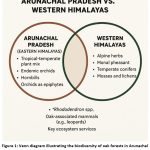 |
Figure 1: Venn diagram illustrating the biodiversity of oak forests in Arunachal Pradesh (Eastern Himalayas) and the Western Himalayas. |
In Arunachal Pradesh, shifting rainfall patterns and changes in monsoon intensity pose significant risks, particularly affecting the delicate balance of soil moisture levels, which are crucial for the forest ecosystem’s stability.38 Increased rainfall during certain periods can lead to waterlogging, which affects root systems and promotes fungal diseases, both of which are expected to increase with rising temperatures39 (Figure 2). The Western Himalayas will experience similar risks, however, warmer temperatures may create drought-like conditions during dry seasons, intensifying stress on oak species.
Forest Health and Vulnerability to Pests and Diseases
Warmer and more erratic climates create favourable condition for the spread of invasive species and pathogens (Figure 2). Oak forests in both regions are already showing signs of increased pest pressure. For instance, the oak moth (Operophtera brumata), which affects Quercus species, could expand its range with rising temperatures, further impacting the health of the forests’ in both the Eastern and Western Himalayas. The spread of fungal infections such as Phytophthora spp. also poses a significant threat. This increasing vulnerability can lead to decreased oak regeneration rates, with long-term implications for forest stability.40
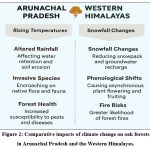 |
Figure 2: Comparative impacts of climate change on oak forests in Arunachal Pradesh and the Western Himalayas. |
Conservation Strategies in the Face of Climate Change
Integrated Conservation Approaches
Arunachal Pradesh utilizes community-based conservation models, including Joint Forest Management (JFM) and Village Forest Development Committees (VFDCs). These models encourage local participation in forest management and enhance sustainability against climate-related disruptions (Figure 3). In these models, community engagement plays a vital role in addressing to climate change impacts, such as changing water cycles and forest health.41
In the Western Himalayas, large-scale protected areas and wildlife corridors, like the Great Himalayan National Park help reduce the impacts of climate change by preserving large, contiguous tracts of forest habitat that can support shifting species ranges (Figure 3). However, habitat connectivity remains a challenge due to increasing human settlements and agricultural activities.42 Both regions require more adaptive management strategies to address climate change related disturbances by emphasizing climate adaptation through forest restoration, habitat protection, and collaborative approaches (Figure 3).
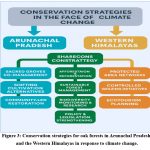 |
Figure 3: Conservation strategies for oak forests in Arunachal Pradesh and the Western Himalayas in response to climate change. |
Policy and Research Needs
There is an urgent need in both regions to implement climate adaptation strategies for the future management of oak forests (Figure 3). In order to implement effective policies, it is significant to improve monitoring of oak health, track changes in species distribution, and assess the vulnerability of forests to climate change (Table 3). Local climate action plans must be developed that specifically target the integration of climate change considerations into forest policy, with focus on ecosystem-based adaptation measures42 (Figure 4).
Table 3: Policy-driven interventions for Oak Forest conservation: A strategic framework
| Policy | Strategic action | Arunachal Pradesh focus | Western Himalayas focus |
| Forest governance & regulation | Strengthen enforcement of forest protection laws | Integrate community forest rights under FRA, 2006; Align with Pakke 2047 Declaration for climate-resilient forest management | Enhance patrolling and monitoring via forest departments |
| Climate-responsive zoning | Define eco-sensitive and climate-resilient zones | Delineate zones integrating indigenous land-use systems; Integrate with Pakke Declaration zoning guidelines | Expand buffer zones around protected areas |
| Afforestation & restoration policies | Promote native species reforestation | Focus on Quercus griffithii, Q. serrata regeneration under climate-smart reforestation; guided by Pakke Declaration goals | Encourage natural oak regeneration over pine monoculture |
| Community participation & incentives | Policy frameworks to support community-led conservation | Institutionalize Van Panchayats & Joint Forest Management (JFM) with tribal councils; promote community forest initiatives under Pakke 2047 vision | Strengthen JFM through Panchayati Raj institutions |
| Data, monitoring & early warning systems | Create open-access forest vulnerability maps and data tools | Encourage community-driven biodiversity monitoring under Pakke-linked citizen science programs | Implement remote-sensing and AI tools for phenological shifts |
| Policy-education integration | Climate curriculum in forestry training institutes | Incorporate TEK (Traditional Ecological Knowledge) in policy training; Pakke as a model site for environmental education | Link research outputs to field-level policy implementation |
| Incentives & green finance | Payments for Ecosystem Services (PES) and REDD+ models | Pilot PES in community forests & watersheds around Pakke Landscape | Integrate oak conservation into CAMPA funds & CSR projects |
 |
Figure 4: Seven strategic policy pillars guiding adaptive Oak Forest management and conservation efforts in Arunachal Pradesh. |
Conclusions
Oak forests play a crucial role in maintaining biodiversity and delivering ecosystem services in both Arunachal Pradesh and the Western Himalayas. However, with the changes in growing climatic conditions, it is necessary for conservation strategies to adapt in managing these forests. The responses of both regions are distinguishable from each other, but the challenges they face are quite similar, including rising temperatures, changes in rainfall patterns, and altered forest health. A combination of community-based management, scientific research, and robust climate change adaptation plans is essential to ensure the long-term conservation and health of these oak forests.
Acknowledgementsl
The authors acknowledge the contributions of authors and the information shared through various publications for preparing the article. Authors also thenkful to the two anonyous reviewers for their insightful comments and suggestions that greatly imporved the manuscript.
Funding Sources
The author(s) received no financial support for the research, authorship, and/or publication of this article.
Conflict of Interests
The authors do not have any conflict of interest.
Data Availability Statement
This statement does not apply to this article.
Ethics Statement
This research did not involve human participants, animal subjects, or any material that requires ethical approval.
Informed Consent Statement
This study did not involve human participants, and therefore, informed consent was not required.
Permission to Reproduce Material from other Sources
Not applicable
Authors Contributions
Johnson Singh: Conceptualization, Methodology, Data Collection, Writing – Original Draft.
S. Lodhiyal: Visualization, Supervision, Reviewing.
S. Kanwal: Supervision, Reviewing.
Balasubramanian: Data Collection, Analysis, Writing – Review & Editing.
Avinash Sharma: Data Collection, Analysis, Writing – Review & Editing.
References
- Chandran A et al. The Role of Oak Forests in Environmental Regulation in the Eastern Himalayas. Journal of Climate Change Research. 2021;19(4):148-159.
- Saxena AK. Conservation Strategies in the Western Himalayas. Journal of Himalayan Biodiversity. 2020;22(2):102-117.
- Garkoti, SC, Sharma CM, Baduni, NP. Diversity, distribution, and ecological importance of Quercus species in the Indian Himalayan Region. Tropical Ecology. 2021;62:25–37.
- Singh P, Hajra PK. Floristic diversity of Arunachal Pradesh. Botanical Survey of India, Kolkata. 1996;1:1-23.
- Myers N, Mittermeier RA, Mittermeier CG, da Fonseca GA, Kent J. Biodiversity hotspots for conservation priorities. Nature. 2000;403:853–858.
CrossRef - Dutta S, Sharma SK. Ecological status of oak forests in the Eastern Himalaya: A case study from Arunachal Pradesh, India. Indian Journal of Forestry. 2020;43”153–160.
- Rawat GS. Status and conservation of Himalayan broadleaf forests: An overview. In C. Uttam & D. K. Upreti (Eds.), Forests of the Himalaya. 2017;pp.115–132.
- Manish K, Pandit MK. Biodiversity richness, endemism and conservation priorities in the Indian Himalaya. Biological Conservation. 2018;222:39–46.
- Joshi VC, Negi VS, Bisht D, Sundriyal RC, Arya D. Tree biomass and carbon stock assessment of subtropical and temperate forests in the Central Himalaya, India. Trees, Forests and People. 2021;6:100147.
CrossRef - Negi GCS, Sharma S, Vishvakarma SCR. Carbon allocation in tree species of the Central Himalaya: Implications for carbon storage. Indian Forester. 2003;129:873–878.
- Chaturvedi RK, Raghubanshi AS, Singh JS. Carbon density and accumulation in woody species of tropical dry forest in India. Forest Ecology and Management. 2011;262: 1576–1588.
CrossRef - Valdiya KS Accelerated erosion and landslide-prone zones in the Central Himalayan region. IAHS-AISH Publication. 1985;159:1–12.
- Tiwari AK, Bhat JA, Negi GCS. Role of oak (Quercus leucotrichophora) forests in hydrological services in Central Himalaya, India. Ecological Processes. 2017; 6:1–9.
- Singh S P, Rawat YS. Mountain biodiversity and ecosystem services in the Himalaya: Drivers of change and current understanding. Environmental Development. 2012;2:18–30.
- Webber KM, Dhaliwal S, Wong K. Conducting literature reviews hermeneutically. Journal of Applied Hermeneutics. 2023;1-15.
CrossRef - Page MJ, McKenzie JE, Bossuyt PM, Boutron I, Hoffmann TC, Mulrow CD, Shamseer, L, Tetzlaff JM, Akl EA, Brennan SE, Chou R. The PRISMA 2020 statement: An updated guideline for reporting systematic reviews. 2021;372:n71.
CrossRef - Snyder H. Literature review as a research methodology: An overview and guidelines. Journal of Business Research. 2019;104:333–339.
CrossRef - Boell SK, Cecez-Kecmanovic D. A hermeneutic approach for conducting literature reviews and literature searches. Communications of the Association for information Systems, 2014;34:12.
CrossRef - Dey B et al. Floral Composition and Diversity of Oak Forests in Arunachal Pradesh. Indian Journal of Forest Research 2019;10:14-24.
- Kumar P, Sharma A. Community Based Conservation Initiatives in Arunachal Pradesh: A Successful Model. Journal of Environmental Management 2018;55:1710-1718.
- Tiwari SM et al. Coping with Climate Change: Adaptation Strategies for Oak Forests in the Eastern Himalayas. Climate Adaptation Strategies for Forestry 2018;Springer:217-226.
- Ruiz-Peinado R, Oviedo JA, Senespleda EL, Oviedo FB, del Río Gaztelurrutia M. Forest management and carbon sequestration in the Mediterranean region: A review. Forest Systems 2017;26:10.
CrossRef - Negi CS, Sharma M. Impact of Climate Change on Forest Composition in the Indian Himalayas. Environmental Research Letters 2019;14:09806.
- Vidal A et al. Shifting Forest Boundaries: The Impact of Climate Change on Alpine Oak Forests in the Himalayas. Environmental Science & Policy 2022;124:134-145.
- Garg S, Aggarwal RK. Biodiversity and Conservation of Oak Forests in the North-Eastern Himalayas: A Review. Biodiversity and Conservation 2017;25:1439–1454.
- Mishra P, Suresh D. Ecological Significance of Oak Forests in Arunachal Pradesh: A Case Study. Nature and Conservation 2017;14:51-61.
- Sathyakumar S, Bashir T. Wildlife of the Himalaya: conservation issues and the way forward. Mountains, Ecosystem and Man. 2010;322-43.
- Rani S. Climate, Land-Use Change and Hydrology of the Beas River Basin, Western Himalayas. Springer 2023;1-210.
CrossRef - Kougioumoutzis K, Constantinou I, Panitsa M. Rising Temperatures, Falling Leaves: Predicting the Fate of Cyprus’s Endemic Oak under Climate and Land Use Change. Plants 2024;13(8):1109.
CrossRef - Sagar N, Suresh KP, Naveesh YB, Archana CA, Hemadri D, Patil SS, Archana VP, Raaga R, Nandan AS, Chethan AJ. Forest fire dynamics in India (2005–2022): Unveiling climatic Impacts, spatial Patterns, and interface with anthrax incidence. Ecological Indicators 2024;166:112454.
CrossRef - Matta G, Kumar A, Singh Tomar D, Kumar R. Climate change in the Himalayan region: susceptible impacts on environment and human settlements. Frontiers in Environmental Science. 2025;13:
CrossRef - Kumar S, Khanduri VP. Impact of climate change on the Himalayan alpine treeline vegetation. 2024;e40797.
CrossRef - Mirhashemi H, Heydari M, Karami O, Ahmadi K, Mosavi A. Modeling climate change effects on the distribution of oak forests with machine learning. Forests. 2023;14:469.
CrossRef - Kattel GR Climate warming in the Himalayas threatens biodiversity, ecosystem functioning and ecosystem services in the 21st century: is there a better solution?. Biodiversity and Conservation. 2022;31:2017-2044.
CrossRef - Negi M, Negi VS. Temporal changes in Oak forests over last three decades in western Himalaya, India. Trees, Forests and People. 2021;6:100146.
CrossRef - Kreuzwieser J, Rennenberg H. Molecular and physiological responses of trees to waterlogging stress. Plant, cell & environment. 2014;37:2245-59.
CrossRef - Basu R, Misra G, Sarkar D. A remote sensing based analysis of climate change in Sikkim supported by evidence from the field. Journal of Mountain Science 2021;18(5):1256-67.
CrossRef - Prasad NA, Rani S. Ecosystem Services Provided by Oak Forests in India’s Himalayan Ranges. Forest Ecosystems Journal 2023;24(2):95–106.
- Keenan RJ. Climate change impacts and adaptation in forest management: a review. Annals of forest science 2015;72:145-67.
CrossRef - Salick J, Ghimire SK, Fang Z, Dema S, Konchar KM, Collaborating authors (who have taken active part in data collection from 2005–2011): Denmark:. Himalayan alpine vegetation, climate change and mitigation. Journal of Ethnobiology 2014;34:276-93.
CrossRef - Littell JS, Peterson DL, Millar CI, O’Halloran KA. US National Forests adapt to climate change through Science–Management partnerships. Climatic Change. 2012;110:269-96.
CrossRef - Scarano FR. Ecosystem-based adaptation to climate change: concept, scalability and a role for conservation science. Perspectives in Ecology and Conservation. 2017;15:65-73.
CrossRef