


 PDF Downloads:
238
PDF Downloads:
238


Introduction
Horticulture is the segment of agriculture that deals with the growing, harvesting, processing, and marketing of various crops, including fruits, vegetables, plantation crops, tuber crops, aromatic plants etc. The Indian government started a change in farming in the 1960s with the Green Revolution. This made farms much more productive and helped India become self-sufficient in food grains. However, productivity growth hit a wall in the 1990s, notably during the Eighth Five-Year Plan. During the same period, India did LPG (Liberalization, Privatization, and Globalization) reform, which significantly curtailed various subsidies on necessary agricultural inputs such as fertilizers, pesticides, credit facilities, high-yielding seeds, etc. doing this, agrarian productivity declined very heavily also, and agricultural GDP growth averaged only 1.9 percent from 1997-98 to 2004-05,1,2 and this phenomenon is termed the agrarian crisis of the 1990s in Indian agriculture. India’s agriculture economy has mostly moved into high-value areas like horticulture and livestock to get through this crisis. Assam has also made a big change from growing only rice to focusing on high-value sectors like horticulture, fishery, and livestock.3
Over the past 20 years, Assam has seen a huge increase in the production and productivity of many horticultural crops. This is because the state’s agro-climatic conditions are stable and good for growing high-value horticultural crops like fruits, vegetables, and spices. Horticultural crops occupy about 15 percent of the gross cropped area of the state, with an annual production of more than 67 lakh metric tons (MT) of various horticultural products; in the year 2023-24, the area under horticultural crops was 6.76 lakh hectares, production was 81.03 lakh MT, and the average yield was 50838 Kg/hectare.4
The Economic Survey of Assam for 2023–24 says that the state is now mostly self-sufficient in grain crops, especially rice. As a result, the commercialization of the horticulture sector has been prioritized. With changing consumer preferences and increasing demand for high-value horticultural products and organic goods in both domestic and international markets, Assam is well-positioned to capitalize on its favorable agro-climate for cultivating a wide range of horticultural crops. On the other hand, tea has long been the state’s most important agricultural export, but since the fiscal year 2015–16, its share of the export basket has dropped significantly. This drop is worrisome, but it also indicates that the state’s agricultural exports are becoming more varied.5 Beyond tea, Assam has developed a diverse range of exportable agricultural and horticultural products, including Joha rice, Bhut jolokia, cane and bamboo products, Muga and Eri fabrics, and various fruits and spices like pumpkin, jackfruit, litchi, pineapple, Assam lemon, ginger, turmeric, black rice, red rice, and Assam honey. APEDA helps third-party companies export these goods to many nations. Mumbai, Kolkata, and New Delhi are the main commercial hubs for these goods.6–8 From 2015–16 to 2021–22, Assam’s agricultural product exports grew by around 80%. The main places they went to were the Middle East, the UK, Southeast Asia, Bangladesh, Hong Kong, and Singapore. 6,8–10 APEDA has played a crucial role in promoting export-oriented crops and supporting the agricultural community. Over the past few years, APEDA has organized numerous capacity-building programs on export awareness throughout Assam, including in the Northeast region. Additionally, APEDA has facilitated 22 International Buyer-Seller Meets and trade fairs from 2019-20 to 2021-22 and conducted various training programs on pre-harvest and post-harvest management to enhance export potential from the region.6
Review of Literature
The state of Assam has a significant agro-climate advantage for growing horticultural crops, including those in the hill areas, which are capable of producing extensive fruits. Agricultural growth stimulates rural non-farm activity by increasing demand for production inputs and consumer goods.11 Assam has registered a significant increase in the area, production, and productivity of horticultural crops due to commercialization and government initiatives,12 but segment-wise or crop-wise, this growth of horticultural crops resulted in variation across segments, such as Assam contributing 18.08 percent of the total value of pineapple production to India and 5.25 percent and 6.12 percent of the value of citrus and litchi production, respectively.12 Earlier studies also indicate that increasing horticultural crop production is primarily supported by the expansion of the area; however, the productivity role in horticultural crop production in Assam is relatively sluggish compared to India’s overall horticultural productivity.13 Therefore, the literature suggests the importance of modern inputs and effective water management, particularly in low-productivity districts, the effective use of fertilizers and pesticides, and the dissemination of agricultural knowledge, etc.14 Despite efforts, productivity instability persists, with significant variations across districts. To address this, large-scale promotion of stabilization measures, such as insurance, should be prioritized.15
Agricultural exports are a significant component of the nation’s GDP, as this sector is highly labor-intensive, which helps recruit many unemployed rural residents. Those farmers engaged in producing export-oriented horticulture are more comfortable than those who are not.16 Studies have found that a 1% increase in agricultural exports boosts farm employment by 0.302% without significantly affecting non-farm employment. Additionally, it has been revealed that agricultural exports have positive demand shocks.17 Horticultural crop production for export is typically influenced by the quality of the soil, the abundance of water, and the agro-climate. To produce for export, farmers require large-scale production, as well as efficient transportation, purchasing centers, and storage facilities.18 Another study, found that knowledge of horticultural crop exports is positively and significantly influenced by both the distance to the market and the level of education.19 Agricultural exports are highly sensitive to global market price fluctuations,20 but domestic market fluctuations of agricultural goods can be mitigated through trade with other countries.21
From existing studies, it has been observed that the previous studies primarily emphasised on the trends and growth of area, production, and productivity of horticultural crops in Assam. However, there are limited studies on Assam’s agricultural exports potential. Therefore, this study aims to examines the recent trends and growth of the horticultural exports from Assam besides updating the studies on horticultural crops present status in Assam. Additionally, although horticultural crops area, production and productivity trends are available but update of recent data required to understand present status of horticultural crops, and to continue the update crops status the trends for the year 2013-14 to 2022-23 has determined.
Materials and Methods
This study utilized secondary data collected from various credible sources. Information regarding the growth trends and growth rates in the area, as well as the production and productivity of key horticultural crops in India, with a specific focus on Assam, has been sourced from both published and unpublished materials. These include the Directorate of Economics and Statistics, the Directorate of Agriculture, the Government of Assam, various editions of the Statistical Handbook of Assam, and multiple editions of the Economic Survey of Assam. Additionally, data on the export of crops in India, particularly Assam’s contribution was gathered from APEDA for the periods 2011-12 to 2022-23.
Compound Annual Growth Rates (CAGR)
To examine the annual growth rate of horticultural crops in India and the state of Assam, this paper calculated the Compound Annual Growth Rate (CAGR) of area harvested, production, and productivity of major horticultural crops in India, in general, and in Assam, in particular. For estimating the Compound Annual Growth Rate (CAGR), we use the following semi-log-linear trend equation, which was also employed by such as 12,21–23

Where lnY is the logarithmic value of the variable under consideration,
β0 is the constant term,
β1 is the coefficient to be estimated
t is the time period, and
U is the error term.
The ordinary least squares technique is used to determine the value of the respective coefficients. The compound growth rate (r) has been calculated as follows.

Where eβ1 is the exponential value of the regression coefficient β1
Enumeration of Instability
To examine the instability in respective variables, we have calculated and analyzed the instability index using the method provided by Cuddy and Della-Valle24; this method was also employed by Researcher.13,15,25,26
Cuddy & Della-Valle Instability Index (%) = CV.√(1-R2)
The ranges of CDVI are given as follows:
Low instability = 0 to 15
Medium instability = 15 to 30
High instability = 30 and above
Enumeration of Supply-Demand gap
The population of Assam has been projected for years using the following formula: –

Pn = Population forecast for n years
Pn-1 = Population of last known year
r = rate of population growth (during 2001 & 2011 census)
Aggregate demand (Dn) projected using the formula-
Dn = Population in the ‘n’ year * per capita fruits/vegetables requirement prescribed by the ICMR- National Institute of Nutrition27 report of 2024.
Results
Analysis of growth trends of horticultural crops area, production and productivity in India and Assam:
The growth trends of area, production, and productivity of horticultural crops in Assam state in comparison to overall India are presented in Table 1, which illustrates substantial growth across all three parameters during the study period. As shown in Table 1, A look at how horticulture crops have significant changed from 2013–14 to 2022–23 shows that there are big differences in growth patterns and stability measures between India as a whole and Assam in particular, except for India in 2014–15, which is also evident in Fig. 1 and Fig. 2, respectively. The data shows that area expansion, output growth, and productivity changes all have different paths, and there are large variances in the indications of instability.
Comparative analysis of growth rate and instability of India and Assam
The area growth rate of Assam was higher than the national average, with a compound annual growth rate (CAGR) of 2.90% compared to India’s 2.10%. This shows that Assam had a very ambitious plan to expand its horticulture area during the study period. But the growth rate of production was the opposite, with India having a greater CAGR of 2.90% than Assam’s 2.30%.
The biggest difference is in productivity trends. Assam’s CAGR was -0.50%, which is worrying, whereas India’s was 0.70%, which is good. Even though the land in Assam has grown, productivity has gone down. This shows that there are problems with agricultural efficiency and adopting new technologies.
The CDVI analysis is a better way to quantify instability since it takes into account trend effects in time series data. Assam had a CDVI of 3.57, which meant that the area was less stable than India’s 2.71. Assam had a CDVI of 2.82, which was better than India’s 3.39, nevertheless. Assam’s productivity instability was still higher (2.04) than India’s (1.15).
Share of Assam in India’s horticultural area, production
Assam’s contribution to India’s horticultural sector stayed almost the same during the studied years, however it was small. The state’s part of the area ranged from 2.53% to 2.96%, during the study periods and its share of production ranged from 2.70% to 2.99%, during the same periods. This shows that Assam’s share of national horticulture production has not grown much, even if the area has grown significantly.
Table 1: Status of horticultural crops in Assam state and overall India (Area in Lakh ha; Production in Lakh MT; Productivity in MT/hectare)
| Assam | India | % share of Assam to all India | ||||||
| Year | Area | Production | Productivity | Area | Production | Productivity | Area | Production |
| 2013-14 | 6.11 | 75.87 | 12.39 | 241.98 | 2773.52 | 11.46 | 2.53 | 2.74 |
| 2014-15 | 6.44 | 81.68 | 12.68 | 234.10 | 2809.86 | 12.00 | 2.75 | 2.91 |
| 2015-16 | 6.45 | 85.46 | 13.25 | 244.72 | 2861.88 | 11.69 | 2.64 | 2.99 |
| 2016-17 | 6.49 | 86.24 | 13.28 | 248.51 | 3006.43 | 12.10 | 2.61 | 2.87 |
| 2017-18 | 7.47 | 89.18 | 13.59 | 252.36 | 3106.70 | 12.31 | 2.96 | 2.87 |
| 2018-19 | 7.47 | 89.81 | 12.02 | 257.37 | 3110.52 | 12.09 | 2.90 | 2.89 |
| 2019-20 | 7.56 | 91.68 | 12.13 | 264.82 | 3204.71 | 12.10 | 2.85 | 2.86 |
| 2020-21 | 7.62 | 92.55 | 12.25 | 274.76 | 3346.03 | 12.18 | 2.77 | 2.77 |
| 2021-22 | 7.60 | 94.17 | 12.39 | 280.42 | 3471.79 | 12.38 | 2.71 | 2.71 |
| 2022-23 | 7.85 | 96.03 | 12.51 | 284.38 | 3554.82 | 12.50 | 2.76 | 2.70 |
| CAGR | 2.90*** | 2.30*** | -0.50*** | 2.10*** | 2.90*** | 0.70*** | ||
| CV% | 9.11 | 6.94 | 4.28 | 6.64 | 8.71 | 2.58 | ||
| CDVI | 3.57 | 2.82 | 2.04 | 2.71 | 3.39 | 1.15 | ||
Source: Various issues of Statistical Handbook of Assam & Handbook of Statistics on Indian States
Note: ***Significant at 1 percent, ** Significant at 5 percent, *Significant at 10 percent
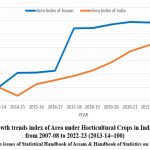 |
Figure 1: Growth trends index of Area under Horticultural Crops in India and Assam from 2007-08 to 2022-23 (2013-14=100) |
Source: Various issues of Statistical Handbook of Assam & Handbook of Statistics on Indian States
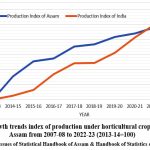 |
Figure 2: Growth trends index of production under horticultural crops in India and Assam from 2007-08 to 2022-23 (2013-14=100) |
Source: Various issues of Statistical Handbook of Assam & Handbook of Statistics on Indian States
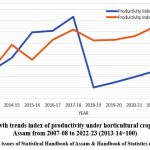 |
Figure 3: Growth trends index of productivity under horticultural crops in India and Assam from 2007-08 to 2022-23 (2013-14=100) |
Source: Various issues of Statistical Handbook of Assam & Handbook of Statistics on Indian States
Growth trends of agricultural and horticultural exports between India and Assam
According to Table 2, there has been notable growth in both agricultural and horticultural exports from India and Assam during the study period compared to the reference year (i.e., 2011-12); India’s agricultural exports increased from 19643.25 Thousand MT in the reference year to 44463.33 thousand MT in 2022-23 while in Assam, the quantity of exports changes a lot, from a low of 4.43 thousand MT in 2011-12 to high a high of 45.53 thousand MT in 2022-23. The percentage of India’s agricultural exports that came from Assam also changed a lot, from 0.023% in 2011-12 to highest point in 2020-21 at 0.136, again dropped to 0.102 2022-23.
The path of horticulture exports shows 0.55 thousand MT in 2011-12, and eventually a big high in 2012–2013 (15.75 thousand MT), followed by a general decline, with exports reducing to ₹1.51 crores by 2022–2023. The percentage contribution reached its highest point in 2012-13 at 0.418%, but by 2022-23, it had dropped to 0.027%, which suggests that it is hard to keep up a steady level of horticulture exports.
Comparative analysis of growth rate and instability of exports between India and Assam
Assam’s agricultural exports grew at a CAGR of 14.20%, which is far faster than India’s national agricultural export growth of 4.00%. This growth, on the other hand, was quite unstable, as shown by a CV of 60% and a CDVI of 21, which means it was somewhat unstable. Assam’s horticulture exports grew at a moderate rate, with a CAGR of 4.50%, which is a little higher than India’s horticultural export growth of 3.60%. But this sector was quite unstable, with a CV of 91% and a CDVI of 68, which shows that it was very unstable. India’s exports show a lot more steadiness in both areas. On the other hand, India’s agricultural exports had a CV of 31% and a CDVI of 13, which means they were not very unstable. Horticultural exports were even more stable, with a CV of 19% and a CDVI of 7. This big difference shows that Assam’s exports are far more unstable than the national average. This suggests that policies need to be put in place to make export performance more stable.
Supply-Demand gap of fruits and vegetables in Assam
This export potential is further reinforced by data in Table 3, which presents the supply-demand gap of fruits and vegetables in the state. The recent five-year data of the supply-demand gap have been calculated, and from the enumerated result, it can be observed that the supply of fruits in Assam consistently surpasses the demand for fruits and increases from 9.53 lakh MT in 2019-20 to 13.42 lakh MT in 2023-24, while vegetables also recorded considerable excess supply during the same periods. Even though there is a lot of extra output, export use is still quite low. Only 0.28% of the surplus went to exporting fruits, and only 0.14% went to exporting vegetables. In 2019, the most fruit was exported (0.094 lakh MT), while in 2021, the most vegetables were exported (0.0121 lakh MT).
Table 2: Trends in agricultural and horticultural export from India and contribution by Assam/Growth rates of these variables (Quantity in 000’MT)
| Year | Contribution of Assam to India’s Agricultural Export | Agricultural Export of India | Contribution of Assam to India’s horticultural export | Horticultural Export of India | % Contribution of Assam to India | |
| Agriculture | Horticulture | |||||
| 2011-12 | 4.43 | 19643.25 | 0.55 | 3353.39 | 0.023 | 0.016 |
| 2012-13 | 21.14 | 29804.66 | 15.75 | 3767.52 | 0.071 | 0.418 |
| 2013-14 | 14.48 | 30001.58 | 2.85 | 3765.45 | 0.048 | 0.076 |
| 2014-15 | 12.05 | 27134.31 | 1.49 | 3395.94 | 0.044 | 0.044 |
| 2015-16 | 18.87 | 20474.81 | 2.47 | 3557.67 | 0.092 | 0.070 |
| 2016-17 | 26.92 | 21386.73 | 4.66 | 5025.46 | 0.126 | 0.093 |
| 2017-18 | 21.19 | 22404.83 | 8.12 | 3927.27 | 0.095 | 0.207 |
| 2018-19 | 10.58 | 23183.19 | 10.44 | 4668.99 | 0.046 | 0.224 |
| 2019-20 | 13.88 | 18271.11 | 9.54 | 3709.10 | 0.076 | 0.257 |
| 2020-21 | 43.60 | 32109.76 | 5.21 | 4343.83 | 0.136 | 0.120 |
| 2021-22 | 40.57 | 42763.85 | 2.42 | 4829.99 | 0.095 | 0.050 |
| 2022-23 | 45.53 | 44463.33 | 1.51 | 5691.44 | 0.102 | 0.027 |
| CAGR | 14.20*** | 4.00*** | 4.50*** | 3.60*** | ||
| CV% | 60 | 31 | 91 | 19 | ||
| CDVI | 21 | 13 | 68 | 7 | ||
Source: APEDA
Table 3: Supply and demand gap of fruits and vegetables in Assam
| Fruits | Vegetables | |||||||||
| Year | Population (Lakh) | Supply (Lakh MT) | Demand (Lakh MT) | Supply-Demand Gap | Exported
(Lakh MT) |
Population (Lakh) | Supply (Lakh MT) | Demand (Lakh MT) | Supply-Demand Gap | Exported
(Lakh MT) |
| 2019 | 353.7 | 22.26 | 12.73 | 9.53 | 0.094 | 353.7 | 54.99 | 51.64 | 3.35 | 0.0004 |
| 2020 | 359.28 | 22.29 | 12.93 | 9.36 | 0.031 | 359.28 | 55.84 | 52.45 | 3.39 | 0.0019 |
| 2021 | 364.9 | 23.05 | 13.14 | 9.91 | 0.003 | 364.9 | 57.58 | 53.28 | 4.3 | 0.0121 |
| 2022 | 370.7 | 25.53 | 13.35 | 12.19 | 0.005 | 370.7 | 58.21 | 54.12 | 4.09 | 0.0059 |
| 2023 | 376.58 | 26.98 | 13.56 | 13.42 | 0.002 | 376.58 | 57.18 | 54.98 | 2.2 | 0.0044 |
Source: APEDA & Statistical Handbook of Assam
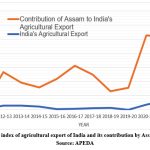 |
Figure 4: Growth index of agricultural export of India and its contribution by Assam (2011-12=100) |
Source: APEDA
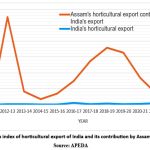 |
Figure 5: Growth index of horticultural export of India and its contribution by Assam (2011-12=100) |
Source: APEDA
Discussion
Horticulture is slowly becoming a long-term job for farmers that lets them diversify their crops and make money all year long. The substantial area, production growth of horticulture particularly for Assam, indicated farmers are becoming more aware of the benefits of commercialization, and the government is putting in place different programs to help them.12 Furthermore, from the productivity growth rate of horticultural crops in Assam, it can be easily concluded that horticultural production in Assam is primarily facilitated by area expansion rather than productivity; this result is also supported by Bhuyan et al.13 To sustain this growth, the Government of Assam introduced several initiatives, including the Horticulture Mission for North East and Himalayan States (HMNEH), Mission Organic Value Chain Development in Assam (MOVCDA), and the Rashtriya Krishi Vikas Yojana (RKVY).12,28 To boost the productivity of agricultural and horticultural crops in Assam, the Government of Assam in the budget 2025-26 announced significantly subsidized high-yielding seed distribution to farmers.29 This suggests that Assam has strong potential to boost production by improving productivity, given that its area growth rate exceeds the national average.
Even Assam have naturally suitable for growing diversified horticultural crops but in terms of export this is a recent development. The agricultural and horticultural export from Assam registered a significant improvement in terms of growth rate comparison to India. The agricultural export during the later period of study depicted significant increase compared to earlier year, this is because the higher agricultural export growth rate was primarily contributed to by a significant rise in rice exports from 2020-21 onwards. On the other hand, the dip in horticultural export during 2022-23 was because of imposition of Onion export ban in late 2023 for curbing domestic supply disruptions.30 Examining the supply-demand gap of fruits and vegetables it indicated that Assam has growing amounts of surplus fruits and vegetables which can be exported but unfortunately state yet to exploit its full export potential. Despite, Assam recorded remarkable performance in terms of growth rate in agricultural and horticultural exports but it experienced substantial inconsistency in its horticultural export contribution, which may be because, during the study period, some years Assam recorded zero or very limited exports of particular crops due to several technical and institutional obstacles.
After discussing with exporter of horticultural crops it has revealed that exporters faced several challenges such as scattered and lack of quality production, excessive use of chemicals and pesticide, complex marketing system which leads to higher collection cost for exporter as they depend on aggregator or wholesaler, higher transportation cost as there is no direct exporting facility available in Assam. Because of such problems the overall landing cost of the exporters for the horticultural products becomes exorbitantly high compared to other international competitors and eventually leads to domestic market profits and international marketing profits equal. Therefore, they are discouraged from engaging in exports, as equivalent profits can be earned in the domestic market. Therefore, to make Assam’s grown horticulture to reached in international market adequate measures need to be implement by Government along with the participation of farmers, traders, exporters required.
Strengthen export of horticultural products from Assam:
Focus on products and markets
Facilitating Assam’s horticultural crops in a well-functioning international market will boost economic status of farmers and others stakeholders. Singh & Chand31 suggested that to succeed to accessing international market one might compete in exports in three ways. One, prices in primary markets should be sufficiently lower than international prices to lower prices in the domestic market the cost of production for farmers needs to be adequately reduced by utilizing mechanization in agriculture, soil testing, and the efficient use of chemicals and pesticides. If the prices in the local market remain higher, the agricultural products of Assam will be unable to compete in international markets. Second, the price spread across various marketing stages should be reduced. This is because a higher price spread indicates that farmers receive limited profit from agriculture, which will reduce their willingness to improve the agricultural system and ultimately, production will suffer. Third, producers should be integrated into global value chains; this is one of the essential solutions to reduce intermediaries by integrating farmers with global value chains through farmer-producer organizations (FPOs).
Export infrastructure
An export plan for Assam should include products and markets to fix regional disparities at the state level, promote exports in each district.32 Assam is blessed with numerous agricultural and horticultural products with significant potential to accessing international markets, but as of now, for baby boom periods, as the state is centrally unable to implement region-specific measures to upgrade specific crops, the state can identify the diversify exportable agricultural and horticultural product in district wise and engaging District Agriculture Office to implement necessary measure such as providing efficient and affordable seeds, crops quality upgradation, adequate use of pesticide and fertilizer per importing countries standard, efficient post-harvest management and more importantly encouraging for organic production, additionally efforts could be made towards understanding the culture of different countries, the Sanitary and Phytosanitary (SPS) and Technical Barriers to Trade (TBT) issues, business ecosystem, conducting business to business meetings for securing export contracts, among other things. Disseminates information about selected crops importance in international markets and potential higher profitability of cultivating the specific crop then there will be greater possibility arise during the reasonable time for Assam to attain a greater foundation of agricultural and horticultural crop export. The federal government developed One District One Product (ODOP) and District Export Promotion Committee’s (DEPC) to formulate District Export Action Plans (DEAPs) 32. Assam has started ODOP to help the push industry, but yet to works on DEPC and DEAP for exports.
Fiscal Incentives
Providing fiscal incentives will helps farmers and exporters in Assam become worldwide rivals. Because Assam is landlocked, exporters there need to lower their logistics costs. APEDA helps export flowers, fresh produce, culinary herbs, dried flowers, processed foods, poultry, dairy, and medicinal plants.33 Until 2016, the Ministry of Commerce and Industry giving freight subsidies to some states which helps lowers the price of shipping and landing agricultural goods for exporters in competitive worldwide marketplaces, but in later periods it was discontinued.33 Landlocked state like Assam this sort of incentives appreciable so government needs to takes such incentive for boosting export eco-system.
Limitation
This paper is primarily based on secondary sources, and this paper examined the export status of Assam based on data gathered from APEDA, but to comprehensively examine export status, it will be reasonable to study based on directly collected data from APEDA registered various exporters, and a comprehensive study based on farm household surveys will be more suitable to get precise information about the agricultural and horticultural export scenario of Assam.
Conclusion
This study indicated that Assam registered a remarkable progress in area and production of horticultural crops, but in terms of productivity state recorded negative growth trend over the years. It has also indicated that horticultural crop production in Assam is primarily contributed to by area expansion, while in the case of India, besides area, productivity also partially contributes. However, in terms of export Assam recorded a 14.20% compound annual growth rate in its agricultural export contribution compared to overall India’s 4 percent. However, this growth rate was primarily driven by the latest rise in rice exports. In contrast, the horticultural export of Assam registered a growth rate of 4.50 percent per annum which is marginally higher than overall national 3.60 percent. To got more insight of export potential of Assam, the supply-demand gap of fruits and vegetables has determined which indicated significant potential of horticultural exports. But in terms of stability of exports, Assam registered moderate instability in agricultural export and higher instability in horticultural export, while overall national growth rates recorded significantly stability compared to the state. Higher instability indicated lack of continuity and unsustainable or inconsistency of Assam’s agricultural and horticultural exports.
Acknowledgement
The author gratefully acknowledges the Department of Economics, Gauhati University, for granting opportunity to pursue the Ph.D. research work. The author also extends sincere thanks to the reviewer for valuable suggestions.
Funding Sources
The author(s) received no financial support for the research, authorship, and/or publication of this article
Conflict of Interest
The authors do not have any conflict of interest.
Data availability statement
All data that support the findings of this study are included in this manuscript and its supplementary information files.
Ethics Statement
This research did not involve human participants, animal subjects, or any material that requires ethical approval.
Informed Consent Statement
This study did not involve human participants, and therefore, informed consent was not required.
Permission to reproduce material from other sources
Not Applicable
Author Contributions
Saddam Hussain: Writing—review & editing, Writing – original draft, Validation, Resources, Methodology, Investigation, Formal analysis, Data curation, and Conceptualization.
Dr. Dharmendra Nath: Supervision
Reference
- Government of India. Report of the Working Group on Agricultural Marketing Infrastructure and Policy Required for Inte Rnal and External Trade for the Xi Five Year Plan 2007-12.; 2007.
- Ahoy P. Agrarian Crisis India: An aftermath of the New Economic Reforms. Asian Journal of Social and Human Sciences. 2016;1(2). doi:10.13187/ajshs.2016.2.31
CrossRef - Haque J. Economic Diversification as a Strategy against Agrarian Crisis an Appraisal of Rural Fishery Horticulture and Dairy Farming. Thesis. Gauhati University; 2020.
- Govt. of Assam. Economic_survey_assam_2024-25.; 2025.
- Exim Bank of India. EXPORT-IMPORT BANK OF INDIA Unlocking Assam’s Export Potential.; 2022. Accessed July 5, 2025. https://www.eximbankindia.in/Assets/pdf/research-on-states/Exim_Bank_Unlocking_Assams_Export_Potential.pdf
- Government of India. Government formulates strategy to promote NER as agri export .
- Government of Assam. Exportable items and border infrastructure | Industries & Commerce | Government Of Assam, India.
- APEDA. Agrarian exports from Assam Rs 4,000 crore in 2022-23. . November 13, 2023. Accessed July 9, 2025. https://agriexchange.apeda.gov.in/news/Newssearch.aspx?newsid=48599&Date=28Feb2023
- APEDA. Assam agricultural-exports witness 80% growth. July 2022. Accessed July 9, 2025. extracted from https://agriexchange.apeda.gov.in/news/NewsSearch.aspx?newsid=43828
- Singh B. Farmers in Assam export pumpkins to Dubai. . The Economic Time. May 29, 2020.
- Haggblade S, Hazell P. Give to AgEcon Search Agricultural Technology and Farm-Nonfarm Growth Linkages.; 1989. http://ageconsearch.umn.edu
CrossRef - Gogoi M, Pathok P, Assistant R, Bharadwaz PJ. Status of area, production and productivity of fruit crops (Major and indigenous) of North East India, with special reference to Assam. ~ 1556 ~ The Pharma Innovation Journal. 2022;(3):11. http://www.thepharmajournal.com
- Bhuyan D, Kotoky A. Instability in Production and Productivity of Horticultural Crops in Assam. Indian J Agric Res. 2023;57(1):123-127. doi:10.18805/IJARe.A-5927
CrossRef - Kumar P, Nain MS. Agriculture in India: A SWOT Analysis.; 2013. www.mofpi.nic.in
- Kumar A, Jain R. Growth and Instability in Agricultural Productivity: A District Level Analysis. . Agricultural Economic Research Review. 2013;26:31-42.
- Afari-Sefa V. Give to AgEcon Search The Distributional Effects of Horticultural Export Value Chains among Smallholders In Southern Ghana.; 2007. http://ageconsearch.umn.edu
- He X. US agricultural exports and labor market adjustments. Agricultural Economics (United Kingdom). 2020;51(4):609-621. doi:10.1111/agec.12575
CrossRef - Laosutsan P, Shivakoti GP, Soni P. Agricultural and natural resources adaptations to climate change: Factors influencing the adoption of good agricultural practices and export decision of thailand’s vegetable farmers. Int J Commons. 2019;13(2):867-880. doi:10.5334/ijc.895
CrossRef - Saripalle M. Munich Personal RePEc Archive Market awareness and profitability: case study of Mango production in Karnataka, India. Econ Polit Wkly. 2019;LIV(4). Accessed July 9, 2025. https://www.epw.in/journal/2019/4/special-articles/market-awareness-and-profitability.html
- Dastagiri MB. India’s Horticultural Export Markets: Growth Rates, Elasticities, Global Supply Chains, and Policies. Modern Economy. 2017;08(07):847-864. doi:10.4236/me.2017.87059
CrossRef - Hussain S, Nath DD. Indo-Bhutan Agricultural Trade: Trends and Prospects. IJNRD – INTERNATIONAL JOURNAL OF NOVEL RESEARCH AND DEVELOPMENT. 2025;10(5):e576-e583. doi:https://doi.org/10.56975/ijnrd.v10i5.307191
CrossRef - Dasgupta M, Dey T, University T. Title: Exports of Fruits and Vegetables from Northeast India: Prospects and Challenges. Econ Polit Wkly. 2024;59(1).
- Venkatesha MH, Yogish SN. Trends in area, production and productivity of pomegranate producing states of India. International Journal of Multidisciplinary Research and Development Online www.allsubjectjournal.com. 2016;3:356-359. www.allsubjectjournal.com
- Cuddy JDA, Della Valle PA. Measuring the instability of time series data. Oxf Bull Econ Stat. 1978;40(1):79-85.
CrossRef - Vasavada KM, Shiyani RL. Growth and Instability of Exports of Vegetable Products from India. Economic Affairs (New Delhi). 2021;66(3):363-369. doi:10.46852/0424-2513.3.2021.1
CrossRef - Mashindano O, Kazi V, Mashauri S, Baregu S. Taping Export Opportunities for Horticulture Products in Tanzania: Do We Have Supporting Policies and Institutional Frameworks?
- ICMR-National Institute of Nutrition. Dietary Guidelines for Indian-2024.; 2024.
- Baruah D, Borah N, Deka N. Supply-Demand Projection and Gap Analysis for Fruits in Assam. Economic Affairs (New Delhi). 2022;67(4):393-392. doi:10.46852/0424-2513.4.2022.3
CrossRef - Government of Assam. Assam Budget 2025-26 Speech English.; 2025.
- Government of India. Centre withdraws 20% duty on Onion Export effective from April 1st, 2025 . PIB.
- Singh H, Chand R. The Seeds Bill, 2011: Some Reflections. Agricultural and Food Sciences, Economics, Law. Published online 2011. Accessed April 27, 2025. https://www.semanticscholar.org/paper/The-Seeds-Bill%2C-2011%3A-Some-Reflections-Singh-Chand/d61b5d4a83948a2ea8dd9 46543de4a 6244829af1
- NITI Aayog. EXPORT PREPAREDNESS INDEX 2022.; 2022. Accessed July 5, 2025. https://niti.gov.in/sites/default/files/2023-07/Export-Preparedness-Index-2022_0.pdf
- Exim Bank of India. Promoting Exports from Bihar: Insights and Policy Perspectives.; 2019.