


 PDF Downloads:
206
PDF Downloads:
206


Introduction
Agriculture continues to be a fundamental component of the economy and food security in sub-Saharan Africa. In Burkina Faso, agriculture constitutes the primary source of income and subsistence for a large majority of rural households. However, the sector faces major constraints, including progressive soil degradation, the adverse effects of climate variability, and low levels of intensification of agricultural practices.1 These challenges significantly hinder efforts to increase productivity and ensure the sustainability of farming systems, particularly in Sudano-Sahelian zones, where fragile soils and unfavorable climatic conditions exacerbate the vulnerability of smallholders. In the face of these challenges, association cropping systems have been identified as a potentially efficacious approach to enhancing agricultural productivity while concurrently strengthening the sustainability of family farms. This potential efficacy is attributed to three key mechanisms: The optimization of resource utilization, the preservation of soil fertility, and the mitigation of crop failure.2 This mode of production is based on the simultaneous cultivation of two or more species on the same plot, enabling more efficient use of resources (water, light, nutrients) and reducing risks. In addition, integrating leguminous into these systems offers specific advantages, such as biological nitrogen fixation, weed suppression, and erosion control.3
Sorghum production in Burkina Faso, a staple crop for many rural populations, remains marked by low productivity. This is due to several complex and interdependent constraints. Firstly, the soils of the Sudano-Sahelian zone have low natural fertility, due to their pedological age. Climatic conditions, characterized by low and irregular rainfall, aggravate this situation by limiting crop yields. Moreover, the seeds used by farmers often come from traditional varieties that exhibit substandard performance and limited quality. Farmers also face difficulties accessing fertilizers, both organic and mineral, due to their high costs and limited availability. Finally, the lack of adequate public policies to support agricultural investment helps perpetuate extensive farming systems, which are insufficient to meet the increasing food demands.4,5 These challenges are exacerbated by the continuous exploitation of soils without adequate replenishment of nutrients removed by crops, thereby accelerating their progressive degradation.6
Previous research has demonstrated the effectiveness of cereal-leguminous associations in improving crop yields. For example, The sorghum-cowpea association significantly increased grain and straw productivity, as measured by the Land Equivalent Ratio (LER).7 However, few studies have been devoted to other promising leguminous, such as mungbean (Vigna radiata) and voandzou (Vigna subterranea), whose potential advantages remain underexplored in association systems with sorghum. Yet these crops are of significant agronomic interest: mungbean, renowned for its high protein content, contributes to food security and soil fertility, while voandzou, a drought-tolerant native crop, offers increased resilience in arid zones.8,9
It is in this context that this study was carried out, with the general aim of evaluating the productivity of two sorghum intercropping systems combining mungbean or voandzou. Specifically, it aims to (i) Evaluate the productive performance of two types of intercropping systems sorghum with mungbean and sorghum with voandzou compared with monoculture systems. (ii) Evaluate the effect of intercropping systems on crop physiological responses to understand their interactions between crops better.
Materials and Methods
Study site
The present study was conducted in the villages of Tansin and Yilou, both located in the Centre-Nord region of Burkina Faso. Tansin lies within the province of Sanmatenga, specifically in the commune of Korsimoro (coordinates: 12°49’24” N, 1°4’12” W). This site is situated in the Sudano-Sahelian climatic zone.10 For the year 2020, corresponding to the study period, the monthly average rainfall and the number of rainy days are presented in Figure 1. The total annual rainfall accumulated to 801 mm over 45 rainy days. The predominant soils in this area are leached tropical ferruginous soils, eutrophic brown soils, and lithosols.11
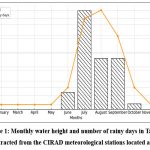 |
Figure 1: Monthly water height and number of rainy days in Tansin |
Source: Data extracted from the CIRAD meteorological stations located at the Tansin site
Within Yilou site, the total annual rainfall recorded was 891.1 mm distributed over 38 rainy days. The average monthly rainfall and the number of rainy days is detailed in Figure 2. The main soil types observed at Yilou include leached tropical ferruginous soils, poorly developed soils characterized by gravel erosion, lithosols on cuirass, eutrophic brown soils over basic rock formations, as well as hydromorphic and hydromorphic sodic soils.11
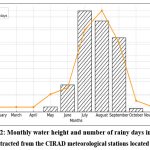 |
Figure 2: Monthly water height and number of rainy days in Yilou. |
Source: Data extracted from the CIRAD meteorological stations located at the Yilou site.
Plant material
Sorghum variety (Sorghum bicolor [L.] Moench) called Sariasso 18 obtained from CIRAD, was used in this study. Its sowing maturity cycle (50%) is between 115-120 days. Its resistance to post-flowering drought is average, and it is tolerant to lodging. The plants vigorous to emerge with low sensitivity to photoperiod and therefore consistently assured production.12 The “Tigré” variety of mungbean (Vigna radiata (L.) R. Wilczek) was used in this study. Its sowing-maturity cycle lasts 75-90 days. It is drought tolerant and can grow with low rainfall (600-1000 mm/year). The BF KVS 234 variety of voandzou (Vigna subterranea) was also used. Its sowing-maturity cycle lasts 85 days. It can grow well with low rainfall (600-700 mm) evenly distributed over 3-4 months and a temperature between 15 and 35°C.13
Experimental setup
The experimental setup is the same in both villages considered, with a total of 8 trials per village established on the farms of eight (08) volunteer farmers. Each participating farmer has a Fisher block with three (03) treatments. The blocks were distributed as follows:
4 blocks dedicated to associations involving sorghum and mungbean (Vigna radiata).
4 blocks dedicated to associations involving sorghum and voandzou (Vigna subterranea).
In each block, treatments were randomized to three modalities (Figure 3):
Treatment 1
Leguminous monocrop system (MP: pure Mungbean or VP: pure Voandzou), with 10 m-long rows spaced 40 cm x 40 cm apart.
Treatment 2
Intercropping of sorghum with one of the two leguminous, in an alternating arrangement of 2 rows of 10 m each (S+M: Sorghum associated with Mungbean; S+V: Sorghum associated with Voandzou).
Treatment 3
Sorghum monocrop system (SP: Sorghum pure), with 10 m rows spaced at 80 cm x 40 cm.
The size of the elementary plots is 96 m² (10 m x 9.6 m). The elementary plots are separated from each other by an 80 cm aisle, to avoid border effects and guarantee the independence of treatments. For each block (farmer), the location of the plots is randomly affected.
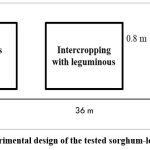 |
Figure 3: The experimental design of the tested sorghum-leguminous systems. |
Applied technical routes
Within the framework of the experimental set-up, the technical itineraries for the different treatments (mungbean, voandzou and sorghum in monocrop and the intercropping system with sorghum and one of the leguminous) were standardized to focus the study solely on the effect of crop association. Plots were prepared by ploughing to a depth of 15 cm. Sowing took place on July 17, 2020 at Tansin and on July 19, 2020 at Yilou. Sowing was carried out at specific spacings: 40 cm x 40 cm for mungbean and voandzou in pure cultivation. For sorghum in pure culture, the spacing is 80 cm x 40 cm, and alternating lines of 10 m for associations (2 lines of sorghum alternating with 2 lines of mungbean or voandzou). Sorghum and mungbean were sown at a rate of 3 to 4 seeds per poquet, followed by removal at 15 days after sowing (DAS), leaving two plants per poquet. Voandzou was sown at one seed per packet. An organic fertilizer of 6.5 t/ha was applied before sowing for all plots. At 30 days after sowing (DAS), a mineral fertilization of 150 kg/ha NPK was applied. Technical itineraries included two weedings at 15 and 45 days after sowing, followed by ridging at 60 days after sowing. An insecticide application was carried out on the mungbean plots, both monocrop and in intercropping, at 55 DAS to protect the crops against pests. Harvests occurred for mungbean and voandzou at 87 and 91 DAS respectively, and for sorghum at 137 DAS.
Measuring physiological parameters
Measure stomatal conductance and leaf water potential
Stomatal conductance and minimum water potential were measured only in the bloc where we study intercropping with voandzou at Yilou and the intercropping with mungbean at Tansin. They were carried out at solar noon (between 12 noon and 2 p.m.). Stomatal conductance was measured using an AP4 porometer (delta-Tdevices Caridge-UK).
It was carried out at the reproductive stage, i.e. 60 DAS at Tansin and Yilou, and involved previously marked plants. Four plants were selected in the monocropping plots and 6 plants in the intercropping plots, with three (3) plants per crop. On each plant, measurements were taken on two leaves (third and fifth leaves from the apical leaf). In this way, the value of stomatal conductance or water potential for a plot is the average of the 2 leaves per plant and 4 or 6 plants in each plot.
For the measurement of leaf water potential, the leaves were detached immediately following the stomatal conductance measurement and placed in airtight bags. Destructive measurements of minimum leaf water potential were thus measured using a Campbell J 14 Instruments hydraulic pressure chamber14 and reported in bars before conversion to megapascals for calculations. A 5 cm fragment of the sampled leaf is trapped in the chamber and pressure is exerted on the walls of the leaf blade until the sap contained in the leaf exudes from the nervures. The pressure exerted is read on the unit’s pressure gauge. This pressure, with a negative sign, corresponds to the water potential in the leaf.
LAI measurement
LAI was measured using a LI-Cor Plant Canopy Analyzer (PCA) LAI.15 Measurements were taken very early in the morning before sunrise and in the evening after sunset. For each elementary plot, measurements were made following the crop rows.
For a monocropping plot, three rows were measured. In each row, 3 measurements were taken with the LAI-meter barrel grazing the soil at two-step intervals, taking into account the border effect. For the intercropped plots, measurements were taken on two sorghum rows, two leguminous rows and two rows between the sorghum and the leguminous.
Determination of grain yields (RG), cereal straw biomass yield (RBFC) and leguminous straw biomass yield (RBFL)
Yields were assessed at harvest after the maturity of sorghum grains and leguminous pods. All grains and pods were harvested from each plot. After drying, dry weights were measured using a Raguso electronic hook scale (measuring range: min10g; max 40 kg).
For leguminous tops, we carried out a complete harvest per plot. The leguminous tops were dried and then weighed.
For the sorghum stalks, we cut and weighed sorghum stalks from 2 lines taken at random from each plot, noted the weights of the stalks from these 2 lines, took a common sample from each elementary plot (1 stalk per line) and weighed this sample fresh, then dried and weighed it dry. The weight of the two lines was extrapolated to the number of sorghum lines in the plot. The grains and straw obtained were weighed and the values extrapolated to the hectare (kg/ha) using the following formulas:
Grain Yield (GY) of different crops
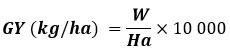
W = Dry grain weight in kilograms.
Ha = Harvested area of the plot in m² corresponding to the weight P
Cereal straw biomass yield (CSBY)

Dry Sample W = Dry sample weight of forage in kilograms,
Fresh Sample W = Fresh forage sample weight in kilograms
Wt fresh = Total weight of fresh forage in kilograms
Ha = Harvested area in m² corresponding to fresh Pt weight
Leguminous straw biomass yield (LSBY)

Dry Sample W = Dry sample weight of forage in kilograms,
Fresh Sample W = Fresh forage sample weight in kilograms
Wt fresh = Total weight of fresh forage in kilograms
Ha = Harvested area in m² corresponding to fresh Pt weight
Calculating the Land Equivalent Ratio (LER)

The Land Equivalent Ratio (LER) was used to assess the productivity of the intercropping system compared with pure cropping. The LER is defined as the area of land under pure cultivation required to produce the quantity produced by 01 ha of intercropping plot.16 It is determined by the following formula:
y1 +…………+ yi = yield of each component in the intercropping
Y1 +……………+ Yi = yield of each component in monocropping
If LER=1, there is no difference between the two cultivation methods (monocropping and intercropping).
If LER < 1, there is a loss of yield in Intercropping.
If LER > 1, there is a productive advantage for the intercropping, i.e. the associated crops are more productive than the monocropping.
Statistical data analysis
The various parameters measured in the field and calculated were entered using Microsoft Excel. This software was used to calculate means, standard errors (SE) and graphs. Analysis of variance (ANOVA) was performed using XLSTAT version 2016, taking into account standard association factors. The homogeneity of variances was verified by Levene’s test, and normality by Shapiro-Wilk’s test. The Tukey test was used to compare means when the analysis of variance revealed significant differences between treatments, at the 5% probability threshold.
Results
Crop physiological response according to intercropping or monocropping Leaf area indices (LAI) according cropping system
Figure 4 shows the boxplot of LAI values, enabling us to compare the effects of different treatments on plant cover. The LAI of sorghum in monocropping (1.41± 0.20) and in intercropping with Mungbean (1.35± 0.16) showed no significant difference (P=1.000). In a similar manner, the LAI of Mungbean (1.29± 0.41) exhibited no significant difference (P=0.998) in its intercropping with sorghum.
The LAI of sorghum in monocropping and in intercropping with Voandzou (0.97± 0.284), showed no significant difference (P=0.633). In a similar manner, the LAI of Voandzou (0.68± 0.24) exhibited no significant difference (P=0.273) in its intercropping with sorghum, which could be explained by its lower morphology and shallower rooting, reducing its access to resources compared with sorghum.
Statistical analysis of all treatments revealed a p-value of 0.206, indicating that there was no statistically significant difference between treatments in terms of LAI. The different modalities tested (SP, VP, MP, S+V, S+M) had no significant effect on the quantity of photosynthetic tissue per unit area of soil, which remained identical overall.
The distribution of LAI by site (figure 4) shows no significant difference (P=0.366) between Yilou (LAI=1.007± 0.235) and Tansin (LAI=1.381±0.235). Boxplot analysis of this distribution shows greater dispersion in Tansin than in Yilou, with the presence of an outlier.
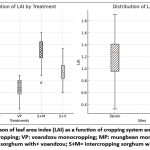 |
Figure 4: Comparison of leaf area index (LAI) as a function of cropping system and site – Legend: SP: sorghum monocropping; VP: voandzou monocropping; MP: mungbean monocropping; S+ V= Intercropping sorghum with+ voandzou; S+M= intercropping sorghum with mungbean. |
Effect of cropping system on plant stomatal conductance
Figure 5 shows the variation in stomatal conductance of sorghum, mungbean and voandzou according cropping system. In Tansin, the figure 5 shows sorghum in monocropping (SP) with a higher conductance (411.840 ±95.625 mmol/m²/s) than sorghum in intercropping with mungbean (S+M) (252±45 mmol/m²/s), but with no significant difference (P=0.122; Table 1). In Yilou, the trend is reversed, with sorghum in intercropping with voandzou (S+V) (340.944 ±50.885 mmol/m²/s), having a higher conductance than sorghum in monocropping (SP) (264.750 ±40.254 mmol/m²/s), but also with no significant difference (P=0.241; Table 1). Statistical analysis reveals that the crops (sorghum, mungbean and voandzou) have approximately the same stomatal movement in the two-cropping system at both Yilou and Tansin. Table 1 below presents the ANOVA results for stomatal conductance of sorghum, mungbean and voandzou.
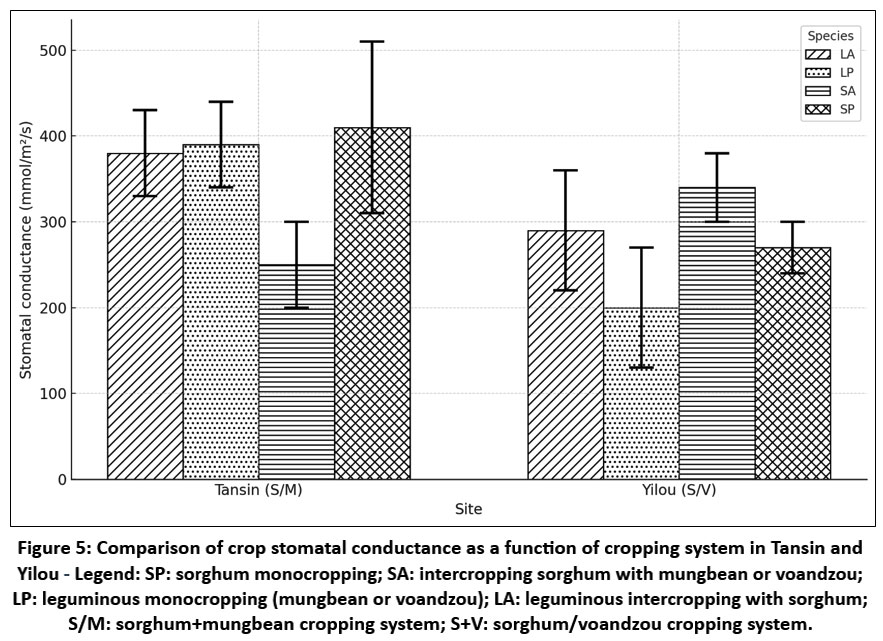 |
Figure 5: Comparison of crop stomatal conductance as a function of cropping system in Tansin and Yilou – Legend: SP: sorghum monocropping; SA: intercropping sorghum with mungbean or voandzou; LP: leguminous monocropping (mungbean or voandzou); LA: leguminous intercropping with sorghum; |
Table 1: ANOVA results for stomatal conductance in sorghum, mungbean and voandzou – Legend: SP: pure sorghum plot; VP: pure voandzou plot; MP: pure plot; S+V= plot of sorghum combined with voandzou; S+M= plot of sorghum combined with mungbean
| Sites | Contrast | p-value | Significant |
| Yilou | SP vs S +V | 0,241 | No |
| VP vs S+V | 0,317 | No | |
| Tansin | SP vs S+M | 0,122 | No |
| MP vs S+M | 0,935 | No |
Effect of cropping on plant minimum leaf water potential.
At Tansin, the water potential of sorghum in intercropping with mungbean (-194.17 ± 16.01 mbar) is lower than that of sorghum in monocropping (-163.78 ± 8.20 mbar), although this difference is not significant (P=0.312) (Figure 6 Table 2). In Yilou, the water potential of sorghum in association with voandzou (-163.78 ± 8.20 mbar) is higher than that of pure sorghum (-177.42 ± 9.15 mbar), although this difference is not statistically significant (P= 0.249) (Figure 7, Table 2)
In Tansin, mungbean in association has a lower water potential than that in monocropping (-59.00 mbar in MP vs. -52.63 mbar in S+M), but with no significant difference (P =0.977) (Figure 6, Table 2). In Yilou, voandzou in pure culture conserves water better than that in association (-71.96 mbar in S+V vs. -64.78 mbar in VP; P =0.594) (Figure 6, Table 2).
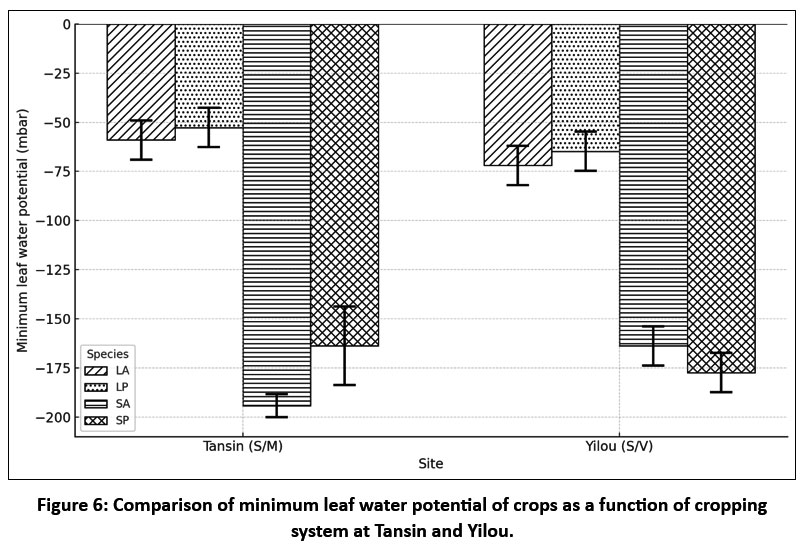 |
Figure 6: Comparison of minimum leaf water potential of crops as a function of cropping system at Tansin and Yilou. |
Legend: SP: pure sorghum plot; SA: sorghum combined with either mungbean or voandzou; LP: pure leguminous plot (mungbean or voandzou); LA: leguminous combined with sorghum; S/M: sorghum/mungbean cropping system; S/V: sorghum/voandzou cropping system.
Table 2: ANOVA results for minimum leaf water potential in sorghum, mungbean, and voandzou. – Legend: SP: pure sorghum plot; VP: pure voandzou plot; MP: pure plot; S+V= plot of sorghum combined with voandzou S+M= plot of sorghum combined with mungbean
| Sites | Contrast | p-value | Significant |
| Yilou | SP vs S+V | 0,312 | No |
| VP vs S+V | 0,594 | No | |
| Tansin | SP vs S+M | 0,249 | No |
| MP vs S+M | 0,977 | No |
Compare cropping system with grain yield et biomass LER
Grain yield LER
Figure 7 shows the grain LER results for the different cropping systems at each site. At Yilou, we note total grain LERs above 1 in the S+M systems (median LER=1.5), showing that the sorghum-mungbean intercropping is more efficient than monocropping. In contrast, the S+ V intercropping systems (median LER=1.1) show considerable variability, with some values above 1, others below. Statistical analysis shows that the difference between S+M and S+V is not statistically significant (P=0.301). This means that grain yields (LER) are similar, whatever the type of association.
At Tansin, analysis of the grain LERs of the S+M intercropping systems showed a median (LER= 1.1) (Figure 7), showing mixed results with great variability where some LER values were below 1, and others well above 1. The S+V association shows LER values (median LER=0.911) close to 1. Statistical analysis shows a p-value=0.684, meaning that there is no statistically significant difference between the cropping systems (S+M and S+V) at Tansin.
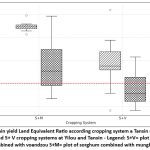 |
Figure 7: Grain yield Land Equivalent Ratio according cropping system a Tansin and Yilou for the S+ M and S+ V cropping systems at Yilou and Tansin – Legend: S+V= plot of sorghum combined with voandzou S+M= plot of sorghum combined with mungbean |
LER biomass straw yield
Figure 8 shows the straw LERs by system at both sites. At Yilou, both systems (S+M and S+V) have LERs well above 1 (Figure 8), showing the increased efficiency of the associations for forage production. The S+M intercropping has the highest LER (median = 1.4-1.5). The S+ V association has a median of around 1.3, which is still a good straw yield. On the other hand, statistical analysis shows that there is no difference between S+M and S+V LER at Yilou (P= 0.792).
In Tansin, the median LER of S+M is less than 1 (≈ 0.8) (Figure 8), indicating that the association is no more productive than the monocropping system. The LER of S+V intercropping has a median close to 1 (Figure 8). However, statistical analysis shows that at Tansin, there is no significant difference between the S+M and S+V LERs (P = 0.902).
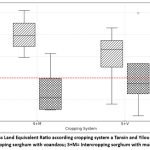 |
Figure 8: Biomass Land Equivalent Ratio according cropping system a Tansin and Yilou – Legend: S+V= Intercropping sorghum with voandzou; S+M= Intercropping sorghum with mungbean |
Discussion
The results of this study show that the physiology of sorghum and mungbean is independent of their growth conditions, whether in pure culture or association. This observation suggests good stomatal opening and optimal gas exchange, favoring transpiration and photosynthesis, irrespective of the cropping method. The sorghum-mungbean association can improve overall productivity without altering the physiological growth of sorghum. This is notably achieved by maintaining stable stomatal conductance and photosynthetic functioning.17
Statistical analysis of the results for stomatal conductance (G) and leaf water potential (ΨH) revealed non-significant differences between treatments. However, G showed an advantage in treatments SP (pure sorghum) and MP (pure mungbean) over treatment S+M (sorghum in association with mungbean), while an advantage was observed in S+V (sorghum associated with voandzou) over SP and VP (pure voandzou). These results could be explained by differences in the morphology and physiology of the root systems of the leguminous plants used in association. Root competition in associative systems closely depends on sowing density, species-specific root architecture, and soil type.18 The treatment effect observed on ΨH in our study could be explained by the root characteristics of mungbean and voandzou, although this effect is not statistically different. Mungbean, having a higher root density, could increase competition for water, thus reducing water availability for sorghum. Crops combined with legumes having dense root systems can negatively influence the water balance of cereals in constrained environments. This phenomenon has also been reported in previous studies.19 On the other hand, voandzou, with its more diffuse, nitrogen-fixing root system, can improve soil structure and promote better water and nutrient uptake. This facilitation would explain the lower ΨH values observed in the S+V treatment. The association of sorghum with legumes that have high nitrogen-fixing potential promotes better adaptation to water stress. These observations are consistent with previous findings.20 While physiological parameters did not significantly differ among treatments, trends observed align with previous work showing that root system interactions in intercrops can shape plant responses. Recent findings emphasize that physiological performance, such as stomatal activity, LAI, and water balance, can be influenced by root morphology, planting density, and moisture stress conditions in cereal-legume systems.18 ,23
Our results did not reveal significant differences in the leaf area index (LAI) between sole cropping and intercropping systems. This contrasts with previous findings.19 This discrepancy could be attributed to favorable soil and climatic conditions and the functional complementarity between sorghum and the leguminous mungbean and voandzou. Sorghum and leguminous likely exploited different ecological niches, reducing competition for water, light, and nutrients. Although treatments did not show significant differences, the intercropping systems remained competitive in terms of canopy coverage. The beneficial effect of leguminous could be related to their ability to fix atmospheric nitrogen, indirectly enhancing sorghum growth. These results highlight the potential of cereal-leguminous intercropping systems as a sustainable strategy to optimize resource use and improve crop performance under local agro-ecological conditions. Recent studies support the potential of sorghum-legume intercropping systems in improving land productivity and yield stability in Sahelian conditions, even when statistical differences are not always evident.20,7
In terms of grain LER, we observed that all the S+ M and S+ V systems at Yilou offer an advantage for intercropping (LER >1) in terms of grain production, with respective LERs of 1.5 and 1.1. The average grain LER of 1.5 for sorghum/mungbean means that the combination is more efficient and to achieve the same production in pure crops, 50% more land would have to be cultivated; for sorghum/voandzou, the LER of 1.1 means that 10% more land would have to be cultivated. In maize/cowpea associations in Burkina Faso, LERs were observed to vary between 1 and 1.46, suggesting that associated crops can offer advantages in terms of yield and efficient use of cultivable space. This trend has been corroborated by previous studies.3 At Tansin, LERs are 1.1 for S+M and 0.91 for S+V. Overall, LERs are slightly lower at Tansin than at Yilou. The difference in performance between Yilou and Tansin can be attributed to variations in pedoclimatic conditions. The performance of sorghum-cowpea associations is highly dependent on local conditions, notably rainfall and soil fertility. This has been demonstrated in previous studies.20 More abundant rainfall was recorded at Yilou and could explain the better results observed in our study. Consistent with our observations, several recent studies have reported that LER values often favor intercropped systems due to improved spatial resource use. However, such trends must be interpreted with caution when statistical significance is lacking.24,25
In terms of biomass LERs, all systems offered an advantage for the association (biomass LER >1) in biomass production at Yilou (S+ M= 1.4 and S+ V=1.3). In the first year, no system offered an advantage in biomass gain for the association at either Yilou or Tansin. This result was also reported in earlier findings.21 This could be explained by the fact that our study had a more interesting rainy season, with 320 mm more than the first year at Yilou. The differences in performance between the sites could be attributed to local soil and climate conditions and cultivation practices. The influence of rainfall, soil texture and crop management seem to play a decisive role in the success of the associations. At Yilou, where rainfall was more abundant, associative systems performed better, while at Tansin, where conditions were more restrictive, the advantage of associations was less marked.
From an agronomic point of view, the results suggest that the sorghum-mungbean association has a higher potential in terms of grain yield and biomass, thanks to a moderate complementarity between the two species. Voandzou seems less competitive in sorghum associations in terms of yield. However, its interest lies in its ability to improve soil structure and provide quality forage, which could be exploited in integrated crop-livestock systems. Notably, voandzou has been shown to enhance soil structure and provide high-quality forage, which may be useful in integrated crop-livestock systems.22.
The adoption of these associations could be an effective diversification strategy for farmers in the Sudano-Sahelian zone, strengthening the resilience of production systems in the face of climatic variations and soil degradation. Given the limited statistical significance in our findings, these conclusions should be interpreted as preliminary indications rather than definitive outcomes. Complementary trials taking into account local cropping practices, improved technical itineraries and optimized sowing densities could enable us to refine recommendations for better adoption of these practices on the farm.
Conclusion
This study set out to explore how intercropping sorghum with mungbean and voandzou might influence productivity in the Sudano-Sahelian zone of Burkina Faso. Although most of the observed differences between cropping systems were not statistically significant, some patterns—particularly in land use efficiency (LER) and biomass production, suggest that intercropping, especially with mungbean, holds potential.
The variability in outcomes across sites highlights how sensitive these systems are to local conditions such as soil type and rainfall. Because of this, firm conclusions about the superiority of one intercropping strategy over another would be premature.
Still, the results offer valuable insight. They show that even in challenging environments, sorghum-legume associations could help farmers make more efficient use of their land and resources. Going forward, longer-term studies across more diverse environments are needed to better understand these systems, especially how they affect soil health over time and how their design can be optimized to support both productivity and sustainability.
Acknowledgment
The author would like to thank the McKNight 3F project for funding this research. The CIRAD (International Cooperation Centre in Agronomic Research for Development) and AMSP (Association Minim Song Panga) are sincerely thanked for their technical assistance in conducting the study. The author also expresses deep gratitude to the Biosciences Laboratory of Joseph Ki-Zerbo University (UJKZ) for providing support in physiological measurement equipment and for their valuable advice.
Funding Sources
This study was carried out as part of an internship within the McKNight 3F project funded by CIRAD. The grant number is not known to the intern.
Conflict of Interest
The authors do not have any conflict of interest
Data Availability Statement
This statement does not apply to this article.
Ethics Statement
This research did not involve human participants, animal subjects, or any material that requires ethical approval.
Informed Consent Statement
This study did not involve human participants, and therefore, informed consent was not required.
Permission to reproduce material from other sources
Not applicable
Authors’ Contributions
Touwendé SAWADOGO: Data collection, statistical analysis of results, drafting the original manuscript, revision, and editing of the manuscript.
Hugues Roméo BAZIE: Development of the research methodology, supervision of data analysis and results, and active participation in the writing and validation of the manuscript.
Paulin BAZIE: Overall monitoring of the study, critical revision of the article, correction of technical and linguistic errors in the final manuscript.
Zézouma SANON: Monitoring the progress of the study, revision and correction of the article to ensure scientific coherence and editorial quality.
Gérard ZOMBRE: Field monitoring of the study, final manuscript correction, contribution to the revision of methodological aspects and improvement of the clarity of results.
References
- Food and Agriculture Organization of the United Nations (FAO). The State of Food and Agriculture 2017: Harnessing food systems for inclusive rural transformation: Rome, Italy: FAO; 2017.
- Vanlauwe B, Coyne D, Gockowski J, et al. Sustainable intensification and the African smallholder farmer. Current Opinion in Environmental Sustainability. 2020; 45:1–10.
- Agegnehu G, Ghizaw A, Sinebo W. Intercropping and crop rotation: Principles and practices for sustainable intensification in smallholder agriculture. Agronomy for Sustainable Development. 2021; 41:21.
- Sheahan M, Barrett C, B. Ten striking facts about agricultural input use in Sub-Saharan Africa.Food Policy. 2017; 67:12–25.
CrossRef - GWP/AO. Inventory of local populations’ climate change adaptation strategies and exchange of best practice experiences between different regions in Burkina Faso: 2010:85. Available at: www.gwpao.org. Accessed February 27, 2016.
- Kihara J, Bationo A, Vanlauwe B, et al. Soil health and sustainable agriculture in sub-Saharan Africa : Nature Reviews Earth & Environment. 2020; 1:584–593.
- Ouédraogo R, Sawadogo T, Tapsoba E, et al. Performance of sorghum-cowpea intercropping systems under contrasting soil fertility conditions in the Sahel : Agronomy. 2022; 12(3):693.
- Food and Agriculture Organization of the United Nations (FAO). Pulses: seeds for a sustainable future. Rome, Italy: FAO; 2016.
- Diatta AA, Thomason W, Thompson TL. Effet de l’association du haricot mungo sur le rendement du mil dans le bassin arachidier, Sénégal : Innovations Agronomiques. 2019; 74:69–81.
- Ndanga GK. Gestion de l’eau agricole et économie des usagers du barrage de Korsimoro (Burkina Faso): État des lieux et pistes de réflexion. 2011:54.
- Étude morpho pédologique de la province du Bam : Burkina Faso; 1995:96/Vol 1. Technical Report/N°097
- Centre de coopération internationale en recherche agronomique pour le développement (CIRAD). SARIASO 18: An improved sorghum variety. 2014.
- Linnemann AR, Westphal E, Wessel M. Photoperiod regulation of development and growth in bambara groundnut (Vigna subterranea) : Field Crops Research. 1995; 40(1):39–47.
CrossRef - Laffray PL, Louguet D. Techniques d’études de l’état hydrique des plantes : Bulletin d’Amélioration de la Production Agricole en Milieu Aride. 1988; 1:7–34.
- Danner M, Locherer M, Hank T, Richter K. Measuring Leaf Area Index (LAI) with the LI-Cor LAI 2200C or LAI-2200 (+2200Clear Kit) – Theory, Measurement, Problems, Interpretation : EnMAP Field Guide Technical Report. GFZ Data Services; 2015.
- Africa RISING. Sustainable Intensification of Key Farming Systems in the Sudan and Guinea Savannas of West Africa. 2017:41.
- Raboin LM, Sawadogo N, Zongo M. Agronomic performance of sorghum and leguminous intercrops in the Sahel: Root interactions and productivity : Revue Africaine d’Agronomie. 2023; 12(2):45–56.
- Zhang Y, Li L, Wang X, Zhang F. Intercropping and belowground interactions: A meta-analysis of root dynamics, resource partitioning and productivity : Field Crops Research. 2021; 271:108-258.
CrossRef - Sanna B, Ouédraogo R, Zida B. Influence of rainfall and cropping system on sorghum and cowpea productivity in a farming environment : Revue Sciences et Techniques, Série Sciences Naturelles et Appliquées. 2023; 41(1):78–92.
- Zongo D, Sawadogo M, Kaboré P. Impact of cropping associations and agroecological practices on crop yield in the Sudano-Sahelian zone of Burkina Faso : International Journal of Biological and Chemical Sciences. 2021; 15(4):1895–1910.
- Ouédraogo N. Association de cultures et variétés adaptées: Deux options agroécologiques profitables économiques : Mémoire de master. Université Joseph KI-ZERBO; 2020:79
- Mayes S, Massawe F, Alderson P, et al. Bambara groundnut: A climate-resilient, resource-use efficient legume for sustainable food and nutritional security in sub-Saharan Africa : Frontiers in Sustainable Food Systems. 2021; 5:660-800.
- Amouzou K A, Naudin K, Zombré G, Bayala J, Fustec J, Tittonell P, Dufour L. Soil cover and water stress effects on leaf area index and yield components in cereal-legume cropping systems in West Africa : European Journal of Agronomy. 2021; 124:126-252.
- Assefa G, Tessema Z K, Belay A, Fikre A, Ayele G. Productivity and land use efficiency of intercropping sorghum with legumes under different planting arrangements : Agronomy Journal. 2021; 113(2):943–955.
- Mekonnen T, Gebeyehu S, Woldegiorgis G. Effect of intercropping sorghum with legumes on yield advantage and economic return : Heliyon. 2021; 7(10):208-288.
Abbreviations List
LAI – Leaf area index;
LER – Land Equivalent Ratio;
SP – Sorghum monocrop;
MP – Mungbean monocrop;
VP – Voandzou monocrop;
S+M – Sorghum intercropping with Mungbean;
S+V – Sorghum intercropping Voandzou;
LP: Leguminous monocropping;
LA: Leguminous intercropping with sorghum