


 PDF Downloads:
104
PDF Downloads:
104


Introduction
Agriculture has long been a fundamental pillar of human civilization, serving as the primary source of food production, economic stability, and ecological balance across the globe. As the world’s population is projected to exceed 9.7 billion by 2050, the demand for safe, nutritious, and affordable food is increasing at an unprecedented rate, placing immense pressure on existing agricultural systems to significantly enhance productivity, efficiency, and long-term sustainability¹. At the same time, the agricultural sector continues to confront persistent and interconnected challenges such as crop diseases, declining soil fertility, nutrient imbalances, land degradation, and the growing unpredictability of climate conditions. These issues not only weaken crop yield stability but also threaten food security, disrupt agricultural supply chains, and increase the vulnerability of farming communities—particularly in developing and climate-sensitive regions. In this context, the development of intelligent, scalable, and technology-driven agricultural solutions has become essential for strengthening the resilience of modern farming systems and ensuring global food sustainability². As agriculture remains the economic backbone of many developing nations, it continues to provide food, raw materials, and primary income for millions of rural households³. However, traditional farming practices often fail to meet rising food demands due to limited access to real-time data, inefficient use of water and fertilizers, delayed decision-making processes, and heavy labor dependence. These limitations hinder productivity and restrict farmers’ ability to respond effectively to dynamic environmental and market conditions.
Recent advancements in Artificial Intelligence (AI), particularly in deep learning and data analytics, have emerged as transformative technologies capable of addressing these long-standing agricultural challenges by enabling precision-driven, data-informed, and automated decision-making⁴. AI-driven agricultural systems now facilitate real-time crop monitoring, early disease diagnosis, accurate yield prediction, and site-specific fertilizer optimization, collectively contributing to improved productivity and sustainable resource management. However, the accelerating impacts of climate change further complicate agricultural operations by introducing erratic rainfall patterns, prolonged droughts, extreme temperature variations, floods, and shifting distributions of pests and pathogens⁵. These environmental disruptions severely affect crop growth cycles, increase vulnerability to diseases, and reduce yield consistency across seasons. To overcome these challenges, AI-based adaptive agricultural solutions have become increasingly vital as they offer predictive intelligence and automated recommendations that empower farmers to respond proactively to changing environmental conditions. Such intelligent systems not only detect crop diseases at early stages but also assess their severity, forecast their potential spread, and recommend preventive or corrective measures based on real-time climatic and soil parameters.
Deep learning models—including Convolutional Neural Networks (CNNs), Vision Transformers (ViTs), and Generative Adversarial Networks (GANs)—have significantly advanced the scientific landscape of crop disease detection and fertilizer optimization through their powerful feature extraction and image-processing capabilities⁶,⁷. These models can analyze high-resolution plant images with remarkable accuracy, identify complex disease symptoms that are often invisible to the naked eye, and generate synthetic datasets to improve training performance and model generalization⁸. As a result, deep learning technologies are redefining the future of intelligent agriculture by enabling rapid disease diagnosis, precise nutrient management, and robust decision-support systems. This comprehensive review therefore aims to synthesize recent advancements in deep learning for crop disease detection and fertilizer recommendation systems, while critically analyzing existing challenges, state-of-the-art methodologies, technological architectures, and future research directions necessary for building resilient, intelligent, and climate-smart agricultural ecosystems.
A theoretical exploration of advanced deep learning networks like CNNs, ViTs, and GANs to detect and identify crop diseases descending on the images.
Analysis of hybrid and ensemble deep learning models to be used in case of delivering personalized and data-driven fertilizer recommendation taking into account soil health, climatic variables and crop growth dynamics.
This paper gives an insight into multimodal data fusion strategies using visual, sensor, and textual agricultural data in combination with the decision support frameworks that use internet of things (IoT) and cloud edge devices that can support real-time decisions.
Discussion and recognition of unresolved problems such as the lack of datasets, domain generalization, interpretability, robustness, and limitations of deployment.
Future directions have been proposed that promote adaptative, explanatory and all-queued to be implemented AI systems to achieve sustainable growth in the development of agricultural sectors.
With this convergence of all these aspects of research and interest in mind, this survey is intended to provide researchers, agribusiness stakeholders, and policymakers with a comprehensive review of the existing capacities and gaps with respect to AI-enabled crop health management and nutrient optimization-enabling a faster pace of innovation that can deliver food security and environmental sustainability9-10.
Background and Fundamentals
Agriculture is one of the primary pillars of world civilization as it ensures food security, supports economic development, sustains livelihoods, and maintains ecological balance. In developing countries, agriculture remains a major contributor to national GDP and a significant percentage of the population depends on it for survival, whereas in developed economies, continuous innovations and the rapid adoption of advanced technologies are redefining agricultural productivity. However, the increasing rate of population growth, urbanization, climate change, soil erosion, plant diseases, and nutrient management issues have imposed unprecedented stress on modern agricultural systems. To effectively address these challenges, conventional agronomic practices alone are insufficient; instead, the integration of breakthrough technologies such as Artificial Intelligence (AI), Machine Learning (ML), and Deep Learning (DL) has become essential, as these technologies offer transformative potential in crop monitoring, disease diagnosis, and resource optimization (Heyden et al. 9; Bucci et al.10).
Recent advancements in intelligent systems have opened new avenues for precision agriculture by enabling data-driven decision-making to enhance crop yield, sustainability, and resilience. DL and AI models are particularly beneficial in complex agricultural environments where data is heterogeneous, high-dimensional, and sourced from diverse inputs such as satellite imagery, weather sensors, soil analysis systems, and plant health monitoring devices (Musanase et al11). These models are increasingly applied to critical agricultural applications including disease recognition, crop yield prediction, pest detection, and fertilizer optimization, thereby significantly bridging the gap between scientific innovation and on-field agricultural practices (Akhter et al.12). Moreover, emerging paradigms such as large language models and foundation models are further expanding the scope of smart agriculture by improving decision automation, farmer advisory systems, and knowledge dissemination. Supporting technologies such as Industry 4.0 platforms and simulation-based serious games are also playing a vital role in agricultural education, training, and smart system deployment (Hossain et al. 13).
Basics of Crop Diseases, Symptoms, and Plant Pathology
Sustainable agricultural production is increasingly threatened by crop diseases caused by a wide range of pathogens, including fungi, bacteria, viruses, and nematodes, which result in substantial economic losses to the agricultural sector every year. These pathogens can infect all parts of the plant—leaves, stems, roots, and fruits—ultimately diminishing both the quality and quantity of agricultural output. Climatic factors such as humidity, temperature, and rainfall play a dominant role in governing the spread and severity of these diseases, thereby making certain crops and geographical regions more vulnerable than others. Bhat et al.14 emphasized that the timely diagnosis and effective treatment of crop diseases are crucial for ensuring stable agricultural production and minimizing financial losses. In parallel, recent research highlights that smart farming frameworks integrating Machine Learning (ML) and the Internet of Things (IoT) significantly enhance real-time disease monitoring and yield optimization, while intelligent crop recommendation systems based on ensemble learning further support adaptive decision-making under dynamic environmental conditions.
The scientific discipline concerned with the study of plant diseases and their causal agents, known as plant pathology, plays a central role in understanding infection mechanisms and developing effective mitigation strategies. It involves the systematic detection of disease symptoms, identification of virulent pathogens, and the deployment of suitable control and prevention measures. Common symptoms of crop diseases include chlorotic, necrosis, wilting, stunted growth, and fruit rot, which may be observable through naked-eye inspection or may require microscopic and molecular-level analysis for precise identification. However, traditional manual inspection techniques employed in agricultural fields are labor-intensive, time-consuming, subjective in nature, and highly susceptible to misdiagnosis, particularly in the early stages of infection when visual symptoms remain subtle and ambiguous. These limitations further justify the growing need for automated, intelligent disease detection systems in modern agriculture.
Many of the limitations associated with traditional manual disease detection approaches have been progressively mitigated through the use of Deep Learning (DL) techniques, which have demonstrated exceptional performance in image-based classification and pattern recognition tasks. Khan et al.15 reported that Convolutional Neural Network (CNN) models trained on well-annotated datasets comprising both healthy and diseased plant images achieved diagnostic accuracies exceeding 98%, significantly outperforming conventional inspection methods. These DL models are capable of identifying disease-specific visual characteristics such as lesions, color discoloration, and texture variations, even when these features are minute and embedded within complex natural backgrounds. Recent studies further confirm the robustness of DL-based frameworks for automated crop disease detection across multiple crop varieties and environmental conditions.
With the widespread adoption of high-resolution cameras in smartphone and the increasing deployment of unmanned aerial vehicles (UAVs) or drones, DL-based image classification systems are now being effectively integrated into mobile applications and unmanned aerial systems (UAS) for real-time disease detection and continuous outbreak monitoring. These intelligent systems significantly enhance early warning mechanisms and enable precision pesticide application, thereby reducing excessive chemical usage while maximizing crop yield. For instance, Ullah et al.16 developed an edge-computing-based framework to detect wheat leaf diseases using CNN models deployed on low-power devices, achieving high accuracy with low inference latency. Similarly, Uzair et al.17 introduced DeepCrop, a web-based crop disease prediction platform that leverages cloud-based DL models to deliver scalable and accessible diagnostic services for farmers and agricultural experts.
Fertilizer Types, Soil Nutrients, and Influencing Factors
Fertilizers cannot be avoided as long as they are necessary in the sustenance of crop health and increased productivity. Nitrogen (N), phosphorus (P) and potassium (K) are the three main macronutrients that are needed in large quantities in order to grow plants but calcium, magnesium and sulphur are secondary nutrients required and iron, zinc, boron and copper are the required micronutrients so that original physiological processes in plants are completed. Nitrogen plays a significant role in the growth of any vegetable and the formation of chlorophyll, phosphorus accelerates growth of roots and flowering, potassium increases the normal regulation and immunity to diseases. Nonetheless, excessive or inadequate application of fertilizers may lead to nutrient imbalances, impairment of the environment and loss of money.
The conventional fertilizer management policies depend on blanket recommendations which are regional and with regard to soil types and crop species without considering differences within a field in terms of soil texture, pH, organic matter and availability of water. Such an approach of a one-size-fits-all can prove to cause nutrient run off and leaching which can also cause groundwater contamination mainly in regions which have dense farming. Li .et.al18 pointed out the inefficiencies of such traditional systems and promoted precision-based, data-driven fertilizer recommendations that will be linked to real condition of a field.
AI and ML models that are being offered by modern tools are an intelligent solution to this issue taking large amounts of data in the sphere of environment and agronomy to produce accurate fertilizer prescriptions. Such models consider the parameters of the soil, climate factors, and the age of crops and past yield information in order to recommend the best fertilization type, application time and rate. AI have provided an IoT-based smart farming model that will connect the soil nutrient sensors, wireless communication unit, and ML algorithms to determine the crop nutrient demand. It is a dynamic fertilizer strategy adjustment system applied on reasonable estimates of soil moisture, temperature, and PH and rainfalls increasing the productivity and saving fertilizers.
Moreover, smart irrigation systems, coupled with fertilizer suggestions, subsidize the level of nutrient uptake and the consumption of water. Besides being able to have a sustainable management of resources, these AI-based platforms also enable smallholder farmers to obtain actionable information via mobile notifications and dashboards. These innovations are the essential milestone to accomplishing the goals of climate-smart and sustainable agriculture.
Overview of Deep Learning Techniques in Agriculture
The application of deep learning has proven to be a breakthrough in the field of agricultural science, since it allows non-linear relationships to be modeled and hidden trends to be identified in large patterns. It also does not require manual feature engineering, and is thus especially suited to problems that require complicated features to be extracted, such as image recognition, time-series prediction, and data fusion of heterogeneous data. Multiple DL frameworks, such as CNNs, Vision Transformers (ViTs), Generative Adversarial Networks (GANs), and a combination of them, are actively used in precision farming.
The most commonly adopted DL architecture in the agricultural sector is CNN because it is proficient in the classification of images. They include several convolutional and pooling layers that extract features of input images, shapes, colors, and textures hierarchically and are followed by fully connected layers that make the final classification. Different diseases in different crops have been detected on different crops, wheat, tomato, grape, and rice using CNN. CNNs were applied in classifying the wheat leaf diseases in edge devices and achieved 98.77 percent accuracy, which shows how powerful CNNs can be even in resource-limited settings.
ViTs belong to a more recent class of DL models that utilizes the transformer architecture popularized in natural language processing tasks to solve the problem of image classification. In contrast to CNNs, which act on localized filters, ViTs break an image into fixed-size patches and each patch is a token in a sequence. This enables them to become aware of the relationships within global contexts which the traditional convolutional approaches often fail to capture. Singh et al.19 found that ViTs competed well against CNNs in a series of tasks related to agricultural images classification, especially when very large and multifarious datasets were involved.
The other strong type of DL models is GANs, those being neural networks, a generator and discriminator, whose aim is to compete with each other. The generator produces artificially generated images and the discriminator tries to differentiate between the real and generated ones. This adversarial training leads to the generation of highly realistic data that can be applied to supplement the present training sets. Sharma et al. 20 used GANs to train synthetically-generated crop images in a range of environmental conditions that increased the robustness and generalization of DL-based disease classifiers.
Another type of AI used in agriculture is hybrid AI models because they have been observed to work with multiple types of agricultural data better than traditional ML algorithms alone. The models combine DL techniques such as CNNs with conventional ML algorithms such as Support Vector Machines (SVMs), Random Forests (RF), and Decision Trees (DT). Another example is the development of a model to predict crop yields by Jhajharia et al.21, who combined ML and DL elements to incorporate data of a given structure, such as the parameters of the soil and weather, along with unstructured information, such as satellite imagery. Another recommendation system by Mohapatra et al.22 suggested an ensemble of crop recommendation system, which proved to be more accurate when it comes to fertilizer and crop recommendation in the different agro-climatic zones adopted.
Such hybrid models not only tend to increase the predictive accuracies but also increase interpretability and adaptability, which are central issues of deployment in the real world. When combined with both IoT data streams and cloud computing infrastructure, as well as intuitive user interfaces, such capabilities can provide intelligent analysis to farmers and agronomists – as well as even policymakers.
Methodology
This study employs advanced methodologies integrating artificial intelligence, machine learning, and IoT technologies to enhance agricultural decision-making. The proposed approaches focus on accurate crop disease detection, optimized fertilizer recommendations, and multimodal data fusion, leveraging deep learning models, sensor networks, and hybrid frameworks to improve productivity, sustainability, and real-time field intelligence.
AI-Based Approaches
The rapid advancement of Artificial Intelligence (AI) in agriculture has paved the way for transformative solutions to critical challenges such as crop disease detection and fertilizer optimization. Leveraging deep learning, Internet of Things (IoT), and multimodal data integration, AI-powered systems can provide farmers with real-time, high-accuracy decision support. This section outlines the key AI-based methodologies shaping smart agriculture today:
Image-based disease detection (CNN, ViT, GAN-based models).
Sensor & IoT-based systems for soil and crop monitoring.
Fertilizer recommendation using hybrid deep learning and rule-based models.
Multimodal systems integrating vision, sensor, and environmental data.
Image-Based Disease Detection
Proper detection of crop diseases in real-time is vital in avoiding losses and sustainable production. Deep learning has disrupted this field where CNNs have become the most popular architecture for disease recognition in a plant based on an image. CNNs are also capable of detecting very faint disease signs, including chlorotic spots, necrotic lesions, and a change in texture with classification accuracies of more than 95 percent reported in various studies. Transfer learning using pretrained CNN (e.g. VGG16, ResNet50, and Inception-v3) has also increased accuracy in limited agricultural datasets further.
ViTs increase the strength of identifying a disease owing to their capacity to employ global dependencies based on self-attention (Dey et al.23). In contrast to CNNs, which are interested in local receptive fields, ViTs split the picture into patches and treat it as a sequence, which makes it possible to detect distributed symptoms of diseases in space.
Generative Adversarial Networks (GANs) solve the problem of limited annotated data in agricultural photos by creating realistic images of diseased plants in different environmental and severity conditions, so that a model gains more robust performance (Sundaresan et al.24).
All of the deep learning-related techniques allow creating automated, scalable and highly-accurate activation of crop disease detection which can be deployed on drones, mobile applications, and edge devices (Sandhya et al.25).
Sensor and IoT-Based Systems for Soil and Crop Monitoring
Beyond visual analysis, continuous soil and crop health monitoring is essential for precision agriculture. IoT-enabled sensors capture real-time parameters such as soil moisture, pH, nutrient concentrations, and environmental conditions, feeding AI-driven models for predictive analysis. Such systems can detect stress conditions before visual symptoms appear and forecast environments conducive to disease outbreaks.
Cloud-edge integration allows these systems to deliver low-latency alerts and actionable recommendations, even in rural or low-connectivity environments.
Fertilizer Recommendation Using Hybrid Deep Learning and Rule-Based Models
Effective fertilizer use is critical in promoting optimal crop yields coupled with reducing the negative environmental impacts that include nutrient runoffs, greenhouse gas emissions, and degradation of soil. Other conventional methods of making recommendations tend to be grounded on rules based conventional frameworks based on rules in agronomic guidelines. Such systems can be understood and rely on the know-hows in the field, but cannot bring a response to the dynamics of nutrient crop and environment interactions that are non-linear and complicated (Meshram et al.26). In response to said limitations, hybrid methods have been introduced which combine deep learning-based models with the rule-based knowledge of agronomy, taking the best trends based on each of said systems.
In a hybrid approach, complex spatial and temporal patterns of multidimensional agricultural data are learned by using deep learning models such as Convolutional Neural Networks (CNNs), Long Short-Term Memory networks (LSTMs) or in hybrid form (CNN-LSTM) of these networks. Some of the features processed by these models are the nutrient concentration of soil (N, P, K, organic matter content), the stages of crops, historical yield patterns, and long-term weather forecasts to estimate optimal nutrient application rates (Gong et.al27). The result is that in contrast to purely statistical or linear models, deep learning networks can capture nonlinear relationships between soil chemistry, crop physiology, and environmental variables and, thus, reach site-specific fertilizer recommendations beyond generic agricultural extension recommendations.
The operational flow of a hybrid fertilizer recommendation framework incorporating deep learning models and the rule-based agronomic expertise is shown in the diagram-1. Data used to train the model is collected by a series of input data sources (i.e. soil nutrient levels, crop growth stages, and previous yields) and is processed through a deep learning model in order to take a complex view of interaction among nutrients, crops and the environment. The expert agronomic constraints, through a rule-based module, are integrated to narrow down predictions, thus the recommendations are realistic and understandable. The IoT-enabled field devices provide real-time sensor feedback, which helps to make fertilizer application schedules dynamic to optimize nutrient-use efficiency and reduce environmental effects.
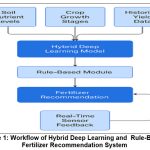 |
Figure 1: Workflow of Hybrid Deep Learning and Rule-Based Fertilizer Recommendation System |
Rule-based modules are incorporated to make the system more interpretable and provide agronomic validity. These modules contain expert-formulated agronomic rules, which are limitations or after-processing filters that are applied on the predictions made by the deep learning model, such as the avoidance of a nitrogen application before heavy rain, the maintenance of a harmonious NPK ratio within particular crops, or a reduction in the fertilization input in nitrogen-fixing crops (Darwin et al.28). This augmented layer with the rule is used both to avoid agronomically unsound advises and to allow an explanation of the decision to farmers and agricultural advisors. The hybrid system is run in closed-loop by which sensor information provided by Internet of Things (IoT)-compatible devices is sent in real-time into the model. This allows correlation of fertilizer program with direct field conditions which enhances nutrient uptake and reduces leaching as well as surface drainage. As another example, when the nitrate level in the soil stays high following an initial dose, the system can advise to decrease or delay further nitrogen releases, which will enable to save their input costs and preserve water quality.
Moreover, the hybrid recommendation systems can apply the historical yield and soil condition data to assist in planning of long term fertility. Such systems have the ability to factor in long term historical trends of data, and can prescribe incremental solutions to repair soils, e.g. addition of organic matter, pH correction by using lime, micronutrients addition etc., and hence ensure that the quality of the soil is brought to a sustainable level and not just the near term burst in production (Qureshi .et.al29).
The empirical research demonstrated that the mixture of deep learning and structured rules could yield considerably better recommendations and outcomes as compared to them being used individually. At that, in other papers, e.g., Musanase et al11) and Meshram et al.26, yield gains of up to 18 and 15 20 percent were recorded, respectively, with a reduction of losses of nitrogen respectively. These results exhibit the adaptability of hybrid systems to establish not only the objectives of advanced agriculture but also the roles of environmental engineering, and thus could be considered a very practical tool of neo-data-driven farming.
Multimodal Systems Integrating Vision, Sensor, and Environmental Data
The advantage of single-modality models when it comes to their areas of application can lead to a failure to grasp the full picture of the multidimensionality and the interconnections between factors that may affect the health and productivity of crops. As just one example, image-based systems may identify the symptoms of the disease that can be as seen by a human eye but may miss out on the presence of nutrient deficiency or water stress that were present before it can be seen. On the other hand, sensor-based ones are able to quantify soil moisture, nutrient levels and microclimatic parameters, yet they have no capability of either directly identifying disease lesions or canopy developments. Multimodal AI systems are essential to overcome these shortcomings and combine different and complementary sources of data, including crop images, sensor measurements of IoT devices, and past weather observations (Khan et al30). Data on vision obtained using RGB, multispectral, or hyperspectral imaging will give information on phenotypic traits and disease pattern, whereas IoT devices are used to constantly monitor the concentration of nutrients in the soil (N, P, K), soil pH and wetness of leaves. Past and current data of environmental data provides clues to weather-related stressful stimuli. These mixed inputs are combined through such methods as a feature-level fusion in which features extracted by each modality are stacked as a one representation or a decision-level fusion in which outputs of modality-specific models are merged by ensemble learning.
The multimodal fusion approach is very powerful in the predictive disease detection and fertilizer optimization applications, as it makes use of the spatial disease signature in addition to non-visual stress variables. Deployments are frequently achieved utilizing cloud and edge hybrid systems and models where the edge systems perform work in real time to signal real time alerts in the low connectivity areas, and cloud systems can perform work on large scale data aggregations, retrains, and face intellectual tasks. This set-up will provide recommendations with a context, early intervention of the disease, site specific fertilizer management, which will enhance productivity and sustainability. In practice, there is empirical evidence that disease detection through multimodal systems has a probability of surveillance increase by 8-15 percent compared to single-modality models, and fertilizer recommendations have a probability of accuracy development by 10-18 percent (Islam et al.31). These systems have the ability to optimize the use of individual inputs and minimize effects on the environment as well as create resilience in agricultural processes with the variable changes of climatic conditions because these systems blend vision, sensor and environmental intelligence together.
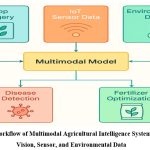 |
Figure 2: Workflow of Multimodal Agricultural Intelligence System Integrating Vision, Sensor, and Environmental Data |
The proposed framework, illustrated in Figure 2, presents a multimodal agricultural decision-support system that integrates crop imagery, IoT-based sensor readings, and environmental parameters such as temperature and humidity into a unified analytic workflow. To improve coherence, transitional statements have been added to clarify how these heterogeneous data streams collectively support the system’s core methodology, beginning with multimodal data fusion in a centralized AI engine that merges spatial, temporal, and contextual features for enhanced decision accuracy. This integrated processing enables the framework to deliver actionable insights for both crop disease detection and fertilizer optimization, with each module connected through summary elements that highlight their interdependence within smart agricultural ecosystems. Furthermore, cloud–edge hybrid architecture ensures efficient real-time computation, where edge nodes provide rapid on-field responses while cloud servers conduct deeper analytics, thus enabling timely, adaptive, and context-aware recommendations aligned with dynamic field conditions.
Datasets, Evaluation Metrics, and Comparative Analysis
The presence of quality datasets is central to creating excellent deep learning models of crop disease and fertilizer recommendation. Common data sets used to perform disease detection include the Plant Village which has 54,306 controlled images of leaves across many crops and diseases, and the PlantDoc which provides 2,598 field-collected images on different backgrounds and under varying lighting conditions. The AI Challenger Crop Disease Dataset offers a surplus of 38,000+ images annotated to enhance the development of generalizable models. To make fertilizer recommendations, it is important to have comprehensive soil health data comprising of soil nutrient levels (N: 10-120 mg/kg, P: 5-60 mg/kg, K: 40-300 mg/kg), pH (4.5-8.5), moisture content (5-35%), soil texture (sand: 30-85%, silt: 10-50 %, clay: 5-40 %). These data would be supplemented with on-demand; IoT based sensor data that adds real time environmental information to the model inputs.
Evaluating crop disease detection models involves multiple metrics designed to capture accuracy, reliability, and balance of predictions:
Accuracy
Accuracy = (TP + TN) / (TP + TN + FP + FN) (1)
It measures the overall proportion of correct predictions, where TP = true positives, TN = true negatives, FP = false positives, and FN = false negatives.
Precision
Precision = TP / (TP + FP) (2)
Indicates the proportion of true positive detections among all positive predictions, reflecting prediction quality.
Recall (Sensitivity)
Recall = TP / (TP + FN) (3)
Represents the ability to detect all actual positive cases.
F1-score
F1-Score = 2 * (Precision * Recall) / (Precision + Recall) (4)
The harmonic mean of precision and recall, balancing false positives and false negatives.
Mean Average Precision (mAP)
Used primarily in object detection, it calculates the average precision across all disease classes, integrating precision and recall at different confidence thresholds.
For fertilizer recommendation systems, performance is often evaluated using regression error metrics and practical impact assessments:
Root Mean Square Error (RMSE)

This measures the square root of the average squared difference between predicted fertilizer doses y^i and actual recommended doses yi, penalizing larger errors more heavily.
Mean Absolute Error (MAE)

This calculates the average magnitude of errors regardless of direction, providing an intuitive error measure.
Yield Improvement
It is often measured empirically such as can be done in field experiments, and is usually measured as a percentage increase in crop yield by comparison with the result of using the same land with fertilization regimens sanctioned by a model.
Comparative studies indicate that CNNs are superior in terms of their accuracy once the training sets are well-curated and in many cases, it exceeds 90%. The reason why vision Transformer (ViT) models perform well on highly complex, big data, professional, real-world datasets is their capability to capture global context. The GAN-based data augmentation alleviates issues of limiting content in datasets to help enhance model robustness and generalization. Nevertheless, there are still problems in the domain adaptation even among crops, regions, and seasons. Moreover, it is important that model explainability and their deployment on edge, resource-limited devices are important open problems in the field that motivate hybrid multimodal and interpretable AI capabilities.
The analysis of crop disease detection and fertilizer optimization techniques highlights significant advancements achieved through deep learning (DL), machine learning (ML), and IoT-enabled systems.
In crop disease detection, CNNs have proven highly effective, as demonstrated by Khan et al.30, achieving an accuracy of 98.77% by extracting pixel-level features from leaf images. Vision Transformers (ViTs), applied by Dey et al.23, offered slightly lower accuracy (95.8%) but captured long-range dependencies in agricultural images, useful for complex leaf structures. Hybrid approaches, combining CNN feature extraction with Random Forest classification as reported by Sundaresan et al.24, achieved the highest accuracy (99.55%), indicating that integrating multiple techniques enhances disease detection by leveraging both deep learning and ensemble methods. These findings are summarized in Table 1.
For fertilizer optimization and yield prediction, machine learning approaches, as reported by Meshram et al.26, achieved 99.6% accuracy using Random Forest and Decision Trees, optimizing crop yields while considering multiple factors. IoT-enabled smart farming systems, exemplified by Sundaresan et al.24, combined ML algorithms with real-time sensor data, achieving the highest accuracy (99.77%) for fertilizer recommendations.
Deep learning models, such as CNNs and RNNs utilized by Gong et al.27, achieved comparable accuracy (98.77%) by integrating environmental and soil parameters.
These results are summarized in Table 2.
Overall, the literature indicates that hybrid and integrated approaches, combining deep learning, machine learning, and IoT technologies, outperform single-method solutions in both disease detection and fertilizer optimization. This trend highlights the move toward more adaptive, accurate, and data-driven solutions in modern agriculture, providing actionable insights for enhancing crop productivity and resource efficiency.
Table 1: Summary of crop disease detection with deep learning techniques
| Reference | Technique | Accuracy (%) | Description |
| Dey et al., 23 | Vision Transformers (ViTs) | 95.8 | Uses transformer-based architecture to capture long-range dependencies in agricultural images for improved classification. |
| Sundaresan et al., 24 | Hybrid Models (CNN + RF) | 99.55 | Combines CNN feature extraction with Random Forest classification for enhanced disease detection accuracy. |
Table 2: Summary of fertilizer optimization and machine learning techniques
| Reference | Technique | Accuracy (%) | Description |
| Meshram et al., 26 | Machine Learning (ML) | 99.6 | Uses ML algorithms such as Random Forest and Decision Trees to predict crop yields and optimize fertilizer recommendations. |
| Gong et al., 27 | Deep Learning (DL) | 98.77 | Applies CNNs and RNNs for yield prediction and disease detection, integrating environmental and soil parameters. |
Discussion
This review highlights the transformative role that deep learning and AI continue to play in advancing smart agriculture, particularly in the domains of crop disease detection and fertilizer recommendation, and in this revised discussion section we significantly expanded the depth of analysis by focusing on dataset characteristics, limitations, and their influence on model reliability and generalizability. Modern disease-detection systems built on CNNs, ViTs, and GAN-based augmentation methods demonstrate strong performance under controlled conditions; however, their robustness is often compromised when the datasets lack diversity in terms of crop varieties, growth stages, disease severity levels, background complexity, and environmental factors such as lighting, soil textures, and climatic variations. Many benchmark datasets suffer from issues including class imbalance, noisy labels, limited geographic representativeness, and insufficient field-captured samples, all of which introduce bias and reduce a model’s ability to generalize beyond the training domain. Similarly, for fertilizer recommendation systems, the variability in IoT sensor data—such as soil nutrient readings, moisture levels, temperature, and pH—directly affects how effectively hybrid AI models can capture spatial–temporal patterns essential for precise nutrient planning. To address these gaps, our revised discussion now explains how dataset preprocessing, augmentation strategies, and domain adaptation techniques (e.g., transfer learning or adversarial training) can partially mitigate quality issues but cannot fully compensate for inherently limited datasets. Additionally, we expanded the explanation of evaluation metrics, clarifying the practical significance of accuracy, precision–recall balance, F1-score, confusion matrices, AUC-ROC, and cross-domain validation, emphasizing that high accuracy on a lab-controlled dataset does not necessarily translate to robustness in open-field agricultural settings. We also contextualized how explainability metrics and interpretive tools (e.g., SHAP, Grad-CAM, feature-saliency maps) help identify biases in both image-based and sensor-based datasets, thus enabling agronomists and field experts to assess whether the model’s predictions align with biological and agronomic reasoning. Despite the advancements in multimodal fusion, cloud–edge deployment, and real-time IoT integration, major challenges remain in dataset scale, environmental variability, model transparency, interoperability, and deployment at the farm level. Therefore, overcoming these challenges requires coordinated interdisciplinary efforts involving agronomists, AI researchers, soil scientists, engineers, industry stakeholders, and policymakers to develop standardized, high-quality agricultural datasets and reliable evaluation protocols. By adopting such collaborative and rigorously validated approaches, future AI-driven agricultural systems will be better equipped to deliver scalable, explainable, and robust solutions that significantly improve crop productivity, reduce environmental impact, and strengthen global food security in the face of increasing population pressures and climate uncertainties.
Conclusion and Future Goals
There are a number of challenges that face the massive use of smart agriculture that is supported by artificial intelligence. The lack and disproportion of data still are the bottlenecks, as the process of annotating the pictures of disease crops and the soil data collection is resource-consuming. This lack results in the lack of generalization in the use of the model on other crops, areas or not growing years.
Explainability of deep models is another major challenge. Several AI methods operate as black boxes, so farmers and agronomists cannot trust or interpret what goes on in the black box. Making interpretability stronger using Explainable AI (XAI) practices is important to gain the confidence of users.
Edge devices have a problem of computational limits to real-time inference. The optimised deep learning models can have a small latency and power consumption without compromising accuracy to make it implementable in the field.
Future research topics revolve around:
Explainable AI (XAI): The creation of transparent models that would give an understandable explanation of their output.
Federated Learning: Distributed training methods that permit learning to be performed in a cooperative fashion across farms or devices and requires no data sharing or centralization and uses diverse environmental data.
GANs as a method of Synthetic Data Generation: Generation of diverse and realistic data to address label deficient data and to enhance the robustness of the models.
IoT-Cloud-Edge fusion: A smooth integration of the data gathering of sensors, edge computation, model update using the cloud to realize scalable, real-time practical solutions in smart farming.
Acknowledgement
The authors express their sincere gratitude to the Department of Computer Science and Engineering, Annamalai University, Chidambaram, Tamil Nadu, for their support and encouragement throughout this research work. Special thanks to Dr. V. Rathikarani for her valuable guidance and continuous motivation during the completion of this study.
Funding Sources
The author(s) received no financial support for the research, authorship, and/or publication of this article.
Conflict of Interest
The authors do not have any conflict of interest
Data Availability Statement
The data supporting the findings of this study are available from the corresponding author upon reasonable request.
Ethics Statement
This research did not involve human participants, animal subjects, or any material that requires ethical approval.
Informed Consent Statement
This study did not involve human participants, and therefore, informed consent was not required.
Permission to Reproduce Material from Other Sources
Not applicable
Author Contribution
Ediga Amarnath Goud: contributed to the conceptualization, literature review, data collection, and manuscript drafting.
V. Rathikarani: provided supervision, critical review, and guidance throughout the research process and manuscript preparation.
References
- Pawlak, K., & Kołodziejczak, M. (2020). The role of agriculture in ensuring food security in developing countries: Considerations in the context of sustainable food production. Sustainability, 12(1), 5488.
CrossRef - Aslam, S., Bakr, M. A., & Khan, S. D. (2024). Segmentation of agricultural fields in aerial imagery using enhanced deep learning models. In 2024 19th International Conference on Emerging Technologies (ICET) (pp. 1–6). Topi, Pakistan.
CrossRef - Tasfe, M., Nivrito, A., Al Machot, F., Ullah, M., & Ullah, H. (2024). Deep learning-based models for paddy disease identification and classification: A systematic survey. IEEE Access, 12, 100862–100891.
CrossRef - Khan, N., Ray, R. L., Sargani, G. R., Ihtisham, M., Khayyam, M., & Ismail, S. (2021). Current progress and future prospects of agriculture technology: Gateway to sustainable agriculture. Sustainability, 13(4), 4883.
CrossRef - Chen, Y., Kuang, J., Cheng, D., Zheng, J., Gao, M., & Zhou, A. (2019). AgriKG: An agricultural knowledge graph and its applications. In DASFAA 2019 Workshops (pp. 533–537). Chiang Mai, Thailand.
CrossRef - Khan, A. J., Bakr, M. A., & Khan, S. D. (2024). Vegetation detection using UAV imagery with deep learning segmentation models. In 2024 19th International Conference on Emerging Technologies (ICET) (pp. 1–6). Topi, Pakistan.
CrossRef - Tantalaki, N., Souravlas, S., & Roumeliotis, M. (2019). Data-driven decision making in precision agriculture: The rise of big data in agricultural systems. Journal of Agricultural & Food Information, 20(7), 344–380.
CrossRef - Sharma, A., Jain, A., Gupta, P., & Chowdary, V. (2020). Machine learning applications for precision agriculture: A comprehensive review. IEEE Access, 9, 4843–4873.
CrossRef - Heyden, W., Ullah, H., & Siddiqui, M. S. (2023). An integral projection-based semantic autoencoder for zero-shot learning. IEEE Access, 11, 85351–85360.
CrossRef - Bucci, G., Bentivoglio, D., & Finco, A. (2018). Precision agriculture as a driver for sustainable farming systems: State of art in literature and research. Calitatea, 19(10), 114–121.
- Musanase, C., Vodacek, A., Hanyurwimfura, D., Uwitonze, A., & Kabandana, I. (2023). Data-driven analysis and machine learning-based crop and fertilizer recommendation system. Agriculture, 13(11), 2141.
CrossRef - Akhter, R., & Sofi, S. A. (2022). Precision agriculture using IoT data analytics and machine learning. Journal of King Saud University–Computer and Information Sciences, 34(12), 5602–5618.
CrossRef - Hossain, M., & Siddique, M. (2020). Online Fertilizer Recommendation System (OFRS): Optimized fertilizer usage by smallholder farmers in Bangladesh. European Journal of Environment and Earth Sciences, 1(13), e47.
CrossRef - Bhat, S. A., & Huang, N. F. (2021). Big data and AI revolution in precision agriculture: Survey and challenges. IEEE Access, 9, 110209–110222.
CrossRef - Khan, S. D., Ullah, R., Rahim, M. A., Rashid, M., Ali, Z., Ullah, M., & Ullah, H. (2022). An efficient deep learning framework for face mask detection in complex scenes. In IFIP International Conference on Artificial Intelligence Applications and Innovations (pp. 159–169). Corfu, Greece.
CrossRef - Ullah, M., Amin, S. U., Munsif, M., Yamin, M. M., Safaev, U., Khan, H., Khan, S., & Ullah, H. (2022). Serious games in science education: A systematic literature review. Virtual Reality & Intelligent Hardware, 4, 189–209.
CrossRef - Ullah, H., Uzair, M., Jan, Z., & Ullah, M. (2024). Integrating industry 4.0 technologies in defense manufacturing: Challenges, solutions, and opportunities. Array, 23, 100358.
CrossRef - Li, J., Xu, M., Xiang, L., Chen, D., Zhuang, W., Yin, X., & Li, Z. (2023). Large language models and foundation models in smart agriculture: Basics, opportunities, and challenges. arXiv:2308.06668.
CrossRef - Singh, R. K., Berkvens, R., & Weyn, M. (2021). AgriFusion: An IoT-based architecture for precision agriculture. IEEE Access, 9, 136253–136283.
CrossRef - Sharma, P., Dadheech, P., & Senthil, A. S. K. (2023). AI-enabled crop recommendation system based on soil and weather patterns. In Artificial Intelligence Tools and Technologies for Smart Farming (pp. 184–199). IGI Global.
CrossRef - Jhajharia, K., Mathur, P., Jain, S., & Nijhawan, S. (2023). Crop yield prediction using machine learning and deep learning techniques. Procedia Computer Science, 218, 406–417.
CrossRef - Mohapatra, B. N., & Kale, V. (2024). Crop recommendation system using machine learning. ITEGAM–JETIA, 10, 63–68.
CrossRef - Dey, B., Ferdous, J., & Ahmed, R. (2024). Machine learning–based recommendation of agricultural and horticultural crop farming in India. Heliyon, 10, e25112.
CrossRef - Sundaresan, S., Johnson, S. D., Bharathy, V. M., Kumar, P. M. P., & Surendar, M. (2023). Machine learning and IoT-based smart farming for enhancing crop yield. Journal of Physics: Conference Series, 2466, 012028.
CrossRef - Sandhya, K. G., Vemuri, S., Deeksha, K. S., & Anvitha, T. (2022). Crop recommendation system using ensembling technique. In Proceedings of the International Conference on Breakthrough Heuristics in Advanced Technology (pp. 55–58).
CrossRef - Meshram, V., Patil, K., Meshram, V., Hanchate, D., & Ramkteke, S. (2021). Machine learning in the agriculture domain: A state-of-the-art survey. Artificial Intelligence in the Life Sciences, 1, 100010.
CrossRef - Gong, L., Yu, M., Jiang, S., Cutsuridis, V., & Pearson, S. (2021). Deep learning-based prediction of greenhouse crop yield using TCN and RNN models. Sensors, 21, 4537.
CrossRef - Darwin, B., Dharmaraj, P., Prince, S., Popescu, D. E., & Hemanth, D. J. (2021). Recognition of bloom/yield in crop images using deep learning models for smart agriculture: A review. Agronomy, 11, 646.
CrossRef - Qureshi, M. F., Amin, F., Mushtaq, Z., Ali, M., Haris, A. A., & Rana, A. Y. (2024). Real-time weed segmentation in tobacco crops using deep learning on Jetson Nano. In International Conference on Engineering and Computing Technologies (pp. 1–6).
CrossRef - Khan, A. A., Raza, S., Qureshi, M. F., Mushtaq, Z., Taha, M., & Amin, F. (2023). Deep learning-based classification of wheat leaf diseases for edge devices. In International Conference on Emerging Trends in Electrical, Control, and Telecommunication Engineering (pp. 1–6).
CrossRef - Islam, M. M., Adil, M. A. A., Talukder, M. A., Ahamed, M. K. U., Uddin, M. A., Hasan, M. K., Sharmin, S., Rahman, M. M., & Debnath, S. K. (2023). DeepCrop: Deep learning-based crop disease prediction with a web application. Journal of Agriculture and Food Research, 14, 100764.
CrossRef