


 PDF Downloads:
86
PDF Downloads:
86


Introduction
Wheat (Triticum aestivum) occupies the second position among cereal crops that are important to India, following rice, absorbing considerable space in the food security machinery and the agricultural economy in India. Uttar Pradesh is the single most significant contributor of more than 30% of the total wheat production of India.1 The state’s great spatial expanse, favourable agro-climatic conditions and entrenched cropping patterns of wheat give Uttar Pradesh the pride of being called the backbone of the wheat economy of India.2 Wheat production monitoring and forecasting in a continuous mode are vital in national food planning, advice to farmers and buffer stock management through institutions like the Food Corporation of India.
Various factors, including cropped area, technology, input intensification and climate variance have influenced the fluctuation of wheat production in Uttar Pradesh in different decades. Hence, understanding and modeling them using time series forecasting has become vital for predicting future trends and working out policy interventions. Statistical time series models, particularly ARIMA (Auto Regressive Integrated Moving-Average), could be used to project crop production based on trends and patterns in time series data.3-4
The state of Uttar Pradesh lies in the Indo-Gangetic Plain, where fertile soils, good irrigation and a cool period after monsoons combine to support large-scale wheat farming.5 The rabi season starts in November and the crops get harvested in March-April. The central districts responsible for wheat production include Meerut, Muzaffarnagar, Bareilly and Agra. The introduction of high-yielding varieties and irrigation-based intensification significantly increased wheat yields in the state during the Green Revolution.6
Nevertheless, despite all the input expansion, yield gains have been stagnant in the past twenty years. This state of affairs has thus triggered a debate on whether the ceilings on yields have now been reached under present agronomic systems or whether adaptive strategies need to be implemented to tackle emerging constraints such as soil degradation, micronutrient deficiencies and heat stress during grain filling stages.7-8
Even in the case of agricultural production forecasting, the needs of various stakeholders must be considered. Government agencies that design procurement and pricing policies, traders, agro-industries and research institutions concerned with food security. Short-term forecasts help provide a cushion against market fluctuations whereas long-term forecasts are relevant for policy planning and resource management.9 With climate change increasing uncertainty, data-driven crop yields forecasting becomes increasingly important for building climate resilience in agriculture.10
In India, conventional forecast methods mainly consider expert judgment and weather forecasts. However, statistical and machine learning techniques have grown in popularity because they can deal with nonlinear multivariate relationships. Among these, ARIMA models remain popular because of their general applicability, goodness of fit, projection power, robustness, simplicity with which they can be understood and interpreted and capability to address univariate data set conversion through time.4
Since wheat production is multiplicatively related to area and yield, cultivation area depends on farmers’ sowing decisions influenced by the input costs, price expectations and government incentives. Meanwhile, yield is affected by weather, soil fertility, irrigation and varietal choices.11 Thus, the two variables are not only independent influencers but also dynamically interact with each other to arrive at a final production figure.
Various studies have demonstrated that variability in yield contributes more to production uncertainty than area, especially in states such as UP, where the area under cropping remains relatively unchanged.12 Thus, yield prediction models are of paramount importance, a concept that becomes even more relevant in the presence of real-time meteorological and remote sensing data.13 However, in this study the projections based on historical area-yield data because of their availability, consistency and suitability in policy-level modelling.
Time series analysis is particularly useful to agriculture in forecasting, as it can decompose historical trends, seasonal patterns and random fluctuations inherent in the data. Box-Jenkins’s methodology (ARIMA) and its extensions (e.g., SARIMA) have been the most frequently used ones to deal with agricultural time series.3 Various authors used ARIMA to forecast wheat production in different Indian states.14,15 In many of these studies, ARIMA performed better than the traditional linear regression because of its flexibility in handling the autocorrelation structure in the regressors and differencing, where the regressors are non-stationary.
ARIMA is therefore a linear model that does not consider exogenous variables unless these are incorporated into an ARIMAX framework. However, due to its simplicity a clear and meaningful set of parameters and the ability to provide confidence intervals pertaining to forecasting, this model remains highly favoured in academia and policy literature.14
A study carried out by Mishra and Pradhan 15 on the forecasting of wheat production in Bihar brought forth the fact that ARIMA models have been used, and the ARIMA (1,1,1) was found to be best performing by AIC and RMSE; thus, it closely linked forecasted values with those of observed production. Pathak, Rao and Sharma 14 used a similar approach in Madhya Pradesh and proved that time series models would give fairly accurate expectations of wheat yield for five years into the future. Chand and Pandey 2 in Uttar Pradesh looked at trends over a decade in wheat. They found yield variability increasing in the western area, perhaps due to delayed sowing and micronutrient imbalance.
Aggarwal, Rani and Chaturvedi 8 observed weather variability and showed that post-anthesis temperatures are rising, threatening wheat yields increasingly. Such study results bring forward the need to build the concept of yield resilience and risk mitigation into forecasting systems.
In studies, the significance of area trends has also been highlighted in the forecasting system. If one exists, Kaur, Singh and Sidhu 11 demonstrated that ignoring an area trend may lead to an underestimate of total production in regions with expanding wheat cultivation. Therefore, the holistic forecast should consider area and yield trends, which this study explicitly does.
Despite historical data of good quality and the standard application of fitting ARIMA models in agricultural forecasting, a comprehensive study on forecasting wheat production in Uttar Pradesh on both area and yield fronts is conspicuously missing. At the same time, national-level projections exist. However, the heterogeneities in agroecological conditions demand analyses at the regional and state levels, since policies are implemented at the state level in India’s Federal system.
Apart from these, very few studies project production till 2030, which can be an important horizon to anchor SDG 2 (Zero Hunger) commitments and the national agricultural planning cycle. This study attempts to plug this gap through a robust ARIMA-based forecasting model of wheat production in UP till 2030 using observed area and yield data from 1997 to 2022.
Materials and Methods
Data Source
The raw data were accessed from the Directorate of Economics and Statistics (DES) under the Department of Agriculture Cooperation and Farmers Welfare, Ministry of Agriculture and Farmers Welfare, Government of India. The agency is known as the authentic source for agricultural production statistics in the country, collecting, validating and disseminating district-wise and state-wise data related to crop area, yield and production.16
This study collected historical data from 1997 to 2022 for the State of Uttar Pradesh, specifically for the Rabi season wheat. The dataset comprised data of:
Gross sown area (in hectares),
Average yield (metric tonnes/ha) and
Total production (metric tonnes)
These values were extracted from the official “Crop Production Statistics” published annually by the Ministry of Agriculture and Farmers Welfare, Government of India. Data are given at the district level and aggregated by summing district statistics to give values for the state for each year in the period under study. This official data source carries high credibility and uniformity and is thus appropriate for long-term trend analysis and time series modelling.
Data points were pre-processed to be consistent; they were checked for missing or anomalous values and converted into a clean time series format for prediction.
Study Area
Uttar Pradesh, located in northern India, is the most populous state and holds a critical place in Indian agriculture. Taking the space of about 243,290 square kilometres, this state comprises a significant portion of the Indo-Gangetic Plain, one of the region’s most fertile and densely cultivated habitats. This physiographic zone is endowed with deep alluvial soils, practically flat terrain and many rivers such as the Ganga, Yamuna and Ghaghara, with widespread irrigation infrastructure, provide an excellent environment for intensive crop cultivation.
The state’s climate is a subtropical monsoon type, characterized by hot summers, a short rainy season from June to September and cool winters from November to February. The said climatic conditions are best suited for rabi season cultivation, for which wheat is the major crop. The time for sowing is generally late November, and harvesting goes on till March and April. A relatively cool and dry winter is beneficial for the critical growth stages of wheat, namely tillering and grain filling, which in turn, help boost production.
With 75 districts under administration in Uttar Pradesh, many districts such as Meerut, Muzaffarnagar, Sitapur, Bareilly, Agra and Barabanki act as wheat production centres because of an ad hoc agro-climatic environment and dependable irrigation. Therefore, this region was transformed through the Green Revolution of the 1960s and 1970s, introducing high-yielding wheat varieties, fertilizers and mechanization. However, the area under wheat did not seem to change much until recent times, remaining steady between 9.2 and 9.8 million hectares. Production growth, thus, has mainly come through yield with increases due to improvements in agronomy, inputs and irrigation efficiencies.
However, issues concerning soil nutrient imbalances, terminal heat stress and declining factor productivity have become troubling recently. These constraints might negate the benefits so far obtained and thus call for precision agriculture plus climate-resilient practices.
Uttar Pradesh constitutes a perfect case for forecasting studies considering its presence in national food security, its relatively steady agricultural production over the years and the availability of a long-term series of high-quality data. Therefore, Uttar Pradesh provides sound empirical grounds for the time-series modelling of wheat production using ARIMA models for agricultural policy formulation and planning based on data.
Methodology
This study aimed to estimate the quantity of wheat produced in the future in Uttar Pradesh using the time series forecasting method on area under cultivation and yield, among others, as the basis of crop production estimation. The following equation thus computed the total wheat production available for each year from 1997 to 2022:
𝑃𝑡 = 𝐴𝑡×𝑌𝑡 (1)
Where:
𝑃𝑡 = Total wheat production in year 𝑡 (in M.Ts.)
𝐴𝑡 = Area under wheat cultivation in year 𝑡 (in hectares)
𝑌𝑡 = Yield per hectare in year 𝑡 (in tonnes per hectare)
This formula was used to prepare a univariate time series of wheat production, which was used to forecast the production from the years 2023 to 2030. The ARIMA model was utilized for this purpose: the classical statistical tool for modelling and forecasting, especially for time series with a trend and autocorrelation. The ARIMA model can be symbolized as ARIMA (p, d, q), where ‘p’ represents the number of autoregressive terms, d ‘ refers to the degree of differencing required to make the series stationary and ‘q’ is the number of moving average terms.
The modelling process commenced with checking for stationarity in the production time series through the ADF test. If it turned out that the series was nonstationary, it would differentiate it, usually once to stabilize the mean of the series. Thereafter, with a stationary series, ACF and PACF plots were examined to select support and resistance parameter values: the autoregressive term of order p and the moving average term of order q. Several ARIMA models were fitted and then compared against one another based on model selection criteria, mainly the AIC and BIC to determine the best-fitting model.
Once the optimum model was selected, MLE was used to estimate ARIMA parameters, followed by model checking. Residuals from the estimated models were analysed for normality and lack of correlation; violating any of these was detrimental to the forecast. Autocorrelation presence or lack thereof in residuals was statistically tested using the Ljung–Box Q-test.
Once the model was validated, it was used to forecast wheat production from 2023 to 2030. These forecast outputs presented point estimates with 95% confidence intervals, marking the expected range of variation and uncertainties. As shown in a time series plot, these results exhibited historical trends accompanied by projected future values.
The model forecasts were first examined for performance using standard statistical measures of errors, such as RMSE, MAE, and MAPE, i.e., the degrees of the deviation of theoretically optimal estimates from whatever gains are observed. These metrics were determined from the model’s fitted values during the historical period and compared with the actual observations to assess these metrics.
Results
The purpose of this research was to model and forecast the wheat production of Uttar Pradesh over the years using historical data from 1997 to 2022 via an ARIMA time series framework. The findings are bifurcated into the descriptive section, consisting of the analysed historical trends of wheat area, yield and production and the forecasted section, wherein the predictions of production for 2023 to 2030 are made based on the fitted ARIMA model. Throughout this 26-year timeline, wheat production in Uttar Pradesh steadily increased. On the contrary, the wheat-growing area fluctuated, remaining between approximately 9.2 and 9.8 million hectares. In some years, the area under wheat fluctuated; however, the long-term trend towards expansion or contraction was non-existent, thus indicating that wheat production has increased through yield.
The yield per hectare has steadily increased, rising from approximately 2.40 tonnes per hectare in the late 1990s to nearly 4.00 tonnes per hectare in 2022, pointing towards the success of better farming practices, improvements in irrigation infrastructure and acceptance of hybrids or high-yielding varieties. The rise in yield would result in an increase in production from 22.14 million tonnes in 1997 to 38.54 million tonnes in 2022, an increase of 74% for the target period considered.
Post-2005 is when the significant production increases occurred, probably aided by government interventions such as the National Food Security Mission (NFSM) and increased investments in the rural agricultural economy. However, years like 2002, 2009 and 2015 recorded slow or stagnant productions due to weather anomalies such as late rainfall, early heatwaves, or unseasonal hailstorms when the crops were at critical stages of development. The upward trend, however, remained resilient to these interruptions.
ARIMA Model Forecasting
The ARIMA (1,1,1) model was selected based on the stationarity and autocorrelation tests. The ADF test signalled the need for first differencing to render the series stationary. Parameter identification relied on the ACF and PACF plots. Upon fitting, residuals underwent the Ljung-Box Q test, which supported randomness and forecast validity. Therefore, production was forecasted concerning this model for the 8 years 2023-2030. Point forecasts and 95% confidence intervals are given in Figure 1. Trend-wise, the forecast does suggest continuation, with a slight moderation of the growth rate towards the latter years.
In 2023, wheat production is forecasted to hit 38.50 million tonnes, slightly different from the 2022 actual production. Therefore, the production will reach the important 40-million-tonne mark for the first time in 2025 at 40.13 million tonnes. Production will further grow to 41.64 million tonnes in 2030. This reflects a progressive cumulative projected increase of about 3.1 million tonnes (8.1%) over the forecast horizon.
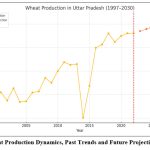 |
Figure 1: Wheat Production Dynamics, Past Trends and Future Projections (1997–2030). |
It is typical in projections involving time series, observe that the confidence intervals surrounding the forecasts increase in width as time progresses. For example, in 2023, the 95 percent prediction interval is relatively narrow, lying between 37.5 and 39.5 million tonnes, indicating a high level of certainty about the forecast. By 2030, this interval widens from 38.8 to 44.4 million tonnes, indicating that uncertainty rises as the forecast horizon is extended. The time series plot in Figure 1 visually depicts production between 1997 and 2030 and highlights the incumbent rise and the expected further rise in production capacity. Observed values from 1997 to 2022 align very well with forecasted values from 2023 to 2030 with smooth transitions observed post-2022. On the dotted vertical line (in red), the forecast begins. The forecast remains tied and consistent with its history, there have been no spikes or dips along the way, which is testimony to the soundness of the forecasts and the absence of structural breaks within the data.
Forecast results on its characteristics underscore the normalcy of wheat production in Uttar Pradesh. Because Uttar Pradesh is an established agricultural state with suitable natural conditions for wheat and supportive policies, the model shows that wheat production remains on the rise in the current scenario. However, such a slight production increase speaks more about nearing production ceilings using current technology.
From a planning and policy perspective, these projections hold vital implications. With projected production, procurement targets could be set, food grain availability for PDS could be ascertained and requirements for storage and transportation could be anticipated.
Given a relatively stable production trend, under exceptions such as climate shocks or major disruptions in policy, Uttar Pradesh could continue to be India’s leading state in wheat production. However, sluggish growth underlines the imperative of moving away from area-based interventions and focusing on yield-enhancing strategies like climate-smart agriculture, mechanization and irrigation management to unlock future productivity.
Discussion
The study forecasted that wheat production in Uttar Pradesh would continue rising due to consistent improvements in yield while the net sown area progressed toward stagnation. The ARIMA (1,1,1) model estimated an increase in wheat production from 38.54 million tonnes during 2022 to 41.64 million tonnes in 2030, where yield growth was the major driver, unlike land expansion. Such a trend reflects national-level trends wherein Uttar Pradesh enjoys a critical position in India’s wheat economy.
India’s wheat production has, over the period, experienced various phases of growth-the period of the Green Revolution with high-yielding varieties, then formation of stagnation in productivity during 1990 followed by another revival of wheat production after 2005 with a rejuvenation following the targeted policy measure- the National Food Security Mission (NFSM). Uttar Pradesh, constituting more than 30% of India’s wheat production has exhibited a similar trend especially with significant investments in irrigation in the state and good quality seed and input subsidies.17
The relatively flat trend observed for cultivated area in 1997-2022 matches those findings, where wheat land is seemingly nearing saturation in the Indo-Gangetic plains, with UP lying at the center of that. This stagnancy thus calls for reliance on TFP improvements for growth. The increase in the yield levels from about 2.40 t/ha in the 1990s to 4.01 t/ha in 2022 also sustains the view that the productivity of UP is increasing due to better agronomic management and the adoption of newer cultivars.18 Interestingly, the production forecast depicts a widening growth margin that gradually reduces with time. This trend may be interpreted as a system approaching the technical limit under current practices. Hence, if one were to continue with the current technologies, the returns may dwindle, and henceforth, it would become crucial to make breakthroughs in developing climate-resilient varieties, site-specific nutrient management and precision agriculture.19
Further, while the statistical robustness of ARIMA forecasts is unquestionable, their ability to consider exogenous shocks such as abrupt climate anomalies or sudden policy changes is constrained. Given that wheat in Uttar Pradesh is mainly irrigated, climate vulnerabilities, namely terminal heat during grain filling or irregular winter rainfall patterns, could have disastrous effects on the state’s future production. For instance, studies have found that almost a 5% reduction in yield can occur with a temperature increase of 1°C during the terminal stage.20
The present forecast, therefore, bears important policy implications. Since targets for foodgrain procurement and buffer stocks rest on correct supply estimates, the results can help governments plan MSPs, construct warehouses and even allocate subsidies. Regional forecasts such as this should also help direct resources in the agro-climatic zones of UP so district-level interventions can be made specific to constraints.
Since Uttar Pradesh preserves a stable upward drift of wheat growth, the incremental nature of forecasted gains points to a possible need for a second-generation agricultural transformation. This transformation goes beyond land expansion and intensification, toward climate-smart, input-efficient and farmer-centric innovation. The results are given to act as a quantitative projection and serve as a clarion call for anticipatory action.
Policy and Recommendation
Several crucial policy directives emerge from this study’s results to ensure the sustenance and enhancement of wheat production and productivity in Uttar Pradesh. Cultivated areas are no longer being expanded and forecasted moderation in production increases must urge land-based expansion shifts toward productivity-based intensification. The foremost should be the development and distribution of climate-resilient wheat varieties, especially those tolerant to terminal heat stress and irregular winter rainfall, which are increasingly challenging yield stability in the Indo-Gangetic plains. Therefore, there is a need for State-supported breeding programs and public-private research partnerships cantered on varietal solutions for specific agroecological regions.
The second point to be highlighted was that while the irrigation infrastructure of Uttar Pradesh is relatively developed, there are still considerable inefficiencies in water allocation and delivery. The state must invest in micro-irrigation technologies, for example drip and sprinkler systems and provide incentives for water-conserving agronomic practices, as these alternatives will be best suited to mitigate climatic uncertainties and sustain productive agriculture without further depletion of groundwater reserves. Simultaneous to this imperative is the immediate mainstreaming of precision agriculture technologies including digital soil maps, weather-based decision support tools and satellite-based yield monitoring. These technologies may be democratized through well-targeted subsidies, agritech incubators and rural extension programs.
Another key intervention involves revamping the agricultural extension ecosystem. The observed inter-district disparities in yield performance suggest unequal access to knowledge and resources. Capacity-building and outreach among the Krishi Vigyan Kendras (KVKs) and decentralizing extension models through data-driven means can ensure that farmers promptly adopt best practices in the localized situations. Simultaneously, procurement and storage policies also need reform and increased production. Thus, further warehousing, logistics infrastructure improvement and guaranteeing remunerative MSP would facilitate producer incentives and food security objectives.
Meanwhile, it is equally important for policymaking to enhance agroecological intensification while improving input-use efficiency and reducing adverse environmental externalities. Conservation tillage, crop diversification and integrated nutrient management are some techniques that must be promoted in the sustainable intensification framework. Lastly, forecast-based agricultural planning has to be incorporated into the governance system. Predictive models such as ARIMA should be institutionalized in agricultural departments to improve anticipatory decision-making, budget planning and disaster response.
Conclusion
A strong ARIMA time series model was developed to analyse and forecast wheat production in Uttar Pradesh from the year 1997 through 2030. Analysis found that even though the net sown area has not increased, wheat production has steadily increased, primarily due to yield improvements. In terms of production, there has been an increase of 22.14 million tonnes to 38.54 million tonnes in 1997-2022, whereas the ARIMA model predicts this to grow further to 41.64 million tonnes by 2030.
An ARIMA (1,1,1) model was used in the study after confirmation of stationarity, AIC-based model selection and diagnostic checking of residuals, thereby lending validity and reliability to the model. The model forecasts closely match agronomic trends and offer valuable insights into Uttar Pradesh’s production potential under the current technological and policy regime. Moreover, such a forecast also hints at a slowdown in the growth rate over time, suggesting that interventions affecting productivity may yield maximum efficiency. This spells a box for productivity unless next-generation innovations come in agriculture. The study has confirmed the centrality of Uttar Pradesh for the whole of India for wheat security and continuing productivity-enhancing interventions in the state through technology, extension services and climate adaptation.
This upward trend for wheat production in Uttar Pradesh must be sustained through a concentrated focus on climate-resilient varietal development, precision agriculture practices, and irrigation efficiency. Policymaking must cater to innovation-driven productivity enhancement, strong extension networks, and adaptive planning inches of mitigating climatic risks for sustainable food security.
Acknowledgement
The authors extend their gratitude to Ministry of Agriculture for providing the data.
Funding Sources
The author(s) received no financial support for this article’s research, authorship, and/or publication.
Conflict of Interest
The author(s) do not have any conflict of interest.
Data Availability Statement
This statement does not apply to this article.
Ethics Statement
This research did not involve human participants, animal subjects, or any material that requires ethical approval.
Informed Consent Statement
This study did not involve human participants, and therefore, informed consent was not required.
Permission to reproduce material from other sources
Not Applicable.
Author Contributions
Ashwani was responsible for conceptualizing and designing the experiments, analysing and interpreting the data, and preparing and editing the manuscript.
Abhay Kumar and Sonali Kumari Suman conducted the literature review, conducted experimental procedures, performed data analysis, prepared the manuscript, and reviewed the results.
Veer Singh played a role in data analysis and manuscript preparation.
References
- Kumar V, Singh JP, Tiwari A. Wheat production scenario in India with special reference to Uttar Pradesh. J Agri Res Innov. 2022;8(1):34-41.
CrossRef - Chand R, Pandey LM. Fertilizer use, productivity, and food security in India. Indian J Agric Econ. 2008;63(3):466-482.
- Box GEP, Jenkins GM, Reinsel GC, Ljung GM. Time Series Analysis: Forecasting and Control. 5th ed. Hoboken, NJ: Wiley; 2015.
- Makridakis S, Spiliotis E, Assimakopoulos V. Statistical and machine learning forecasting methods: Concerns and ways forward. PLoS One. 2018;13(3):e0194889.
CrossRef - Tripathi RS, Jha AK, Kumar S. Resource use efficiency in wheat farming in Uttar Pradesh. Agric Econ Res Rev. 2013; 26:53-60.
- Sharma P, Dagar JC, Singh A. Historical overview of wheat development in India. Agric Rev.. 2014;35(3):180-188.
CrossRef - Lobell DB, Schlenker W, Costa-Roberts J. Climate trends and global crop production. Science. 2012;333(6042):616-620.
CrossRef - Aggarwal PK, Rani S, Chaturvedi RK. Impacts of climate change on wheat in India. Curr Sci. 2019;117(9):1437-1442.
- Ghosh M. Agricultural forecasting in India: Trends, models, and challenges. Agric Econ Res Rev. 2021;34(1):45-56.
- Jat ML, Singh RG, Saharawat YS. Climate-smart agriculture in the Indo-Gangetic Plains. J Environ Manage. 2016;183:167-175.
- Kaur J, Singh RP, Sidhu RS. Wheat production and yield trends in north-west India. Agric Situat India. 2017;73(6):23-30.
- Ashwani, Kumar A, Suman SK. Trends And Insights In Agricultural Performance Of Uttar Pradesh: An Analytical Focus On Foodgrains. T Dec Geo. 2025;:266-277.
- Ray DK, Ramankutty N, Mueller ND, West PC, Foley JA. Recent patterns of crop yield growth and stagnation. Nat Commun. 2015; 3:1293.
CrossRef - Pathak H, Rao DLN, Sharma P. Forecasting wheat production in India: A state-wise time series analysis. Indian J Agric Res. 2020;54(1):45-52.
- Mishra S, Pradhan R. Time series forecasting of wheat production in Bihar using ARIMA. Int J Agric Stat Sci. 2021;17(2):289-295.
- Directorate of Economics and Statistics, Department of Agriculture Cooperation and Farmers Welfare, Ministry of Agriculture and Farmers Welfare, Government of India.
- Adegoroye A. Wheat production forecast and yield trends in Uttar Pradesh: implications for agricultural planning. J Agric Forecast Anal. 2025;15(2):101-115.
- Chand R, Singh R, Kumar A. Growth, productivity and sustainability of wheat in India: recent trends and policy implications. Indian J Agric Econ. 2022;77(3):289-308.
- Singh S, Sharma P, Gupta V. Technological innovations in wheat production: pathways to sustainable yield growth in the Indo-Gangetic Plains. Agric Syst. 2021;194:103278. doi:10.1016/j.agsy.2021.103278.
CrossRef - Aggarwal PK, Hebbar KB, Venugopalan MV, Rani S, Bala A, Biswal A. Quantifying the impacts of climate change on wheat yields in India. Clim Change. 2019;154(3-4):457-472. doi:10.1007/s10584-019-02453-6.