


 PDF Downloads:
471
PDF Downloads:
471


Introduction
Chang and Miles1 states that mushrooms are a type of macrofungus that has the properties of a fruiting body that can either be hypogeous or epigeous. It is large enough to be seen with the naked eye and can be plucked by hand. With their nutritional, medicinal and pharmacological value, mushrooms have been of great scientific and industrial interest not only in the food industry but also in biopharmaceutical industries. The global diversity of mushrooms species is estimated about 0.14 million of which 14,000 species have been clearly described, with around 7000 considered edible, over 2000 species are perceived as safe for human consumption and 700 species (approx.) have been documented to possess notable pharmalogical properties.2 Mushrooms have been sharing a long- standing association with humans providing biological, nutritional and economic benefits. Mushrooms have been traditionally consumed for their distinctive taste and flavour, high nutritional benefits, being rich in proteins, vitamins, minerals and dietary fibres while containing low levels of fat and cholesterol.3
The 19th century saw the start of India’s systematic mushroom harvesting and scientific research, which is still going strong today. To date, approximately 850 species of mushrooms have been recorded across the country. 3 India’s varied agro- climatic conditions provide highly conducive environment for growing diverse mushroom species, which includes the widely cultivated button mushroom (Agaricus Biosporus), Oyster mushroom (Pleutrotus spp.) and special varieties such as Shiitake (Lentinula edodoes).4 The annual production of mushrooms in India is estimated at approximately 0.24 million tonnes. Among the cultivated varieties, the white button mushroom holds the predominant position, accounting for nearly 73% of the country’s total mushroom output, followed by Oyster mushrooms, which contributes around 16%.5
The North- eastern region of India is home to a large biodiversity of mushrooms, with Oyster mushroom (Pleurotus spp.) having the maximum share in cultivated mushroom, followed by shiitake mushroom, milky mushroom and paddy straw mushroom. Nagaland is home to more than 1402 documented species across the region and over 50 species are identified for their edibility and has been eaten as a traditional delicacy since ancient times. Commercial cultivation of different species of mushrooms is possible due to the prevailing climatic conditions of Nagaland. However, large scale production is primarily centred on oyster mushroom due to their simplicity of cultivation. With low input requirements and the easy accessibility of raw materials such as paddy straw and quality spawn make oyster mushroom a preferred choice among growers. This species adapts and thrives in both temperate and subtropical environments of the state.6
In Nagaland, mushroom cultivation is gaining popularity among small and marginal farmers, including landless rural households as a supplementary source of income and livelihood. Despite its growing popularity, the sector still continues to face several challenges, such as little to no technical knowledge, poor farm management and limited awareness of cost- effective production systems. The slow adoption of improved cultivation technologies and research support for the efficient utilization of locally available agriculture residues hampers the production of mushrooms.
Following are the objectives that have been framed in order to study the production, resource use and challenges of oyster mushroom cultivation in the state:
To study the key financial and institutional factors influencing production outcomes.
To identify the constraints and challenges faced by the mushroom growers.
Thus, these objectives can facilitate to design solutions and strategies to amplify sustainability and improve socio economic well- being of the communities in Nagaland.
Materials and Methods
Data collection procedure and Sampling framework
A well- planned questionnaire was used to execute in- person interview in order to gather primary data. The research was conducted in two of Nagaland’s major Oyster mushroom growing districts – Chumoukedima and Dimapur. Since the target group was dispersed and unlisted, 70 respondents were identified using snowball sampling technique. However, the samples collected may not fully represent the entire population as the respondents were identified through referrals, thereby reducing the generalization of the findings.
Data analysis methodology
Benefit- cost ratio, descriptive statistics, Cobb- Douglas production function and Garrett Ranking technique was applied to statistically analyse the data.
Benefit- Cost analysis
The formula for evaluating Benefit- Cost ratio is as follows:
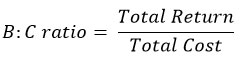
Decision Rule:
B: C ratio > 1 = Profitable
B: C ratio = 1 = Indifferent
B:C ratio < 1 = Loss
Resource Efficiency
Using the Cobb- Douglas production function, the production performance and resource efficiency of oyster mushroom cultivation were assessed. This functional form’s wide application in farm- level efficiency, its ease of computation and simplicity in handling several inputs led to its selection.
The Cobb- Douglas production function was defined as follows to ascertain the relationship between input and output variables:

Where,
y = Gross Return
x1 = Expenditure on Straw
x2 = Expenditure on Spawn
x3 = Expenditure on Labour
x4 = Expenditure on Poly bags
x5 = Expenditure on Miscellaneous
e = Base of Logarithm
u=Random error term
The production function becomes linear in logarithmic form and is expressed as:

The regression Co- efficient (β1) in the Cobb- Douglas production function denotes production elasticity, indicating the percentage change in output associated with one percentage change in input.
The resource- use efficiency ratio was computed using the formula:

Where,
r = Efficiency Ratio
MVP = Marginal Value Product
MFC = Marginal Factor Cost
The following formula is used to measure the MVP:
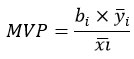
bi = Regression co-efficient of input x1
ȳi = Calculated geometric meany value of yi
xi = Geometric mean value of the ith resource used.
Decision criteria
r =1 indicate resource is optimally used
r >1 suggest underutilization of resources
r <1 indicates overutilization of the resources
Constraints
The Garrett ranking method was adopted to determine the constraints or problems faced by mushroom growers in adopting mushroom cultivation. The limitations were ranked by the farmers according to their influence on the production. The following equation was used to convert the ranked responses into score values:

Where,
Rij = Rank for ith item (1,2,3……,ith)
Nj = Number of items ranked by the jth individual (1,2,3…….,jth)
Henry Garrett’s table was used to convert each rank’s percentage into scores.
Results and Discussion
Oyster mushroom farms were split into three groups depending on the number of mushroom cylinders in their farms: small farms (less than 500 cylinders), medium farms (between 500 and 1000) and big farms (more than 1000 cylinders). The study was conducted on a sample of 70 oyster mushroom, 39 of which were small farms (55.71%) having an average of 199.85 cylinders, 14 farmers (20%) has medium farms with an average of 687.14 cylinders and the remaining 17 were large farms (24.29%) with an average of 2973.53 cylinders.
Table 1: Farm classification according to mushroom cylinders
| Size of farm | Total number of farms | Average quantity of cylinders | % |
| Small (<500) | 39 | 199.85 | 55.71 |
| Medium (500-1000) | 14 | 687.14 | 20 |
| Large (>1000) | 17 | 2973.53 | 24.29 |
| Total | 70 | 100 |
Source: Field survey (June – November 2025)
The cost- benefit analysis of small, medium and large farms is shown in Table 2. Based on the price of ₹150 per kg of oyster mushrooms, the three farms gross return were calculated at ₹74,900, ₹2,57,700 and ₹10,87,500 respectively. According to the estimated benefit- cost, for each rupee paid, farmers earn ₹2.02, ₹2.04 and ₹2.30 respectively. The ratio increases with farm size which suggests that larger farm generates higher and profitable income than small scale farms. Sachan and Kumar7 on their research in Uttar Pradesh found increasing trend with an increase in farm size.
Table 2: Return and expense of Oyster mushroom cultivation
| Average cost and Return | Amount (₹)
(small <500) |
Amount (₹)
(medium 500-1000) |
Amount (₹)
(Large >1000) |
| a. Yield ( in kg) | 499.33 | 1718 | 7250 |
| b. Price of mushroom (@ ₹ 150per kg) | 74,900 | 2,57,700 | 10,87,500 |
| c. Gross return | 74,900 | 2,57,700 | 10,87,500 |
| d. TFC | 20,000 | 80,000 | 3,00,000 |
| e. TVC + Depreciation | 17,550 | 46,000 | 1,72,000 |
| f. Total Cost
(TFC+TVC+ Depreciation) |
37,000 | 1,26,000 | 4,72,000 |
| g. Net income | 37,900 | 1,31,700 | 6,15,500 |
| h. B:C Ratio | 2.02 | 2.04 | 2.30 |
Source: Field Survey (June- November2025)
Result from descriptive statistics of variables
Table 3 represents presents a statistical overview of the data set used in the production function analysis. The variables are presented in logarithmic form. The findings reveal that the mean value of gross return was 12.037, with an associated standard deviation of 1.373, indicates moderate variation in the income generated from mushroom production among the respondents. The minimum (9.90) and maximum (16.85) values indicates differences in output levels which may be attributable to differences in scale of production or level of input utilization.
The average values of the independent variable i.e., straw (8.833) and spawn (9.244) suggests that majority of the farmers utilized these inputs in considerable quantities. Labour with a mean of 4.969 and minimum value of 0.00 suggests that some farmers relied on family labour or minimal hired labour. The mean values of polybags (6.807) and miscellaneous (7.859) and the relatively smaller standard deviation of 1.207 and 1.065 indicates moderate expenditure and less variability in their use across the farms compared to other inputs. The mean and range value shows that there is considerable variability among farmers in their input use and output. These disparities form a reliable foundation for assessing the effect of differential resource utilization on gross returns as analyzed through subsequent regression analysis.
Table 3: Descriptive statistics of Model variables
| Variables | Mean | Standard Deviation | Minimum | Maximum |
| Dependent variable
ln_gross return |
12.037 | 1.373 | 9.90 | 16.85 |
| Independent variables
ln_straw |
8.833 | 1.282 | 6.21 | 13.61 |
| ln_spawn | 9.244 | 1.288 | 7.31 | 12.51 |
| ln_labour | 4.969 | 4.658 | 0.00 | 11.41 |
| ln_polybags | 6.807 | 1.207 | 4.79 | 10.17 |
| ln_miscellaneous | 7.859 | 1.065 | 6.21 | 10.82 |
Source: Field survey (June- November2025)
The predicted coefficients of the Cobb- Douglas production function applied to oyster mushroom cultivation are displayed in Table 4. Gross return is the dependent variable while straw, spawn, labour, polybags, and other expenses are independent variables. The function revealed that the cost of spawn, polybags and miscellaneous at 10%, 1% and 5% level of significance have a statistically significant influence on production.
The co-efficient of straw (-0.05) was statistically insignificant (p=0.49), indicating that a 1% increase in straw usage would result in a 0.05% decrease in gross return. This may be linked to the overutilization of substrate beyond their need, which could lead to poor aeration, contamination risk and inefficient moisture balance. All this highlights improper allocation of resources in the farm and the optimal need of proper input management in the oyster mushroom farms. Earlier studies in Punjab have demonstrated that straw has no discernible impact on the gross return from growing mushrooms.8 Likewise; labour had a moderate impact on mushroom production, as evidenced by its positive but negligible coefficient (0.01) and p- value of 0.39.
The value of coefficient for spawn recorded a positive value of 0.23 and was found to be statistically significant at 10 percent significance level (p= 0.06), implying that 1 percent increase in spawn is expected to increase the gross return by 0.23 percent. Studies in Jorhat also found that cost of spawn packets have significant influence on gross return of mushroom production.9 The coefficient value of polybags (0.57) and miscellaneous costs (0.34) indicates that if the quantity of polybags and miscellaneous cost is increased by 1 percent, then the productivity would increase by 0.57 percent and.0.34 percent respectively.
94% of the variation in the dependent value was explained by the included predictors, according to the high explanatory variable, as indicated by the R2 value of 0.94. The model’s strength and dependability are supported by the adjusted R2. Furthermore, the overall statistical significance of the regression model was evidenced by the F- Statistics (188.42), which was significant at 1 percent level.
The production elasticity of 1.10 exceeds unity, signifying growing returns on scale. Production function defines that when the sum of elasticities is more than unity, a proportionate increase in input would result in a more proportionate increase in output. This indicates that farmers can improve their productivity by effective expansion of input use, as a 1 percent increase in input variables would yield an approximately 1.10 percent rise in total output. This conclusion is supported by data from past studies in Jorhat district of Assam, which noted rising returns to scale.9 The presence of growing returns to scale suggest that the oyster mushroom farmers are not producing at their maximum capacity and may increase their efficiency by using more inputs.
Table 4: Estimation of co- efficient value and related variables using Cobb- Douglas production function.
| Variables | Coeff. | Std. Err. | T | P value |
| Intercept | 3.63 | 0.55 | 6.57 | 0.00 |
| ln_straw | -0.05 | 0.07 | -0.70 | 0.49 |
| ln_spawn | 0.23* | 0.12 | 1.93 | 0.06 |
| ln_labour | 0.01 | 0.02 | 0.86 | 0.39 |
| ln_polybags | 0.57*** | 0.15 | 3.85 | 0.00 |
| ln_miscellaneous | 0.34** | 0.12 | 2.77 | 0.01 |
| Returns to scale | 1.10 | |||
| F value | 188.42 | |||
| Prob>F (F- statistics) | 0.00 | |||
| R- Squared | 0.94 | |||
| R Square Adjusted | 0.93 |
Source: Field survey (June- November2025), Note: ***, ** and * indicates significance at 1%, 5% and 10%
Resource efficiency analyses given in table 5 reveals that most of the inputs in mushroom cultivation are over utilized except for polybags which is slightly underutilized. The overutilization of straw and its negative MVP of -0.07 indicates that straw is used beyond its optimal need and an additional use of straw would reduce the output instead of increasing it. Spawn, labour and miscellaneous inputs also shows inefficient resource utilization among farmers which is beyond their economically optimal level and this leads to inefficient cost management and reduced profit margin. Similar study in Dehradun revealed that profitability in mushroom cultivation could be optimized through a reduction in labour use.10 The over utilization and underutilization of the resources could be due to lack of proper knowledge or training leading to excessive use of inputs, misjudgment of optimal quantity needed for production, poor input management and limited awareness concernin the productivity potential of certain inputs. Phuyal et.al.11 suggests that over utilization or underutilization could be due to lack of knowledge on improved production technology.
Table 5: Efficiency of resource usage with the Cobb- Douglas production function
| Variables | Coeff. | Geometric mean | MVP | MFC | R | Decision |
| ln_straw | -0.05 | 8.749 | -0.07 | 1 | -0.07 | Over utilised |
| ln_spawn | 0.23 | 9.159 | 0.30 | 1 | 0.30 | Over utilized |
| ln_labour | 0.01 | 3.315 | 0.04 | 1 | 0.04 | Over utilized |
| ln_polybags | 0.57 | 6.707 | 1.02 | 1 | 1.02 | Underutilized |
| ln_miscellaneous | 0.34 | 7.792 | 0.52 | 1 | 0.52 | Over utilized |
| Geometric mean of yield | 11.963 |
Source: Field survey (June- November2025), Note: ***, ** and * indicates significance at 1%, 5% and 10% respectively.
Constraints in mushroom production
Table 6 represents the various problems or constraints encountered by Oyster mushroom cultivators in the study area. The result showed that insufficient capital or financial support constituted the major constraint (63.13). This suggests that insufficient access to credit facilities or financial hampers the smooth operation and expansion of mushroom cultivation. Similarly, in Kathmandu valley of Nepal, studies demonstrated that the mushroom growers expressed lack of financial assistance as the predominant constraint.11
The second major constraint was unfavourable climatic conditions (57.91), which affected the growth and productivity of mushrooms. Lack of quality inputs such as straw and spawn ranked third (54.9), which highlights the difficulty in procuring reliable and good-quality inputs for Oyster mushroom production. Similar studies show that with a mean score of 71.83, the constraint of unavailability of quality spawns was ranked the highest in West Bengal.12
Problem created by diseases and insects (51.5) is another notable challenge, followed by perishable nature of mushrooms (44.97), which makes storage and transportation of mushrooms difficult. Ranking sixth is lack of an organized marketing channel (43.19), which indicates difficulties in accessing profitable and stable markets by the farmers. Lack of skilled labour (40.5) and technical knowledge (38.41) were ranked seventh and eighth respectively, showing that lack of technical knowledge and trained manpower are also significant constraints in oyster mushroom cultivation.
Thus, the overall findings suggest that mitigating these constraints through financial assistance, training and better infrastructure would sustain and enhance the profitability of Oyster mushroom farming within the study area.
Table 6: Constraints dealt by mushroom cultivators
| Sl. No. | Constraints | Total score | Mean score (MS) | Rank |
| 1 | Lack of capital/ financial support | 4419 | 63.13 | I |
| 2 | Climatic conditions | 4054 | 57.91 | II |
| 3 | Lack of quality materials (straw/ spawn) | 3843 | 54.9 | III |
| 4 | Diseases & Insects | 3605 | 51.5 | IV |
| 5 | Perishable nature of mushrooms | 3148 | 44.97 | V |
| 6 | Lack of organized marketing channel | 3023 | 43.19 | VI |
| 7 | Lack of skilled labour | 2835 | 40.5 | VII |
| 8 | Lack of technical skills | 2689 | 38.41 | VIII |
Source: Field survey 2025
Conclusion
The study concludes that Oyster mushroom cultivation is a profitable and sustainable agricultural enterprise in Nagaland, contributing to household income and livelihood diversification. The rising B: C ratio across small, medium and large farms shows profitability with increasing farm sizes. While labour and straw demonstrated inefficiencies, the Cobb- Douglas production function emphasizes the effective utilization of inputs such as straw, poly bags and other costs. The existence of increasing returns to scale further indicates that productivity could be enhanced by using inputs efficiently and by adopting improved production practices.
The findings further suggests some important policy implications. Since the production elasticities shows increasing returns to scale, mushroom cultivation in the state can be enhanced through easy credit access, institutional support and training programs on efficient and optimal use of inputs. These programmes should be introduced to improve resource use efficiency of mushroom growers in the state.
The study identified major constraints that hinder productivity, including lack of capital, unfavourable climatic conditions, poor quality inputs and inadequate technical knowledge among farmers. Tackling these issues through institutional credit facilities, technical programs and establishment of organized marketing networks would strengthen the mushroom production.
In conclusion, Oyster mushroom cultivation holds substantial potential for agribusiness development, sustainable livelihood enhancement and socio- economic empowerment of small and marginal farmers in Nagaland. However, this would be feasible only if efficient resource management, skill- based extension and input availability are provided.
Acknowledgement
We express our sincere gratitude to all the oyster mushroom cultivators for their time, experience, valuable information, cooperation and support for this study. The authors also extend our heartfelt thanks to the Department of Economics, St. Joseph University, Nagaland for their academic guidance and encouragement throughout the research work.
Funding Sources
The author(s) received no financial support for the research, authorship, and/or publication of this article
Conflict of Interest
The authors do not have any conflict of interest
Data Availability Statement
The datasets generated and/ or analysed during the current study are available from the corresponding author on reasonable request.
Ethics Statement
This research did not involve human participants, animal subjects or any material that requires ethical approval.
Permission to reproduce materials from other sources:
Not applicable
Author Contributions
Temsunaro Imsong: Conceptualization, Data Collection, Methodology, Analysis, Writing- Original Draft
Praveen Dukpa: Analysis, Supervision, Writing- Reviewing & Editing
References
- Chang, S. T., Miles, P. G. Mushroom biology-a new discipline. Mycologist, 1992; 6: 64-65.
CrossRef - Jo, W. S., Hossain, M. A., Park, S. C. Toxicological profiles of poisonous, edible, and medicinal mushrooms. Mycobiology, 2014; 42(3): 215–220.DOI:10.5941/MYCO.2014.42.3.215.
CrossRef - Thatoi, H., Singdevsachan, S. K. Diversity, nutritional composition and medicinal potential of Indian mushrooms: A review. African Journal of Biotechnology , 2015; 13(4): 523-545. DOI:10.5897/AJB2013.13446
CrossRef - Nandeha, N. History and Global Status of Mushroom Production in India. In: R. Padamini, S.K. Rathour, M.M. Dange, M.U. Ali & H. Chavda, ed, Mushroom the Fascinating Fungi. New Delhi: Emerald Publishing House 2024: 1-15. https://www.researchgate.net/publication/ 382267790_ History_and_Global_Status_of_Mushroom_Production_in_India. Accessed January 10, 2026.
- Sharma, V.P., Annepu, S.K., Gautam, Y., Singh, M., Kamal, S. Status of Mushroom production in India. Mushroom Research. 2017; 26(2): 111-120.
- Rajesha, G., Bendangsenla, Singh, M., Seyie, A., Rajkhowa, D.J. Scenario of commercial mushroom production in Nagaland. Mushroom Research, 2022; 31(1): 113-117. DOI: 10.36036/MR.31.1.2022. 326292.
CrossRef - Sachan, S., Kumar, R. Cost Benefit Analysis and Marketing of Mushroom in Uttar Pradesh. Plant Archives. 2020; 20(2): 2532-2536
- Singh, R., Singh J.M. Mushroom growing in Punjab: cost components, and determinants affecting its productivity. Agricultural Economics Research Review. 2018; 31(2): 299-304. DOI: 10.5958/0974-0279.2018.00047.2.
CrossRef - Saikia, T., Hazarika, J.P. Gogoi, H. Resource use efficiency in mushroom cultivation in Jorhat district of Assam. Agriulture Update. 2014; 9(1): 37-40.
- Dhiman, S., Gangwar, R. R., Misra, S., Pant, D.K., Joshi, N. Economics of production of mushroom in Dehradun district of Uttarakhand. The Pharma Innovation Journal,2022; 11(9): 1043-1048.
- Phuyal, S., Dutta, J.P., Kattel, R.R., Dhakal, B. Resource use efficiency of mushroom production in Kathmandu Valley. Food & Agribusiness Management (FABM), 2023; 4(2): 104-108. DOI:10.26480/ fabm.02.2023.104.108
CrossRef - Roy, R., Rudra, B.C., Majumder, D., Mondal, A. Perceived constraints in Mushroom Production Enterprise in West Bengal. International Journal of Current Microbiology and Applied Science, 2020; 9(4): 1579-1583. DOI:10.20546/ijcmas.2020.904.185
CrossRef