


Introduction
Contemporary agricultural systems are challenged to balance crop production with environmental considerations such as soil quality, water use and climate change. Although large amounts of chemical fertilizers are used with short-term crop yields to increase the supply and growing demand of food, it has caused soil degradation, nutrient imbalances, greenhouse gas emissions and water pollution.1 Such challenges are in direct contradiction to the principles of cleaner production, which is about using less resources, producing less waste or emissions and making better commercial decisions looking at the long term.
Micro fertilizers, comprising of living beneficial microorganisms like nitrogen fixers, phosphate solubilizers and plant growth promoting rhizobacteria have gained prominence as eco-friendly substitutes to their synthetic counterparts.2 Micro fertilizers contribute to the greening of agricultural production and to clean agriculture & circular bioeconomy targets by improving nutrient supply, fostering better soil health, and decreasing reliance on chemicals. Nevertheless, the success of Micro fertilizers is context-specific and depends on soil properties, crop species and variety, agro-environmental conditions as well as application methods.3
Climate change adds complexity in agricultural decision making through its uncertainty factor upon the rainfall occurrence, temperature extremes and soil moisture availability.4 Consequently, static or rule-based fertilizer recommendations are sometimes inadequate to cope with a dynamic agro-environmental situation. There is an increasing demand for data-driven decision support systems to assimilate heterogeneous data structures and bring recommendations up-to-date with the changing climate and soil status.
Machine learning algorithms have proven successful in modeling complex, non-linear relationships among agricultural systems.5 Recent works have utilized machine learning to conduct crop yield prediction, nutrient management and precision agriculture, but most of the current solutions are mainly concerned with the chemical fertilizer optimization.6 In contrast, Micro fertilizer-type recommendation strategies based on cleaner production and climate change adaptation were relatively poorly developed.
To address this research gap, the present study examines a machine-learning framework that combines soil-health indicators, climatic variables and crop attributes for classifying a nutrient-input recommendation label. The objectives are to (1) describe the integration of soil, crop and climate features, (2) compare RF, SVM, GB and ANN using classification metrics, and (3) identify the validation needed before such a framework can be used for agronomic decision support. The analysis is based on secondary datasets. It does not directly measure crop yield, chemical-fertilizer substitution, greenhouse-gas emissions or climate resilience; these outcomes are therefore treated as topics for future evaluation rather than demonstrated effects.
Literature Review
Micro fertilizers have become a popular alternative to chemical fertilizers as they are environmentally safe and can increase nutrient cycling within the soil, improving its structure.7 Micro fertilizer application has been observed to increase the crop yield, enhance microbial activity, and decrease the environmental pollution.8 In addition, Micro fertilizers help in maintaining soil fertility for longer duration which is one of the objectives of sustainable agriculture systems.9 Despite these advantages, poor field performance is still a major cause of concern which is generally attributed to irregularity in soil and climatic conditions.10
Principles of cleaner production propose preventive environmental solutions that minimize the use of resources and the generation of waste.11 In crop production, clean processes are applied for using renewable biological resources with less dependence on synthetic inputs. Micro fertilizers are complementary for circular bioeconomy patterns due to the encouragement they lend for nutrient recycling and minimalization of external chemical inputs.12 Nevertheless, effective adoption of cleaner practices in agriculture needs smart applications able to optimize the choice and rates of input application under various environmental situations.13
In agriculture, machine learning is so popular for research because of its capability to deal with large-scale and rich-structure data. For instance, Random Forest, Support Vector Machine (SVM), and Artificial Neural Networks have been successfully used for crop yield prediction and soil classification, as well as irrigation management.14 Ensemble learning techniques, in particular, have shown good robustness and predictability achievements for agricultural purposes.15
Many researches have been conducted to recommend fertilizer products by machine learning models, but most of them are associated with the prediction of chemical fertilizer dosage but not Micro fertilizer selection.16 And, climate factors are usually taken as second-class citizen of these systems which reduces the adaptability of them when suffering from climatic stress.17
Resilience in agriculture Climate resilience in agriculture is the capacity of farming systems to minimize productivity losses due to climate (variability/severity) and extreme weather events.18 Climatically based data-driven nutrient management approaches have proven to be successful in increasing yield stability and decreasing environmental risk.19 However, incorporation of climate resilience indicators in Micro fertilizer recommendation systems is yet to be studied at large especially from cleaner production angle.20 From the reviewed literature, it is observed that MEAAF have limited coverage on provision of biofertilizer recommendation, partial attention to climate-resilience indicators and minimum correlation to cleaner production and circular bioeconomy guiding principles. In response to these deficiencies, this work presents a machine learning (ML) based Micro fertilizer recommendation system that is combined with soil, crop, and climate data for cleaner and climate-adaptive agricultural systems.
Recent studies have explored the integration of emerging technologies into sustainable and data-driven agricultural practices. Patel et al.²¹ discussed the controversies and potential benefits associated with genetically modified organism (GMO) adoption in agriculture, highlighting the importance of evaluating agricultural innovations from multiple perspectives. Patel et al.²² investigated machine-learning-based enhancement of hydroponic fertilization efficiency, emphasizing the potential of data-driven approaches for nutrient management in controlled agricultural environments. Similarly, Patel and Bhatt²³ presented an AI-driven precision farming approach that leverages environmental and soil parameters for crop yield prediction. Collectively, these studies highlight the growing role of artificial intelligence, machine learning, and digital technologies in agricultural decision support. However, integrating soil-health indicators, crop characteristics, and climatic variables specifically for micro fertilizer recommendation remains an area requiring further investigation. To address this gap, the present study proposes a machine-learning-based framework for classifying micro fertilizer recommendations using soil, crop, and climate attributes to support cleaner and more sustainable agricultural decision-making.
Proposed Framework
In this article, we propose an ML driven Micro fertilizer recommendation system to promote cleaner and climate-smart agricultural practices. The framework adopts a multi-level structure, which can help users to process data, perform prediction and make decision in an orderly way. By incorporating soil health indicators, crop attributes and climate data the approach provides precise contextualized Micro fertilizer recommendations in line with cleaner production and circular bioeconomy rationales. The general structure of the proposed framework is windowed in Figure 1.
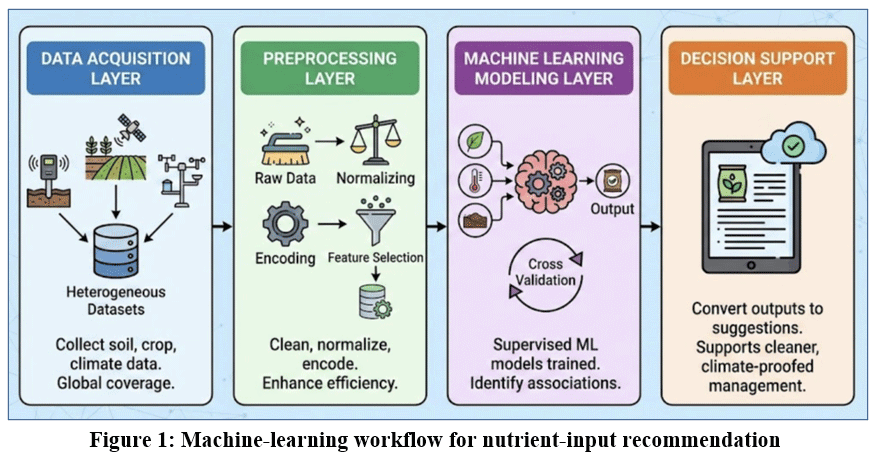 |
Figure 1: Machine-learning workflow for nutrient-input recommendation |
Data Acquisition: It is responsible for collecting soil, crop and climate data from the most authoritative sources in order to describe agro environmental variability. Integration of heterogeneous datasets enables a global coverage of Micro fertilizer affecting factors.
Preprocessing: Cleaning, Normalizing and encoding are done to raw data make them consistent with ML tools. Feature selection is used to preserve the most meaningful features and enhance model efficiency.
Machine Learning modeling: Here the supervised machine learning models are trained, and validated to identify the association among agro-environmental input variables and Micro fertilizer recommendation Cross validation is applied to evaluate the performance of the model in different climates.
Decision Support: This layer converts model outputs into suggestions on Micro fertilizers for current agriculture. The decision support system supports cleaner and climate-proofed nutrient management.
Dataset Description
The original submission identifies multiple sources for soil-health, crop and climate information. However, the submitted description does not provide the record count from each source, precise geographic and temporal coverage, source versions, or the record-linkage procedure. These details are necessary to assess representativeness and reproduce the analytical dataset. The authors must insert the verified source-wise counts and final sample size from the original data-processing records before resubmission.
Soil data were received from the Soil Health Card (SHC) dataset which is a representative, field-wise measurement or estimation of soil fertility indicators. Crop-related data were from FAO crop yield statistics, while the Kaggle crop recommendation dataset was used to enrich crop-specific attributes. Meteorological parameters were downloaded from NASA POWER, a database providing high resolution satellite-derived agro climatic data.
The reported input variables include soil pH, nitrogen, phosphorus, potassium, organic carbon, rainfall, temperature, humidity and crop type. The original manuscript identifies the target as a “micro fertilizer class” but does not specify the class names or explain how labels were assigned. Before resubmission, define the target category precisely, list each class and its frequency, and state whether labels were assigned by experts, taken from an existing source, generated by rules, or validated through field observations. Do not describe labels as agronomically optimal unless that status is supported by evidence.
Table 1: Dataset Parameters Used for Micro fertilizer Recommendation
|
Category |
Parameters (Unit / Type) |
Relevance |
|
Soil |
pH (–), N (kg/ha), P (kg/ha), K (kg/ha), Organic Carbon (%) |
Indicates soil fertility, nutrient availability, and microbial activity |
|
Climate |
Rainfall (mm), Temperature (°C), Humidity (%) |
Influences nutrient dynamics, microbial survival, and crop response |
|
Crop |
Crop type (Categorical) |
Defines crop-specific nutrient and Micro fertilizer requirements |
|
Output |
Micro fertilizer category (Categorical) |
Recommended Micro fertilizer for given agro-environmental conditions |
Table 1 shows parameters which enable the machine learning models to model intricate relationships among soil fertility, climatic atmosphere and crop needs facilitating reliable Micro fertilizer recommendations which are locale-specific that comply with cleaner production ambitions.
Methodology
The task is formulated as supervised classification. Let xᵢ denote the vector of soil, climate and crop features for observation i, and let yᵢ denote its recorded recommendation label. A trained classifier estimates f(xᵢ) = ŷᵢ. This notation describes prediction of the recorded label; it does not, by itself, establish that the predicted class is agronomically optimal. The four classifiers reported in the original manuscript are RF, SVM, GB and ANN. The final version must document the exact label definitions and source, selected features, preprocessing steps, software versions, hyperparameter search and final parameter settings.
The analysis pipeline should document data retrieval and harmonization, duplicate checks, missing-value and outlier treatment, categorical encoding, scaling where required, feature selection, and the final sample size. Data should be partitioned before fitting preprocessing transformations or selecting features. The manuscript must state the actual train/test split, cross-validation folds, random seed, class-balancing method if used, hyperparameter optimization procedure and evaluation protocol. If records share farms, villages or time periods, grouped or time-aware splitting should be considered to reduce leakage. These settings must be recovered from experiment logs or established by rerunning the analysis; they should not be guessed.
Model performance should be reported using accuracy, precision, recall and F1-score, with the averaging method (macro, micro or weighted) explicitly stated. For each class, precision = TP/(TP+FP), recall = TP/(TP+FN), and F1 = 2 × precision × recall/(precision + recall). The final manuscript should include class-wise metrics, a confusion matrix, the target-class distribution and cross-validation variability or confidence intervals where available. A simple baseline comparison is also recommended. These results must be generated from the verified evaluation outputs.
Table 2 : Model Performance Comparison
|
Model |
Accuracy (%) |
Precision |
Recall |
F1-Score |
|
Random Forest (RF) |
91.8 |
0.92 |
0.91 |
0.91 |
|
Gradient Boosting (GB) |
89.6 |
0.89 |
0.88 |
0.88 |
|
Artificial Neural Network (ANN) |
87.4 |
0.87 |
0.86 |
0.86 |
|
Support Vector Machine (SVM) |
85.2 |
0.84 |
0.83 |
0.83 |
The original table reports the highest summary scores for RF among the four evaluated classifiers. This comparison remains provisional until the test-set construction, class distribution, metric averaging and cross-validation results are documented and the values are checked against the original outputs. The analysis does not include field-yield measurements, observed fertilizer-use changes, emissions data or environmental-impact assessment. Consequently, the classification scores cannot establish that the framework improves nutrient availability, substitutes chemical fertilizer or produces cleaner environmental outcomes. Those potential benefits require separate agronomic and environmental validation.
Conclusion
This study presents a preliminary machine-learning classification framework that combines soil, crop and climate attributes to support nutrient-input recommendation. The original manuscript reports RF as the highest-scoring classifier among RF, GB, ANN and SVM; however, the reported metrics require verification alongside a reproducible description of dataset construction, target-label provenance and validation. Because the current analysis relies on secondary datasets and does not report field trials, it does not demonstrate yield improvement, greater yield stability, reduced chemical-fertilizer use or enhanced climate resilience. Future work should evaluate the model on independent locations and seasons, verify recommendation labels with qualified agronomists, and measure crop, input-use and environmental outcomes before making these claims.
Acknowledgement
The authors are also thankful to the Director of the institute for providing support in carrying out this experiment.
Funding Sources
The author(s) received no financial support for the research, authorship, and/or publication of this article.
Conflict of Interest: The authors do not have any conflict of interest.
Data Availability Statement
The manuscript includes the dataset produced or examined during the current research study. The data used to support the findings of this study are available upon request from the corresponding author.
Ethics Statement
This research did not involve human participants, animal subjects, or any material that requires ethical approval.
Informed Consent Statement
This study did not involve human participants, and therefore, informed consent was not required.
Clinical Trial Registration
This research does not involve any clinical trials.
Permission to Reproduce Material from Other Sources
Not Applicable.
Authors’ Contributions:
- Juhi Patel: Conceptualization, Methodology, Data Collection, Data Analysis, Writing – Original Draft Preparation.
- Tejaskumar Bhatt:Conceptualization, Supervision, Writing – Review and Editing.
These contributions demonstrate the distinct roles each author played in the research project, ensuring transparency and recognition of their respective contributions to the study.
References
- Tilman D, Cassman KG, Matson PA, Naylor R, Polasky S. Agricultural sustainability and intensive production practices. 2002;418(6898):671-677. doi:10.1038/nature01014
CrossRef - Vessey JK. Plant growth promoting rhizobacteria as biofertilizers. Plant Soil. 2003;255(2):571-586. doi:10.1023/A:1026037216893
CrossRef - Bhattacharyya PN, Jha DK. Plant growth-promoting rhizobacteria: emergence in agriculture. World J Microbiol Biotechnol. 2012;28(4):1327-1350. doi:10.1007/s11274-011-0979-9
CrossRef - Intergovernmental Panel on Climate Change. Climate Change 2021: Impacts, Adaptation and Vulnerability. Cambridge University Press; 2021.
- Kamilaris A, Prenafeta-Boldú FX. Deep learning in agriculture: a survey. Comput Electron Agric. 2018;147:70-90. doi:10.1016/j.compag.2018.02.016
CrossRef - Chlingaryan A, Sukkarieh S, Whelan B. Machine learning approaches for crop yield prediction and nitrogen status estimation in precision agriculture: a review. Comput Electron Agric. 2018;151:61-69. doi:10.1016/j.compag.2018.05.012
CrossRef - Malusá E, Pinzari F, Canfora L. Efficacy of biofertilizers: challenges to improve crop production. Appl Soil Ecol. 2016;108:1-7.
CrossRef - Adesemoye AO, Kloepper JW. Plant-microbes interactions in enhanced fertilizer-use efficiency. Appl Microbiol Biotechnol. 2009;85(1):1-12. doi:10.1007/s00253-009-2196-0
CrossRef - Sharma A, Singh R. Biofertilizers for sustainable agriculture. Renew Agric Food Syst. 2020;35(3):289-301.
- Bashan Y, de-Bashan LE, Prabhu SR, Hernandez JP. Advances in plant growth-promoting bacterial inoculant technology: formulations and practical perspectives (1998-2013). Plant Soil. 2014;378(1-2):1-33. doi:10.1007/s11104-013-1956-x
CrossRef - United Nations Environment Programme. Cleaner Production Guidelines. United Nations Environment Programme; 2011.
- D’Amato D, Droste N, Allen B, et al. Green, circular, bio economy: a comparative analysis of sustainability avenues. J Clean Prod. 2017;168:716-734. doi:10.1016/j.jclepro.2017.09.053
CrossRef - Liu Y, Li Y, Zhang H. Sustainable agriculture and cleaner production: a review. J Clean Prod. 2021;305:127147.
- Breiman L. Random forests. Mach Learn. 2001;45(1):5-32. doi:10.1023/A:1010933404324
CrossRef - Jeong JH, Resop JP, Mueller ND, et al. Random forests for global and regional crop yield predictions. PLoS One. 2016;11(6):e0156571. doi:10.1371/journal.pone.0156571
CrossRef - Lobell DB, Burke MB. On the use of statistical models to predict crop yield responses to climate change. Agric For Meteorol. 2010;150(11):1443-1452.
CrossRef - Food and Agriculture Organization of the United Nations. Climate-Smart Agriculture Sourcebook. Food and Agriculture Organization of the United Nations; 2017.
- Ramesh R, et al. Climate-resilient nutrient management strategies. Agric Syst. 2019;176:102672.
- Tripathi A, Mishra AK, Rani A. Biofertilizers and climate resilience. 2020;12(12):1-18.
- Patel JK, Bhatt TP. Harnessing machine learning for soil microbial biomass enhancement and sustainable agriculture solutions. In: Choudrie J, Mahalle PN, Perumal T, Joshi A, eds. ICT for Intelligent Systems. ICTIS 2025. Lecture Notes in Networks and Systems. Vol 1507. Springer; 2026:113-122. doi:10.1007/978-981-96-8750-3_10
CrossRef - Patel J, Bhatt T, Joshi A. Navigating GMO adoption in agriculture: balancing controversies and benefits. Curr Agric Res. 2024;12(3).
CrossRef - Patel J, Bhatt T, Joshi A. IoT-driven enhancement of hydroponic fertilization efficiency through machine learning: a data-centric strategy. In: Proceedings of the 2024 Second International Conference on Intelligent Cyber Physical Systems and Internet of Things (ICoICI). IEEE; 2024:298-302. doi:10.1109/ICoICI62503.2024.10696575
CrossRef - Patel JK, Bhatt TP. AI-driven precision farming: leveraging environmental and soil parameters for accurate crop yield prediction. In: Iglesias A, Shin J, Bhatt N, Joshi A, eds. Information Systems for Intelligent Systems. Lecture Notes in Networks and Systems. Vol 1758. Springer; 2026:82-91. doi:10.1007/978-3-032-13419-6_9
CrossRef