

Introduction
Heavy metal contamination and their subsequent impact on plants, humans and animals is a matter of global concern. Their persistence and non-biodegradable nature make them consistent and a great threat to the environment. Cadmium (Cd) ranks among the most hazardous heavy metals, and its biological functions in both plants and animals remain unidentified.1 Nonetheless, it poses a major threat to plant development and productivity.2 There are two major sources of cadmium: natural, which include soil erosion and volcanic eruption; and anthropogenic activities such as mining, smelting and agriculture activities.3,4 Rapid industrial revolution in recent years has vastly contributed to the Cd deposition in the soil. The cadmium contamination of the soil is responsible for its accumulation in plants, as Cd is easily absorbed by the plant’s root.2 Cadmium is readily absorbed by the plant roots through the transport pathways of microelements such as Fe, Mn or Zn and disrupts their uptake leading to their crisis in the plants.5-7 Crop plants growing in high level of Cd contaminated soil exhibited various growth, physiological and biochemical disorder such as reduction in seed germination, root elongation, nutrient uptake, photosynthetic pigments, sugars and soluble protein, changes in membrane permeability, modulation in enzyme activities and reactive oxygen species (ROS) activity.8-10 The generation of reactive oxygen species (ROS) induced by cadmium, including hydrogen peroxide (H2O2), superoxide ( ), singlet oxygen (1O2), and hydroxyl radical , occurs at both cellular and subcellular levels. This process is responsible for the oxidative degradation of macromolecules such as nucleic acids, proteins, and lipids, as well as the compromise of membrane integrity and the disruption of metabolic processes, ultimately leading to the inhibition of plant growth.11-13 To scavenge and alleviate the negative effects of heavy metal-induced oxidative stress, plants produce and employ a variety of defensive enzymes such as peroxidase (POD), catalase (CAT), and superoxide dismutase (SOD), as well as accumulate osmotic substances such as proline.14,15 Superoxide dismutases neutralize to produce H2O2 and O2, whereas CATs and peroxidases detoxify H2O2.16,17 Proline reduces oxidative stress by upregulating the antioxidant defense enzymes, making the defense system active. However, plant genotypes, age and environmental conditions may influence the antioxidative response of plants towards heavy metals.18 Many have reported the elevation in the antioxidant activities under Cd stress, while some have observed the reduction in the activities.19 Fenugreek (Trigonella foenum-graecum L.) is a valuable leguminous crop grown in many countries, including India, because of its food value and medicinal importance.20,21 Fenugreek, also known as methi in India, is produced in quantities of approximately 55 thousand tons per year.22,23 Heavy metal-induced oxidative stress has a detrimental effect on a variety of agricultural crops, causing not only decrease in plant growth and yields but even plant deaths.24 Present study aims to evaluate the impact of different levels of Cd concentration on morpho-physiological and biochemical attributes of fenugreek at its early stage of growth and alteration of antioxidant defense activity in response.
Materials and Methods
Plant treatment and growth measurement
Fenugreek seeds taken from Raiganj Beej Bhander, Mohanbati Raiganj, Uttar Dinajpur, West Bengal were surface sterilized with 0.1% HgCl2 for 3 min before being washed three or four times with distilled water. After the sterilization, fifteen seeds were placed in the sterilized petriplates (90 mm) in between filter papers moistened with different concentrations of Cd (5 µg mL-1, 10 µg mL-1, 15 µg mL-1, 20 µg mL-1, and 25 µg mL-1) for 7 days. For the control, seeds were exposed to distilled water. Three replicas were maintained for each treatment including control in optimal conditions (temperature 24±2 °C, humidity 62-69% and photoperiod 16 h) at growth chamber. Solutions of Cd concentration were given to the respective petriplates to maintain the concentration. Over a period of seven days, seed germination was observed, and additional growth indices, including the germination index (Gt/Dt), Dt number of days to germinate; Gt = the number of seeds germinated each day corresponding to Dt),25 lengths of shoots, roots, and seedlings, as well as the fresh weight of seedlings and the seedling vigour index ; where, were measured.
Physiological assessment
Extraction and estimation of photosynthetic pigments
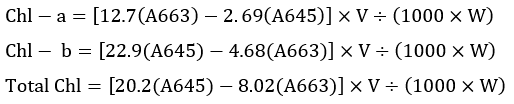
Photosynthetic pigments, including Chlorophyll a (Chl-a), Chlorophyll b (Chl-b), and Total chlorophyll (Total Chl), were extracted using the method of Lichtenthaler26 with some modifications. 0.3 g of each treatment’s leaves were homogenized with 80% (v/v) acetone in a pestle and mortar before being centrifuged at 5,000 rpm for 10 min. After centrifugation, the supernatant was collected to assess the pigment content spectrophotometrically at 645 nm and 663 nm, respectively, and calculated using the formulae27 listed below:
Determination of protein content under Cd stress
Proteins were extracted and estimated from the fresh seedlings. Fresh seedlings (100 mg) were collected at random from each treatment and homogenized in 5 mL of 0.1 M potassium phosphate buffer (pH 7.0) before being centrifuged at 10,000 rpm for 20 min. The protein content in the supernatant was determined using the method described by Lowry et al.28 Absorbance readings were taken at 660 nm, and the protein concentration in the samples was calculated and reported as mg/g of fresh weight. A standard curve was generated using bovine serum albumin (BSA).
Detection and estimation of H2O2 and lipid peroxidation
Hydrogen peroxide (H2O2) was detected histochemically by using 3, 3ʹ-Diaminobenzidine (DAB).29 The procedure described by Velikova et al,30 with slight modifications, was utilized to determine the content of hydrogen peroxide in tissue samples. Fresh seedlings, each weighing 0.5 g, were homogenized with 3 mL of 0.1% trichloroacetic acid (TCA) while kept chilled in an ice bath. This mixture was then centrifuged at 12,000 g for 20 min. Subsequently, 1 mL of 1 M potassium iodide (KI) was added to a reaction mixture containing 0.5 mL of 10 mM phosphate buffer and 0.5 mL of the supernatant. The resulting solution was incubated in darkness for 30 min. The optical density (OD) of the supernatant was measured at 390 nm, and the hydrogen peroxide content in each sample was calculated and expressed as µM g-1 FW.
The method of Shen et al31 with slight modifications was used to get the malondialdehyde (MDA) content of the tissue, produced by the thiobarbituric acid (TBA) reaction. Fresh leaves (0.5 g) from each treatment was homogenized with 10% TCA (5 mL) and centrifuged at 6,000 rpm for 10 min. The mixture containing aliquot (2 mL) of the supernatant and 0.6% TBA (2 mL) in 10% TCA was heated at boiling temperature and cooled in an ice bath. Again, samples were centrifuged and absorbance was read at 450, 532 and 600 nm by UV-VIS spectrophotometer (Analytical UV-2080T, Gujarat, India). MDA content as MDA (µmol L-1) = was measured and expressed in µmol-1 FW.
Biochemical assessment
Determination of proline content
About 0.5 g of fresh seedlings was ground in 10 mL of 3% aqueous sulphosalicylic acid and then subjected to centrifugation at 6,000 rpm for 15 min.32 Prior to cooling in an ice bath, a mixture consisting of 2 mL of the supernatant, 2 mL of glacial acetic acid, and acid ninhydrin reagent was boiled for 60 min. After cooling, 4 mL of toluene was added and mixed well for 20-30 sec. The chromophore was then cautiously moved to a new tube, and its absorbance was recorded at 520 nm using a toluene blank as a reference. In order to calculate the proline content, which was expressed as µmoles/g tissue, a standard curve was created using proline standards.
Extraction and determination of antioxidant enzyme activities
To measure the antioxidant enzyme activity, precisely 0.1 g of leaves were weighed and homogenized with 5 mL of potassium phosphate buffer (pH 7.0). After that, the homogenate was centrifuged for 20 min at 10,000 rpm. Enzyme activities were determined by using the supernatant. Methods of Siddiqui et al33 with slight modifications was used to determine the CAT activity. The reaction mixture was made which consisted of phosphate buffer (2.6 mL), enzyme extract (0.1 mL) and 0.1 mL of H2O2 (1%). Blank sample was prepared by replacing the enzyme extract with phosphate buffer to the reaction mixture. The OD value was taken at 240 nm at 30 sec intervals till 2 min. The CAT activity was calculated in nmol H2O2 min-1, using an extinction coefficient of 39.4 mM cm-1, and expressed as min-1g-1 FW. The method of Zhang34 with slight modifications, was used to assess changes in peroxidase activity. The reaction mixture was composed of 4.7 mL of 0.1 M potassium phosphate buffer, 0.1 mL of 20 mM H2O2, 0.1 mL of 27 mM guaiacol, and 0.1 mL of enzyme extract. Absorbance at 470 nm was monitored every 30 seconds for a duration of 3 min. The activity was calculated with an extinction coefficient of 25.5 mM cm-1 and expressed as min-1g-1 FW.
Statistical analysis
Data collected from six different treatments, including control and concentrations of 5, 10, 15, 20, and 25 µg mL-1 of Cd, were subjected to statistical analysis through analysis of variance (ANOVA) using Statistix 8.1, with each treatment replicated three times. Multiple comparisons were performed to compare the mean values between treatments (p<0.05) using Fischer least significant difference (LSD) test. Pearson correlation analysis was carried out to find the exact correlation coefficient values among the morpho-physiological and biochemical parameters studied under stress.
Results
Cadmium stress on plant growth
Results exhibited that all the morphological traits were greatly affected by Cd stress. Root length, shoot length, germination index, seedling length, seedling vigour index and fresh weight were sharply decreased under stress. Table 1 shows how morphological parameters are affected by Cd stress at different concentrations. The germination index did not significantly change in the current study at the lower concentrations of Cd (5, 10, and 15 µg mL-1), but it significantly decreased in seed treated with Cd at 20 µg mL-1 and 25 µg mL-1 (Table 1). Plants exhibited a significant reduction in root length (26.81-82.1%), shoot length (25.79-67.75%), and fresh weight (11.93-37.61%) at various levels of Cd stress (5 – 25 µg mL-1) compared to the control (Table 1). Similarly, compared to the control, plants treated with 20 µg mL-1 Cd, showed greater decrease in seedling length and seedling vigour index by 67.75% and 67.45% respectively. Similar results were also recorded at 25 µg mL-1 Cd for seedling length and seedling vigour index. Even fresh weight was also recorded Lowest at 25 µg mL-1 Cd.
Cadmium stress on photosynthetic traits
Cd stress significantly reduced the accumulation of chlorophyll content in all the treated plants compared to control. Maximum chlorophyll content was observed in control (Chl-a= 0.403 mg g-1FW, Chl-b= 0.185 mg g-1FW and Total chlorophyll= 0.587 mg g-1FW) but sharply declined in all the Cd-treated plants. There was a successive decline in all the treated plants from lower to higher concentration. The reduction was maximum at 25 µg mL-1 of Cd (50.62% of Ch-a, 53.51% of Ch-b and 51.62% of Total chlorophyll).
Protein, Proline, ROS and lipid peroxidation under cadmium stress
All of the treated plants showed a progressive increase in proline content when exposed to higher Cd concentrations. Proline content increased by 172.4% at 25 µg mL-1 of Cd, while it was lowest in the control. As demonstrated in Fig. 2C, all treated plants exhibited an increasing trend in protein content up to 20 µg mL-1 of Cd, after which a significant decline was observed. However, no significant difference was observed in protein content between 10 µg mL-1 of Cd and 15 µg mL-1 of Cd. H2O2 was found to be present and to accumulate in all the Cd-treated plants. The appearance of distinguished brown precipitates in the leaf in stressed plants marked the accumulation of H2O2 (Fig. 1C). All the treated plants showed significant accumulation of H2O2 compared to control (Fig. 1B) with maximum at 25 µg mL-1 of Cd. In order to determine the levels of lipid peroxidation, MDA content in all the treated plants was measured. Study found significant elevation (p˂0.05) of MDA content in stressed plants when compared with control. No significant enhancement was reported among the Cd-treated plants at 15, 20 and 25 µg mL-1 of Cd (Fig. 1A). However, they all had an 80% enhancement in MDA content compared to untreated plants (control).
Effect of cadmium on catalase and peroxidase activity
In comparison to control, plants treated to varying concentrations of Cd showed a notable increase in CAT and POD activity. Cadmium stimulated the enhancement in antioxidant enzyme activity with highest at 25 µg mL-1 Cd with catalase exhibiting 725.2 % enhancement whereas, peroxidase showed 1704.6% enhancement (Fig. 2A and B). In comparison, the control, which did not receive any treatment, exhibited the lowest levels of enzyme activity.
Relationship between plant growth and physiological traits under cadmium stress through correlation analysis
Pearson’s correlation analysis revealed the existence of positive and/or negative correlation among growth, physiological and biochemical traits of all the treated plants. There was a notable correlation between the germination index (GI) and several parameters: fresh weight (r=0.89), shoot length (r=0.80), seedling length (r=0.85), seedling vigor index (r=0.85), chlorophyll a (r=0.90), total chlorophyll (r=0.89), and chlorophyll b (r=0.83). However, the correlation with root length was comparatively weaker (r=0.78). This pattern suggests that cadmium toxicity significantly influences these parameters. Additionally, POD, CAT, MDA, and H2O2 were found to have strong negative correlations with all morpho-physiological parameters (Fig. 3).
Discussion
Cadmium is one of the most toxic and non-essential heavy metals with severe impact on both plants and animals.35 Cd-induced toxicity brings about various morpho-physiological and biochemical changes in the plants, which cost the plants heavily causing a decrease in seed germination, poor seedling growth, reduction in biomass, inhibition of photosynthetic activity and enhanced ROS generation.36,37 Several studies have reported the morphological and physiological impacts of Cd stress on fenugreek following substantial Cd deposition.38,39 Under environmentally controlled conditions, exposure of plants to different concentrations of Cd produced a substantial effect on the growth performances of fenugreek, including germination, root length, shoot length, and fresh weight, as compared to the plants growing in normal (control) condition. Although all the treated fenugreek seeds initially didn’t show any challenges from Cd stress and continued to germinate, other growth parameters were substantially reduced. The results are consistent with the findings of Meng et al,36 where lower concentrations of Cd had no significant effect on germination in Brassica napus, while higher concentrations reduced the other growth indices of the treated plants. As Cd levels increased particularly at relatively higher Cd concentrations, the germination index decreased along with other morphological parameters such as root length, shoot length and fresh weight of the seedlings.
Table 1: Effect of different concentrations of cadmium (Cd) on Root length, Shoot length, Germination index, Seedling length, Seedling vigour index, Fresh weight, chlorophyll a (Chl-a), chlorophyll b (Chl-b), and total chlorophyll in fenugreek
|
Treatment |
Root (cm) |
Shoot (cm) |
Germination index |
Seedling length (cm) |
Seedling vigour index |
Fresh weight (g) |
Chl-a (mg g-1FW) |
Chl-b (mg g-1FW) |
Total chlorophyll (mg g-1FW) |
|
Control |
0.933 |
3.200 |
38.893 |
4.133 |
413.33 |
1.09 |
0.403 |
0.185 |
0.587 |
|
5µg ml-1 |
0.733 |
2.333 |
37.726 |
3.067 |
306.667 |
0.96 |
0.375 ±0.0005b |
0.158 |
0.533 |
|
10µg ml-1 |
0.633 |
1.733 |
37.06 |
2.367 |
236.667 |
0.9 |
0.297 |
0.112 |
0.410 |
|
15µg ml-1 |
0.567 |
1.567 |
36.893 |
2.133 |
213.333 |
0.82 |
0.287 |
0.112 |
0.400 |
|
20µg ml-1 |
0.467 |
1.300 |
34.226 |
1.333 |
133.333 |
0.77 |
0.268 |
0.104 |
0.373 |
|
25µg ml-1 |
0.167 |
1.167 |
32.56 |
1.333 |
133.333 |
0.68 |
0.199 |
0.086 |
0.284 |
The values are means ± SD (n=3). Different letters within columns are statistically different ((p<0.05) according to LSD test
Since Cd stress affects germination and germination index, consequently the other morpho-physiological parameters are negatively affected. In line with this, Revathy and Shanker40 and Zayneb et al38 have also investigated that Cd stress negatively affected germination and other morpho-physiological traits such as seedling vigor index and photosynthetic pigments. The decrease in these growth parameters in the treated plants may be attributed to the reduced uptake of required minerals and reduced photosynthetic activity under Cd stress.41 Photosynthetic pigments play an integral part in plant growth and development. The leaf photosynthesis is highly sensitive to Cd stress contributing negatively to the growth of plants and hence, Cd is great suppressor of photosynthesis.42 Therefore, reduction in the growth indices in current study may be due to the reduced production of photosynthetic pigments. Many have found the deleterious impact of Cd on photosynthetic pigments,43,44 which is consistent with our findings. Cadmium also inhibits the enzymes essential for the biosynthesis of chlorophyll and this may also be the reason for the reduced photosynthetic efficacy of the treated plants and their reduced growth.45,46,7 Reactive oxygen species (ROS) are primarily responsible for heavy metal toxicity in plants. ROS-led oxidative damage is largely responsible for physiological and biochemical changes and degradation of various macromolecules, enzyme activity and cellular structure.47 When plants are subjected to cadmium stress, there is an overproduction of ROS, including H2O2, ( ), and 48,7 which adversely affects plant health. This excessive production of ROS hampers plant growth and inflicts significant damage on lipids, proteins, and DNA.49 Altaf et al50 found that oxidation of 3, 3′-diaminobenzidine (DAB) staining by H2O2 resulted in the formation of brown precipitate in leaf confirming the presence of H2O2. Increased production of ROS (H2O2) causes the destruction of membrane through lipid peroxidation. Lipid peroxidation, driven by ROS, is the most used parameter to estimate the degree of oxidative stress. Polyunsaturated fatty acids in membranes undergo oxidation due to accumulation of free radicals, which results in the production of MDA.51 To assess lipid peroxidation, the MDA content was analyzed in plants treated with Cd and in control plants. In this study, a notable increase in the MDA content of plants exposed to Cd treatment was observed. The treated plant exhibited a progressive rise in MDA content with highest at 25 µg mL-1 Cd. The rise in MDA levels in the treated plants indicates that Cd induces the lipid peroxidation causing oxidative damage to the plants and also reveals that more the oxidative stress induced by Cd, more is the lipid peroxidation. These findings corroborate the work of Sakhai et al,52 who discovered that increased concentration of Cd elevated the MDA level in fenugreek.
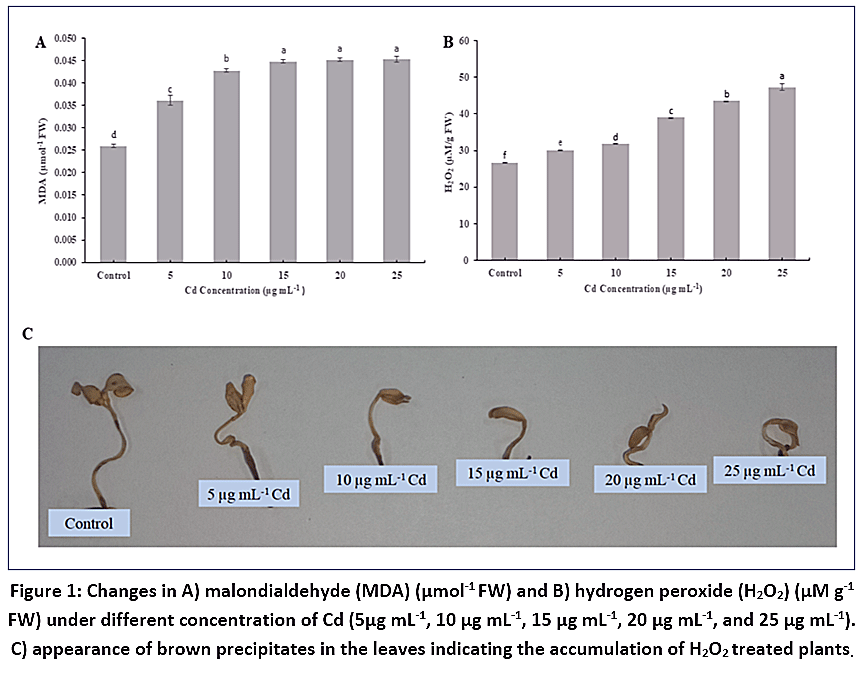 |
Figure 1: Changes in A) malondialdehyde (MDA) (µmol-1 FW) and B) hydrogen peroxide (H2O2) (µM g-1 FW) under different concentration of Cd (5µg mL-1, 10 µg mL-1, 15 µg mL-1, 20 µg mL-1, and 25 µg mL-1). C) appearance of brown precipitates in the leaves indicating the accumulation of H2O2 treated plants. |
Many studies have reported the reduction in soluble protein in plants exposed to cadmium.53,54 The reduced protein content at higher Cd concentrations revealed the Cd-induced oxidative stress was evident in fenugreek. These findings suggest that while lower concentrations of Cd do not adversely affect protein content, higher concentrations do, aligning with the work of Zhao et al9. Our results also align with those of John et al55 and Aibibu et al.56 The reduction in protein content at elevated concentrations might result from the overproduction of ROS, which aggressively degrades the protein.57
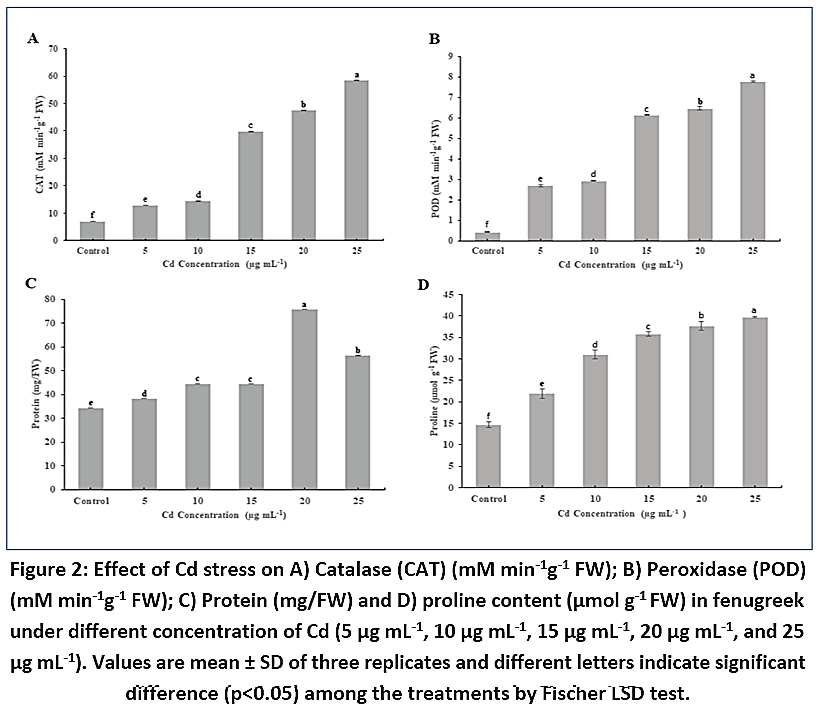 |
Figure 2: Effect of Cd stress on A) Catalase (CAT) (mM min-1g-1 FW); B) Peroxidase (POD) (mM min-1g-1 FW); C) Protein (mg/FW) and D) proline content (µmol g-1 FW) in fenugreek under different concentration of Cd (5 µg mL-1, 10 µg mL-1, 15 µg mL-1, 20 µg mL-1, and 25 µg mL-1). |
Cadmium-induced oxidative stress causes the generation and accumulation of H2O2, which subsequently increases the activity of antioxidant enzymes.58 Çatav et al59 documented that enzyme activities, specifically CAT and POD, were elevated under Cd stress compared to the control. Our findings align with this, as we observed a marked increase in the antioxidant activities of CAT and POD when exposed to Cd stress. This rise in enzyme activity in plants subjected to Cd stress might be linked to the accumulation of H2O2. Reports suggest that CAT and POD act as protective enzymes for neutralizing the oxidative damage resulting from H2O2.60,61 Although the activity of CAT and POD increases under Cd stress, current study witnessed significant growth inhibition in the treated plants. This suggests that CAT and POD enzymes may not be sufficient to decompose H2O2 to protect the plants from Cd-induced oxidative damage. Furthermore, as reported by Zhang et al,62 increasing toxicity of Cd could also impair the effectiveness and activity of such a defense system. Proline, a water-soluble amino acid, is an important osmotic protective substance that plays a crucial role in protecting and maintaining the normal function of a cell and its parts.63,9 It is one of the most common metabolic responses to environmental stresses which enables plants to survive under stressful conditions. Typically, this amino acid elevates in response to heightened stress, serving as an indicator of toxicity caused by heavy metals. In this study, the proline level rose as the Cd concentration increased, reaching a peak of 39.733 µmol g-1 FW at 25 µg mL-1 Cd (Fig. 2D). This indicates that higher Cd concentration induced fenugreek to produce more proline under stress. The Pearson correlation analysis indicates that all morpho-physiological parameters, including root length, shoot length, fresh weight, seedling length, seedling vigor index, and photosynthetic pigments, exhibit a strong positive correlation with one another. This suggests that the growth of plants is linked to photosynthesis driven by chlorophyll. However, they had strong and negative correlations with biochemical changes such as proline content, POD, CAT, peroxide H2O2, and MDA. This indicates that although, Cd had an overall impact on growth performance and biochemical changes in Cd-exposed plants, they have different relationship, affecting each other.
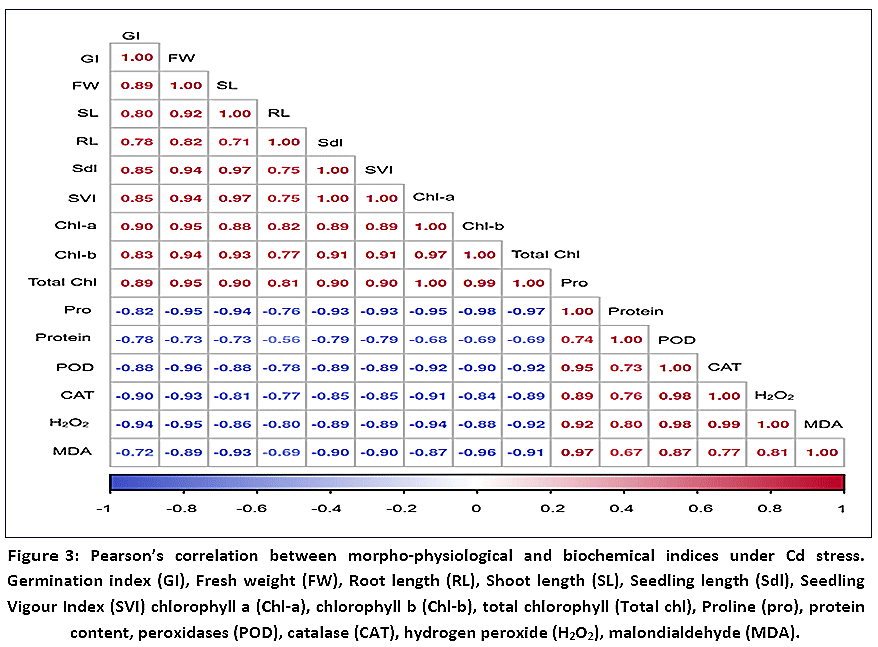 |
Figure 3: Pearson’s correlation between morpho-physiological and biochemical indices under Cd stress. Germination index (GI), Fresh weight (FW), Root length (RL), Shoot length (SL), Seedling length (Sdl), Seedling Vigour Index (SVI) chlorophyll a (Chl-a), chlorophyll b (Chl-b), |
The negative correlation between morpho-physiological parameters and biochemical parameters indicates that increasing oxidative stress negatively affects germination, seedling growth and photosynthetic pigment accumulation in plants. Proline showed strong positive correlation with antioxidant enzymes (POD and CAT), MDA and H2O2 highlighting the coordinated activation of the defense system.
Conclusion
Exposure of fenugreek to cadmium stress caused the accumulation of H2O2 leading to increased proline, MDA content and activity of CAT and POD. Study investigated that increasing concentration of Cd, inhibited the germination index, root length, shoot length, seedling length, and fresh weight. These results were attributed to decline in photosynthetic pigments and reduction in soluble protein at higher concentration by Cd-induced oxidative stress. These findings help in greater understanding of fenugreek response to Cd stress at its early stage. Despite increased activity of POD and CAT in the treated plants, they suffered from plant growth inhibition which needs to be investigated in further studies.
Acknowledgment
Authors are thankful to the Department of Botany, Raiganj University for providing instrumentation facility required for the submitted work.
Funding Sources
The author(s) received no financial support for the research, authorship, and/or publication of this article
Conflict of Interest
The authors do not have any conflict of interest
Data availability
The authors affirm that data supporting the investigations of study are included in the article.
Ethics Statement
This research did not involve human participants, animal subjects, or any material that requires ethical approval
Informed Consent Statement
This study did not involve human participants, and therefore, informed consent was not required
Clinical Trial Registration
This research does not involve any clinical trials
Author Contributions
- Sumitra Chhetri: Conceptualization, Methodology, Writing – Original Draft;
- Siddhu Chhetri: Data Collection, Analysis, Writing – review & editing, Validation;
- Arka Pratim Chakraborty: Visualization, Data curation;
- Parimal Mandal: Analysis, Writing – review & editing;
- Zerald Tiru: Conceptualization, Supervision, Methodology, Writing – review & editing, Validation.
Permission to Reproduce Material
Not Applicable
References
- Nazemi M., Ebrahimibasabi E., Ebrahimi, A. Integrated application of cold atmospheric plasma and dopamine mitigates cadmium toxicity by enhancing antioxidant defense and restricting cadmium accumulation in fenugreek (Trigonella foenum-graecum). Environmental Technology & Innovation 2026; 43:105190. https://doi.org/10.1016/j.eti.2026.105190
CrossRef - Suhani I., Sahab S., Srivastava V., Singh R.P. Impact of cadmium pollution on food safety and human health. Current opinion in toxicology 2021; 27: 1-7.
CrossRef - Song J., Sun Z., Saud S., Fahad S., Nawaz T. Exploring the deleterious effects of heavy metal cadmium on antioxidant defense and photosynthetic pathways in higher plants. Plant Stress 2025; 15: 100716.
CrossRef - Aslam M.M., Okal E.J., Waseem M. Cadmium Toxicity Impacts Plant Growth and Plant Remediation Strategies. Plant Growth Regulation 2023; 99: 397–412. https://doi.org/10.1007/s10725-022-00917-7
CrossRef - Sterckeman T., Thomine S. Mechanisms of Cadmium Accumulation in Plants. Critical Reviews in Plant Sciences 2020; 39: 322–359 https://doi.org/10.1080/07352689.2020.1792179
CrossRef - Zulfiqar U., Ayub A., Hussain S., Waraich E.A., El-Esawi M.A., Ishfaq M., Ahmad M., Ali N., Maqsood M.F. Cadmium Toxicity in Plants: Recent Progress on Morpho-physiological Effects and Remediation Strategies. Journal of soil science and plant nutrition 2022; 22: 212–269. https://doi.org/10.1007/s42729-021-00645-3
CrossRef - Naciri R., Lahrir M., Benadis C., Chtouki M., Oukarroum A. Interactive Effect of Potassium and Cadmium on Growth, Root Morphology and Chlorophyll A Fluorescence in Tomato Plant. Scientific reports 2021; 11: 5384. https://doi.org/10.1038/s41598-021-84990-4
CrossRef - Ci D., Jiang D., Wollenweber B., Dai T., Jing Q., Cao W. Cadmium Stress in Wheat Seedlings: Growth, Cadmium Accumulation and Photosynthesis. Acta physiologiae plantarum 2010; 32: 365–373. https://doi.org/10.1007/s11738-009-0414-0
CrossRef - Zhao H., Guan J., Liang Q., Zhang X., Hu H., Zhang J. Effects of Cadmium Stress on Growth and Physiological Characteristics of sassafras Seedlings. Scientific reports 2021; 11: 9913. https://doi.org/10.1038/s41598-021-89322-0
CrossRef - Fatima A., Farid M., Farid S., Ishaq H.K., Iftikhar U., Rizwan M., Zubair M., Ali S. Heavy Metals Induced Physiological and Biochemical Changes in Fenugreek (Trigonella foenum–graecum L.). In: Hasanuzzaman M (ed) Approaches to the Remediation of Inorganic Pollutants, Springer, Singapore, 2021; pp 239–258
CrossRef - Hu Y., Wang H. Production and scavenging of reactive oxygen species in plant cells under cadmium stress. Agronomy Journal 2025; 117(4): e70116.
CrossRef - Kokebie D., Enyew A., Masresha G., Fentie T., Mulat E. Morphological, physiological, and biochemical responses of three different soybean (Glycine max) varieties under salinity stress conditions. Frontiers in Plant Science 2024; 15: 1440445.
CrossRef - Akhtar T., Zia-Ur-Rehman M., Naeem A., Nawaz R., Ali S., Murtaza G., Maqsood M.A., Azhar M., Khalid H., Rizwan M. Photosynthesis and Growth Response of Maize (Zea mays L.) Hybrids Exposed to Cadmium Stress. Environmental Science and Pollution Research 2017; 24: 5521–5529. https://doi.org/10.1007/s11356-016-8246-0
CrossRef - Kapoor D., Kaur S., Bhardwaj R. Physiological and Biochemical Changes in Brassica juncea Plants under Cd‐Induced Stress. BioMed research international 2014; 2014: 726070. https://doi.org/10.1155/2014/726070
CrossRef - Zouari M,, Ben A.C., Zorrig W., Elloumi N., Rabhi M., Delmail D., Ben R.B., Labrousse P., Ben A.F. Exogenous Proline Mediates Alleviation of Cadmium Stress by Promoting Photosynthetic Activity, Water Status and Antioxidative Enzymes Activities of Young Date Palm (Phoenix dactylifera L.). Ecotoxicology and environmental safety 2016; 128: 100–108. https://doi.org/10.1016/j.ecoenv.2016.02.015
CrossRef - Mishra S., Jha A., Dubey R. Arsenite Treatment Induces Oxidative Stress, Upregulates Antioxidant System, and Causes Phytochelatin Synthesis in Rice Seedlings. Protoplasma 2011; 248: 565–577
CrossRef - Pérez F.J., Villegas D., Mejia N. Ascorbic Acid and Flavonoid-peroxidase Reaction as a Detoxifying System of H2O2 in Grapevine Leaves. Phytochemistry 2002; 60: 573–580. https://doi.org/10.1016/S0031-9422(02)00146-2
CrossRef - Rui H., Chen C., Zhang X., Shen Z., Zhang F. Cd-induced Oxidative Stress and Lignification in the Roots of Two Vicia sativa L. Varieties with Different Cd Tolerances. Journal of Hazardous Materials 2016; 301: 304–313. https://doi.org/10.1016/j.jhazmat.2015.08.052
CrossRef - Anjum N.A., Sharma P., Gill S.S., Hasanuzzaman M., Khan E.A., Kachhap K., Mohamed A.A., Thangavel P., Devi G.D., Vasudhevan P., Sofo A. Catalase and ascorbate peroxidase—representative H2O2-detoxifying heme enzymes in plants. Environmental science and pollution research 2016 23: 19002–19029. https://doi.org/10.1007/s11356-016-7309-6
CrossRef - Kidwai M.K., Dhull S.B. Heavy Metals Induced Stress and Metabolic Responses in Fenugreek (Trigonella foenum–graecum L.) Plants. In: Naeem M, Aftab T, Khan MMA (eds) Fenugreek: Biology and Applications, Springer, Singapore, 2021; pp 327–353
CrossRef - Alaraidh I.A., Alsahli A.A., Razik E.S. Alteration of Antioxidant Gene Expression in Response to Heavy Metal Stress in Trigonella foenum–graecum L. South African Journal of Botany 2018; 115: 90–93. https://doi.org/10.1016/j.sajb.2018.01.012
CrossRef - Meena M., Meena S., Meena R., Choudhary N. Production, Export and Price Behaviour of Fenugreek in India. Indian Journal of Ecology 2024; 51: 231-236. https://doi.org/10.55362/IJE/2024/4222
CrossRef - Khan A., Bibi S., Javed T., Mahmood A., Mehmood S., Javaid M.M., Ali B., Yasin M., Abidin Z.U., Al-Sadoon M.K., Babar B.H., Iqbal R., Malik T. Effect of Salinity Stress and Surfactant Treatment with Zinc and Boron on Morpho-physiological and Biochemical Indices of Fenugreek (Trigonella foenum–graecum). BMC Plant Biology 2024; 24(1): 138. https://doi.org/10.1186/s12870-024-04800-7
CrossRef - Alengebawy A., Abdelkhalek S.T. Heavy Metals and Pesticides Toxicity in Agricultural Soil and Plants: Ecological Risks and Human Health Implications. Toxics 2021; 9: 42. https://doi.org/10.3390/toxics9030042
CrossRef - Si A., Z Sun, Z Li, B Chen, Q Gu, Y Zhang, L Wu, G Zhang, X Wang, Z Ma. A genome wide association study revealed key single nucleotide polymorphisms/genes associated with seed germination in Gossypium hirsutum L. Frontiers in plant science 2022; 13: 844946. https://doi.org/10.3389/fpls.2022.844946
CrossRef - Lichtenthaler H.K. Chlorophylls and carotenoids: pigments of photosynthetic biomembranes. Methods Enzymology 1987; 148: 350–382. https://doi.org/10.1016/0076-6879(87)48036-1
CrossRef - Mustafiz A., Sahoo K.K., Singla-Pareek S.L., Sopory S.K. Metabolic Engineering of Glyoxalase Pathway for Enhancing Stress Tolerance in Plants. In: Ramanjulu S (ed) Plant stress tolerance, volume 639 of the series methods mol biol. Totowa, NJ: Humana Press, 2010; pp 95–118
CrossRef - Lowry O., Rosebrough N., Farr A.L., Randall R.J. Protein Measurement with the Folin Phenol Reagent. Journal of Biological Chemistry 1951; 193: 265–275.
CrossRef - Kumar D., Yusuf M.A., Singh P., Sardar M., Sarin N.B. Histochemical Detection of Superoxide and H2O2 Accumulation in Brassica juncea Seedlings. Bio-protocol 2014; 4: e1108-e1108.
CrossRef - Velikova V., Yordanov I., Edreva A. Oxidative Stress and Some Antioxidant Systems in Acid Rain-treated Bean Plants: Protective Role of Exogenous Polyamines. Plant science 2000; 151: 59-66. https://doi.org/10.1016/S0168-9452(99)00197-1
CrossRef - Shen H., Dong S., Li S., Wang W., Xiao J., Yang M., Zhang J., Gao X., Xu Y., Zhi Y., Liu S., Dong Q., Zhou H., Yeomans J.C. Effects of Warming and N Deposition on the Physiological Performances of Leymus secalinus in Alpine Meadow of Qinghai-Tibetan Plateau. Frontiers in Plant Science 2020; 10:1804. https://doi.org/10.3389/fpls.2019.01804
CrossRef - S., Waldren R., Teare I. Rapid Determination of Free Proline for Water-stress Studies. Plant and soil 1973; 39: 205–207. https://doi.org/10.1007/BF00018060
CrossRef - Siddiqui Z.S., Wei X., Umar M., Abideen Z., Zulfiqar F., Chen J., Hanif A., Dawar S., Dias D.A.,Yasmeen R. Scrutinizing the Application of Saline Endophyte to Enhance Salt Tolerance in Rice and Maize Plants. Frontiers in Plant Science 2022; 12: 770084. https://doi.org/10.3389/fpls.2021.770084
CrossRef - Zhang X.Z. The measurement and mechanism of lipid peroxidation and SOD POD and CAT activities in biological system. In: Zhang XZ (ed) Research methodology of crop physiology. Beijing Agriculture Press, Beijing, 1992; pp 208–211
- Wang M., Chen Z., Song W., Hong D., Huang L., Li Y. A Review on Cadmium Exposure in the Population and Intervention Strategies Against Cadmium Toxicity. Bulletin of environmental contamination and toxicology 2021; 106: 65–74. https://doi.org/10.1007/s00128-020-03088-1
CrossRef - Meng H., Hua S., Shamsi I.H., Jilani G., Li Y., Jiang L. Cadmium-induced Stress on the Seed Germination and Seedling Growth of Brassica napus, and its Alleviation through Exogenous Plant Growth Regulators. Plant Growth Regulation 2009; 58: 47–59. https://doi.org/10.1007/s10725-008-9351-y
CrossRef - El Rasafi T., Oukarroum A., Haddioui A., Song H., Kwon E.E., Bolan N., Tack F.M.G., Sebastian A., Prasad M.N.V., Rinklebe J. Cadmium Stress in Plants: A Critical Review of the Effects, Mechanisms, and Tolerance Strategies. Critical Reviews in Environmental Science and Technology 2022; 52: 675–726. https://doi.org/10.1080/10643389.2020.1835435
CrossRef - Zayneb C., Bassem K., Zeineb K., Grubb C.D., Noureddine D., Hafedh M., Amine E. Physiological Responses of Fenugreek Seedlings and Plants Treated with Cadmium. Environmental Science and Pollution Research 2015; 22: 10679–10689. https://doi.org/10.1007/s11356-015-4270-8
CrossRef - Faizy H.S., Sahi B.G., Mahdi H.S., Hamid H.M.S. The Impact of Heavy Metals (Cadmium & Nickel) on Seed Germination, Photothynsises Pigments and Vegetative Growth of Fenugreek (Trigonell afoenum–Graecum) Plant. Journal of Duhok University 2022; 25: 88–100. https://doi.org/10.26682/ajuod.2022.25.1.10
CrossRef - Revathy K., Shanker S.R. Effect of Cadmium Stress on Seed Germination and Seedling Morpho-physiological Growth Parameters of Barnyard Millet (Echinochloa frumentacea link). Plant Science Today 2022; 10: 252–260. https://doi.org/10.14719/pst.2012
CrossRef - Sheikh L., Naz N., Oranab S., Younis U., Alarfaj A.A., Alharbi S.A., Ansari M.J. Minimization of Cadmium Toxicity and Improvement in Growth and Biochemical Attributes of Spinach by Using Acidified Biochar. Scientific Reports 2025; 15: 5880. https://doi.org/10.1038/s41598-025-90746-1
CrossRef - Xue Z.C., Gao H.Y., Zhang L.T. Effects of Cadmium on Growth, Photosynthetic Rate and Chlorophyll Content in Leaves of Soybean Seedlings. Biologia Plantarum 2013; 57: 587–590. https://doi.org/10.1007/s10535-013-0318-0
CrossRef - Li X., Zhao M., Guo L., Huang L. Effect of Cadmium on Photosynthetic Pigments, Lipid Peroxidation, Antioxidants, and Artemisinin in Hydroponically Grown Artemisia annua. Journal of Environmental Sciences 2012; 24: 1511–1518. https://doi.org/10.1016/S1001-0742(11)60920-0
CrossRef - Wahid A., Ghani A., Javed F. Effect of Cadmium on Photosynthesis, Nutrition and Growth of Mungbean. Agronomy for sustainable development 2008; 28: 273–280. https://doi.org/10.1051/agro:2008010
CrossRef - Muradoglu F., Gundogdu M., Ercisli S., Encu T., Balta F., Jaafar H.Z.E., Zia-Ul-Haq M. Cadmium Toxicity Affects Chlorophyll A and B Content, Antioxidant Enzyme Activities and Mineral Nutrient Accumulation in Strawberry. Biological research 2015; 48: 11. https://doi.org/10.1186/s40659-015-0001-3
CrossRef - Zengin F.K., Munzuroglu O. Toxic Effects of Cadmium (Cd++) on Metabolism of Sunflower (Helianthus annuus) Seedlings. Acta Agriculturae Scandinavica Section B-Soil and Plant Science 2006; 56: 224–229. https://doi.org/10.1080/0906471051003087
CrossRef - Kohli S.K., Handa N., Gautam V., Bali S., Sharma A., Khanna K., Arora S., Thukral A.K., Ohri P., Karpets Y.V., Kolupaev Y.E. ROS signaling in plants under heavy metal stress. In: Khan M, Khan N (eds) Reactive Oxygen Species and Antioxidant Systems in Plants: Role and Regulation under Abiotic Stress. Springer, Singapore, 2017; pp 185-214
CrossRef - Unsal V., Dalkıran T. The Role of Natural Antioxidants Against Reactive Oxygen Species Produced by Cadmium Toxicity: A Review. Advanced pharmaceutical bulletin 2020; 10: 184–202. https://doi.org/10.34172/apb.2020.023
CrossRef - Ahmad P., Sarwat M., Bhat N.A., Wani M.R., Kazi A.G., Tran L.S.P. Alleviation of Cadmium Toxicity in Brassica juncea (Czern. & Coss.) by Calcium Application Involves Various Physiological and Biochemical Strategies. PLoS One 2015; 10: e0114571. https://doi.org/10.1371/journal.pone.0114571
CrossRef - Altaf M.A., Shahid R., Ren M.X., Khan L.U., Altaf M.M., Jahan M.S., Nawaz M.A., Naz S., Shahid S., Lal M.K., Tiwari, R.K. Protective mechanisms of melatonin against vanadium phytotoxicity in tomato seedlings: insights into nutritional status, photosynthesis, root architecture system, and antioxidant machinery. Journal of Plant Growth Regulation 2022; 41(8): 3300-3316. https://doi.org/10.1007/s00344-021-10513-0
CrossRef - Khan M.H., Panda S.K. Alterations in Root Lipid Peroxidation and Antioxidative Responses in Two Rice Cultivars under NaCl-Salinity stress. Acta Physiologiae Plantarum 2008; 30: 81–89. https://doi.org/10.1007/s11738-007-0093-7
CrossRef - Sakhai F.S., Movahedi Z., Ghabooli M., Fard E.M. Positive Effect of Serendipita indica on Fenugreek and its Tolerance Against Cadmium Stress. Current Microbiology 2025; 82: 182. https://doi.org/10.1007/s00284-025-04148-7
CrossRef - Bavi K., Kholdebarin B., Moradshahi A. Effect of Cadmium on Growth, Protein Content and Peroxidase Activity in Pea Plants. Pakistan Journal of Botany 2011; 43: 1467–1470
- Dias M.C., Monteiro C., Moutinho-Pereira J., Correia C., Gonçalves B., Santos, C. Cadmium Toxicity Affects Photosynthesis and Plant Growth at Different Levels. Acta physiologiae plantarum 2013; 35: 1281–1289. https://doi.org/10.1007/s11738-012-1167-8
CrossRef - John R., Ahmad P., Gadgil K., Sharma S. Effect of Cadmium and Lead on Growth, Biochemical Parameters and Uptake in Lemna polyrrhiza Plant Soil and Environment 2008; 54: 262–270.
CrossRef - Aibibu N., Liu Y., Zeng G., Wang X., Chen B., Song H., Xu L. Cadmium Accumulation in Vetiveria zizanioides and its Effects on Growth, Physiological and Biochemical Characters. Bioresource Technology 2010; 101: 6297–6303. https://doi.org/10.1016/j.biortech.2010.03.028
CrossRef - Emamverdian A., Ding Y., Mokhberdoran F., Xie Y. Heavy Metal Stress and Some Mechanisms of Plant Defense Response. The scientific world journal 2015:1–18. https://doi.org/10.1155/2015/756120
CrossRef - Xu P., Zeng G., Huang D., Dong H., Lai C., Chen M., Tang W., Li F., Leng Y., Cheng M., He X., He Y. Cadmium Induced Hydrogen Peroxide Accumulation and Responses of Enzymatic Antioxidants in Phanerochaete chrysosporium. Ecological Engineering 2015; 75: 110–115. https://doi.org/10.1016/j.ecoleng.2014.11.060
CrossRef - Çatav, Ş. S., Genç, T. O., Oktay, M. K., & Küçükakyüz, K. (2020). Cadmium toxicity in wheat: impacts on element contents, antioxidant enzyme activities, oxidative stress, and genotoxicity. Bulletin of environmental contamination and toxicology, 104(1), 71-77.
CrossRef - Li Y., Zhang S., Jiang W., Liu D. Cadmium Accumulation, Activities of Antioxidant Enzymes, and Malondialdehyde (MDA) Content in Pistia stratiotes Environmental Science and Pollution Research 2013; 20: 1117–1123. https://doi.org/10.1007/s11356-012-1054-2
CrossRef - Cheng, Jinfeng, Hongchen Qiu, Zhaoyang Chang, Zaimin Jiang, and Wenke Yin. The effect of cadmium on the growth and antioxidant response for freshwater algae Chlorella vulgaris. SpringerPlus 2016; 5:1–8. https://doi.org/10.1186/s40064-016-2963-1
CrossRef - Zhang F., Zhang H., Wang G., Xu L., Shen Z. Cadmium-Induced Accumulation of Hydrogen Peroxide in the Leaf Apoplast of Phaseolus aureus and Vicia sativa and the Roles of Different Antioxidant Enzymes. Journal of hazardous materials 2009; 168: 76–84. https://doi.org/10.1016/j.jhazmat.2009.02.002
CrossRef - Meena M., Divyanshu K., Kumar S., Swapnil P., Zehra A., Shukla V., Yadav M., Upadhyay R. Regulation of L-proline Biosynthesis, Signal Transduction, Transport, Accumulation and its Vital Role in Plants during Variable Environmental Conditions. Heliyon 2019; 5: e02952. https://doi.org/10.1016/j.heliyon.2019.e02952
CrossRef
Abbreviations
POD – Peroxidase
CAT – Catalase
BSA – Bovine serum albumin
KI – Potassium iodide
MDA – Malondialdehyde
TBA – Thiobarbituric acid
H2O2 – Hydrogen peroxide
O2∙- – Superoxide
1O2 – Singlet oxygen